
Summarize with AI


The best SaaS design agencies for AI legaltech startups in 2026 are Studio Maydit, Engine Digital, Fantasy, Kvalifik, Lighthouse Digital, Clay, BX Studio, Trueform, Phantom, and basement.studio. Studio Maydit and basement.studio lead for this brief. basement.studio names Harvey AI among its clients, which is the closest published work to yours on this entire list, and both studios publish AI client work. Lighthouse Digital and Engine Digital are the weakest fit. One publishes no AI client work at all, and the other is a brand and custom build practice whose named clients are Adidas, Autodesk, and HP.
Lawyers are trained, professionally and expensively, to look for the flaw before they look for the value.
That single fact reshapes every design decision in a legaltech product. A finance user seeing a suggested number will usually check the total. A lawyer seeing a suggested clause will check the source, the date, the jurisdiction, and whether the model has quietly merged two contracts that should never have met. If any of that takes longer than doing the work themselves, the product is finished, and they will not tell you why.
There is also a second reader nobody designs for. The associate uses the tool. The partner decides whether the firm buys it. The risk or IT lead decides whether it may touch client documents at all, and that person has the shortest patience and the most power.
So legaltech products often demo brilliantly and stall in month two. Usage drops to the founder's champion at the firm. Everybody else went back to the old method, quietly, because checking the output cost more than the output saved.
Ten studios follow. Read them holding one question: which of them would design the checking, not the answering.

How we picked these agencies
Five checks, chosen for a product whose users are paid to be sceptical:
- Platform depth. Is application design the practice, or is it a website business with a product service alongside? Your hardest surface is the one where a person reviews what the model produced. That is not a marketing page and page-led studios have never had to build it.
- Proof with users who must defend their work. Have they designed for a profession that has to justify a decision afterwards, in finance, health, insurance, or law? Those users need a trail, not a summary, and a studio that has done it once designs the trail without being asked.
- Pricing. Is a starting figure published? Firms buy through procurement and you will inherit that habit early, so a supplier who states a number can be compared without spending a week on discovery calls.
- Team shape. How many people, and does a senior one stay on the work? Deciding how much of a model's reasoning to show, and how loudly to flag a doubt, is a judgement made on every screen. It is not a job for whoever is free that month.
- Their own site. The only brief they wrote themselves. If it explains a complicated service without hedging, that is the skill you are buying, and hedging is the default failure in this category.
Put most of your weight on the second check, and test it with one question. Ask what they designed for the person who had to approve or review somebody else's work. A studio with that experience will describe something concrete: a source panel, a confidence flag, a diff, an audit record. A studio without it will start talking about clean interfaces.
Each row below is drawn from what the studio publishes about itself, and nothing else. No directory entries, no aggregated scores, no numbers invented to complete a column. Where a studio has published nothing the row says so, which is the same standard you will shortly be asked to meet by every firm that evaluates you.
What goes wrong when AI legaltech products are designed
Three failures, and each one ends with a lawyer going back to the old way.
The answer arrives without its evidence. The model returns a clean paragraph, and the source sits behind a link, a hover, or a second screen. A lawyer will not accept that, so they open the underlying document anyway and read it properly, which means your product added a step instead of removing one. Put the passage next to the claim, on the same screen, with the page and the date visible. It is less elegant and it is the entire product.
The tool is designed to replace judgement rather than speed up the check. Positioning the software as the decision-maker sets up a fight with the only person who can approve the purchase, because their professional liability does not transfer to your model. Design the flow so the human is confirming rather than trusting, and say so plainly. Firms buy speed on verification far more readily than they buy a substitute for it.
Nothing is built for the review trail. The associate runs the tool, the partner signs the advice, and the firm has to be able to show months later how that conclusion was reached. Most legaltech products record none of it, so the firm rebuilds the trail in email and a shared folder. Design the record from the beginning: who ran what, on which version, what the model said, and what the human changed. It is unglamorous and it is what turns a pilot into a contract.
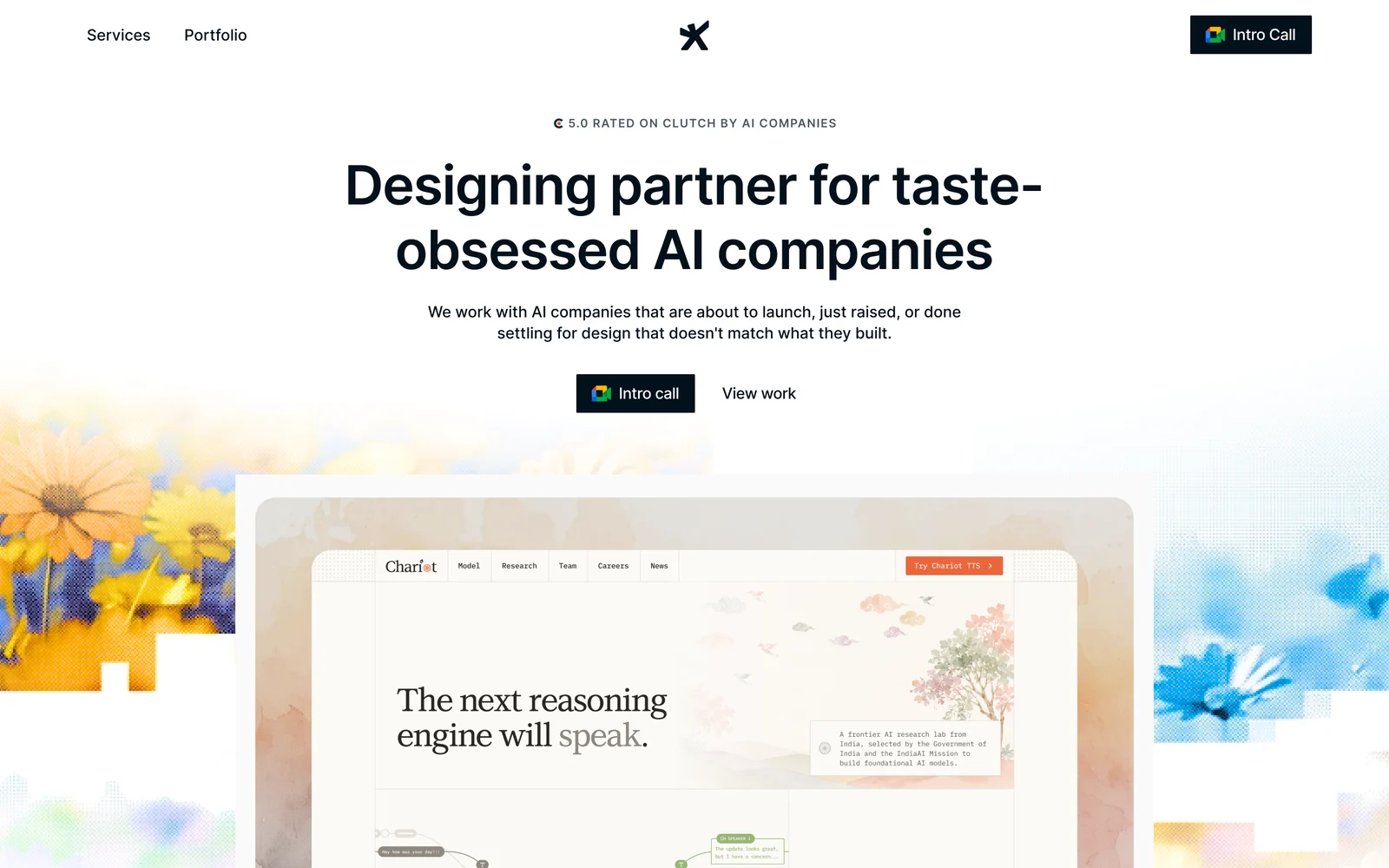
1. Studio Maydit: A Top-Rated Design Agency for AI Founders
Work continues into product design after the site ships, and in legaltech that is where nearly all of the value sits. No partner has ever been convinced by a homepage. They are convinced by the screen where a suggested clause appears beside the paragraph it came from, with a date and a source a colleague can check. That screen decides whether a pilot becomes a contract, and it is invisible from the marketing site entirely.
Studio Maydit is a web and product design studio. Its clients are AI founders in the US, UK, and Europe, which for a legaltech company matters more than usual, since the same product has to behave sensibly under three different legal traditions and the assumptions baked into a screen do not travel quietly. Platform choice follows the job. Framer while the positioning is still being argued between the associate and the partner. Webflow when a marketing hire wants to publish without a release. Custom code when a screen has to show a real document beside real output rather than a picture of one.
Dualite carries the published number. The order there began with narrowing: a repositioned ICP, then a product designed for the smaller group that decision defined, then 100,000+ users across seven months. Legaltech teams should note the sequence, because a tool built for one document type and one moment in a matter gets adopted, while a tool built for all of law gets opened once and admired. Recent clients include Wave, PixelFlow, and Mi-VAD, along with 15 other AI and SaaS teams.
Buying works two ways. Fixed scope runs three to four weeks and fits one bounded job, such as rebuilding the review screen so sources sit beside the claims they support. A monthly retainer suits a team working through a long firm sales cycle, covering new pages, campaigns, and product design, with no long lock-in. Fixed-scope projects end with a diagnosis of what is leaking in the product, which here usually names the step where a lawyer decided it was quicker to do it themselves.
| Check | Finding |
|---|---|
| Based in | Remote, serving US / UK / EU |
| Platform depth | Framer, Webflow, and custom code |
| AI-sector proof | Yes. AI-native clients, published outcome on Dualite |
| Pricing | Fixed scope or monthly retainer, quoted per project |
| Team shape | Founder-led, small senior team |
| Best fit | Legaltech teams whose pilots go quiet in month two |
Worth a call if one champion at the firm is your entire usage graph. Book a 30-minute call.

2. Engine Digital
Engine Digital has built in custom code from Vancouver and New York since 2002, naming Adidas, Autodesk, Goldman Sachs, and HP. Goldman Sachs is a regulated institution with an approval culture very close to a law firm's, so this is a studio that has passed through the sort of review your buyers will run on you.
No team size and no starting figure are published, their AI-sector proof is partial with no AI case study, and a practice built for organisations that size brings a process and a cost shape sized for them.
| Check | Finding |
|---|---|
| Based in | Vancouver and New York |
| Founded | 2002 |
| Team size | Not published |
| Primary platform | Custom code |
| AI-sector proof | Partial. Enterprise and SaaS clients, no AI case study |
| Named clients | Adidas, Autodesk, Goldman Sachs, HP |
| Pricing | Not published |
| Best fit | Legaltech teams selling into large regulated institutions |
3. Fantasy
Fantasy has worked from San Francisco and New York since 1999, across platforms, with published AI client work. A practice that old has redesigned around several changes in how people interact with software, which is useful when your product asks lawyers to work in a way the profession has not worked before.
No team size, no starting figure, and no named clients are published, which leaves very little to evaluate before a call, and that is awkward when a firm asks you to justify your own supplier choices.
| Check | Finding |
|---|---|
| Based in | San Francisco and New York, USA |
| Founded | 1999 |
| Team size | Not published |
| Primary platform | Mixed |
| AI-sector proof | Yes. Published AI client work |
| Named clients | Not published |
| Pricing | Not published |
| Best fit | Legaltech teams rethinking how the work itself is done |
4. Kvalifik
Kvalifik is a Copenhagen studio of eleven to fifty working mainly in Webflow since 2015, with published AI client work and Veo, Maersk, and Relesys named. Maersk is a large European organisation with a strong documentation culture, and designing for people who keep records for a living is closer to your problem than most portfolios here.
No starting figure is published, their platform depth is Webflow rather than application design, and their client base is Northern European industry rather than professional services.
| Check | Finding |
|---|---|
| Based in | Copenhagen, Denmark |
| Founded | 2015 |
| Team size | 11-50 |
| Primary platform | Webflow |
| AI-sector proof | Yes. Published AI client work |
| Named clients | Veo, Maersk, Relesys |
| Pricing | Not published |
| Best fit | Legaltech teams selling into large European organisations |
5. Lighthouse Digital
Lighthouse Digital is a London Webflow studio that publishes a minimum, naming HelloSelf, Freetrade, and IGN. Freetrade is regulated and HelloSelf handles clinical data, so this studio has written for British audiences who are cautious by default and about claims that somebody checks.
They publish no founding year, no team size, and no AI client work at all, which means every conversation about model behaviour, sourcing, and disclosure begins from nothing.
| Check | Finding |
|---|---|
| Based in | London, UK |
| Founded | Not published |
| Team size | Not published |
| Primary platform | Webflow |
| AI-sector proof | No. No published AI client work |
| Named clients | HelloSelf, Freetrade, IGN |
| Pricing | Published minimum |
| Best fit | Legaltech teams wanting a careful UK marketing site |
6. Clay
Clay is a San Francisco studio founded in 2016 at fifty-one to two hundred people, publishing a minimum and AI client work, naming Slack, Stripe, Google, Coinbase, and Amazon. Stripe made an intricate technical product feel safe to a cautious buyer, which is the exact translation problem you have with a managing partner.
Their client list also sets their scale, and a studio built around engagements that size tends to move slowly next to a legaltech team trying to reach a firm before its next budget cycle.
| Check | Finding |
|---|---|
| Based in | San Francisco, USA |
| Founded | 2016 |
| Team size | 51-200 |
| Primary platform | Mixed |
| AI-sector proof | Yes. Published AI client work |
| Named clients | Slack, Stripe, Google, Coinbase, Amazon |
| Pricing | Published minimum |
| Best fit | Legaltech teams making an expensive category bet |
7. BX Studio
BX Studio is a New York team of eleven to fifty working in Webflow, publishing a minimum and AI client work, naming Reddit, Headspace, ASAPP, and Verifone. ASAPP sells AI into large enterprises, and Verifone handles payments, so both regulated buyers and AI positioning appear in the portfolio.
No founding year is published, and Webflow depth reaches the marketing surface rather than the review and audit screens your firms will actually assess.
| Check | Finding |
|---|---|
| Based in | New York, USA |
| Founded | Not published |
| Team size | 11-50 |
| Primary platform | Webflow |
| AI-sector proof | Yes. Published AI client work |
| Named clients | Reddit, Headspace, ASAPP, Verifone |
| Pricing | Published minimum |
| Best fit | Legaltech teams needing a strong site in New York hours |
8. Trueform
Trueform has worked in Framer from Switzerland since 2022, publishes a minimum and AI client work, and names Miro, Morning Brew, Bilt Rewards, and Gather. Swiss practice tends to be precise and understated, which suits a market where overclaiming is not merely unfashionable but a professional risk your buyers will notice immediately.
No team size is published, and a Framer studio works on the marketing surface, so nothing in the portfolio speaks to the document review interface your product lives or dies on.
| Check | Finding |
|---|---|
| Based in | Wil, Switzerland |
| Founded | 2022 |
| Team size | Not published |
| Primary platform | Framer |
| AI-sector proof | Yes. Published AI client work |
| Named clients | Miro, Morning Brew, Bilt Rewards, Gather |
| Pricing | Published minimum |
| Best fit | Legaltech teams whose website overclaims and loses trust |
9. Phantom
Phantom has built in custom code from London and Auckland since 2013, at fifty-one to two hundred people, publishing AI client work and naming Diageo, SAP, Financial Times, and Zendesk. The Financial Times is a business built on citation and record, and SAP is enterprise software sold through long approvals, which together cover both halves of your problem.
No starting figure is published, and a practice of that size with clients that large arrives with a structure built for them rather than for a legaltech company of thirty people.
| Check | Finding |
|---|---|
| Based in | London, UK and Auckland, NZ |
| Founded | 2013 |
| Team size | 51-200 |
| Primary platform | Custom code |
| AI-sector proof | Yes. Published AI client work |
| Named clients | Diageo, SAP, Financial Times, Zendesk |
| Pricing | Not published |
| Best fit | Funded legaltech teams selling to City and enterprise firms |
10. basement.studio
basement.studio builds in custom code from Mar del Plata and Los Angeles, founded in 2018 at eleven to fifty people, publishing a minimum and AI client work, naming Vercel, Cursor, ElevenLabs, Harvey AI, and Scale AI. Harvey AI is a legal product, which makes this the only studio here with published work in your exact category.
Custom code means an engineer is involved in every content change, and a studio with that client list and that team size may simply not have room when you need them.
| Check | Finding |
|---|---|
| Based in | Mar del Plata, Argentina and Los Angeles, USA |
| Founded | 2018 |
| Team size | 11-50 |
| Primary platform | Custom code |
| AI-sector proof | Yes. Published AI client work |
| Named clients | Vercel, Cursor, ElevenLabs, Harvey AI, Scale AI |
| Pricing | Published minimum |
| Best fit | Legaltech teams who want work from inside their own category |
How to choose between them
Sort by which conversation with the firm keeps going wrong, not by which studio is most decorated.
Associates try it twice and stop. Studio Maydit or basement.studio.
The partner will not sign because nothing is traceable. Studio Maydit or Engine Digital.
Risk and IT block the pilot before it starts. Phantom or Clay.
Your website sounds like it is promising too much. Trueform or Lighthouse Digital.
One test before you sign. Give them a real output from your product next to the source document and ask what they would change on that screen. A studio that understands this category will talk about proximity, dates, and what a reviewer needs to see without scrolling. A studio that does not will suggest a cleaner layout and a nicer typeface, which is the version of your product lawyers are already ignoring.