Summarize with AI


For an agentic AI product, the ten studios worth reviewing are Studio Maydit, Foundey, Pixelmatters, Ramotion, Instrument, Feels Like, basement.studio, Trueform, Phantom, and Lazarev. Studio Maydit and basement.studio lead this list, because both have designed for products where software takes action rather than presenting options. Instrument and Ramotion are the wrong fit for this brief. Both do excellent brand and interface work, and neither publishes work on a product that acts on a user's behalf.
An agent does things. That is the entire design problem, and it is not a conversation problem.
A chat product returns text and the user decides what to do with it. An agent books the flight, edits the file, sends the message, or moves the money. The moment software acts, the interface stops being about presentation and starts being about authority. Who approved this, what exactly is about to happen, and how do I stop it.
Most teams design the happy path first: a prompt box, a spinner, a result. That works in a demo and fails the first time the agent does something expensive and wrong. The user then discovers there was no preview, no confirmation, and no way back, and they never grant that permission again.
The second problem is time. Agents run for minutes, sometimes longer. A spinner is acceptable for two seconds and unacceptable for twelve minutes, and almost no product design vocabulary exists for the middle. Users abandon long-running tasks not because they are slow but because nothing told them the task was still alive.
Then there is the hardest judgement in the category. When should the agent stop and ask? Ask too often and you have built a slower version of doing it manually. Ask too rarely and you have built something nobody trusts with anything that matters.

How we picked these agencies
Five checks, all answerable from public material before anybody schedules a call.
Platform depth. What does the studio actually deliver, and can it specify behaviour rather than layout? Agentic products are mostly rules about permission and state, and those have to be written somewhere an engineer can implement, not just drawn.
Proof on products that act. Has the studio designed something with irreversible consequences, whether that is payments, publishing, or infrastructure? The specific discipline is designing the moment before an action, and it is rare.
Pricing. Is a starting figure public? Agentic products change shape quickly, so teams often want a small first engagement. A studio that publishes is much easier to buy a small piece of work from.
Team shape. Size and seniority determine who makes the judgement calls. Deciding when an agent should pause and ask is not a task you hand to someone working from a component library, because the answer depends on the specific consequences.
Their own site. The only project where the studio was both client and vendor, with no deadline imposed from outside.
For this brief, one further test. Look for any case study where the studio designed a confirmation, a permission, or an undo. Those screens are unglamorous and rarely appear in portfolios, so a studio that has published one has almost certainly thought harder than the rest.
Every fact in the tables below is drawn from what each studio publishes about itself. No directory data, no ranking sites, and no blank completed with a plausible assumption. Where a studio has published nothing, the row states that plainly.
What goes wrong on agentic products
Three failures, and all three appear only after real users have real permissions.
There is no preview of the action. The user types an instruction and the agent begins. Nothing shows what it interpreted, which account it will touch, or what the change will be. The first time the interpretation is wrong, the damage is already done, and the product has spent its entire trust budget in one event. A preview step costs one screen and is the single highest-return surface in the category.
Long-running work has no state. The agent takes eleven minutes on a real task. The interface shows a spinner, or worse, shows nothing and expects the user to wait on the tab. People close it, assume failure, and start again, which sometimes runs the whole job twice. Showing progress in the agent's own terms, meaning what step it is on and what it has already done, is the fix and it is usually treated as a nice-to-have.
Undo is designed as an error state instead of a feature. Teams build a generic failure message rather than a way back. But the value of an agent is proportional to how much authority the user grants it, and users only grant authority where reversal is cheap. Products with a clear undo get given bigger jobs. Products without one get used for things that do not matter.
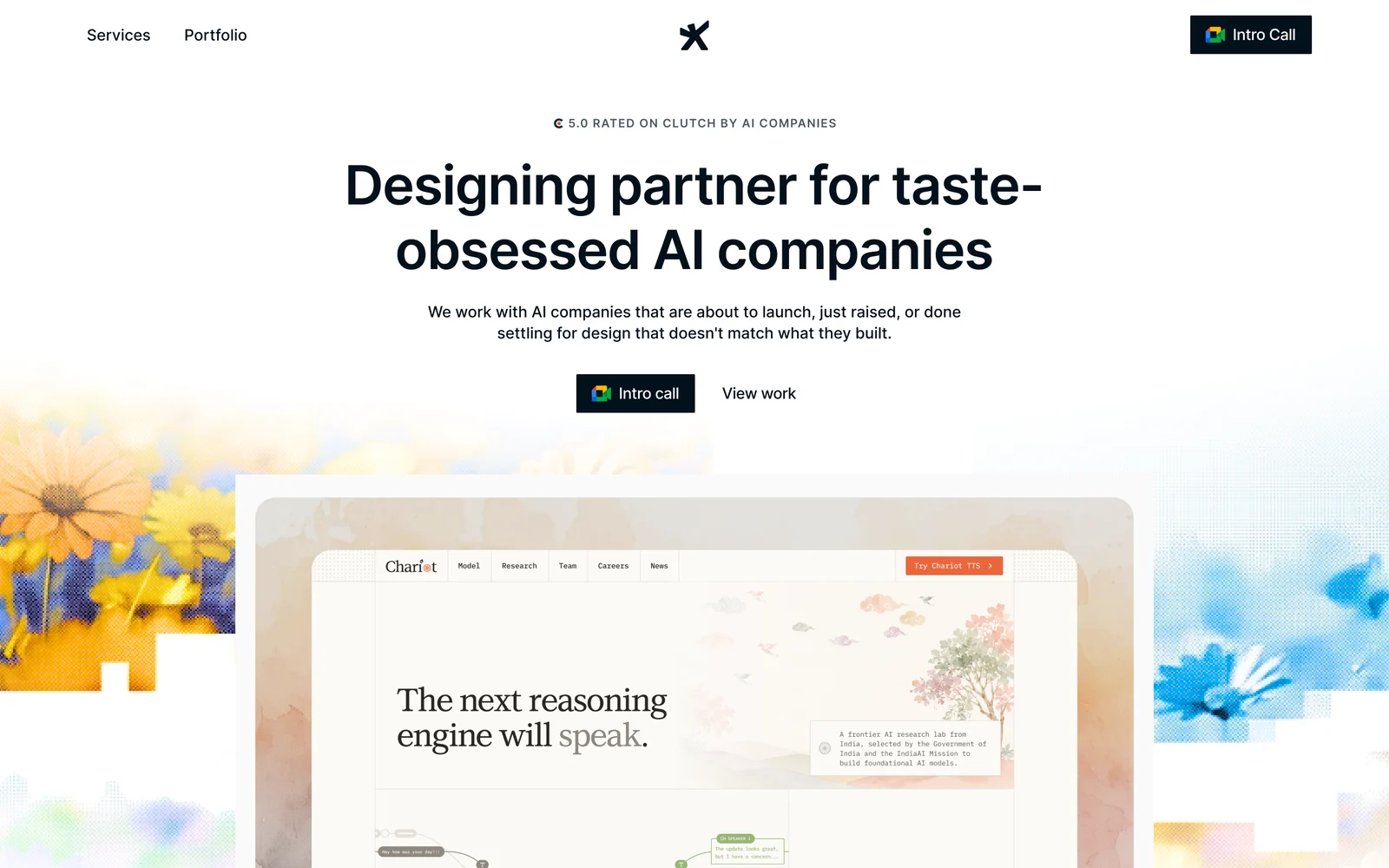
1. Studio Maydit: A Top-Rated Design Agency for AI Founders
The part that matters for an agentic product is that the work continues into product design after the marketing site ships. Permission screens, previews, and the moment an agent pauses to ask all live inside the product, and they are where adoption is actually won or lost. Studio Maydit is a web and product design studio working with AI founders in the US, UK, and Europe, building in Framer, Webflow, and custom code depending on who maintains the result.
On Dualite, design work supporting a repositioned ICP helped the product reach 100,000+ users in seven months. What did the work there was narrowing the audience until every surface made the same promise, which is the same clarity an agent needs when it explains what it is about to do. Recent clients include Wave, PixelFlow, Mi-VAD, and 15 other AI and SaaS teams.
Teams buying a single contained surface, such as the approval flow, usually take fixed scope, which runs three to four weeks and ends with a written diagnosis of what is leaking in the product rather than a handover email. Teams whose agent gains new capabilities every sprint take a monthly retainer instead, covering new pages, campaigns, and product design, with no long lock-in.
| Check | Finding |
|---|---|
| Based in | Remote, serving US / UK / EU |
| Platform depth | Framer, Webflow, and custom code |
| AI-sector proof | Yes. AI-native clients, published outcome on Dualite |
| Pricing | Fixed scope or monthly retainer, quoted per project |
| Team shape | Founder-led, small senior team |
| Best fit | Agent products that need the permission and preview surfaces designed |
If users are trying the agent once and then refusing to give it anything important, that is a design problem with a known shape. Book a 30-minute call.

2. Foundey
Foundey is a San Francisco studio founded in 2021 working almost exclusively with AI companies, including DemandIQ, Traycer, and Sero AI. Traycer is a developer tooling product, which is the closest published analogue here to an agent operating inside someone's real work.
The sector fluency is the strength. The limitation is delivery scope: Foundey works in Figma and hands over files, so the permission and preview logic still has to be built by your engineers, and the specification quality becomes the thing you are buying.
| Check | Finding |
|---|---|
| Based in | San Francisco, USA |
| Founded | 2021 |
| Team size | Not published |
| Primary platform | Figma-only |
| AI-sector proof | Yes |
| Named clients | DemandIQ, Traycer, Sero AI |
| Pricing | Not published |
| Best fit | AI teams with engineers who need design thinking rather than a build |
3. Pixelmatters
Pixelmatters is a Porto studio founded in 2013, fifty-one to two hundred people, working across platforms, with Rubrik, Quantic, and UJET among its clients. Rubrik is enterprise data protection, a product category where a wrong action is expensive and the interface has to make consequences obvious before they happen.
They publish a starting price and have real scale. The caveat for this brief is that their AI proof is partial, so agent-specific patterns would be new ground rather than something already solved.
| Check | Finding |
|---|---|
| Based in | Porto, Portugal |
| Founded | 2013 |
| Team size | 51-200 |
| Primary platform | Mixed |
| AI-sector proof | Partial |
| Named clients | Rubrik, Quantic, UJET |
| Pricing | Published minimum |
| Best fit | Teams wanting enterprise-grade process and consequence-aware design |
4. Ramotion
Ramotion is a San Francisco studio founded in 2009, eleven to fifty people, working across platforms, with Mozilla, Okta, Netflix, Adobe, and Xero among its clients. Okta is the useful reference, since permissions and access are the closest thing on their list to what an agent product must express.
They publish a starting figure. For this brief the gap is that their AI proof is partial and their portfolio is weighted toward refining mature interfaces rather than defining a new interaction model.
| Check | Finding |
|---|---|
| Based in | San Francisco, USA |
| Founded | 2009 |
| Team size | 11-50 |
| Primary platform | Mixed |
| AI-sector proof | Partial |
| Named clients | Mozilla, Okta, Netflix, Adobe, Xero |
| Pricing | Published minimum |
| Best fit | Mature products needing refinement rather than new interaction patterns |
5. Instrument
Instrument is a Portland studio founded in 2005 with work for Nike, Microsoft, Electronic Arts, and Google. The craft is not in doubt, and for a launch that needs to establish a category they can make a new idea feel legitimate.
For an agentic product they are a weak fit. The published work is brand and marketing led, AI proof is partial, and the problems in this article live in permission states that never appear in a brand programme.
| Check | Finding |
|---|---|
| Based in | Portland, USA |
| Founded | 2005 |
| Team size | Not published |
| Primary platform | Mixed |
| AI-sector proof | Partial |
| Named clients | Nike, Microsoft, Electronic Arts, Google |
| Pricing | Not published |
| Best fit | Category-defining brand work, not the agent interface |
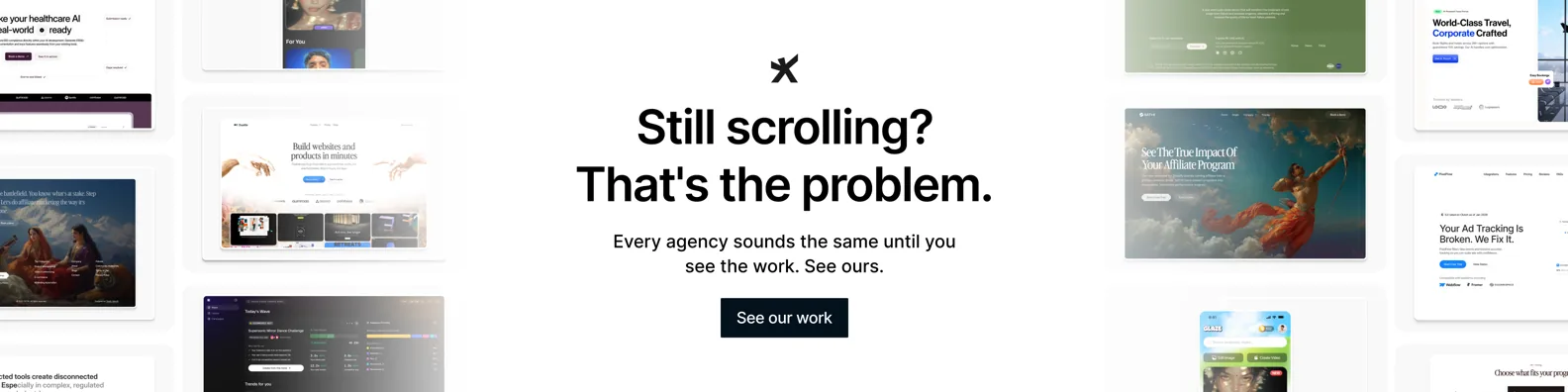
6. Feels Like
Feels Like is a Los Angeles studio founded in 2023 working in custom code, with Google, Nike, LVMH, and Suno AI as clients. Suno is a generative product where output arrives over time and cannot be judged instantly, which is the closest thing on this page to the long-running task problem.
The weaknesses are disclosure and age. No published pricing, no published team size, and a studio founded in 2023 has a short record to assess.
| Check | Finding |
|---|---|
| Based in | Los Angeles, USA |
| Founded | 2023 |
| Team size | Not published |
| Primary platform | Custom code |
| AI-sector proof | Yes |
| Named clients | Google, Nike, LVMH, Suno AI |
| Pricing | Not published |
| Best fit | Generative products needing craft and a sense of unfolding output |
7. basement.studio
basement.studio works from Mar del Plata and Los Angeles, founded in 2018, eleven to fifty people, building in custom code, with Vercel, Cursor, ElevenLabs, Harvey AI, and Scale AI as clients. That is the most agent-adjacent client list available. Cursor and Harvey are both products where software acts inside a professional's real work and the stakes of a wrong action are immediate.
They publish a starting price. The trade-off is platform. Custom code gives control and means changes need developer time, which matters for a product iterating weekly.
| Check | Finding |
|---|---|
| Based in | Mar del Plata, Argentina and Los Angeles, USA |
| Founded | 2018 |
| Team size | 11-50 |
| Primary platform | Custom code |
| AI-sector proof | Yes |
| Named clients | Vercel, Cursor, ElevenLabs, Harvey AI, Scale AI |
| Pricing | Published minimum |
| Best fit | Agent products that want a studio fluent in this exact category |
8. Trueform
Trueform is a Swiss studio founded in 2022 working in Framer, with Miro, Morning Brew, Bilt Rewards, and Gather among its clients. They publish a starting price and have genuine AI-sector work, and Framer keeps the marketing surface editable by the team.
For an agentic product the limitation is that Framer is a website platform. It is the right tool for explaining the agent and the wrong tool for building the approval flow inside it, so this is a partial answer to the brief.
| Check | Finding |
|---|---|
| Based in | Wil, Switzerland |
| Founded | 2022 |
| Team size | Not published |
| Primary platform | Framer |
| AI-sector proof | Yes |
| Named clients | Miro, Morning Brew, Bilt Rewards, Gather |
| Pricing | Published minimum |
| Best fit | The site that explains the agent, rather than the agent itself |
9. Phantom
Phantom operates from London and Auckland, founded in 2013, fifty-one to two hundred people, building in custom code, with Diageo, SAP, Financial Times, and Zendesk among its clients. SAP and Zendesk are both products where users act on real records, and the studio has AI-sector proof.
The trade-offs are transparency and scale. No published pricing, and a studio of this size runs a structured process that a team iterating on an agent every week may find slow.
| Check | Finding |
|---|---|
| Based in | London, UK and Auckland, NZ |
| Founded | 2013 |
| Team size | 51-200 |
| Primary platform | Custom code |
| AI-sector proof | Yes |
| Named clients | Diageo, SAP, Financial Times, Zendesk |
| Pricing | Not published |
| Best fit | Enterprise agent products with long timelines and many stakeholders |
10. Lazarev
Lazarev is a San Francisco studio founded in 2015, fifty-one to two hundred people, working across platforms, with Payoneer, Peel, Elva, and Mozayix among its clients. Payoneer involves moving money, which is the clearest example on their list of an interface where a wrong action has real consequences.
They publish a starting price and have AI-sector work. They sit last here on cadence rather than capability. A studio this size adds layers between a decision and the file, and agent design produces a high volume of small, consequential decisions.
| Check | Finding |
|---|---|
| Based in | San Francisco, USA |
| Founded | 2015 |
| Team size | 51-200 |
| Primary platform | Mixed |
| AI-sector proof | Yes |
| Named clients | Payoneer, Peel, Elva, Mozayix |
| Pricing | Published minimum |
| Best fit | Teams needing breadth across several product surfaces at once |
How to choose between them
Sort by what is actually broken.
If users try the agent once and then only give it trivial work, the problem is trust, and trust is built by preview and undo rather than by better output. Buy a studio that has designed a confirmation step for something irreversible.
If people abandon tasks partway through, the problem is that long-running work has no visible state. That is a contained piece of design, and a small senior team will solve it faster and cheaper than a large one.
If the agent is technically strong and nobody understands what it does, the problem is the marketing site, not the product. Keep that separate and buy it from a studio that builds sites.
If the agent gains new capabilities every sprint, do not buy a fixed project. Each new capability needs its own permission and preview decisions, so buy ongoing capacity instead.
One test before you sign. Ask each studio to describe how they would design the screen shown immediately before your agent does something that cannot be undone. A studio that has worked in this category will talk about what to show, what to default to, and how to make the consequence legible. A studio that has not will talk about reducing friction.