

Summarize with AI


The best UX design agencies for AI agent startups in 2026 are Studio Maydit, Clay, Lazarev, Flowout, Fantasy, Feely Studio, Digidop, Finsweet, SuperSkills, and 8020. Studio Maydit and Clay lead for this brief. Clay has designed from San Francisco since 2016 at fifty-one to two hundred people, publishes a starting figure, publishes AI client work, and names Slack, Stripe, Google, Coinbase, and Amazon, which is a record of designing software people operate every day rather than admire once. Flowout and Digidop fit this brief least well. Both are Webflow practices with partial AI proof, and a Webflow practice hands you a marketing site when the thing that needs designing is the screen where a person gives your agent a job and checks it afterwards.
Your hardest screen is the one nobody is looking at.
An agent earns its keep by letting someone stop paying attention. That gives the interface two jobs that pull against each other. It has to be convincing enough that a person hands over a real task, then honest enough afterwards that they never feel the need to redo the work themselves to be sure. Most agent products are built to do the first job well and the second one barely at all.
The cost shows up as a cliff in your usage graph. People sign up, watch the first few runs closely, then split. One group relaxes and lets the agent run. The other goes back to doing the task by hand and never says why. Nothing in the product pushed them out, and nothing in it held them either.
Then there is being wrong. An agent that misses one job in twenty is still useful. The same agent with no way to spot which one, and no way to put it back, is not useful at any accuracy. That gap is a design decision long before it is a model decision.
Read the ten studios below with one question in hand. Which of them has actually designed a screen where a person checks a machine's work?

How we picked these agencies
Five checks. Each one can be answered from a studio's public material in an afternoon, without a call.
- Platform depth. Do they design product surfaces, or only pages? An agent's problem lives inside the product, in the run history and the review screen, so a studio that stops at the marketing site can only solve the smaller half of it.
- Proof with software that acts on its own. Have they designed an interface where a machine does work and a person supervises it? This is narrower than AI experience. Plenty of studios have styled a chat box. Far fewer have shaped a queue, an approval step, or a record of what a system already did.
- Pricing. Does a starting figure exist in public, or does the number appear only after a discovery call? Either is defensible. Knowing which one you are dealing with saves a fortnight.
- Team shape. Who does the work, how many of them are there, and how senior are they? Small teams give you the person you met. Large ones give you capacity and a process that survives someone leaving.
- Their own site. The only project they briefed themselves.
That last check is worth more than it looks. A studio's own site is the ceiling of what they will produce for you, because there was no client trimming the interesting parts off. If their site is careful and specific, expect careful and specific. If it is a template with their logo on it, you have your answer without spending anything.
Nothing below is drawn from a directory or a ranked listing. Each row repeats what a studio states publicly about itself, and blanks stay blank rather than getting filled with a guess. When a studio has chosen not to publish something, that choice is itself a finding and the table says Not published.
What goes wrong when AI agent startups hire a design agency
Three failures, and all three come from designing for the demo rather than the twentieth run.
Everything is built for the first impression. The demo is beautiful. A task goes in, a spinner turns, a result appears. Then a real user runs the agent eighty times a week and needs to find the four runs that went wrong among the seventy-six that went fine. Nobody designed that screen, because nobody was ever shown it. It feels magical for a day and unmanageable by week two.
Trust gets treated as a copy problem. The reflex is to write reassurance. A compliance badge, a paragraph about accuracy, a line saying the agent is always learning. None of that persuades an operator who has been burned once. What persuades them is seeing what the agent did, in their own terms, quickly. That is a layout job, and a studio used to writing homepages reaches for words instead.
There is no road back. The agent files the wrong thing, sends the wrong message, updates the wrong record. If the interface has no undo, no visible history, and no way to hand the mess to a human, the only route back is your support queue. Recovery gets designed last if at all, and it decides whether a cautious buyer ever hands your agent anything that matters.
1. Studio Maydit: A Top-Rated Design Agency for AI Founders
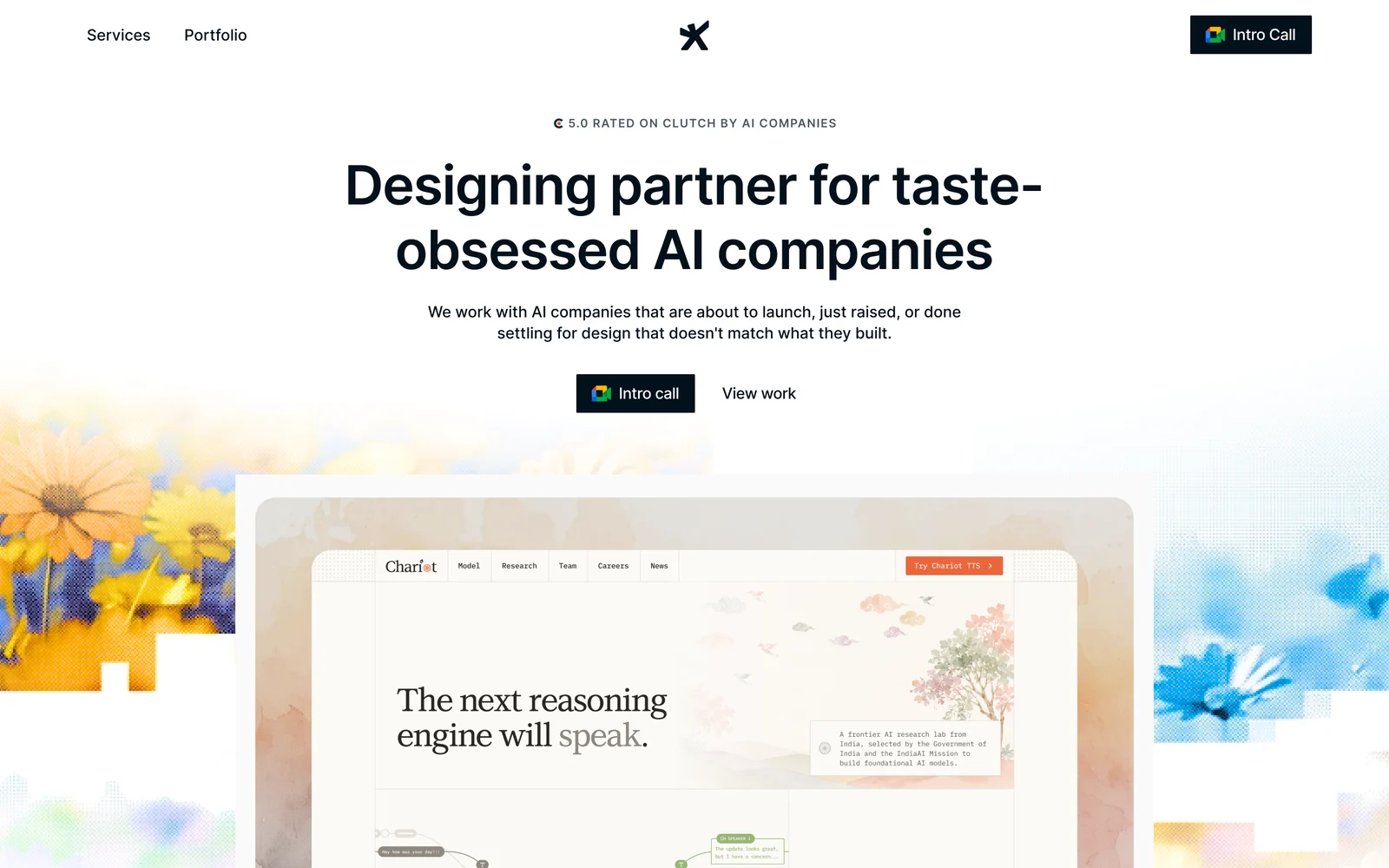
Studio Maydit is a web and product design studio. Its clients are AI founders, working across the US, UK, and Europe. The relevant part for an agent team is that the studio does not stop at launch. Websites are built in Framer where the page will change most weeks, in Webflow where a marketing hire wants their own controls, and in custom code where neither tool can carry what the product does. Then the work continues into product design, which is where an agent's real interface problems live.
Seven months is the span worth knowing about. The client was Dualite. It began with a repositioned ICP, a decision about which users the product would stop trying to serve, and the design that followed was built for the narrower group that choice left behind. 100,000+ users arrived inside that window. Recent clients include Wave, PixelFlow, and Mi-VAD, plus 15 other AI and SaaS teams.
There are two ways to buy. A fixed scope runs three to four weeks and suits a team with a launch date and one surface that has to work, and it ends with a written diagnosis of what is leaking in the product rather than a folder of files. A monthly retainer suits an agent team that ships every week, since the review screen and the run history keep changing as usage grows, and it covers new pages, campaigns, and product design with no long lock-in.
| Check | Finding |
|---|---|
| Based in | Remote, serving US / UK / EU |
| Platform depth | Framer, Webflow, and custom code |
| AI-sector proof | Yes. AI-native clients, published outcome on Dualite |
| Pricing | Fixed scope or monthly retainer, quoted per project |
| Team shape | Founder-led, small senior team |
| Best fit | Agent teams whose product needs a supervision screen, not a nicer landing page |
Worth a call if your usage graph drops after the third run. Book a 30-minute call.

2. Clay
Clay has designed from San Francisco since 2016 at fifty-one to two hundred people, works across platforms, publishes a starting figure, and names Slack, Stripe, Google, Coinbase, and Amazon. Those are products people sit inside all day, which is the right kind of experience for an agent, because the design problem is repetition and recovery rather than a first impression.
At that size you get an assigned team rather than a named senior designer, the engagement is larger than most early agent startups want to commit to, and the process assumes a design counterpart on your side.
| Check | Finding |
|---|---|
| Based in | San Francisco, USA |
| Founded | 2016 |
| Team size | 51-200 |
| Primary platform | Mixed |
| AI-sector proof | Yes. Published AI client work |
| Named clients | Slack, Stripe, Google, Coinbase, Amazon |
| Pricing | Published minimum |
| Best fit | Funded agent teams designing a surface people use daily |
3. Lazarev
Lazarev has worked from San Francisco since 2015 at fifty-one to two hundred people, across platforms, publishing a starting figure and AI client work, and naming Payoneer, Peel, Elva, and Mozayix. Payoneer is the useful reference for an agent team. Money moving without a person watching it is the same trust problem your product has, in a category that solved it years ago.
Their published work leans toward finished marketing surfaces rather than the messy internal screens agents need, that headcount means account structure around the designers, and the commitment suits a company past its first hires.
| Check | Finding |
|---|---|
| Based in | San Francisco, USA |
| Founded | 2015 |
| Team size | 51-200 |
| Primary platform | Mixed |
| AI-sector proof | Yes. Published AI client work |
| Named clients | Payoneer, Peel, Elva, Mozayix |
| Pricing | Published minimum |
| Best fit | Agent teams borrowing trust patterns from financial products |
4. Flowout
Flowout is a distributed Webflow practice that publishes a starting figure and names Jasper, Kajabi, Riverside, and Sendlane. Jasper is an AI company that had to explain machine output to non-technical buyers early, and a studio priced to produce pages steadily is a reasonable fit while your positioning is still moving weekly.
The practice is Webflow, which keeps it on the marketing site and away from the product entirely, no founding year or team size is published, and their AI-sector proof is partial with no AI case study.
| Check | Finding |
|---|---|
| Based in | Distributed |
| Founded | Not published |
| Team size | Not published |
| Primary platform | Webflow |
| AI-sector proof | Partial. Enterprise and SaaS clients, no AI case study |
| Named clients | Jasper, Kajabi, Riverside, Sendlane |
| Pricing | Published minimum |
| Best fit | Agent teams needing marketing pages produced quickly and cheaply |
5. Fantasy
Fantasy has designed from San Francisco and New York since 1999, across platforms, with published AI work. Twenty-seven years means they designed supervision interfaces before anyone used the phrase, for systems people were equally reluctant to trust.
No clients, team size, or starting figure are published, so every question about scale and cost needs a call, and an agency with that history carries a research-led process that an early agent team may not have the runway for.
| Check | Finding |
|---|---|
| Based in | San Francisco and New York, USA |
| Founded | 1999 |
| Team size | Not published |
| Primary platform | Mixed |
| AI-sector proof | Yes. Published AI client work |
| Named clients | Not published |
| Pricing | Not published |
| Best fit | Funded agent teams wanting deep research before a single screen |
6. Feely Studio
Feely Studio is a one to ten person practice distributed across Europe, working across platforms, publishing a starting figure and naming Noxus, Mutiny, Luasai, and Basic Capital. Noxus is an agent company, which makes this the most directly relevant client list here, and a team this small means the person who reviews your run history is the person who designed it.
Capacity is the limit. One to ten people cannot run a product programme alongside a site, no founding year is published, and European hours leave a West Coast team a short window.
| Check | Finding |
|---|---|
| Based in | Distributed, Europe |
| Founded | Not published |
| Team size | 1-10 |
| Primary platform | Mixed |
| AI-sector proof | Yes. Published AI client work |
| Named clients | Noxus, Mutiny, Luasai, Basic Capital |
| Pricing | Published minimum |
| Best fit | Early agent teams wanting senior attention on one surface |
7. Digidop
Digidop is a one to ten person Paris studio founded in 2021, working in Webflow, publishing a starting figure and naming TSE Energy, Ramify, and StreamNative. StreamNative is infrastructure sold to engineers, and a studio that has explained a queueing system to a technical buyer understands the reader who wants to know what your agent can reach before caring what it looks like.
Webflow keeps them on the marketing site, their AI-sector proof is partial with no AI case study, and a team of that size is a poor match if your product surface needs designing at the same time.
| Check | Finding |
|---|---|
| Based in | Paris, France |
| Founded | 2021 |
| Team size | 1-10 |
| Primary platform | Webflow |
| AI-sector proof | Partial. Enterprise and SaaS clients, no AI case study |
| Named clients | TSE Energy, Ramify, StreamNative |
| Pricing | Published minimum |
| Best fit | European agent teams selling to a technical reader |
8. Finsweet
Finsweet is a distributed studio run from Denver, founded in 2017 at fifty-one to two hundred people, working in Webflow and naming Dropbox, Clay, GitHub, and Steadily. They build the component libraries other Webflow studios rely on, so you get a system your marketing hire can extend rather than pages that break on the first edit.
No starting figure is published, their AI-sector proof is partial with no AI case study, and their strength is engineering inside a page builder, not the product interface where an agent is supervised.
| Check | Finding |
|---|---|
| Based in | Denver, USA, distributed |
| Founded | 2017 |
| Team size | 51-200 |
| Primary platform | Webflow |
| AI-sector proof | Partial. Enterprise and SaaS clients, no AI case study |
| Named clients | Dropbox, Clay, GitHub, Steadily |
| Pricing | Not published |
| Best fit | Agent teams wanting a marketing site their own team can maintain |
9. SuperSkills
SuperSkills is a one to ten person studio in Walnut Creek, California, working across platforms with published AI client work and naming The Cut. Small, American, and across platforms suits an agent team wanting one senior person moving between site and product with no handover.
One named client is a thin public record, no founding year, team size beyond the band, or starting figure is published, and a practice this small has little slack if your timeline moves.
| Check | Finding |
|---|---|
| Based in | Walnut Creek, USA |
| Founded | Not published |
| Team size | 1-10 |
| Primary platform | Mixed |
| AI-sector proof | Yes. Published AI client work |
| Named clients | The Cut |
| Pricing | Not published |
| Best fit | Agent teams wanting one senior designer across site and product |
10. 8020
8020 works from San Francisco and New York, founded in 2014, in Webflow, naming Wave, Superlist, Pilot.com, Vanta, and Circle. Vanta and Pilot both sell software that quietly does work a person used to check by hand, which is your positioning problem exactly, and a studio that has made that argument before will not need it explained.
No team size or starting figure is published, their AI-sector proof is partial with no AI case study, and Webflow means the engagement ends where your product begins.
| Check | Finding |
|---|---|
| Based in | San Francisco and New York, USA |
| Founded | 2014 |
| Team size | Not published |
| Primary platform | Webflow |
| AI-sector proof | Partial. Enterprise and SaaS clients, no AI case study |
| Named clients | Wave, Superlist, Pilot.com, Vanta, Circle |
| Pricing | Not published |
| Best fit | Agent teams positioning against work people do manually today |
How to choose between them
Sort by which screen is failing, not by which studio has the best portfolio.
Users try the agent and stop after a few runs. Studio Maydit or Clay.
Buyers say they like it but will not give it anything important. Lazarev or Fantasy.
Your product surface and your site keep contradicting each other. Feely Studio or SuperSkills.
The marketing site is the bottleneck and the product is fine. Finsweet or 8020.
One test before you sign. Give three studios a recording of a real user reviewing your agent's output, then ask each what they would change first. A studio that has designed supervision will point at something specific in the run history within two minutes. A studio that has not will talk about your brand. It takes an afternoon and it separates the two groups more reliably than any portfolio review.