

Summarize with AI


The best UX design agencies for AI automation startups in 2026 are Studio Maydit, Fantasy, SuperSkills, Lazarev, Foundey, Instrument, Ramotion, Feels Like, Clay, and Feely Studio. Studio Maydit and Lazarev lead for this brief. Lazarev has worked from San Francisco since 2015 at fifty-one to two hundred people, works across platforms, publishes a starting figure and AI client work, and names Payoneer, Peel, Elva, and Mozayix, which is a studio that has designed operational software where a mistake costs real money rather than a bad review. SuperSkills and Instrument fit this brief least well. One publishes a single client name, the other carries partial AI proof and a process shaped for organisations far larger than yours, and neither record shows the configuration work this category lives on.
The hardest screen in your product is the one where a customer builds something.
Everything else can be adequate. The marketing site, the settings, the billing page, all of it can be ordinary and nobody will leave. The builder is different. It is where a customer either constructs the thing they actually do at work or discovers that your product handles a simplified version of it, and that discovery happens in the first twenty minutes.
Most builders in this category are copied. A canvas, nodes, arrows between them, a panel on the right. It looks like the products that came before because that pattern is familiar and familiar feels safe. What it is not is designed, and the tell is that a new user can build your demo example easily and their own process not at all.
Their real process is the problem. Your example sends a message when a form is submitted. Their version has four conditions, two approvals, an exception for one region, and a person who checks things on Fridays. That is not an edge case. That is the work.
The ten studios below are worth reading with one question. Which of them has designed a screen where a non-engineer assembles logic and gets it right?

How we picked these agencies
Five checks, weighted for a product whose value sits inside a configuration surface.
- Platform depth. Do they design product interfaces or marketing pages? Your problem is a builder, a run log, and an exception queue, which no amount of website work prepares a studio for, so this check removes more candidates here than in any other category.
- Proof with operational software. Have they designed a tool people use to get work done rather than to be entertained or informed? Operations software has its own grammar. Density is a feature, undo matters more than delight, and the user is often annoyed before they arrive.
- Pricing. Is a starting figure published? A public number lets you rule studios in or out in an afternoon. An unpublished one is common among studios doing deep product work, where scope genuinely varies, so treat it as information rather than a warning.
- Team shape. How many, how senior, and who is on your project? Complex interface work is unusually sensitive to seniority. A junior team will produce something that looks right and falls apart at the third condition.
- Their own site. The only work they briefed themselves.
Read that last one for evidence of decisions rather than taste. A builder screen is nothing but decisions, most of them unglamorous, and a studio whose own site avoids saying anything concrete is showing you how it behaves when a choice has to be made. You want the studio that argues.
Everything below reflects what each studio publishes about itself and nothing else. Rankings, directories, and third-party listings were left out, and no blank was filled with a reasonable guess. When a studio publishes nothing on a point, the row records that plainly as Not published.
What goes wrong when AI automation startups design their product
Three failures, and each one is invisible in a demo.
The builder gets borrowed instead of designed. Somebody looks at the four leading products, takes the canvas and the node panel, and ships a version of it. The result is instantly legible to anyone who has used a competitor and useless to the operations manager who has not. Worse, it inherits every constraint those products designed around years ago, none of which apply to you, and nobody notices because the whole thing looks correct.
Exceptions are treated as an afterthought. The happy path gets weeks of attention. The runs that fail get a red icon and a stack trace. But a customer's confidence is set entirely by what happens when something breaks, because that is the moment they decide whether this product can be trusted with anything that matters. Design the failure screen first and the rest of the product gets easier.
Nobody designs the moment a human is needed. Real workflows have a step that requires judgement, so the automation stops and asks a person. Most products handle this by sending an email and losing the thread. The approval sits in someone's inbox, the run is stalled, and nobody can see why. Getting that handover right is worth more than any amount of model quality, and it is almost always designed last.
1. Studio Maydit: A Top-Rated Design Agency for AI Founders
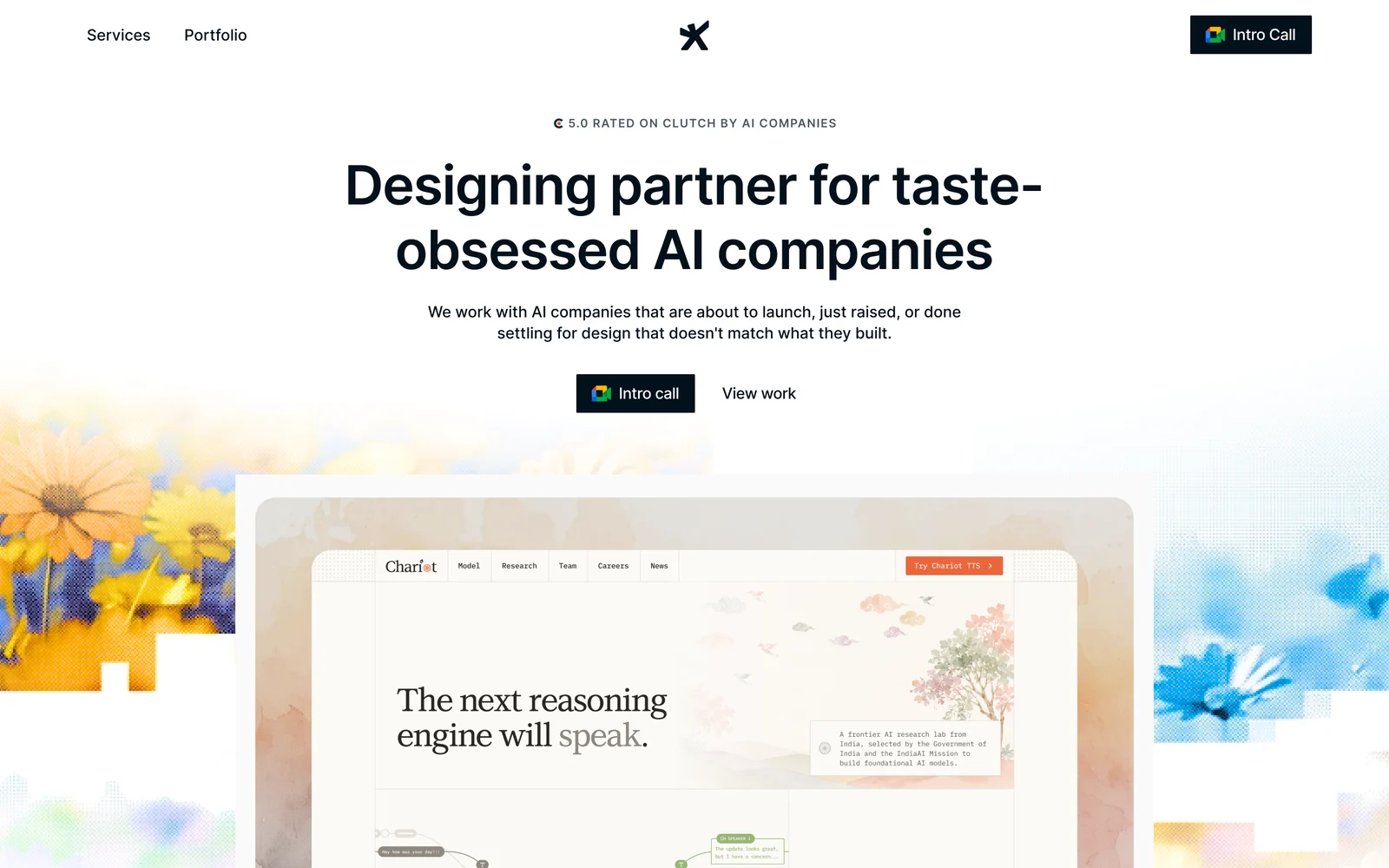
Studio Maydit is a web and product design studio, working with AI founders in the US, UK, and Europe. The part that matters for an automation company is that the engagement does not end at the marketing site. It continues into product design, which is where a builder screen, a run log, and an exception queue all live. Site work happens in Framer when pages change constantly, Webflow when a marketing hire wants their own system, and custom code when the product demands it.
The clearest published result belongs to Dualite. What changed first was not the interface but the target: a repositioned ICP, meaning a deliberate decision about which users would no longer be served. Design followed that. 100,000+ users arrived within seven months. Recent clients include Wave, PixelFlow, and Mi-VAD, together with 15 other AI and SaaS teams.
Two ways to buy exist, and for a company with a heavy product surface the retainer is usually the relevant one. It is monthly, covers new pages, campaigns, and product design, and carries no long lock-in, which fits a builder that keeps growing conditions as customers ask for them. The alternative is a fixed scope of three to four weeks for a team with a launch date, closing with a written diagnosis of what is leaking in the product.
| Check | Finding |
|---|---|
| Based in | Remote, serving US / UK / EU |
| Platform depth | Framer, Webflow, and custom code |
| AI-sector proof | Yes. AI-native clients, published outcome on Dualite |
| Pricing | Fixed scope or monthly retainer, quoted per project |
| Team shape | Founder-led, small senior team |
| Best fit | Automation teams whose builder screen decides the trial |
Worth a call if customers can build your example and not their own workflow. Book a 30-minute call.

2. Fantasy
Fantasy has designed from San Francisco and New York since 1999, across platforms, with published AI client work. Twenty-seven years is long enough to have designed complex configuration interfaces before the current patterns existed, which is exactly the perspective needed by a company trying not to copy the four products everyone copies.
No clients, team size, or starting figure are published, so scale and cost both need a conversation, and an agency with that history runs a research-heavy process that an early automation company may not have runway for.
| Check | Finding |
|---|---|
| Based in | San Francisco and New York, USA |
| Founded | 1999 |
| Team size | Not published |
| Primary platform | Mixed |
| AI-sector proof | Yes. Published AI client work |
| Named clients | Not published |
| Pricing | Not published |
| Best fit | Funded automation teams designing a builder from first principles |
3. SuperSkills
SuperSkills is a one to ten person studio in Walnut Creek, California, working across platforms with published AI client work and naming The Cut. A small American team across platforms means one senior person can hold both the product surface and the site, which keeps the builder and the way you describe it from drifting apart.
One named client is a thin public record for a product problem this specialised, no founding year or starting figure is published, and a team this size has no capacity if your scope grows mid-project.
| Check | Finding |
|---|---|
| Based in | Walnut Creek, USA |
| Founded | Not published |
| Team size | 1-10 |
| Primary platform | Mixed |
| AI-sector proof | Yes. Published AI client work |
| Named clients | The Cut |
| Pricing | Not published |
| Best fit | Automation teams wanting one senior designer across everything |
4. Lazarev
Lazarev has worked from San Francisco since 2015 at fifty-one to two hundred people, across platforms, publishing a starting figure and AI client work, naming Payoneer, Peel, Elva, and Mozayix. Payoneer moves money through rule-driven flows with approvals and exceptions, which is structurally the same problem as an automation builder and a much less forgiving version of it.
That headcount means an assigned team rather than a named senior designer, the engagement is sized beyond what an early automation company usually commits to, and the process assumes a design counterpart internally.
| Check | Finding |
|---|---|
| Based in | San Francisco, USA |
| Founded | 2015 |
| Team size | 51-200 |
| Primary platform | Mixed |
| AI-sector proof | Yes. Published AI client work |
| Named clients | Payoneer, Peel, Elva, Mozayix |
| Pricing | Published minimum |
| Best fit | Automation teams designing approvals and exception handling |
5. Foundey
Foundey is a San Francisco studio founded in 2021, working in Figma, publishing AI client work and naming DemandIQ, Traycer, and Sero AI. Small American AI companies are a more useful reference than famous logos for this brief, because it means the studio is used to a product where the core interaction is still being argued about.
No team size and no starting figure are published, and a Figma-only engagement hands the build to your engineers, which for a complex builder screen means a long implementation your roadmap has to absorb.
| Check | Finding |
|---|---|
| Based in | San Francisco, USA |
| Founded | 2021 |
| Team size | Not published |
| Primary platform | Figma-only |
| AI-sector proof | Yes. Published AI client work |
| Named clients | DemandIQ, Traycer, Sero AI |
| Pricing | Not published |
| Best fit | Automation teams with engineers who want specifications |
6. Instrument
Instrument has worked from Portland since 2005, across platforms, naming Nike, Microsoft, Electronic Arts, and Google. Two decades of work for organisations with many overlapping systems is relevant, since an automation product ends up sitting between other people's tools and has to make sense of processes it did not design.
Their AI-sector proof is partial with no AI case study, no team size or starting figure is published, and an agency of that standing brings a process built for clients considerably larger than an early automation company.
| Check | Finding |
|---|---|
| Based in | Portland, USA |
| Founded | 2005 |
| Team size | Not published |
| Primary platform | Mixed |
| AI-sector proof | Partial. Enterprise and SaaS clients, no AI case study |
| Named clients | Nike, Microsoft, Electronic Arts, Google |
| Pricing | Not published |
| Best fit | Automation teams designing across many connected systems |
7. Ramotion
Ramotion has worked from San Francisco since 2009 at eleven to fifty people, across platforms, publishing a starting figure and naming Mozilla, Okta, Netflix, Adobe, and Xero. Okta and Xero both expose rules, roles, and permissions to non-technical administrators, which is the closest thing to your builder problem in software people already trust.
Their AI-sector proof is partial with no AI case study, a practice of that age is rarely cheap, and their engagements assume a commitment longer than one quarter's work.
| Check | Finding |
|---|---|
| Based in | San Francisco, USA |
| Founded | 2009 |
| Team size | 11-50 |
| Primary platform | Mixed |
| AI-sector proof | Partial. Enterprise and SaaS clients, no AI case study |
| Named clients | Mozilla, Okta, Netflix, Adobe, Xero |
| Pricing | Published minimum |
| Best fit | Automation teams exposing rules to non-technical admins |
8. Feels Like
Feels Like is a Los Angeles studio founded in 2023 working in custom code, with published AI client work and Google, Nike, LVMH, and Suno AI named. A studio that builds what it designs will not hand you a builder screen that turns out to be impossible, which is a common and expensive outcome when configuration interfaces are designed in isolation.
No team size and no starting figure are published, the studio is young so the record is short, and their published work leans toward expressive brand surfaces rather than dense operational tools.
| Check | Finding |
|---|---|
| Based in | Los Angeles, USA |
| Founded | 2023 |
| Team size | Not published |
| Primary platform | Custom code |
| AI-sector proof | Yes. Published AI client work |
| Named clients | Google, Nike, LVMH, Suno AI |
| Pricing | Not published |
| Best fit | Automation teams who want design and build in one place |
9. Clay
Clay has designed from San Francisco since 2016 at fifty-one to two hundred people, across platforms, publishing a starting figure and naming Slack, Stripe, Google, Coinbase, and Amazon. Stripe in particular is a product where non-engineers configure consequential rules, and a studio with that experience understands how much explanation a dangerous setting needs.
At that size you get an assigned team rather than a named senior designer, the commitment is larger than most early automation companies want, and the process assumes design leadership on your side.
| Check | Finding |
|---|---|
| Based in | San Francisco, USA |
| Founded | 2016 |
| Team size | 51-200 |
| Primary platform | Mixed |
| AI-sector proof | Yes. Published AI client work |
| Named clients | Slack, Stripe, Google, Coinbase, Amazon |
| Pricing | Published minimum |
| Best fit | Funded automation teams designing consequential settings |
10. Feely Studio
Feely Studio is a one to ten person practice distributed across Europe, working across platforms, publishing a starting figure and naming Noxus, Mutiny, Luasai, and Basic Capital. Noxus is an AI company building on the same ground you are, and a team this small means the person designing your exception queue is the person you spoke to.
Capacity is the limit at one to ten people, no founding year is published, and European hours leave a West Coast team a short shared window for the kind of daily back and forth builder work needs.
| Check | Finding |
|---|---|
| Based in | Distributed, Europe |
| Founded | Not published |
| Team size | 1-10 |
| Primary platform | Mixed |
| AI-sector proof | Yes. Published AI client work |
| Named clients | Noxus, Mutiny, Luasai, Basic Capital |
| Pricing | Published minimum |
| Best fit | Early automation teams wanting senior attention on one surface |
How to choose between them
Sort by which part of the product is losing customers, not by which portfolio is strongest.
Trials end during setup. Studio Maydit or Fantasy.
Customers automate one small thing and stop. Lazarev or Ramotion.
Failed runs generate support tickets nobody can answer. Clay or Instrument.
Design keeps producing screens your engineers cannot build. Feels Like or Foundey.
One test before you sign. Give three studios a real customer workflow, the messy one with the approvals and the regional exception, and ask each how they would let someone build it. A studio that has done this work will ask about who maintains it after the person who built it leaves. A studio that has not will send you a canvas with nodes on it. An afternoon of their time separates the two completely.