

Summarize with AI


The best UX design agencies for AI devtools in 2026 are Studio Maydit, SuperSkills, Clay, Fantasy, Foundey, Lazarev, Ramotion, Pixelmatters, Instrument, and Feels Like. Studio Maydit and Foundey lead for this brief. Foundey is a San Francisco studio founded in 2021 working Figma-only, with published AI client work and DemandIQ, Traycer, and Sero AI named, and Figma-only is the correct shape when the deliverable is product screens your own engineers will build rather than a site somebody has to host. Instrument and Feels Like fit this brief least well. One is a two-decade brand practice whose references are Nike and Microsoft, the other is a young custom code studio working for luxury names, and neither has published anything resembling a console, a log view, or an error state.
The interesting screens in a devtool have no marketing on them.
They are the API key page, the playground, the request log, the usage graph, and the error message a developer sees at eleven at night when something has stopped working. That last one is the most read screen you will ever ship, and in most devtools nobody has designed it. It renders whatever the backend returned.
This is why devtool UX is a different job from ordinary product design. The user is technical, impatient, and already annoyed by the time they arrive at your interface, because they came from something that failed. They do not want to be guided. They want the exact string that will let them fix it, and they want to copy it.
The second thing that makes it different is that your interface competes with a terminal. Anything a developer can do faster in a shell, they will. A dashboard earns its place only where it shows something a command line cannot: shape over time, a diff between two runs, or a search across a week of requests. Everything else on the page is a tab they will never open.
Then there is the part teams postpone. Keys, roles, environments, and who can spend money. It reads as unglamorous administration right up to the first time a company with a procurement process evaluates you, at which point it becomes the whole conversation.
Read the ten below and ask which of them has shipped a screen a developer opens at eleven at night.

How we picked these agencies
Five checks, each answerable from public material without a call.
- Platform depth. Do they design application interfaces, or the pages that describe them? A devtool's product is dense, stateful, and full of edge cases. A portfolio of marketing sites, however good, is evidence about a different craft.
- Proof with technical users. Have they designed something an engineer uses at work? This is narrower than software experience. Designing a booking flow and designing a request log are both product design, and only one of them teaches you what a developer wants to see when a call returns a 500.
- Pricing. Is a starting figure published anywhere? Both answers are legitimate. The point is knowing before you spend a week arranging calls to find out.
- Team shape. How many people, how senior, and who stays after the kickoff? A devtool scope is usually small and specific, which small teams handle well and large ones price awkwardly.
- Their own site. The only brief they wrote for themselves.
For this category, read a studio's own site for whether it contains anything a technical person would find interesting. A studio that has never had to make a technical idea legible will make your console beautiful and slower to use.
Every table below carries only what a studio publishes about itself. Nothing from directories, nothing from rankings, and no missing fact replaced with a plausible one. A row reading Not published means exactly that.
What goes wrong when AI devtools get designed
Three failures, and each of them shows up in support tickets rather than in design reviews.
The error message was never designed. Whatever the system returned gets displayed, possibly in a red box. A developer reading it cannot tell whether the problem is their key, their payload, their quota, or your service. They open a ticket, and your team spends its week answering questions the interface should have answered.
The dashboard duplicates the terminal. Someone builds a page that lists what the command line already lists, only slower and with pagination. It gets used once during onboarding and never again, while the thing developers genuinely wanted, a way to compare two runs or find one request from last Tuesday, is still missing.
Access and spending are left until an enterprise asks. There are no roles, no environments, and no way to see which key ran up the bill. A serious evaluator finds this in twenty minutes, and it is a retrofit rather than an addition, because permissions touch every screen you have already built.
1. Studio Maydit: A Top-Rated Design Agency for AI Founders
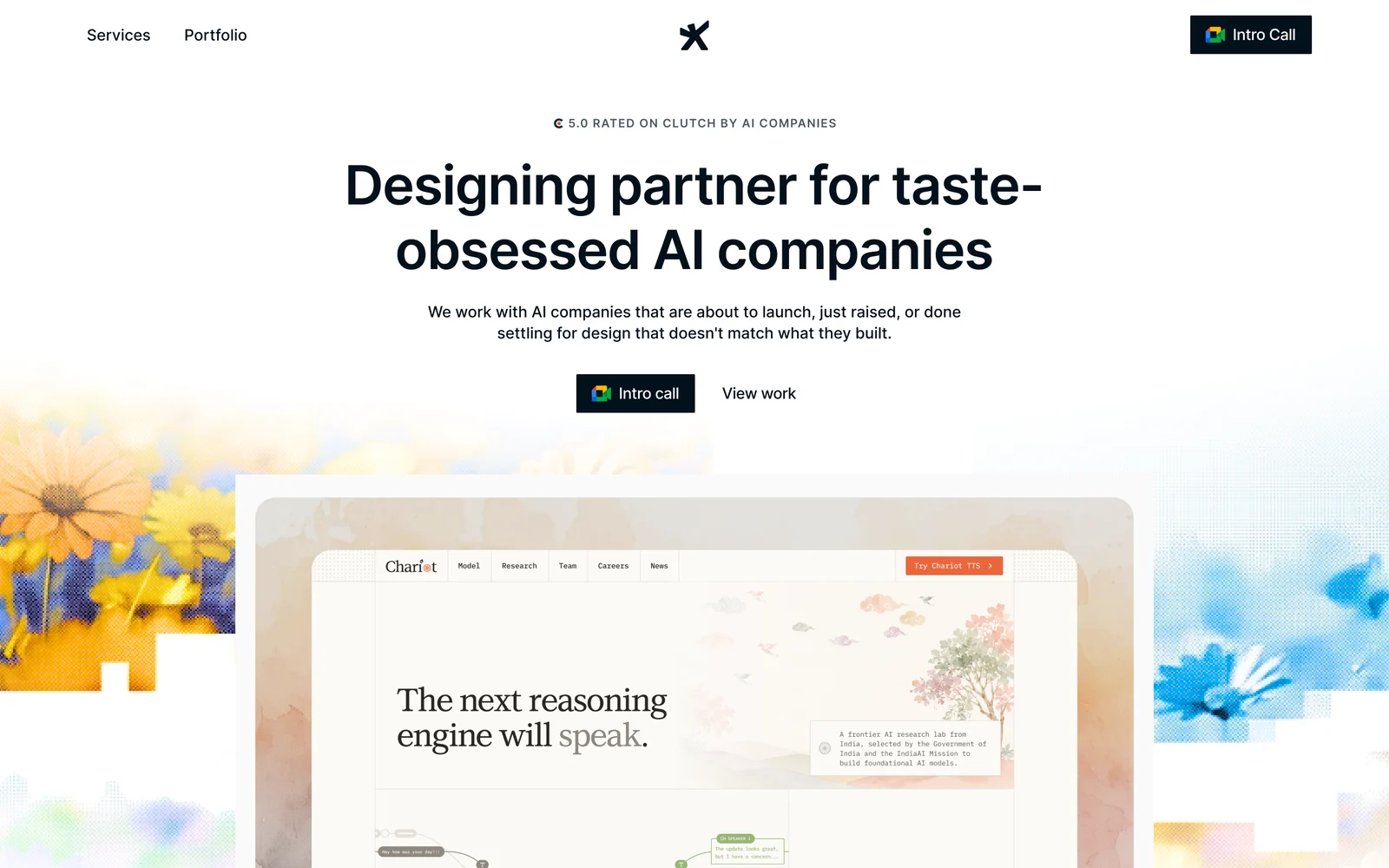
Studio Maydit is a web and product design studio working with AI founders in the US, UK, and Europe. What matters for a devtool brief is that the engagement does not stop at the website. Sites are built in Framer, Webflow, or custom code depending on how often they change, and the work then continues into product design, which is where consoles, logs, and error states get made.
The published outcome is Dualite, where design work supporting a repositioned ICP helped the product reach 100,000+ users in seven months. The order is the useful part for a devtool team: the decision about which users to stop serving came before the screens, and a console designed for both the solo builder and the platform team ends up awkward for each. Recent clients include Wave, PixelFlow, Mi-VAD, and 15 other AI and SaaS teams.
Devtools tend to grow a screen per release, so the arrangement that fits most often is the monthly retainer, which covers new pages, campaigns, and product design and carries no long lock-in. Where a date is already fixed, the alternative is a fixed scope running three to four weeks, closing with a written diagnosis of what is leaking in the product rather than a handover call.
| Check | Finding |
|---|---|
| Based in | Remote, serving US / UK / EU |
| Platform depth | Framer, Webflow, and custom code |
| AI-sector proof | Yes. AI-native clients, published outcome on Dualite |
| Pricing | Fixed scope or monthly retainer, quoted per project |
| Team shape | Founder-led, small senior team |
| Best fit | Devtool teams whose console and docs are read in the same session |
Worth a call if your support queue is answering questions your error messages should. Book a 30-minute call.

2. SuperSkills
SuperSkills is a one to ten person studio in Walnut Creek with published AI client work and The Cut named. A devtool scope is usually one console, one flow, and a set of states, which is the size of work a small studio does well and a large one struggles to price sensibly.
The record is thin. One named client, no founding year, and no starting figure, so the evaluation happens in conversation rather than beforehand. A team that size also has no cover if your project collides with someone else's deadline.
| Check | Finding |
|---|---|
| Based in | Walnut Creek, USA |
| Founded | Not published |
| Team size | 1-10 |
| Primary platform | Mixed |
| AI-sector proof | Yes. Published AI client work |
| Named clients | The Cut |
| Pricing | Not published |
| Best fit | A single console or flow that needs designing properly, once |
3. Clay
Clay has designed from San Francisco since 2016 at fifty-one to two hundred people, across platforms, publishing a starting figure and AI client work, and naming Slack, Stripe, Google, Coinbase, and Amazon. Stripe is the most useful reference on this page, because it is the product most devtools are quietly benchmarked against by their own users.
The size brings an account layer and a rate built for larger engagements, the practice spans platforms rather than specialising in application interfaces, and a small console scope is unlikely to attract their most senior people.
| Check | Finding |
|---|---|
| Based in | San Francisco, USA |
| Founded | 2016 |
| Team size | 51-200 |
| Primary platform | Mixed |
| AI-sector proof | Yes. Published AI client work |
| Named clients | Slack, Stripe, Google, Coinbase, Amazon |
| Pricing | Published minimum |
| Best fit | Funded devtool teams rebuilding a console at real scale |
4. Fantasy
Fantasy has run from San Francisco and New York since 1999, across platforms, with published AI client work. A quarter century of practice means they have watched several interface conventions arrive and be abandoned, which is a useful corrective when your team is arguing about whether the playground should be chat-shaped.
Nothing much can be checked in advance. No client names, no team size, and no starting figure are published. The vintage also implies a process sized for organisations rather than for a devtool team shipping fortnightly.
| Check | Finding |
|---|---|
| Based in | San Francisco and New York, USA |
| Founded | 1999 |
| Team size | Not published |
| Primary platform | Mixed |
| AI-sector proof | Yes. Published AI client work |
| Named clients | Not published |
| Pricing | Not published |
| Best fit | Teams wanting a considered view before committing to a direction |
5. Foundey
Foundey is a San Francisco studio founded in 2021 working Figma-only, with published AI client work and DemandIQ, Traycer, and Sero AI named. Traycer and Sero AI are young technical products, so the studio is working on interfaces that are still being argued about, which is where a devtool console usually is.
Figma-only means the studio hands over files and your engineers do everything after that, which is efficient if you have frontend capacity and a bottleneck if you do not. No team size or starting figure is published, so both have to be established before you can plan around them.
| Check | Finding |
|---|---|
| Based in | San Francisco, USA |
| Founded | 2021 |
| Team size | Not published |
| Primary platform | Figma-only |
| AI-sector proof | Yes. Published AI client work |
| Named clients | DemandIQ, Traycer, Sero AI |
| Pricing | Not published |
| Best fit | Devtool teams with frontend engineers who need screens, not a build |
6. Lazarev
Lazarev has worked from San Francisco since 2015 at fifty-one to two hundred people, across platforms, publishing a starting figure and AI client work, and naming Payoneer, Peel, Elva, and Mozayix. Payoneer is a product with money, permissions, and audit requirements, and those are exactly the mechanics a devtool has to add the first time an enterprise evaluates it.
That headcount brings an assigned team and coordination overhead, the practice is broad rather than specialised in developer interfaces, and the price assumes an engagement longer than one console.
| Check | Finding |
|---|---|
| Based in | San Francisco, USA |
| Founded | 2015 |
| Team size | 51-200 |
| Primary platform | Mixed |
| AI-sector proof | Yes. Published AI client work |
| Named clients | Payoneer, Peel, Elva, Mozayix |
| Pricing | Published minimum |
| Best fit | Devtools adding roles, billing, and audit to an existing console |
7. Ramotion
Ramotion has worked from San Francisco since 2009 at eleven to fifty people, across platforms, publishing a starting figure and naming Mozilla, Okta, Netflix, Adobe, and Xero. Okta is an identity product, which means the studio has designed the least glamorous and most consequential parts of software, the screens where somebody decides who is allowed to do what.
Their AI-sector proof is partial with no AI case study, so the specifics of model behaviour would be new ground. A sixteen-year practice also carries a rate and a process that assume more scope than a focused devtool brief.
| Check | Finding |
|---|---|
| Based in | San Francisco, USA |
| Founded | 2009 |
| Team size | 11-50 |
| Primary platform | Mixed |
| AI-sector proof | Partial. Enterprise and SaaS clients, no AI case study |
| Named clients | Mozilla, Okta, Netflix, Adobe, Xero |
| Pricing | Published minimum |
| Best fit | Devtools where access control is the next thing to get right |
8. Pixelmatters
Pixelmatters has worked from Porto since 2013 at fifty-one to two hundred people, across platforms, publishing a starting figure and naming Rubrik, Quantic, and UJET. Rubrik is infrastructure software with dense operational screens, and a studio comfortable there will not flinch at a request log with fourteen columns.
Their AI-sector proof is partial with no published AI case study. The headcount also means a process and a minimum engagement scaled for larger programmes than a single console redesign.
| Check | Finding |
|---|---|
| Based in | Porto, Portugal |
| Founded | 2013 |
| Team size | 51-200 |
| Primary platform | Mixed |
| AI-sector proof | Partial. Enterprise and SaaS clients, no AI case study |
| Named clients | Rubrik, Quantic, UJET |
| Pricing | Published minimum |
| Best fit | Devtools with dense operational screens and a lot of data on view |
9. Instrument
This Portland agency has run since 2005, works across platforms, and names Nike, Microsoft, Electronic Arts, and Google. Two decades at that level means real craft, and the Microsoft work in particular sits inside an organisation with serious constraints, which is not nothing.
For a devtool console it is still the wrong shape. No team size or starting figure is published, the AI-sector proof is partial, and the published work is brand and campaign rather than application interface. You would be buying reputation and hoping the relevant skill is in there.
| Check | Finding |
|---|---|
| Based in | Portland, USA |
| Founded | 2005 |
| Team size | Not published |
| Primary platform | Mixed |
| AI-sector proof | Partial. Enterprise clients, no AI case study |
| Named clients | Nike, Microsoft, Electronic Arts, Google |
| Pricing | Not published |
| Best fit | Companies whose next problem is brand rather than the console |
10. Feels Like
Feels Like is a Los Angeles studio founded in 2023 working in custom code, with published AI client work and Google, Nike, LVMH, and Suno AI named. Suno AI is a product where the interface had to make something unfamiliar feel obvious, and that instinct has some value if your playground is the first thing new users touch.
The studio is young with a short record, no team size or starting figure is published, and the practice is custom code for brand-led work. A console with permissions, logs, and quota states is a long way from the published portfolio.
| Check | Finding |
|---|---|
| Based in | Los Angeles, USA |
| Founded | 2023 |
| Team size | Not published |
| Primary platform | Custom code |
| AI-sector proof | Yes. Published AI client work |
| Named clients | Google, Nike, LVMH, Suno AI |
| Pricing | Not published |
| Best fit | Teams whose playground needs to feel inviting to a first-time user |
How to choose between them
Sort by which screen is costing you, not by which portfolio reads best.
Support answers questions your interface should. Studio Maydit or Foundey.
An enterprise asked about roles and you had no answer. Ramotion or Lazarev.
The dashboard exists and nobody opens it. Studio Maydit or Pixelmatters.
Your playground loses people in the first minute. Clay or SuperSkills.
One test before you sign. Send three studios a screenshot of your most common error state and ask each what they would change. A studio that has designed for developers will rewrite the message, name what is missing, and say where the fix instruction belongs. A studio that has not will discuss the colour of the alert. It costs them twenty minutes and it settles the shortlist faster than any portfolio review.