Reading time:
14 min read
Last updated:
10 Best UX Design Agencies for AI Healthtech Startups - September 2026
UX design agencies for AI healthtech startups: ten studios compared on product depth, regulated-sector proof, team shape, and whether they publish a price.

Need UX design for an AI healthtech product in 2026? These ten studios are worth comparing, in ranked order: Studio Maydit, Lazarev, Pixelmatters, Ramotion, Clay, Phantom, Fantasy, Foundey, Feely Studio, and SuperSkills. Lazarev is the strongest competitor here. It starts with research, and its Payoneer work shows it can design for a buyer who reads every screen for risk. Pixelmatters is a close second, a Porto team of 51 to 200 whose client Rubrik lives in data security, where proof matters more than polish. At the other end, Feely Studio and SuperSkills are the wrong fit. Both are teams of 1 to 10, and clinical product work runs longer and heavier than a small studio can carry.
In most software, a screen is judged by whether people use it. In clinical software, a screen can also be judged months later, by someone who was not there.
Picture the night something goes wrong. A model flagged a patient as low risk. A nurse accepted the flag. Weeks later, a review board sits down to rebuild what happened. They do not read your code first. They ask what the nurse saw. Which words were on the screen? Was the model's doubt visible? Could she have overridden it in one tap, or did it take four?
That review is where your interface becomes evidence. A label that said "Cleared" instead of "Low risk, review if symptoms change" is now a decision your company made.
Most UX agencies design for the demo, where every patient is typical, every record is complete, and nothing fails. Healthtech needs a studio that designs for the review board too.
As you read the entries below, keep asking one thing: would this studio's screens hold up if a stranger had to explain them after the fact?

How we picked these agencies
The list comes from public evidence only. No studio paid, pitched, or filled in a form to be here. We studied each studio's website and published work, then scored five things any founder can check in an afternoon:
Platform depth. Can the studio design real product interfaces, with states, errors, and edge cases, rather than only marketing pages? Clinical tools live in their edge cases.
Regulated or clinical proof. Named clients whose buyers read software for risk, such as finance, identity, or data security. No studio here publishes a named hospital client, so we looked for the nearest match: work where a wrong screen has a legal or safety cost.
Pricing transparency. Whether the studio publishes a minimum at all. Health startups often budget grant by grant, and an early figure saves a wasted call.
Team shape. Size and continuity. Clinical products take many rounds of review, and a studio needs enough people to keep the same faces on your project from start to finish.
The agency's own website. The one piece of work no client shaped.
That last check is quick. A studio's own site is made with full freedom and its own money on the line. So it shows the ceiling of the team's care, including how it treats small text, contrast, and accessibility, which clinical users will depend on.
How we sourced the facts: every row in every table traces to the studio's own site or a public directory listing, and nothing else. If a studio keeps a detail private, the table says "Not published." We did not guess team sizes, dates, or client names to fill a gap.
What goes wrong when AI healthtech startups hire UX agencies
Three failures come up far more than any others in this field.
The audit trail is designed last. Every time a clinician accepts, edits, or rejects a model suggestion, someone will later need to see it. Agencies treat this record as a log table for engineers to build. Then a compliance review asks who changed what and when, and the answer is buried in a database nobody can read. The clinician who made the call cannot even find it again the next morning. The trail belongs in the design from week one, visible to the people who need it.
Testing happens with the wrong people. Clinicians are hard to book, so the agency tests with staff, friends, or a product manager playing a nurse. Those testers read every word and have time to think. A real nurse has thirty seconds and four other alarms. The design passes every test and fails on the ward. Buttons are too small for gloved hands, key text sits below the fold, and the one warning that matters looks like every other notice on the screen.
Consent and data screens are handed to legal. The screens where patients agree to share data, or where clinicians see what the model used, get treated as paperwork. Counsel writes the text and engineering pastes it in. Patients skip it, clinicians distrust it, and the one screen that builds trust in an AI product is the least designed part of it.
1. Studio Maydit: A Top-Rated Design Agency for AI Founders
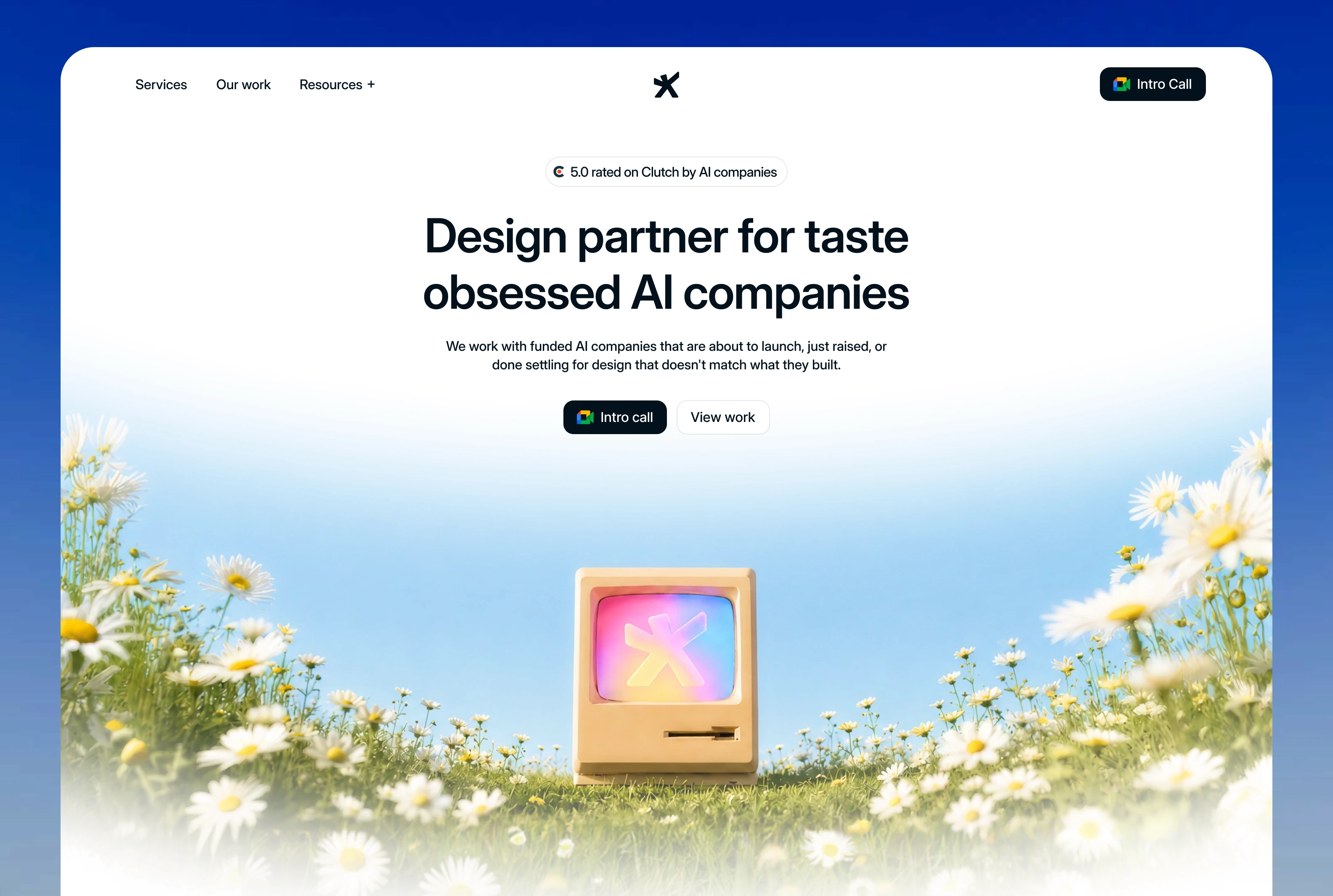
AI founders in the US, UK, and Europe hire Studio Maydit for two jobs that usually go to two vendors. It is a web and product design studio, so the website that wins a pilot and the product that has to survive it are designed by the same people. Framer covers a site the clinical or marketing lead can update without a developer. Webflow fits a larger content site with evidence pages and resources. Custom code serves screens that must sit inside a real product with real data rules.
Healthtech buyers ask for outcomes, not mockups. The clearest one here comes from outside health. After design work supporting a repositioned ICP, Dualite grew to 100,000+ users within seven months. That lesson carries over, since many AI health products only find their true buyer after the first pilot. Recent clients include Wave, PixelFlow, Mi-VAD, and 15 other AI and SaaS teams.
Most health teams work to a pilot start date, so fixed scope often comes first. It runs three to four weeks and ends with a diagnosis of what is leaking in the product, from drop-off in onboarding to screens clinicians skip. After that, a monthly retainer covers new pages, campaigns, and product design as the pilot turns into a rollout, with no long lock-in.
Check | Finding |
|---|---|
Based in | Remote, serving US / UK / EU |
Platform depth | Framer, Webflow, and custom code |
AI-sector proof | Yes. AI-native clients, published outcome on Dualite |
Pricing | Fixed scope or monthly retainer, quoted per project |
Team shape | Founder-led, small senior team |
Best fit | AI health teams heading into a first pilot who need the site and the clinical product designed together |
If a pilot is on the calendar and the product is not ready for it, talk it through with us. Book a 30-minute call.

2. Lazarev
Lazarev is a San Francisco product studio of 51 to 200 with published AI work, a published starting price, and clients including Payoneer, Peel, Elva, and Mozayix. It leads with user research, which is the right instinct in health, where the user and the buyer rarely agree. Payoneer is the useful reference: a money product with compliance checks, risk review, and users who need to trust every step.
Lazarev has no named health client, so clinical workflow will be new ground. Its size also means you should confirm which senior people stay on your project.
Check | Finding |
|---|---|
Based in | San Francisco, USA |
Founded | 2015 |
Team size | 51-200 |
Primary platform | Mixed |
AI-sector proof | Yes. Published AI client work |
Named clients | Payoneer, Peel, Elva, Mozayix |
Pricing | Published minimum |
Best fit | AI health teams who need research with clinicians before any screen is drawn |
3. Pixelmatters
Pixelmatters is a Porto studio founded in 2013, with 51 to 200 people and a published starting price. Its clients include Rubrik, Quantic, and UJET. Rubrik protects company data, so its product has to make risk and recovery clear to careful, anxious users. That is close to what a clinician feels when a model flags a patient. Being in Europe also helps teams selling into UK and EU health systems, where data rules shape the product from the first screen.
Its AI proof is partial. Expect to explain how models behave, and how your product shows doubt, early in the project.
Check | Finding |
|---|---|
Based in | Porto, Portugal |
Founded | 2013 |
Team size | 51-200 |
Primary platform | Mixed |
AI-sector proof | Partial. Tech and SaaS clients, no AI case study |
Named clients | Rubrik, Quantic, UJET |
Pricing | Published minimum |
Best fit | Health teams selling into Europe who need a steady, well-staffed product partner |
4. Ramotion
Ramotion has worked from San Francisco since 2009 with a team of 11 to 50 and a published starting price. Its clients include Mozilla, Okta, Netflix, Adobe, and Xero. Okta is the key name. Identity software is all about who may see what, which is the same question behind patient records, role access, and clinician logins. A studio that has made permissions clear for Okta users can make them clear for a hospital IT team.
AI work is partial here too. The model side, such as showing confidence and designing overrides, will be less familiar to them than the access side.
Check | Finding |
|---|---|
Based in | San Francisco, USA |
Founded | 2009 |
Team size | 11-50 |
Primary platform | Mixed |
AI-sector proof | Partial. Tech and SaaS clients, no AI case study |
Named clients | Mozilla, Okta, Netflix, Adobe, Xero |
Pricing | Published minimum |
Best fit | Health products where roles, permissions, and record access are the hardest screens |
5. Clay
Clay is a San Francisco studio of 51 to 200 with a published starting price and clients such as Slack, Stripe, Google, Coinbase, and Amazon. Stripe and Coinbase sell into regulated money markets, where every screen can end up in front of an auditor. For a health startup growing into several products, Clay can build a system that keeps every team's screens consistent.
Clay is premium, and a seed-stage health startup will be one of its smallest clients. A single triage flow may be too small a brief for it, and its public work shows no clinical product yet.
Check | Finding |
|---|---|
Based in | San Francisco, USA |
Founded | 2016 |
Team size | 51-200 |
Primary platform | Mixed |
AI-sector proof | Yes. Published AI client work |
Named clients | Slack, Stripe, Google, Coinbase, Amazon |
Pricing | Published minimum |
Best fit | Funded health companies with several products that need one design system |

6. Phantom
Phantom works in custom code from London and Auckland, with a team of 51 to 200 and clients including Diageo, SAP, the Financial Times, and Zendesk. For a UK health startup, a London studio that designs and builds in one place can shorten the loop between a clinician's feedback and a working screen.
It publishes no pricing, and its public work leans toward large brands and publishing rather than clinical or regulated tools. Ask to see a dense, data-heavy product screen before you commit.
Check | Finding |
|---|---|
Based in | London, UK and Auckland, NZ |
Founded | 2013 |
Team size | 51-200 |
Primary platform | Custom code |
AI-sector proof | Yes. Published AI client work |
Named clients | Diageo, SAP, Financial Times, Zendesk |
Pricing | Not published |
Best fit | UK health teams who want design and front-end code from the same studio |
7. Fantasy
Fantasy has run since 1999 from San Francisco and New York, and it puts AI strategy beside product and brand. A health founder still deciding what the model should recommend, and what it must leave to a clinician, may need that strategy talk before any design.
It publishes no clients, no team size, and no pricing. For a buyer who must justify every vendor to a compliance lead, that is hard to defend. Expect a paid discovery phase before you see a single flow.
Check | Finding |
|---|---|
Based in | San Francisco and New York, USA |
Founded | 1999 |
Team size | Not published |
Primary platform | Mixed |
AI-sector proof | Yes. Published AI client work |
Named clients | Not published |
Pricing | Not published |
Best fit | Founders setting the line between model advice and clinical judgment |
8. Foundey
Foundey is a San Francisco studio founded in 2021 that works only with early AI companies, such as DemandIQ, Traycer, and Sero AI. It designs in Figma and moves quickly, which suits a health startup still testing what its product even is. Early AI products change shape month to month, and that is the only kind of client it lists.
Speed is also the risk. Clinical products need slow, careful review, and Foundey publishes no health work, no team size, and no pricing.
Check | Finding |
|---|---|
Based in | San Francisco, USA |
Founded | 2021 |
Team size | Not published |
Primary platform | Figma-only |
AI-sector proof | Yes. Published AI client work |
Named clients | DemandIQ, Traycer, Sero AI |
Pricing | Not published |
Best fit | Pre-pilot health founders exploring product ideas before any clinical rollout |
9. Feely Studio
Feely Studio is a distributed European team of 1 to 10 with published AI work, clients such as Noxus, Mutiny, Luasai, and Basic Capital, and a published starting price. The price and the AI familiarity make it a real option for a grant-funded team.
It ranks low because clinical UX needs many rounds of review with busy experts. A very small team has little slack when a hospital pushes a meeting back two weeks.
Check | Finding |
|---|---|
Based in | Distributed, Europe |
Founded | Not published |
Team size | 1-10 |
Primary platform | Mixed |
AI-sector proof | Yes. Published AI client work |
Named clients | Noxus, Mutiny, Luasai, Basic Capital |
Pricing | Published minimum |
Best fit | Early health teams on a tight budget who need one flow designed well |
10. SuperSkills
SuperSkills is a very small studio in Walnut Creek with published AI work and one public client, The Cut. It aims for finish above its price, which can lift an investor demo.
Clinical product design is the hardest possible fit for it. The work runs long, needs cover when someone is away, and demands a track record. SuperSkills publishes no pricing and has little public product work to judge.
Check | Finding |
|---|---|
Based in | Walnut Creek, USA |
Founded | Not published |
Team size | 1-10 |
Primary platform | Mixed |
AI-sector proof | Yes. Published AI client work |
Named clients | The Cut |
Pricing | Not published |
Best fit | Health founders who need one demo screen polished for a pitch |
How to choose between them
Start with the problem you can already see.
Clinicians try the tool once and stop. You need research on the ward before new screens. Lazarev, or Studio Maydit if the site and product both need work before a pilot.
Hospital IT keeps asking who can see what. That is an access problem. Ramotion or Pixelmatters.
You now have three products that look like three companies. You need a design system. Clay.
You are not sure what the model should decide. Settle that first. Fantasy, or Foundey if you are still pre-pilot.
Then run one test. Ask each studio to design the screen a clinician sees when the model is unsure, and to explain what that clinician can do next. A studio ready for health will talk about the next safe action. The rest will talk about colours.

Need more info?
Can't find your answer? Book a call and let's talk.
Continue Reading
10 Best Framer Design Agencies for AI Agent Startups - September 2026
What is the best Framer agency for an AI agent startup? Ten Framer studios ranked for agent products, with pricing, team size and AI work compared.

Siddarth Ponangi
10 Best Framer Design Agencies for Newly Funded Startups - September 2026
Your funding announcement is the biggest traffic day you will have all year. We checked 10 Framer agencies on five public criteria to see which can hit that date.
Siddarth Ponangi
10 Best Custom Code Website Development Agencies for AI Agent Startups - September 2026
AI web development agencies for agent startups. Which teams build custom coded sites a small team can still update weekly after launch.
Siddarth Ponangi