

Summarize with AI


The best UX design agencies for AI infrastructure companies in 2026 are Studio Maydit, Foundey, Fantasy, SuperSkills, Lazarev, Clay, Feely Studio, Instrument, Ramotion, and Pixelmatters. Studio Maydit and Foundey lead for this brief. Foundey works Figma-first from San Francisco with AI-native clients including DemandIQ, Traycer, and Sero AI, which means its hours go into product surfaces rather than marketing pages, and product surfaces are where an infrastructure company is actually judged. Instrument and Pixelmatters fit this brief least well. One is a Portland agency running since 2005 whose named clients are Nike, Microsoft, Electronic Arts, and Google, the other is a fifty-one to two hundred person Porto practice with partial AI proof and no published AI case study. Neither has shown work where the user was an on-call engineer reading a latency chart at two in the morning.
Your product has no screenshot worth taking, and your dashboard is the entire impression.
Infrastructure gets consumed through an API. There is no workflow to film, no satisfying before and after, no interface the customer spends their day inside by choice. What there is instead is a console they open when something needs checking, and a set of docs they read once and return to under pressure. Those two surfaces carry the whole experience of your company, and most teams treat them as engineering output rather than design work.
The buyer has usually decided before you get a say. An engineer evaluating a vector store, an inference endpoint, or an orchestration layer reads the docs, runs a benchmark, and forms a view. Design cannot argue them out of a latency number. What design can do is shorten the distance between signing up and the first call that returns something, and that distance is where most infrastructure companies quietly lose people.
Then there is the console. Built by engineers, it shows everything at once: throughput, error rate, token spend, region, queue depth, all at the same visual weight. Fine on a calm Tuesday. During an incident it is a wall, and the customer forms a lasting opinion of your company while hunting for one number inside it.
The last one is price. Usage-based billing is honest and almost impossible to plan against, and a rate per million tokens with no way to estimate a monthly bill sends a finance-conscious buyer to a competitor who did the arithmetic for them.
Read the ten below as a question about operational surfaces, not brand.

How we picked these agencies
Five checks, each one answerable from public material before anybody books a call.
- Platform depth. What do they actually make, and does it survive contact with an engineering team? A studio that hands over a Figma file and leaves is a different purchase from one that works inside a design system your engineers already maintain.
- Proof on technical products. Have they designed something where the user was a developer or an operator rather than a buyer? Infrastructure UX is a specific discipline. Dense state, unforgiving failure modes, and readers who resent being sold to.
- Pricing. Is a starting figure public? For a company used to publishing its own rate card, a studio that will not name a number is an early signal about how the rest of the engagement will be discussed.
- Team shape. Size and seniority decide how quickly a decision gets made and who is actually in the file. A dense console is not a task you delegate to a junior with a component library.
- Their own site. The one project where they were the client and nobody set the deadline.
For this brief, read a studio's own product pages the way an engineer reads docs. Look for whether they can explain something technical without either dumbing it down or hiding behind it. A studio that writes vaguely about complex work usually designs vaguely around it too.
Everything in the tables comes from what each studio publishes about itself. No directory listings, no third-party rankings, and no blank filled in with a reasonable guess. Where a studio has published nothing, the silence is recorded as the finding.
What goes wrong on AI infrastructure products
Three failures, and all three happen after the sale rather than before it.
Time to first success is nobody's job. The marketing team owns the site, engineering owns the API, and the stretch between them belongs to no one. So the new user gets a key, an example that assumes context they do not have, and a console that opens on an empty state with nothing to do. They close the tab meaning to come back. Most do not.
The console is a metrics dump. Every number an engineer thought worth exposing is on the page, arranged by when it was built rather than by when it is needed. Nothing is prioritised because prioritising means deciding what matters, and that decision is a design judgement nobody made. The result reads fine to the team who built it and is unusable to a customer under pressure.
The docs and the product disagree. Docs are written once at launch and drift, while the console gets shipped weekly. Six months later the naming in the docs no longer matches the naming in the interface, and a customer debugging at speed has to work out which one is lying. That is a design system problem wearing a documentation costume.
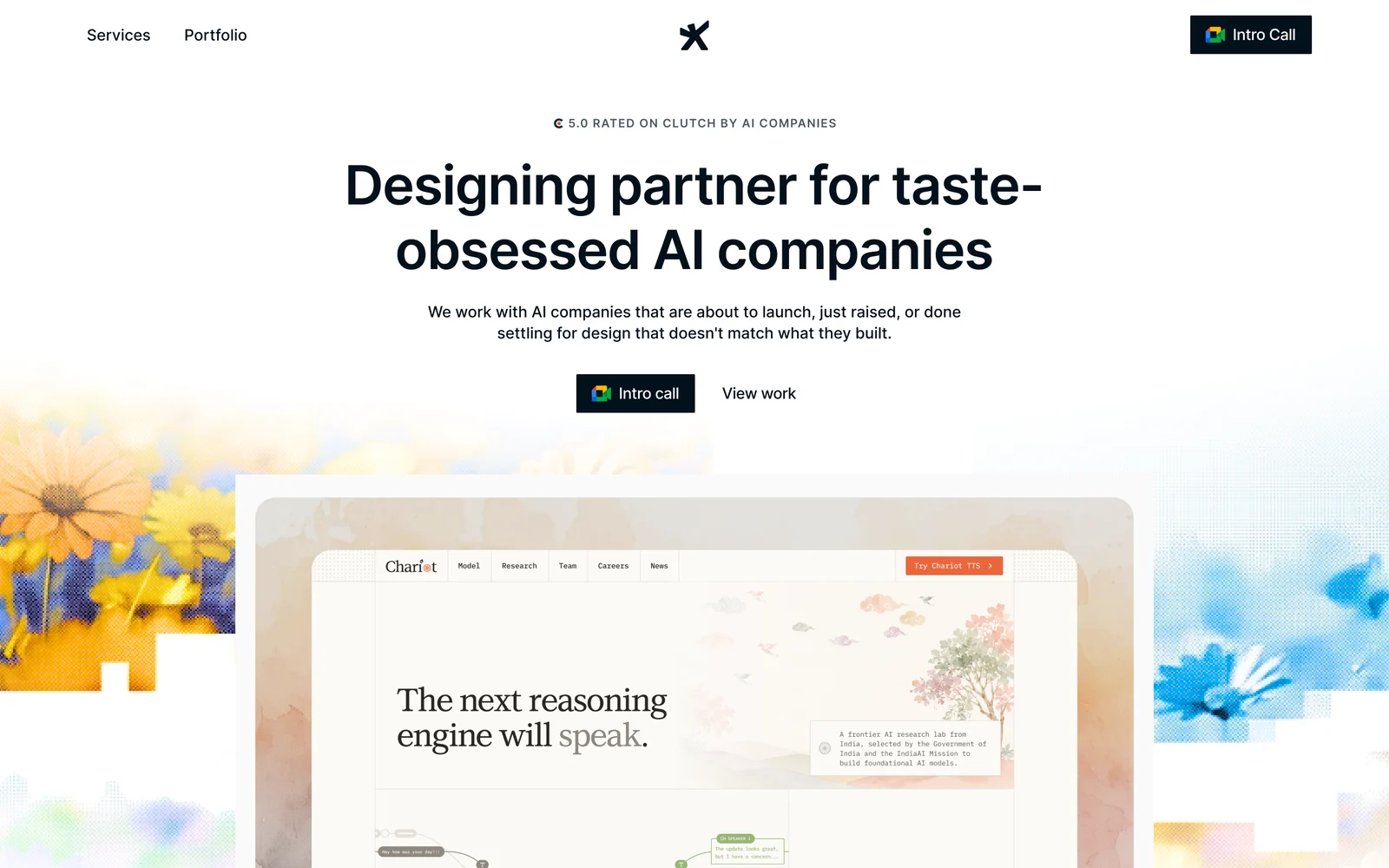
1. Studio Maydit: A Top-Rated Design Agency for AI Founders
Studio Maydit is a web and product design studio working with AI founders in the US, UK, and Europe. The part that matters for an infrastructure company is that the engagement does not stop at the marketing site. It continues into product design, which is where the console and the onboarding path live, and those are the surfaces that decide whether a new key ever becomes a customer.
Builds happen in Framer, Webflow, and custom code, chosen by who will own the thing afterwards rather than by preference. The published outcome is Dualite, where design work supporting a repositioned ICP helped the product reach 100,000+ users in seven months. The move that mattered was deciding precisely who the product was for and letting every surface say the same thing, which is the same discipline a dense console needs. Recent clients include Wave, PixelFlow, Mi-VAD, and 15 other AI and SaaS teams.
Two ways to buy. A monthly retainer suits a company whose console changes every sprint, covering new pages, campaigns, and product design with no long lock-in. Where there is a launch date, fixed scope runs three to four weeks and ends with a written diagnosis of what is leaking in the product rather than a handover email.
| Check | Finding |
|---|---|
| Based in | Remote, serving US / UK / EU |
| Platform depth | Framer, Webflow, and custom code |
| AI-sector proof | Yes. AI-native clients, published outcome on Dualite |
| Pricing | Fixed scope or monthly retainer, quoted per project |
| Team shape | Founder-led, small senior team |
| Best fit | Infrastructure teams whose console and onboarding are engineering output |
Worth a call if your signup rate looks healthy and your activation rate does not. Book a 30-minute call.

2. Foundey
Foundey has worked from San Francisco since 2021, Figma-only, with published AI client work and DemandIQ, Traycer, and Sero AI named. Figma-only sounds like a limitation and here it is closer to a specialisation. The studio's output is product design rather than marketing build, which is the correct half of the problem for a company whose front door is a console.
No team size and no starting figure are published, so the scale of the practice and the cost of entry both stay unknown until a call. A Figma-only studio also hands off to your engineers, which is fine if you have front-end capacity and a problem if you do not.
| Check | Finding |
|---|---|
| Based in | San Francisco, USA |
| Founded | 2021 |
| Team size | Not published |
| Primary platform | Figma-only |
| AI-sector proof | Yes. Published AI client work |
| Named clients | DemandIQ, Traycer, Sero AI |
| Pricing | Not published |
| Best fit | Infrastructure teams with front-end engineers who need design, not build |
3. Fantasy
Fantasy has run from San Francisco and New York since 1999, works across platforms, and publishes AI client work. Twenty-five years of product design means the studio has seen interfaces for complex systems long before the current wave, and complexity is the actual problem here rather than novelty.
The record is thin where it counts for a shortlist. No client names are published, no team size, and no starting figure, so there is very little to evaluate before a conversation. An agency of that vintage also tends to scope programmes rather than a console redesign.
| Check | Finding |
|---|---|
| Based in | San Francisco and New York, USA |
| Founded | 1999 |
| Team size | Not published |
| Primary platform | Mixed |
| AI-sector proof | Yes. Published AI client work |
| Named clients | Not published |
| Pricing | Not published |
| Best fit | Larger infrastructure companies running a full product design programme |
4. SuperSkills
SuperSkills is a one to ten person studio in Walnut Creek working across platforms, with published AI client work and The Cut named. At that size you get the senior people directly, which suits the kind of problem where one person holding the whole information architecture in their head produces a better console than a committee will.
Only one client is named and no founding year or starting figure is published, so the track record is hard to size. A team that small also has obvious capacity limits if your console and your docs need attention in the same quarter.
| Check | Finding |
|---|---|
| Based in | Walnut Creek, USA |
| Founded | Not published |
| Team size | 1-10 |
| Primary platform | Mixed |
| AI-sector proof | Yes. Published AI client work |
| Named clients | The Cut |
| Pricing | Not published |
| Best fit | Infrastructure teams wanting one senior designer on one focused surface |
5. Lazarev
Lazarev has designed from San Francisco since 2015 at fifty-one to two hundred people, across platforms, publishing a starting figure and AI client work, and naming Payoneer, Peel, Elva, and Mozayix. Payoneer is a payments product, which means dense state, real consequences for a misread number, and users who are working rather than browsing. That is the nearest thing on this list to console conditions.
Their platform work is mixed rather than deep in any one place, and the headcount brings an account layer and a minimum engagement sized for programmes. Expect process, and budget for it.
| Check | Finding |
|---|---|
| Based in | San Francisco, USA |
| Founded | 2015 |
| Team size | 51-200 |
| Primary platform | Mixed |
| AI-sector proof | Yes. Published AI client work |
| Named clients | Payoneer, Peel, Elva, Mozayix |
| Pricing | Published minimum |
| Best fit | Infrastructure companies rebuilding a console and a billing surface together |
6. Clay
Clay has worked from San Francisco since 2016 at fifty-one to two hundred people, across platforms, publishing a starting figure and AI client work, and naming Slack, Stripe, Google, Coinbase, and Amazon. Stripe is the reference point that matters here. It is a company whose product is an API and whose documentation and dashboard are widely treated as the standard, and a studio working near that has seen what good looks like on exactly this problem.
The size means an account structure and pricing set for larger engagements. The named clients are also mature companies with internal design teams, so the working model may assume more counterpart capacity than a thirty-person infrastructure startup has.
| Check | Finding |
|---|---|
| Based in | San Francisco, USA |
| Founded | 2016 |
| Team size | 51-200 |
| Primary platform | Mixed |
| AI-sector proof | Yes. Published AI client work |
| Named clients | Slack, Stripe, Google, Coinbase, Amazon |
| Pricing | Published minimum |
| Best fit | Funded infrastructure companies treating docs and console as one system |
7. Feely Studio
Feely Studio is a distributed European team of one to ten people working across platforms, publishing a starting figure and AI client work, and naming Noxus, Mutiny, Luasai, and Basic Capital. Noxus is an AI-native company, and a studio of this size means the person you meet is the person in the file, which shortens the loop on a surface that needs many small decisions rather than one big one.
No founding year is published and the team is small, so a console redesign running alongside a docs overhaul would stretch it. Distributed also means the working hours depend on who is assigned, which is worth pinning down before you start.
| Check | Finding |
|---|---|
| Based in | Distributed, Europe |
| Founded | Not published |
| Team size | 1-10 |
| Primary platform | Mixed |
| AI-sector proof | Yes. Published AI client work |
| Named clients | Noxus, Mutiny, Luasai, Basic Capital |
| Pricing | Published minimum |
| Best fit | European infrastructure teams wanting senior attention on one surface |
8. Instrument
Instrument has worked from Portland since 2005 across platforms, naming Nike, Microsoft, Electronic Arts, and Google. Two decades at that level is genuine craft, and a company planning a brand programme alongside its product work would get something real from the conversation.
For an infrastructure brief it is the wrong shape. The named work is consumer and brand rather than operational, the AI-sector proof is partial with no published AI case study, and no team size or starting figure is published. Nothing here shows a dense interface designed for someone working under pressure.
| Check | Finding |
|---|---|
| Based in | Portland, USA |
| Founded | 2005 |
| Team size | Not published |
| Primary platform | Mixed |
| AI-sector proof | Partial. Enterprise clients, no AI case study |
| Named clients | Nike, Microsoft, Electronic Arts, Google |
| Pricing | Not published |
| Best fit | Infrastructure companies running a brand programme, not a console fix |
9. Ramotion
Ramotion has designed from San Francisco since 2009 at eleven to fifty people, across platforms, publishing a starting figure and naming Mozilla, Okta, Netflix, Adobe, and Xero. Okta is the useful signal. It is an identity product with an admin console that real operators live in, and designing that is closer to your problem than any marketing site would be.
Their AI-sector proof is partial with no published AI case study, so the specific language and failure modes of model infrastructure are not evidenced in the record. A practice of that age also tends to price for engagements longer than a single surface.
| Check | Finding |
|---|---|
| Based in | San Francisco, USA |
| Founded | 2009 |
| Team size | 11-50 |
| Primary platform | Mixed |
| AI-sector proof | Partial. Enterprise and SaaS clients, no AI case study |
| Named clients | Mozilla, Okta, Netflix, Adobe, Xero |
| Pricing | Published minimum |
| Best fit | Infrastructure teams redesigning an admin or permissions console |
10. Pixelmatters
Pixelmatters has worked from Porto since 2013 at fifty-one to two hundred people, across platforms, publishing a starting figure and naming Rubrik, Quantic, and UJET. Rubrik is enterprise data infrastructure, which is a genuinely technical product with an operational interface, and that is the most on-brief reference in the set.
Their AI-sector proof is partial with no published AI case study. The headcount brings a process and a minimum engagement scaled for programmes rather than one console, and Porto leaves a US team a shared window that ends early in the American afternoon.
| Check | Finding |
|---|---|
| Based in | Porto, Portugal |
| Founded | 2013 |
| Team size | 51-200 |
| Primary platform | Mixed |
| AI-sector proof | Partial. Enterprise and SaaS clients, no AI case study |
| Named clients | Rubrik, Quantic, UJET |
| Pricing | Published minimum |
| Best fit | Infrastructure companies wanting one European team for design and build |
How to choose between them
Sort by which surface is losing you customers, not by which portfolio looked best.
People sign up and never make a successful call. Studio Maydit or Foundey.
The console is unreadable during an incident. Lazarev or Ramotion.
Docs and product have drifted apart. Clay or Pixelmatters.
You have front-end engineers and only need the design. Foundey or SuperSkills.
One test before you sign. Give three studios your quickstart and your console, and ask each one what they would change so a new user reaches a first successful response faster. A studio that understands infrastructure will talk about the empty state, the example that assumes too much, and the one number the console buries. A studio that does not will talk about the visual language of the dashboard. Both answers are honest. Only one of them is about your problem.