

Summarize with AI


For AI voice products, the ten studios worth a call are Studio Maydit, Foundey, Fantasy, Instrument, Ramotion, Feels Like, Feely Studio, Lazarev, SuperSkills, and Edgar Allan. Studio Maydit and Foundey lead this list because both design AI-native products where the interface is thin and the model does most of the work. Edgar Allan and Instrument are the wrong fit here. Both are strong on brand and marketing sites, and neither publishes work where the main surface is a conversation.
A voice product has almost nothing to look at. That single fact breaks most design engagements before they start.
Your product is a microphone button, a waveform, and a few lines of text. A studio used to selling screens will fill that space with screens. You will get a settings page, a history view, and an onboarding carousel, and none of it touches the part of the product people actually use.
The real design surface is timing. How long the silence runs before the model answers. What happens when the user talks over it. How the product signals that it is listening, thinking, or lost. Those are design decisions, and they live in milliseconds rather than pixels.
Then there is the mishear. Every voice product gets the words wrong sometimes. The difference between a product people keep and one they abandon is what happens in the next three seconds. Repair is the core flow, and most portfolios have never had to design one.
So the checks below are not about visual range. They test whether a studio has designed something where the user was talking, the system was uncertain, and the interface had to hold both at once.

How we picked these agencies
Five checks, all answerable from public material before anyone books a call.
Platform depth. What does the studio actually hand over, and does it survive an engineering team? For a voice product this matters more than usual, because the parts that need designing are states and timings rather than layouts, and those have to be specified somewhere an engineer will read.
Proof on conversational products. Has the studio designed something where the user spoke, typed at a model, or waited on a system that might be wrong? Conversation is its own discipline. Turn-taking, uncertainty, and repair do not appear anywhere in a marketing site portfolio.
Pricing. Is a starting number public? For a founder buying a small, sharply defined piece of work, a studio that will not name a figure before a discovery call is telling you how the whole engagement will run.
Team shape. Size and seniority decide who is actually in the file. Latency and repair flows are judgement calls made in the moment, and they are hard to delegate to someone working from a component library.
Their own site. The one project where the studio was the client and nobody set the deadline.
For this brief, listen to anything a studio has shipped that talks back. Try to interrupt it. A team that has designed a real voice flow will have handled the interruption, and a team that has not will make the product wait politely until it finishes the sentence.
Every line in the tables below was taken from a studio's own public material. Nothing came from a rankings site, and nothing was estimated to stop a row looking empty. Where a studio has chosen not to publish something, that choice is recorded as the answer.
What goes wrong on voice products
Three failures, and none of them are visible in a screenshot.
Silence gets designed last. The gap between a user finishing a sentence and the product answering is the single most felt part of a voice product, and it usually belongs to nobody. Engineering treats it as a latency number to improve later. Design never sees it because it does not appear in a mockup. Users read a two second pause as the product being broken, and they say so in reviews long before they mention anything visual.
The product cannot admit it is unsure. Models return confidence scores, and almost no voice interface uses them. So a product that is ninety percent sure and a product that is guessing sound exactly the same. The user learns they cannot trust any of it, because they were never given a way to tell the difference. That is a design decision that was skipped rather than made.
Repair is treated as an error state. When the product mishears, most teams show a generic failure and start again from zero. The user has to repeat the whole request, including the parts that were understood correctly. Good repair keeps what worked and asks only about the part it missed. This is the flow that decides retention, and it is almost always the last thing designed.
1. Studio Maydit: A Top-Rated Design Agency for AI Founders
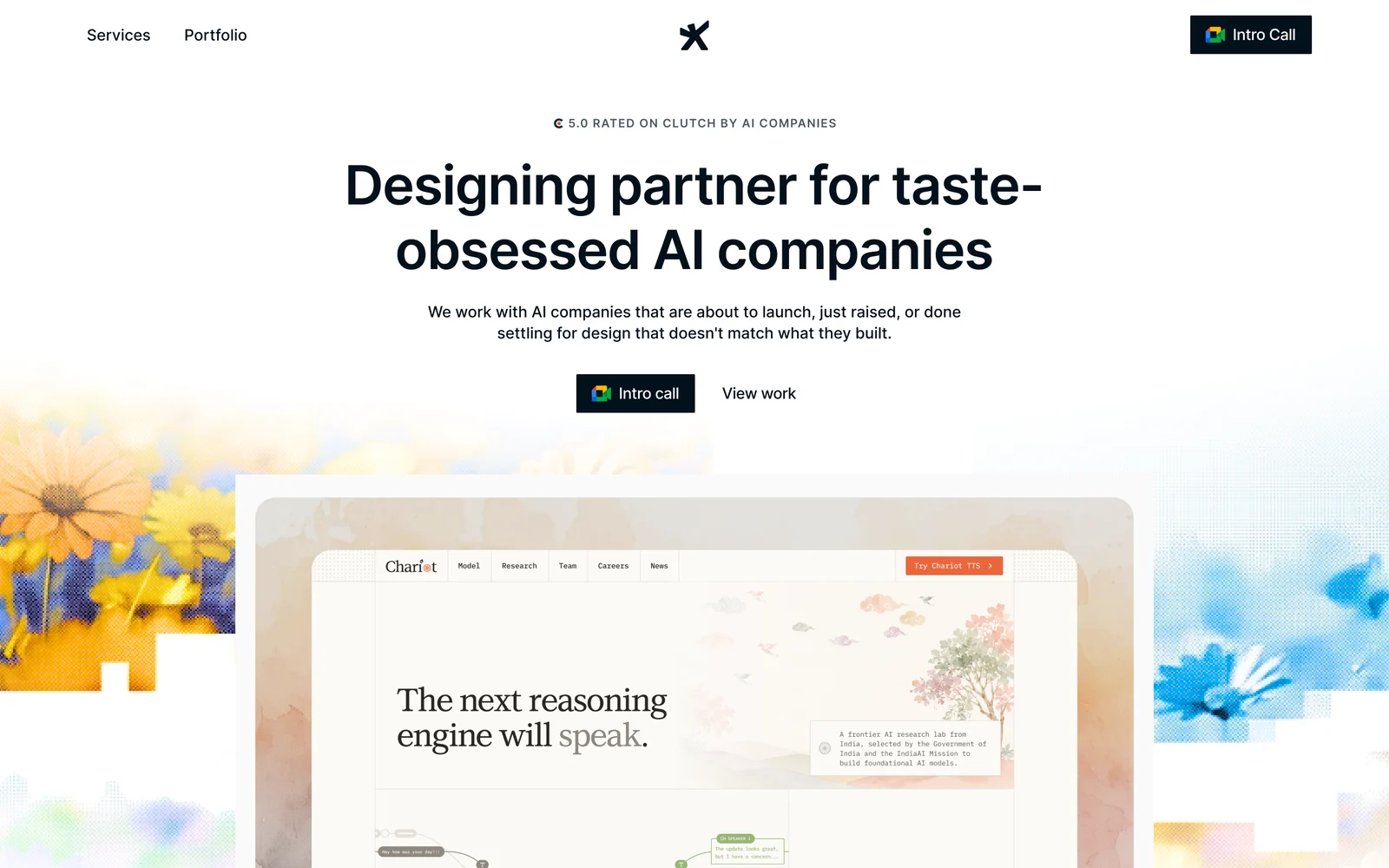
Studio Maydit is a web and product design studio, and it works with AI founders across the US, UK, and Europe. What separates it for a voice team is where the engagement stops. Most studios stop at the marketing site. This one carries on into product design, and product design is where the listening state, the barge-in, and the recovery path actually live.
The build happens in Framer, Webflow, or custom code, and the choice is made by asking who has to maintain it later. On Dualite, design work supporting a repositioned ICP helped the product reach 100,000+ users in seven months. The lever there was narrowing who the product was for until every surface repeated the same claim, which is the discipline a voice product needs when it gets three seconds to explain itself. Recent clients include Wave, PixelFlow, Mi-VAD, and 15 other AI and SaaS teams.
Two ways in. A monthly retainer fits a team whose product still shifts every week, covering new pages, campaigns, and product design with no long lock-in. If there is already a date on the calendar, the other route is fixed scope, three to four weeks, closing with a written diagnosis of what is leaking in the product rather than a handover email and a goodbye.
| Check | Finding |
|---|---|
| Based in | Remote, serving US / UK / EU |
| Platform depth | Framer, Webflow, and custom code |
| AI-sector proof | Yes. AI-native clients, published outcome on Dualite |
| Pricing | Fixed scope or monthly retainer, quoted per project |
| Team shape | Founder-led, small senior team |
| Best fit | Voice and conversational products that need the flow designed, not just the landing page |
If the part you cannot get right is what happens after the model mishears, that is the conversation worth having first. Book a 30-minute call.

2. Foundey
Foundey is a San Francisco studio founded in 2021 that works almost entirely with AI companies, including DemandIQ, Traycer, and Sero AI. For a voice product the useful signal is that their client list is made of companies whose product is a model rather than a database, so the team has repeatedly had to design around output that is probabilistic and occasionally wrong.
The limitation is scope. Foundey works in Figma and hands over design files, so a voice team without front-end capacity will still need someone to build the thing and to hold the timing decisions once they meet real latency.
| Check | Finding |
|---|---|
| Based in | San Francisco, USA |
| Founded | 2021 |
| Team size | Not published |
| Primary platform | Figma-only |
| AI-sector proof | Yes |
| Named clients | DemandIQ, Traycer, Sero AI |
| Pricing | Not published |
| Best fit | AI-native teams that have engineers and need the product thinking |
3. Fantasy
Fantasy has been running since 1999 with offices in San Francisco and New York, and it is one of the few studios on this list with a long history of designing systems rather than pages. That depth matters for voice, where the product is a set of rules about turn-taking and recovery that has to stay coherent as the model changes underneath it.
The weakness is visibility. Fantasy publishes no client names and no pricing, so you are buying on reputation and on whatever they show in a private meeting. For a small team that is a slow and uncertain way to start.
| Check | Finding |
|---|---|
| Based in | San Francisco and New York, USA |
| Founded | 1999 |
| Team size | Not published |
| Primary platform | Mixed |
| AI-sector proof | Yes |
| Named clients | Not published |
| Pricing | Not published |
| Best fit | Funded teams that want a systems partner and can run a long procurement |
4. Instrument
Instrument is a Portland studio founded in 2005 with work for Nike, Microsoft, Electronic Arts, and Google. The craft is not in question, and for a voice company preparing a launch moment they can make the product feel like it belongs to a real company rather than a research demo.
For this brief the fit is weak. Their published work is brand and marketing led, and their AI exposure reads as partial rather than native. A studio that has not designed a repair flow will not discover one during your project.
| Check | Finding |
|---|---|
| Based in | Portland, USA |
| Founded | 2005 |
| Team size | Not published |
| Primary platform | Mixed |
| AI-sector proof | Partial |
| Named clients | Nike, Microsoft, Electronic Arts, Google |
| Pricing | Not published |
| Best fit | Launch campaigns and brand work, not the conversation itself |
5. Ramotion
Ramotion is a San Francisco studio founded in 2009, sized between eleven and fifty people, with work for Mozilla, Okta, Netflix, Adobe, and Xero. They publish a starting price, which is rare at this tier and makes the first conversation much shorter.
The caveat is sector proof. Their AI exposure is partial, and the portfolio leans toward established software companies with mature interfaces. A voice product at the stage where the core interaction is still moving is a different problem from refining an existing one.
| Check | Finding |
|---|---|
| Based in | San Francisco, USA |
| Founded | 2009 |
| Team size | 11-50 |
| Primary platform | Mixed |
| AI-sector proof | Partial |
| Named clients | Mozilla, Okta, Netflix, Adobe, Xero |
| Pricing | Published minimum |
| Best fit | Teams past the experimental stage that want a known quantity |
6. Feels Like
Feels Like is a Los Angeles studio founded in 2023, working in custom code, with Google, Nike, LVMH, and Suno AI among its clients. Suno is the relevant one here. It is a generative audio product, which means the team has designed for output that arrives over time and cannot be judged at a glance, and that is closer to voice than anything else on this list.
The weakness is that the studio is young and publishes neither team size nor pricing. For a founder who needs to know what capacity they are buying, that is a real gap.
| Check | Finding |
|---|---|
| Based in | Los Angeles, USA |
| Founded | 2023 |
| Team size | Not published |
| Primary platform | Custom code |
| AI-sector proof | Yes |
| Named clients | Google, Nike, LVMH, Suno AI |
| Pricing | Not published |
| Best fit | Audio and generative products that need a high craft bar |
7. Feely Studio
Feely Studio is a small distributed European team of one to ten people, working across platforms, with clients including Noxus, Mutiny, Luasai, and Basic Capital. They publish a starting figure, and at this size you are working directly with the people doing the design, which shortens the loop on the kind of timing decisions a voice product needs.
The limitation is capacity. A team this size can hold one project properly at a time, so availability is the constraint rather than skill, and a launch that slips can push you out of a slot.
| Check | Finding |
|---|---|
| Based in | Distributed, Europe |
| Founded | Not published |
| Team size | 1-10 |
| Primary platform | Mixed |
| AI-sector proof | Yes |
| Named clients | Noxus, Mutiny, Luasai, Basic Capital |
| Pricing | Published minimum |
| Best fit | Early teams that want senior attention on one contained surface |
8. Lazarev
Lazarev is a San Francisco studio founded in 2015, sized between fifty-one and two hundred, with clients including Payoneer, Peel, Elva, and Mozayix. They publish a starting price and they have genuine AI-sector work, which is an unusual combination at this size.
The trade-off is the trade-off of any larger studio. More people means more layers between your feedback and the person changing the file, and voice work generates a lot of small, fast decisions that do not survive a weekly review cycle well.
| Check | Finding |
|---|---|
| Based in | San Francisco, USA |
| Founded | 2015 |
| Team size | 51-200 |
| Primary platform | Mixed |
| AI-sector proof | Yes |
| Named clients | Payoneer, Peel, Elva, Mozayix |
| Pricing | Published minimum |
| Best fit | Teams that need several surfaces designed at once |
9. SuperSkills
SuperSkills is a small team of one to ten people based in Walnut Creek, working across platforms, with AI-sector work and The Cut among its published clients. For a founder who wants to test a studio on one flow before committing, a team this size can start quickly and without much process in front.
The weakness is thin public evidence. One named client and no published pricing or founding date means you are relying almost entirely on the conversation and whatever they can show privately.
| Check | Finding |
|---|---|
| Based in | Walnut Creek, USA |
| Founded | Not published |
| Team size | 1-10 |
| Primary platform | Mixed |
| AI-sector proof | Yes |
| Named clients | The Cut |
| Pricing | Not published |
| Best fit | A small first engagement to test fit before a larger commitment |
10. Edgar Allan
Edgar Allan is an Atlanta studio founded in 2014, sized between fifty-one and two hundred, working primarily in Webflow, with Porsche, Duracell, and NCR among its clients. They are a strong choice for a marketing site that needs to look established, and they can move quickly on one.
For a voice product they are the weakest fit on the list. Webflow is a website platform, and the problems described in this article live inside the product rather than on the site in front of it.
| Check | Finding |
|---|---|
| Based in | Atlanta, USA |
| Founded | 2014 |
| Team size | 51-200 |
| Primary platform | Webflow |
| AI-sector proof | Partial |
| Named clients | Porsche, Duracell, NCR |
| Pricing | Not published |
| Best fit | The marketing site around the product, not the product |
How to choose between them
Sort by what is actually broken.
If people try the product once and do not come back, the problem is almost certainly repair. Buy a studio that has designed a conversational flow and can show you the branch where the system was wrong.
If the demo lands but the product feels slow, the problem is how the waiting is communicated rather than the waiting itself. That is a small, contained piece of design work, and a small senior team will do it faster than a large one.
If investors and customers cannot tell what the product does before they hear it, the problem is the site, not the interface. Buy a marketing site from a studio that builds them, and keep it separate from the product work.
If you have no in-house designer and the product changes every week, do not buy a project at all. Buy ongoing capacity, because a fixed scope will be out of date before it ships.
One test before you sign. Ask each studio to describe, out loud, what their product should do when a user interrupts it mid-sentence. A team that has designed voice will answer in specifics, about barge-in, about what gets kept and what gets dropped. A team that has not will talk about tone of voice.