Reading time:
14 min read
Last updated:
10 Best UX Design Agencies for B2B AI SaaS Companies - September 2026
UX design agencies for B2B AI SaaS: ten studios compared on product design depth, named B2B clients, team size, and which ones publish a starting price.


The best UX design agencies for B2B AI SaaS companies in 2026 are Studio Maydit, Lazarev, Clay, Foundey, Ramotion, Fantasy, basement.studio, Feels Like, Feely Studio, and SuperSkills. Studio Maydit and Lazarev lead for teams who need the product interface designed rather than the marketing around it. Clay and Ramotion are the stronger choice when a design system has to hold across many screens and several teams.
B2B AI products have a user problem that consumer AI products do not: the person using it is not the person who bought it.
An admin chose the tool, configured the permissions, and set the policy. A different person uses it forty times a day and never saw the sales deck. A third person, often in security or operations, will eventually ask what the model did and why. Each needs a different view of the same system, and none of them can be designed for by imagining a single user.
Then the model adds its own complication. Outputs are probabilistic, so the interface has to communicate confidence, allow correction, and leave a trail, without turning every screen into a disclaimer.
That is product design work, not visual design work, and the distinction eliminates a lot of otherwise excellent studios.

How we picked these agencies
Public record only, no submissions. For each studio we read their own site and their published work, then checked five things you can verify before any conversation:
Product design depth. Published interface work with real screens and flows, not marketing sites with a product shot in the hero. These are different practices and a strong website studio is not automatically a strong UX studio.
B2B product proof. Named clients whose software has admin roles, permissions, and multiple seats. Designing for an organisation rather than an individual is the core skill here, and consumer work does not develop it.
Pricing. A published starting figure, or nothing until a call.
Team shape. Size, seniority, and whether design and engineering sit in the same studio or a handoff is coming.
Their own site. The single piece of work nobody made them compromise on.
That last one is a weaker signal for UX than for websites, since a studio's own site says little about how they handle a permissions matrix. We still use it, but for this list we weight published product work far more heavily.
Everything in the tables comes from each studio's own site or a public directory listing. Where a detail is not published, we mark it rather than fill it in.
What goes wrong when a B2B AI SaaS company hires a UX agency
Three failures, and the first is close to universal in this category.
The design assumes one user. A single well-crafted flow for the person who uses the product most, and nothing for the admin who configures it or the reviewer who audits it. Those roles then get built by engineers under deadline, which is why the admin section of most B2B AI products looks like it came from another company.
Model confidence gets designed as decoration. A percentage next to an output, or a coloured bar, with no answer to the only question the user has, which is what to do differently when the number is low. Confidence is only useful when it changes an available action. Otherwise it is noise that trains people to ignore it.
Empty states are designed for a product that already has data. Every B2B AI tool is useless on day one until it is connected, configured, and fed. Agencies design the populated dashboard because it looks better in a case study, and the first-run experience, which is where accounts are actually lost, gets whatever time is left.
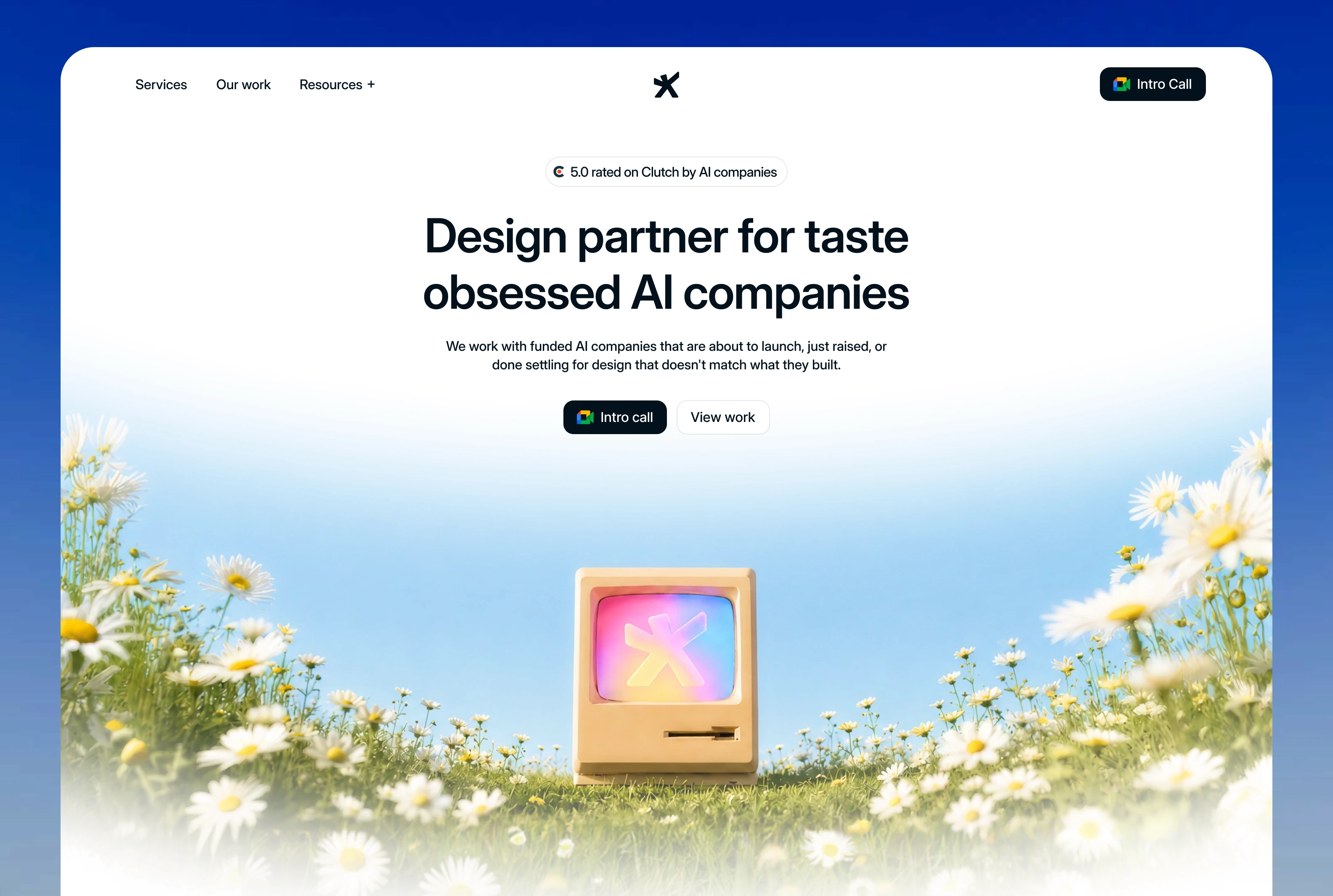
1. Studio Maydit: A Top-Rated Design Agency for AI Founders
Studio Maydit is a web and product design studio working with AI founders in the US, UK, and Europe, and the product half is not an add-on. Engagements that begin with a website carry on into product design after launch, which means the team designing your interface has already had to explain the same product to a stranger in one scroll and knows where the explanation breaks.
The build side spans Framer, Webflow, and custom code, which matters for a B2B SaaS company because design that cannot be implemented is a slower way of writing a wish list. The clearest published outcome is Dualite, where design work supporting a repositioned ICP helped the product reach 100,000+ users in seven months, which is a product and positioning result rather than a visual one. Recent clients include Wave, PixelFlow, Mi-VAD, and 15 other AI and SaaS teams.
Two ways to engage. A fixed scope runs three to four weeks and suits a defined piece of work such as an onboarding flow or an admin surface. A monthly retainer suits a team shipping continuously, covering new pages, campaigns, and product design, with no long lock-in, which is usually the right shape for product work that never really finishes. Fixed-scope engagements end with a diagnosis of what is leaking in the product.
Check | Finding |
|---|---|
Based in | Remote, serving US / UK / EU |
Platform depth | Framer, Webflow, and custom code |
AI-sector proof | Yes. AI-native clients, published outcome on Dualite |
Pricing | Fixed scope or monthly retainer, quoted per project |
Team shape | Founder-led, small senior team |
Best fit | B2B AI SaaS teams who need onboarding and admin surfaces designed by people who also understand the buyer |
Worth a call if signups are fine and activation is not. Book a 30-minute call.

2. Lazarev
Lazarev is a San Francisco studio of 51 to 200 with published AI work, clients including Payoneer, Peel, Elva, and Mozayix, and a published starting price. They are a research-led product studio rather than a website studio that also does interfaces, which is the primary distinction this list is built on. Payoneer is the useful reference: a financial platform with role separation, permissions, and compliance surfaces, which is structurally the same problem a B2B AI product has.
At their size the staffing question is real. Establish who leads your project and how much of their week it gets, because the gap between the pitch team and the delivery team is the main risk at this scale.
Check | Finding |
|---|---|
Based in | San Francisco, USA |
Founded | 2015 |
Team size | 51-200 |
Primary platform | Mixed |
AI-sector proof | Yes. Published AI client work |
Named clients | Payoneer, Peel, Elva, Mozayix |
Pricing | Published minimum |
Best fit | B2B AI SaaS companies who need research before design and have several user roles to serve |
3. Clay
Clay is a San Francisco studio of 51 to 200 with Slack, Stripe, Google, Coinbase, and Amazon published, and a published starting price. Slack and Stripe are the relevant entries: both are products where the design system has to hold across hundreds of screens built by many teams, which is the problem a B2B AI company hits the moment it grows past one squad. If your interface is drifting because three teams are shipping independently, this is the capability you want.
They work at premium scale and pace, and a twelve-person AI company will be their smallest client. A single flow redesign is probably below the engagement size they are set up for.
Check | Finding |
|---|---|
Based in | San Francisco, USA |
Founded | 2016 |
Team size | 51-200 |
Primary platform | Mixed |
AI-sector proof | Yes. Published AI client work |
Named clients | Slack, Stripe, Google, Coinbase, Amazon |
Pricing | Published minimum |
Best fit | Funded B2B AI SaaS companies whose interface needs a system several teams can build against |
4. Foundey
Foundey is a San Francisco studio founded in 2021 working entirely with early-stage AI companies, including DemandIQ, Traycer, and Sero AI. Being Figma-only is a limitation on a website list and much less of one here, because UX work is design rather than build and you almost certainly have engineers already. Their whole client base is companies whose product was still changing while it was being designed, which is the normal condition for a B2B AI product before it settles.
The caution is scale rather than fit. They publish no team size and no pricing, and their references are early-stage, so a company with an established design system and several product teams will be a larger client than they usually take.
Check | Finding |
|---|---|
Based in | San Francisco, USA |
Founded | 2021 |
Team size | Not published |
Primary platform | Figma-only |
AI-sector proof | Yes. Published AI client work |
Named clients | DemandIQ, Traycer, Sero AI |
Pricing | Not published |
Best fit | Early B2B AI SaaS companies with engineers in place who need design direction on a moving product |
5. Ramotion
Ramotion is a San Francisco studio of 11 to 50 running since 2009, with Mozilla, Okta, Netflix, Adobe, and Xero published, and a published starting price. Okta is directly relevant: identity and access management is permissions design in its purest form, and a studio that has made that legible can handle the role structure of a B2B AI product. Seventeen years also means a real design systems practice rather than a recent one.
Their AI-sector work is partial. The model-specific problems, such as showing confidence and designing correction, will be newer ground for them than the B2B structure will.
Check | Finding |
|---|---|
Based in | San Francisco, USA |
Founded | 2009 |
Team size | 11-50 |
Primary platform | Mixed |
AI-sector proof | Partial. Tech and SaaS clients, no AI case study |
Named clients | Mozilla, Okta, Netflix, Adobe, Xero |
Pricing | Published minimum |
Best fit | B2B AI SaaS companies whose hardest surface is permissions, roles, and admin configuration |

6. Fantasy
Fantasy has been running since 1999 and leads with AI strategy alongside product innovation and brand. They are one of very few studios here treating AI as a strategic problem rather than an interface style, which suits a B2B company still deciding how much autonomy to give the model and how much to leave with the user. That is a product strategy question before it is a screen.
They publish neither client names nor pricing, which is a lot of unknowns for a product engagement that will run for months. Expect enterprise scale, enterprise pace, and a discovery phase to fund before you see a flow.
Check | Finding |
|---|---|
Based in | San Francisco and New York, USA |
Founded | 1999 |
Team size | Not published |
Primary platform | Mixed |
AI-sector proof | Yes. Published AI client work |
Named clients | Not published |
Pricing | Not published |
Best fit | B2B AI SaaS companies deciding how much the model should decide, before designing the screens |
7. basement.studio
basement.studio writes front-end code from Mar del Plata and Los Angeles, with Vercel, Cursor, ElevenLabs, Harvey AI, and Scale AI published. They publish a starting price, and their AI-native client list is among the strongest here. Where they help a product team is on interfaces that have to feel fast and be genuinely engineered, since design and implementation sit in the same studio.
Their published work is weighted toward marketing sites and developer-facing surfaces rather than multi-role B2B application design. The admin console and permissions matrix are not what this portfolio demonstrates, which is what puts them here rather than higher.
Check | Finding |
|---|---|
Based in | Mar del Plata, Argentina and Los Angeles, USA |
Founded | 2018 |
Team size | 11-50 |
Primary platform | Custom code |
AI-sector proof | Yes. Published AI client work |
Named clients | Vercel, Cursor, ElevenLabs, Harvey AI, Scale AI |
Pricing | Published minimum |
Best fit | B2B AI SaaS teams designing a developer-facing surface who want design and implementation together |
8. Feels Like
Feels Like is a Los Angeles custom code studio founded in 2023 with Google, Nike, LVMH, and Suno AI published. The craft is real and the luxury brand work shows an unusual level of finish, which can lift a B2B product that currently looks like internal tooling.
The gap for this list is B2B product structure. Their published work is brand and experience rather than multi-role application design, they publish no team size or pricing, and they are young. For an interface that has to serve an admin, a daily user, and an auditor, that is the wrong evidence base.
Check | Finding |
|---|---|
Based in | Los Angeles, USA |
Founded | 2023 |
Team size | Not published |
Primary platform | Custom code |
AI-sector proof | Yes. Published AI client work |
Named clients | Google, Nike, LVMH, Suno AI |
Pricing | Not published |
Best fit | B2B AI SaaS companies whose product works but looks unfinished, where polish is the actual brief |
9. Feely Studio
Feely Studio is a small distributed European team of 1 to 10 with published AI work, clients including Noxus, Mutiny, Luasai, and Basic Capital, and a published starting price at the affordable end. The AI-sector familiarity is genuine and the price makes them a real option for a team that has spent its budget on engineering.
Product design for B2B is sustained work across many screens rather than a defined project, and a team of 1 to 10 has limited capacity to carry that alongside other clients. Their published work also leans toward marketing and brand rather than application interfaces.
Check | Finding |
|---|---|
Based in | Distributed, Europe |
Founded | Not published |
Team size | 1-10 |
Primary platform | Mixed |
AI-sector proof | Yes. Published AI client work |
Named clients | Noxus, Mutiny, Luasai, Basic Capital |
Pricing | Published minimum |
Best fit | Early B2B AI teams who need one flow designed well rather than an ongoing product partnership |
10. SuperSkills
SuperSkills is a very small Walnut Creek studio working across platforms with published AI client work. The proposition is finish above what the price implies, which is genuinely useful to a B2B AI company that has to demo against better-funded competitors.
It sits last because B2B product design is the least suitable work for a single-person studio on this entire list. The job runs for months, spans many screens, and requires continuity when someone is unavailable. With one named public client and no published pricing, there is neither bench depth nor a public track record in application design to rely on.
Check | Finding |
|---|---|
Based in | Walnut Creek, USA |
Founded | Not published |
Team size | 1-10 |
Primary platform | Mixed |
AI-sector proof | Yes. Published AI client work |
Named clients | The Cut |
Pricing | Not published |
Best fit | Very small B2B AI teams needing a single screen or demo flow improved, not ongoing product design |
How to choose between them
Start from the surface that is failing.
People sign up and never activate. This is onboarding and empty states. Studio Maydit or Foundey, both used to products that change while being designed.
Three teams ship three different interfaces. You need a system, not screens. Clay or Ramotion.
Admins cannot configure it without support. Permissions and roles. Ramotion or Lazarev.
Nobody trusts the model's output enough to act on it. Lazarev or Fantasy, who start from research rather than layout.
It works and looks like internal tooling. Feels Like or basement.studio, depending on whether you want polish or engineering.
One question that separates product studios from website studios quickly. Ask how they would design the state where the model is not confident. A product studio will talk about what action becomes available and what the user does next. A website studio will describe how the indicator looks. Only one of those answers is design.

Need more info?
Can't find your answer? Book a call and let's talk.
Continue Reading
10 Best Framer Design Agencies for AI Agent Startups - September 2026
What is the best Framer agency for an AI agent startup? Ten Framer studios ranked for agent products, with pricing, team size and AI work compared.

Siddarth Ponangi
10 Best Framer Design Agencies for Newly Funded Startups - September 2026
Your funding announcement is the biggest traffic day you will have all year. We checked 10 Framer agencies on five public criteria to see which can hit that date.
Siddarth Ponangi
10 Best Custom Code Website Development Agencies for AI Agent Startups - September 2026
AI web development agencies for agent startups. Which teams build custom coded sites a small team can still update weekly after launch.
Siddarth Ponangi