

Summarize with AI


For a generative AI startup, the ten studios worth reviewing are Studio Maydit, Foundey, SuperSkills, Lazarev, Feely Studio, Fantasy, Instrument, Pixelmatters, Ramotion, and BX Studio. Foundey and Feely Studio lead this list. Foundey delivers design only, in Figma, for AI-native clients, which fits a team whose engineers are already building the interface, and Feely Studio has worked on generative products including Mutiny while publishing a starting price. Instrument and Ramotion are the wrong fit here. Both do brand-led work with only partial AI proof, and your problem lives entirely inside the product.
The hardest screen you will ever ship is a rectangle with nothing in it.
Your product can do a hundred things. The interface offers a text field and a cursor. A new user sits in front of it and has to invent, from nothing, both what they want and the words that will produce it. Most people type something vague, receive something mediocre, and conclude the model is not very good. It was, and the interface never gave them a chance to find out.
This is the defining problem of generative products and it does not exist elsewhere in software. Every other tool tells you what it can do by showing you buttons. Yours hides the entire capability behind a prompt, then relies on the user guessing the shape of it.
The problem does not end at the first generation either. Something arrives and it is close but wrong in one respect. What the user wants is to change that one thing. What most products offer is a button that throws the result away and produces a different one, which turns a design tool into a slot machine and teaches people that steering is not possible.
And then there is what happens after. Output appears in a box, and the actual work the person was doing is somewhere else. If getting from your result into their document, their codebase, or their campaign requires copying and pasting, you have built a demonstration rather than a tool.

How we picked these agencies
Five checks, each answerable from public material before any conversation.
Platform depth. What does the studio actually hand over? This splits the page immediately. Some deliver design files for your engineers to build from, and some deliver a running site. A generative product team almost always has engineers already writing the interface, so files are usually the right purchase and a built marketing site is a different project entirely.
Proof with generative products. Has the studio designed something where the content was produced by a model rather than retrieved from a database? This is the criterion doing the real work here, and it is narrower than AI experience in general. Designing an analytics tool teaches you about known quantities. Designing a generative product teaches you about open-ended output, partial correctness, and the fact that the same input can produce different results, which changes how every control on the screen has to behave.
Pricing. Is a starting figure public? Generative startups tend to be engineering-heavy with no design function, which means whoever scopes this has no internal benchmark. A published number supplies one for free.
Team shape. Size decides how much of your model's behaviour has to be explained and to how many people. Explaining where your model is reliable and where it is not is a slow conversation, and it happens once per person involved.
Their own site. The only brief a studio wrote for itself, so it shows what they do without a client shaping it. Read it for whether they can make an abstract capability feel concrete.
For this brief, one further test that separates the field quickly. Ask a studio how they would design the state where the model produces something wrong. Studios with generative experience treat that as a core screen. Studios without treat it as an error message.
Everything in the tables comes from each studio's own published material. Nothing has been inferred or averaged, and where a studio says nothing about price or size the row says so, since that silence is itself part of what you are weighing.
What goes wrong for generative AI products
Three failures, and every one of them shows up in the first session a new user has.
The empty state asks the user to know things they cannot know. A blank prompt field is an exam with no syllabus. Teams compensate by adding placeholder text, which nobody reads, or documentation, which nobody opens. What works is showing the user a small number of concrete starting points that produce a genuinely good result, so the first thing they see is the product being capable rather than themselves being bad at it. This is design work and it usually gets assigned to marketing.
Regenerate is offered where steering is needed. The result is eighty percent right, and the interface gives one option: do it again, differently. That discards the eighty percent that worked and rolls the dice on the rest. Users learn quickly that they cannot direct the product, only resample it, and they stop trying. What they need is a way to keep what is good and change one dimension, which requires deciding what the dimensions are, and that decision is the hardest and most valuable part of the job.
The result has nowhere to go. Output arrives in a container that can be copied or dismissed, while the real work lives in a document, a repository, or a campaign tool somewhere else. Every generation then ends with a manual transfer, and the product remains a place people visit rather than a place they work. Teams notice this late because the metric that reveals it, whether output actually gets used, is rarely the one on the dashboard.
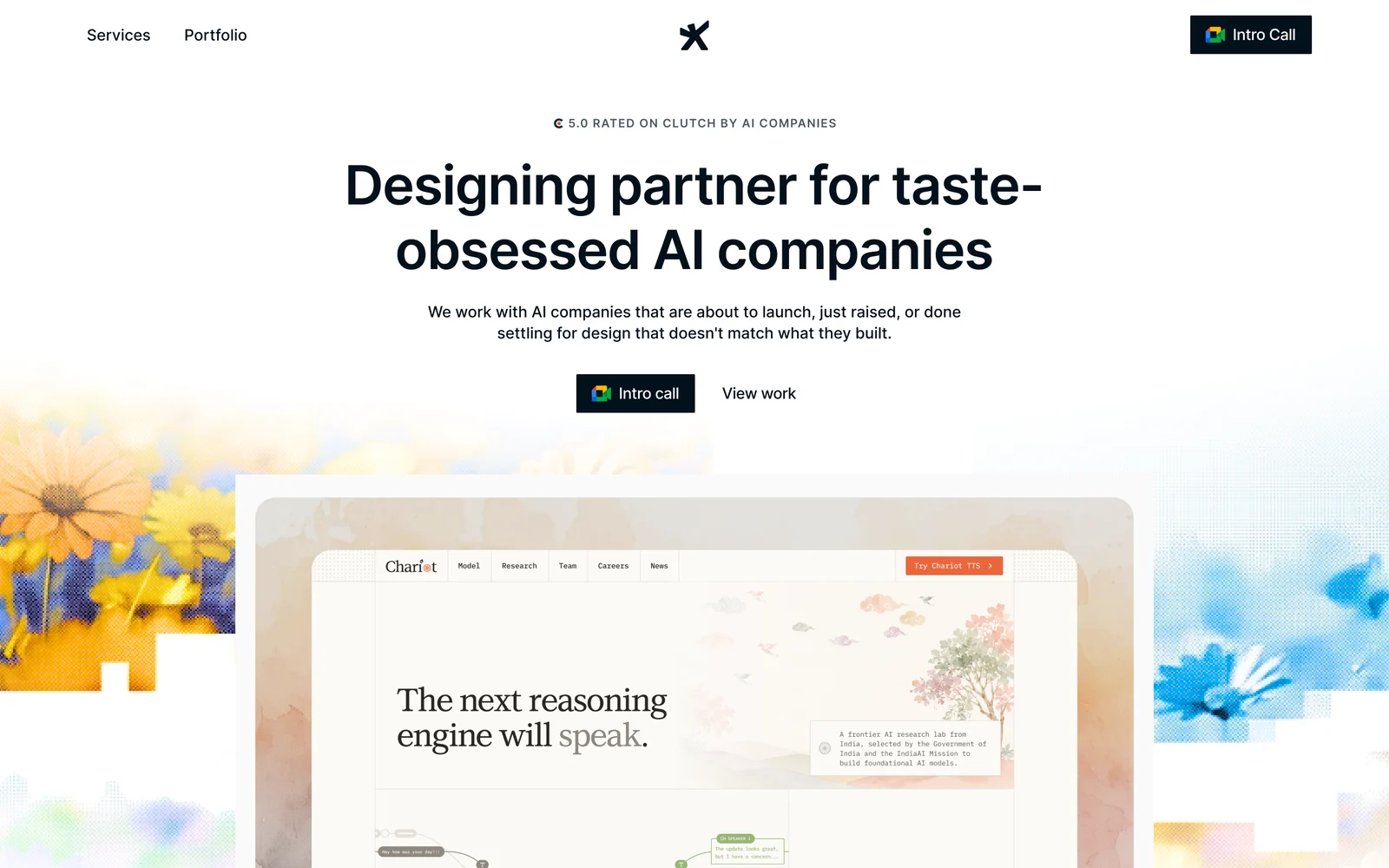
1. Studio Maydit: A Top-Rated Design Agency for AI Founders
Studio Maydit is a web and product design studio, and it works with AI founders across the US, UK, and Europe. For a generative team the relevant part is what happens after a site launches: the practice continues into product design, which is where the prompt, the result, and the editing loop actually live. Platform is chosen by what the thing needs. Framer for a site in constant motion, Webflow where marketing wants its own hands on it, custom code where the product refuses both.
The published outcome is Dualite. What made it work was sequencing, not styling: a repositioned ICP was settled before anything was designed, the work then served that narrower group without exception, and 100,000+ users arrived over seven months. Generative startups tend to resist exactly that narrowing, because the model genuinely can do many things and picking one feels like leaving value behind. It is the opposite. A product that names its user can design a real first-run experience, and a product that does not is stuck offering an empty box. Recent clients include Wave, PixelFlow, Mi-VAD, and 15 other AI and SaaS teams.
Two ways to buy. Fixed scope runs three to four weeks and fits a team with a launch or a funding milestone in view, closing with a written diagnosis of what is leaking in the product, which for generative tools is usually the gap between first prompt and first useful result. Teams shipping continuously take the monthly retainer instead, covering new pages, campaigns, and product design, with no long lock-in.
| Check | Finding |
|---|---|
| Based in | Remote, serving US / UK / EU |
| Platform depth | Framer, Webflow, and custom code |
| AI-sector proof | Yes. AI-native clients, published outcome on Dualite |
| Pricing | Fixed scope or monthly retainer, quoted per project |
| Team shape | Founder-led, small senior team |
| Best fit | Generative teams losing users between the first prompt and the first good result |
If people try your product once and never return, the first ninety seconds is the whole problem. Book a 30-minute call.

2. Foundey
Foundey is a San Francisco studio founded in 2021 that works only in Figma, with DemandIQ, Traycer, and Sero AI as clients. Traycer is a developer tool built on models, so there is direct evidence of designing for open-ended output rather than fixed data, and the design-only model suits a team whose engineers own the front end.
Nothing is built, which leaves an implementation gap your team has to close, and the studio publishes neither pricing nor team size.
| Check | Finding |
|---|---|
| Based in | San Francisco, USA |
| Founded | 2021 |
| Team size | Not published |
| Primary platform | Figma-only |
| AI-sector proof | Yes |
| Named clients | DemandIQ, Traycer, Sero AI |
| Pricing | Not published |
| Best fit | Teams whose engineers will build whatever is designed |
3. SuperSkills
SuperSkills is a one to ten person studio in Walnut Creek with AI-sector proof and The Cut as its named client. For an early team that needs the prompt-and-result loop resolved rather than a full programme of work, a studio this small starts fast and costs little to coordinate with.
The evidence is thin. One named client, no founding year, no published pricing, and limited capacity if the scope grows past a screen or two.
| Check | Finding |
|---|---|
| Based in | Walnut Creek, USA |
| Founded | Not published |
| Team size | 1-10 |
| Primary platform | Mixed |
| AI-sector proof | Yes |
| Named clients | The Cut |
| Pricing | Not published |
| Best fit | Seed-stage teams with one interaction to get right |
4. Lazarev
Lazarev is a San Francisco studio founded in 2015, fifty-one to two hundred people, with AI-sector proof, a published starting price, and Payoneer, Peel, Elva, and Mozayix among its clients. A studio of that size can carry a full product surface, which matters once a generative tool grows history, templates, sharing, and settings around the core loop.
At that headcount, the specifics of how your model behaves have to travel through several people before reaching a screen.
| Check | Finding |
|---|---|
| Based in | San Francisco, USA |
| Founded | 2015 |
| Team size | 51-200 |
| Primary platform | Mixed |
| AI-sector proof | Yes |
| Named clients | Payoneer, Peel, Elva, Mozayix |
| Pricing | Published minimum |
| Best fit | Funded teams designing a whole product rather than one flow |
5. Feely Studio
Feely Studio is a distributed European team of one to ten people with AI-sector proof, a published starting price, and Noxus, Mutiny, Luasai, and Basic Capital as clients. Mutiny generates and personalises content, which is the closest match on this page to the problem of steering machine output toward something a person actually wanted.
The limit is capacity rather than judgement. A team that size cannot hold a large product surface, and no founding year is published.
| Check | Finding |
|---|---|
| Based in | Distributed, Europe |
| Founded | Not published |
| Team size | 1-10 |
| Primary platform | Mixed |
| AI-sector proof | Yes |
| Named clients | Noxus, Mutiny, Luasai, Basic Capital |
| Pricing | Published minimum |
| Best fit | Small teams wanting senior work on the generation loop |
6. Fantasy
Fantasy has worked from San Francisco and New York since 1999 and has AI-sector proof. Generative interfaces have almost no settled conventions, and a studio that has watched several interface eras arrive is better placed than most to invent rather than borrow.
Almost nothing is published. No team size, no pricing, and no named clients, so an evaluation has to happen entirely in conversation.
| Check | Finding |
|---|---|
| Based in | San Francisco and New York, USA |
| Founded | 1999 |
| Team size | Not published |
| Primary platform | Mixed |
| AI-sector proof | Yes |
| Named clients | Not published |
| Pricing | Not published |
| Best fit | Products that need a new interaction pattern rather than a familiar one |
7. Instrument
Instrument has run from Portland since 2005, with Nike, Microsoft, Electronic Arts, and Google as clients. For a launch moment with cultural weight the work is among the strongest on this page, and the longevity is real.
The mismatch is what the job is. This is brand-led work built around clients with internal design teams, the AI-sector proof is partial, and the generative problem is a product problem that brand work does not touch. Nothing is published on pricing.
| Check | Finding |
|---|---|
| Based in | Portland, USA |
| Founded | 2005 |
| Team size | Not published |
| Primary platform | Mixed |
| AI-sector proof | Partial |
| Named clients | Nike, Microsoft, Electronic Arts, Google |
| Pricing | Not published |
| Best fit | Companies buying a brand programme, not a product flow |
8. Pixelmatters
Pixelmatters is a Porto studio founded in 2013, fifty-one to two hundred people, with a published starting price and Rubrik, Quantic, and UJET as clients. It carries design and engineering together, which helps when the interface and the model's behaviour have to be worked out at the same time.
The AI-sector proof is partial, so the specific behaviour of generative output is likely to be learned during your project.
| Check | Finding |
|---|---|
| Based in | Porto, Portugal |
| Founded | 2013 |
| Team size | 51-200 |
| Primary platform | Mixed |
| AI-sector proof | Partial |
| Named clients | Rubrik, Quantic, UJET |
| Pricing | Published minimum |
| Best fit | Teams wanting design and engineering from one supplier |
9. Ramotion
Ramotion has worked from San Francisco since 2009 with eleven to fifty people and a published starting price, for Mozilla, Okta, Netflix, Adobe, and Xero. Adobe is a company whose entire business is tools people create things inside, and that is a useful lineage for a generative product.
Against that, the AI-sector proof is only partial, and the work is weighted toward brand and marketing rather than the product surface this brief is about.
| Check | Finding |
|---|---|
| Based in | San Francisco, USA |
| Founded | 2009 |
| Team size | 11-50 |
| Primary platform | Mixed |
| AI-sector proof | Partial |
| Named clients | Mozilla, Okta, Netflix, Adobe, Xero |
| Pricing | Published minimum |
| Best fit | Teams wanting long experience with creative tooling |
10. BX Studio
BX Studio is a New York team of eleven to fifty people working in Webflow, with AI-sector proof, a published starting price, and Reddit, Headspace, ASAPP, and Verifone as clients. ASAPP is an AI company, and the studio publishes more about itself than most on this page.
It is last for this brief because the practice is Webflow, which builds marketing sites rather than product interfaces. No founding year is published either.
| Check | Finding |
|---|---|
| Based in | New York, USA |
| Founded | Not published |
| Team size | 11-50 |
| Primary platform | Webflow |
| AI-sector proof | Yes |
| Named clients | Reddit, Headspace, ASAPP, Verifone |
| Pricing | Published minimum |
| Best fit | The marketing site, not the generation loop |
How to choose between them
Sort by what is actually broken.
If people try the product once and never come back, the first session is the brief and nothing else matters yet. Foundey or Feely Studio, and spend the whole engagement on what a new user sees before they type anything.
If users generate repeatedly and never keep a result, the problem is steering rather than quality. Buy a studio that has designed generative controls before, meaning Feely Studio or Foundey, and expect the real work to be deciding what the adjustable dimensions are.
If the loop is fine and the product around it has become unmanageable, that is a scale problem and needs a larger team. Lazarev or Pixelmatters.
If output never reaches the place the work actually happens, treat that as the highest-value fix on this page, and choose whoever can start soonest.
One test before you sign. Ask them what they would show a user who has never used a product like yours, in the first ten seconds, before any typing. A studio that has done this will describe specific starting points and why each one demonstrates something. A studio that has not will describe onboarding.