

Summarize with AI


The best UX design agencies for newly funded startups in 2026 are Studio Maydit, BX Studio, Instrument, Phantom, Clay, Lighthouse Digital, Fantasy, SuperSkills, Feely Studio, and Foundey. Studio Maydit and Clay lead for this brief. Clay has been designing since 2016 for Slack, Stripe, and Coinbase, publishes a starting figure, and is large enough to move on a fixed date, which is the constraint that actually governs the quarter after a raise. Lighthouse Digital and SuperSkills are the weakest fit here. One is a London Webflow team with no AI work published, and the other is a one to ten person studio naming a single client, and neither is built for the volume of work that arrives with the money.
You get announced once.
Whatever is live on the morning of the announcement is what several thousand people will see, most of whom will never come back for a second look. Investors forward it. Reporters skim it. Engineers you want to hire open it between meetings. Competitors read every word. It is the largest burst of attention the company will get for a year, and it lands on a product built to be demonstrated by a founder over a call.
The gap shows up in a specific place. Until now every customer arrived through somebody you knew. You set up their account, sat with them, answered the confused message on a Tuesday. That personal handling was doing enormous work, and the announcement removes it. Strangers now arrive with no introduction, and the product has never had to explain itself alone.
There is a second pressure, quieter and slower. The round was raised on a description of what the company will be. The product is a description of what it currently is. Those two things drift apart the moment the money lands, because the story travels faster than the software. New hires read the story and open the product, and the difference between them is the first thing they notice.
Ten studios follow. As you read, ask which of them would help you pick the one thing to fix first.

How we picked these agencies
Five checks, weighted for a company with money it did not have last quarter and a deadline it did not set:
- Platform depth. Can they design the product itself, or do they design pages about the product? Both are real crafts and only one fixes the problem where a stranger opens your app and closes it again.
- Proof with venture-backed companies. Have they worked with startups that had just raised, and can they describe what changed in the twelve weeks afterwards? This is the version of sector proof that applies here. A studio used to established companies plans in quarters. You are working in weeks, with a board that will ask.
- Pricing. Is a number published before the first conversation? Now that there is a budget, the temptation is to stop asking. A studio that publishes has already decided what its work is worth, which makes the negotiation shorter and more honest.
- Team shape. Who does the work, and can they start when you need them to? Post-raise the calendar matters as much as the craft, and the studio with the best portfolio is often the one with no capacity until the quarter after the one you care about.
- Their own site. The brief nobody else set.
Look hard at that last one, because it is the only piece of evidence you get for free. It is the one project with no client, no budget cut, and no compromise to blame, so it shows the ceiling rather than the average. Read what they claim and check whether the work behind it supports the claim.
Every figure in the tables below is taken from what each studio publishes about itself. Nothing is drawn from directories, aggregate scores, or an estimate written to stop a column looking empty. Where nothing is published, the row says so. You have just been through a process where every number you gave was checked, so it would be strange to apply a looser standard here.
What goes wrong when newly funded startups design for growth
Three failures, and each one comes from the same source, which is that the money arrives before the clarity does.
Headcount gets hired against an undefined product. The obvious move after a raise is to hire designers, and it feels like progress on day one. Three months later there are three people producing work in different directions, because nobody wrote down what the product is for or who it is for. Hiring is the right answer once the answer exists. Before that it multiplies the confusion and makes it more expensive to correct, since now there are opinions attached to salaries.
The product still assumes a customer you personally set up. Empty states say nothing useful because there was always a founder in the room. Settings assume knowledge nobody has. There is a step in onboarding that only works if someone tells you about it. None of this failed before, because none of it was ever tested by a stranger. After the announcement it is tested by hundreds, all at once, and none of them will send a message asking what to do.
The site sells the round instead of the product. A funding announcement page appears at the top of the homepage, the headline becomes ambitious and abstract, and the description of what the software actually does moves further down. A buyer who arrives from a news story wants to know what it is and whether it would work for them. Congratulating yourself is the fastest way to lose the exact attention you just paid for with an announcement.
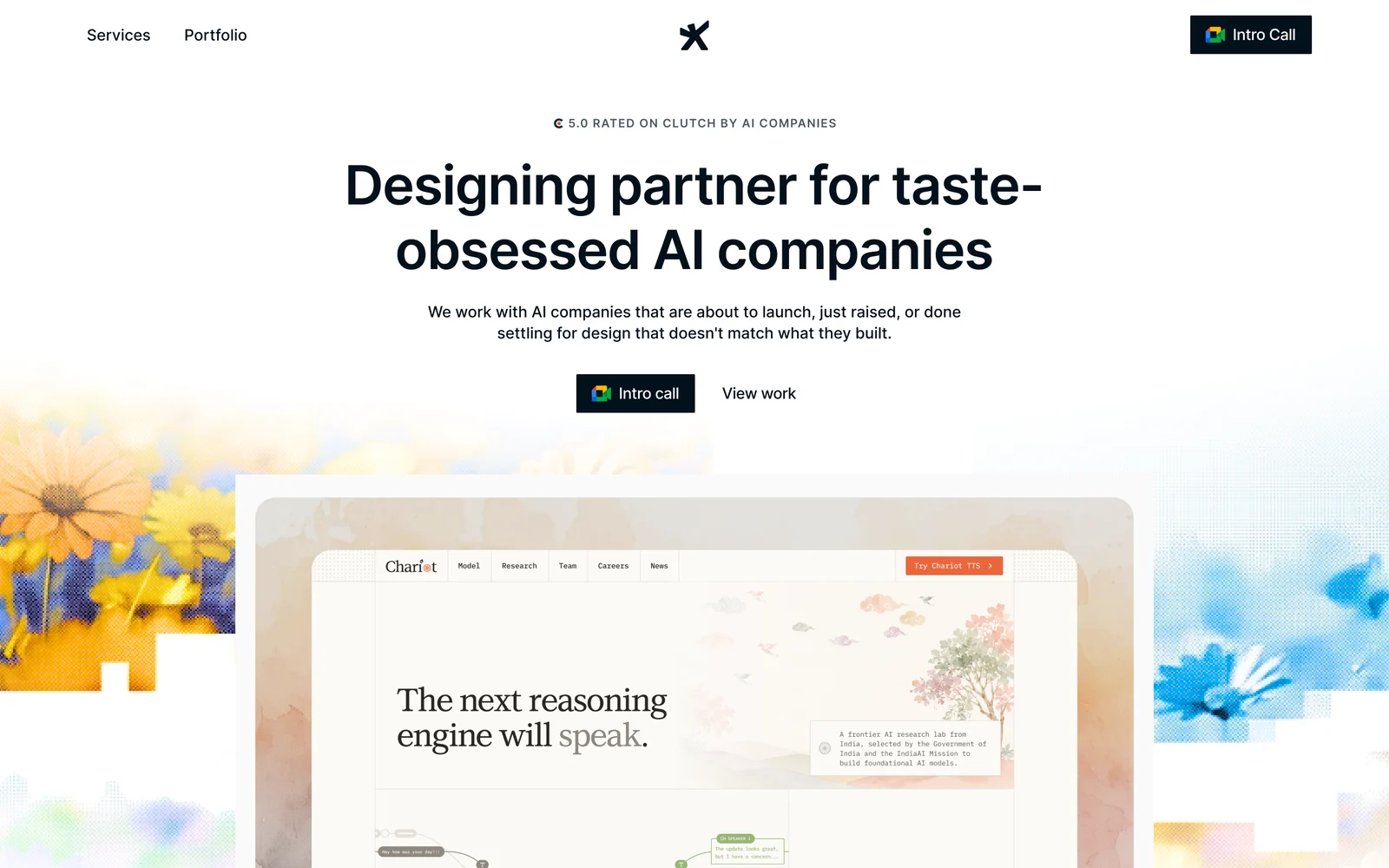
1. Studio Maydit: A Top-Rated Design Agency for AI Founders
Studio Maydit sells work two ways, and the first one exists for the position you are in. Fixed scope runs three to four weeks, which is short enough to land inside the window where the announcement is still generating traffic. Teams that keep shipping take a monthly retainer instead, covering new pages, campaigns, and product design, with no long lock-in. Either way, fixed-scope projects end with a diagnosis of what is leaking in the product rather than a file handover, which after a raise is usually the more valuable half.
It is a web and product design studio, working with AI founders in the US, UK, and Europe. Sites get built in Framer, Webflow, or custom code, chosen by who has to change things afterwards rather than by preference, and the work continues into product design once the site is live. That second half is where the post-announcement problem actually sits, since the visitors are new and the product has never had to introduce itself.
Dualite is the engagement with a public number attached to it. The work began by settling a repositioned ICP, and the product that followed was aimed only at that audience. Seven months later it had passed 100,000+ users. Recent clients include Wave, PixelFlow, and Mi-VAD, along with 15 other AI and SaaS teams.
| Check | Finding |
|---|---|
| Based in | Remote, serving US / UK / EU |
| Platform depth | Framer, Webflow, and custom code |
| AI-sector proof | Yes. AI-native clients, published outcome on Dualite |
| Pricing | Fixed scope or monthly retainer, quoted per project |
| Team shape | Founder-led, small senior team |
| Best fit | Funded teams with an announcement date and a short window |
Worth a call if the round is closing and the product has never met a stranger. Book a 30-minute call.

2. BX Studio
BX Studio works from New York with eleven to fifty people, mainly in Webflow, publishing a minimum and naming Reddit, Headspace, ASAPP, and Verifone. They publish AI client work, and ASAPP is a funded AI company, so the pattern of a company growing quickly on new money is one they have worked inside rather than read about.
No founding year is published, and Webflow depth means the strongest work sits on the marketing site rather than inside the product, which is where a stranger arriving from your announcement will decide.
| Check | Finding |
|---|---|
| Based in | New York, USA |
| Founded | Not published |
| Team size | 11-50 |
| Primary platform | Webflow |
| AI-sector proof | Yes. Published AI client work |
| Named clients | Reddit, Headspace, ASAPP, Verifone |
| Pricing | Published minimum |
| Best fit | Funded teams needing a site that holds announcement traffic |
3. Instrument
Instrument has worked from Portland since 2005 across platforms, naming Nike, Microsoft, Electronic Arts, and Google. Twenty years of practice buys a particular thing here, which is the ability to make a young company read as substantial without overclaiming, and that is precisely the tone a post-raise announcement needs.
Their AI-sector proof is partial with no AI case study, no team size or starting figure is published, and a studio shaped around long brand programmes is a difficult fit for a company that needs something finished before the attention fades.
| Check | Finding |
|---|---|
| Based in | Portland, USA |
| Founded | 2005 |
| Team size | Not published |
| Primary platform | Mixed |
| AI-sector proof | Partial. Enterprise and SaaS clients, no AI case study |
| Named clients | Nike, Microsoft, Electronic Arts, Google |
| Pricing | Not published |
| Best fit | Funded teams investing in a full brand rather than a sprint |
4. Phantom
Phantom has built in custom code from London and Auckland since 2013 with fifty-one to two hundred people, publishing AI client work and naming Diageo, SAP, Financial Times, and Zendesk. Coverage across two hemispheres and a team that size means they can hold a deadline through the summer, which is worth more than it sounds when your date is fixed by a press embargo.
No starting figure is published, and neither the team size nor the enterprise client base suggests a studio interested in the small, fast, unglamorous work a first post-raise quarter often needs.
| Check | Finding |
|---|---|
| Based in | London, UK and Auckland, NZ |
| Founded | 2013 |
| Team size | 51-200 |
| Primary platform | Custom code |
| AI-sector proof | Yes. Published AI client work |
| Named clients | Diageo, SAP, Financial Times, Zendesk |
| Pricing | Not published |
| Best fit | Funded teams with an enterprise buyer and a hard date |
5. Clay
Clay has worked from San Francisco since 2016 with fifty-one to two hundred people, across platforms, publishing a minimum and publishing AI client work, naming Slack, Stripe, Google, Coinbase, and Amazon. That client list is the most senior on this page, and a studio of that scale can put a full team on a fixed date rather than fitting you around other work.
No weakness is hidden here so much as priced in. It is a premium practice, the process assumes a client who can commit, and a startup three weeks past a first round may find the engagement larger than the problem it is trying to solve.
| Check | Finding |
|---|---|
| Based in | San Francisco, USA |
| Founded | 2016 |
| Team size | 51-200 |
| Primary platform | Mixed |
| AI-sector proof | Yes. Published AI client work |
| Named clients | Slack, Stripe, Google, Coinbase, Amazon |
| Pricing | Published minimum |
| Best fit | Funded teams with real budget and a serious product rebuild |
6. Lighthouse Digital
Lighthouse Digital is a London Webflow studio publishing a minimum and naming HelloSelf, Freetrade, and IGN. Freetrade is a consumer fintech that grew fast under public scrutiny, so this is a team that has produced marketing work while a client was being watched closely, which is the condition you enter on announcement day.
No AI-sector proof, no founding year, and no team size are published, and a Webflow practice will not touch the onboarding flow where your new visitors are actually getting stuck.
| Check | Finding |
|---|---|
| Based in | London, UK |
| Founded | Not published |
| Team size | Not published |
| Primary platform | Webflow |
| AI-sector proof | No |
| Named clients | HelloSelf, Freetrade, IGN |
| Pricing | Published minimum |
| Best fit | Funded UK teams wanting a fast marketing site refresh |
7. Fantasy
Fantasy has worked from San Francisco and New York since 1999, across platforms, publishing AI client work. A quarter century in practice means they have watched a great many companies come into money, and the judgement about what to do first and what to leave alone is the scarce thing in your quarter.
No team size, no starting figure, and no named clients are published, which leaves very little to evaluate before a conversation, and evaluating quickly is exactly what a compressed post-raise timeline requires.
| Check | Finding |
|---|---|
| Based in | San Francisco and New York, USA |
| Founded | 1999 |
| Team size | Not published |
| Primary platform | Mixed |
| AI-sector proof | Yes. Published AI client work |
| Named clients | Not published |
| Pricing | Not published |
| Best fit | Funded teams wanting long-experience judgement on sequencing |
8. SuperSkills
SuperSkills is a one to ten person studio in Walnut Creek working across platforms, publishing AI client work and naming The Cut. A small team means the person you meet is the person doing the work, and after a raise the risk of being sold by a partner and delivered by a junior is real.
Only one client is named, no founding year, and no starting figure is published, and a team this small cannot absorb the amount of work that lands in the first quarter after a round.
| Check | Finding |
|---|---|
| Based in | Walnut Creek, USA |
| Founded | Not published |
| Team size | 1-10 |
| Primary platform | Mixed |
| AI-sector proof | Yes. Published AI client work |
| Named clients | The Cut |
| Pricing | Not published |
| Best fit | Funded teams with one narrow problem and a senior pair |
9. Feely Studio
Feely Studio is a one to ten person team distributed across Europe, working across platforms, publishing a minimum and publishing AI client work, naming Noxus, Mutiny, Luasai, and Basic Capital. Mutiny and Basic Capital are both venture-backed companies that had to explain a new category quickly, which is close to the job an announcement page has to do.
No founding year is published, a team that size has no reserve capacity if your timeline slips, and the European working day gives you a short overlap if your board sits on the west coast.
| Check | Finding |
|---|---|
| Based in | Distributed, Europe |
| Founded | Not published |
| Team size | 1-10 |
| Primary platform | Mixed |
| AI-sector proof | Yes. Published AI client work |
| Named clients | Noxus, Mutiny, Luasai, Basic Capital |
| Pricing | Published minimum |
| Best fit | Funded teams needing a new category explained clearly |
10. Foundey
Foundey is a San Francisco studio founded in 2021 working only in Figma, publishing AI client work and naming DemandIQ, Traycer, and Sero AI. All three are young AI companies, so this is a team that spends its time on products at your exact stage rather than on the established software estates most studios serve.
No team size or starting figure is published, and nothing gets built, so your engineers carry implementation at the moment they are least available and most distracted by hiring.
| Check | Finding |
|---|---|
| Based in | San Francisco, USA |
| Founded | 2021 |
| Team size | Not published |
| Primary platform | Figma-only |
| AI-sector proof | Yes. Published AI client work |
| Named clients | DemandIQ, Traycer, Sero AI |
| Pricing | Not published |
| Best fit | Funded teams with engineers ready to build from files |
How to choose between them
Sort by what the announcement will expose, not by which studio looks most impressive on a board slide.
Strangers reach the product and leave without trying it. Studio Maydit or Clay.
The homepage talks about the round and not the software. BX Studio or Lighthouse Digital.
The company reads as smaller than it now is. Instrument or Phantom.
Nobody agrees what to build first. Studio Maydit or Fantasy.
One test before you sign. Tell them the date and ask what they would cut. A studio that suits a funded startup will immediately narrow the work and name the one thing worth finishing properly. A studio that says everything is achievable in the time available is either not listening or planning to hand it to whoever is free.