

Summarize with AI


The best UX design agencies for pre-seed AI startups in 2026 are Studio Maydit, Flow Ninja, Foundey, Feely Studio, Flowout, Fantasy, Engine Digital, Refokus, 8020, and Edgar Allan. Studio Maydit and Foundey lead for this brief. Foundey is a 2021 San Francisco studio working only in Figma, publishing AI client work and naming DemandIQ, Traycer, and Sero AI, which are all companies at roughly your stage, and a files-only engagement is the least expensive serious shape available when your engineers can build. Engine Digital and Edgar Allan are the weakest fit here. One has served Goldman Sachs and Adidas since 2002 and the other runs full brand programmes from Atlanta, and both are sized for organisations with a budget cycle rather than a runway.
Something worth saying before the list. At pre-seed, most design spending is early.
Not wrong, early. You have a small amount of money that is supposed to buy evidence, and design can absolutely produce evidence. What it cannot do is produce certainty about a product nobody has used yet. The characteristic pre-seed mistake is buying a finished-looking version of a guess, and finished-looking guesses are hard to change, because now there is a beautiful thing everyone is attached to.
Watch how it usually goes. A site gets built around the positioning you have in month two. In month five you talk to twenty prospects and learn the real buyer is a different person with a different problem. The site is now wrong in a way that cannot be patched, so it gets rebuilt, and the money that was meant to buy evidence bought a rehearsal.
There is a second pattern, quieter and more expensive. Founders show investors a polished prototype and show users the actual product, and the two drift apart. The team optimises the one that gets applause in meetings. Six months later the demo is excellent, the product is unchanged, and nobody can explain why usage is flat.
So the useful question is not which studio is best. It is what the smallest piece of design work is that would tell you something you do not currently know. Ten studios follow, and the honest note is that several of them are excellent and too large for where you are.

How we picked these agencies
Five checks, weighted for a company with more runway anxiety than budget:
- Platform depth. Do they design software, or pages about software? At pre-seed the product usually matters more, because your first believers judge whether the thing works, not whether the homepage is elegant.
- Proof with venture-backed companies at the earliest stage. Have they worked with pre-revenue teams, and were they willing to make the engagement smaller? This is the version of sector proof that decides your outcome. A studio used to funded companies will happily design the full surface. The useful question is whether they will talk you out of it and do one flow instead.
- Pricing. Is a starting number published? This check carries more weight for you than for anyone else on this list. Two of the nine studios below publish a figure. If a studio will not indicate a number before a call, you are spending scarce time discovering you cannot afford them.
- Team shape. How small, and how senior? Pre-seed engagements go best with one or two experienced people and no account layer, because there is not enough work to justify a team and not enough budget to pay for the coordination.
- Their own site. The one brief they set and approved themselves.
Read that fifth one closely, because it is free evidence and you have little else. It is the only project with no client, no reduced budget, and nobody to blame, so it shows what the studio does at full stretch. Check especially whether they explain what things cost and how they work, since a studio comfortable being direct about money will be direct about scope too.
Every figure in the tables below comes from what each studio publishes about itself. No directory profiles, no aggregate scores, and no estimates written to fill a gap. Where nothing is published, the row says so. You are about to spend real time on this decision, so the inputs should be things you can verify rather than things somebody asserted.
What goes wrong when pre-seed AI startups design for growth
Three failures, and all three come from buying finish before you have found the shape.
The site is built around positioning that has not settled. Month two positioning becomes a beautiful site. Month five customer conversations move the buyer, the problem, and the language. Now every page is subtly wrong and none of it can be edited into rightness, so it gets rebuilt. Design work at this stage should be structured so that changing the message is cheap, which usually means fewer pages, plainer language, and a build somebody on your team can edit without help.
The demo and the product become two different things. One version exists for investors and one exists for users. The demo gets the attention because the feedback is immediate and flattering. The product stays raw, usage stays flat, and the gap between the two grows until a diligence conversation exposes it. Keep one thing, show that thing to both audiences, and let it be less impressive than it could be.
The first decision gets outsourced before it is made. No studio can tell you who your product is for. If you arrive without that decision, you will receive a confident, well-crafted version of somebody's guess, and it will be persuasive enough that you stop questioning it. Make the call first, even loosely, even if you are unsure. A studio is very good at expressing a decision and very bad at making one on your behalf.
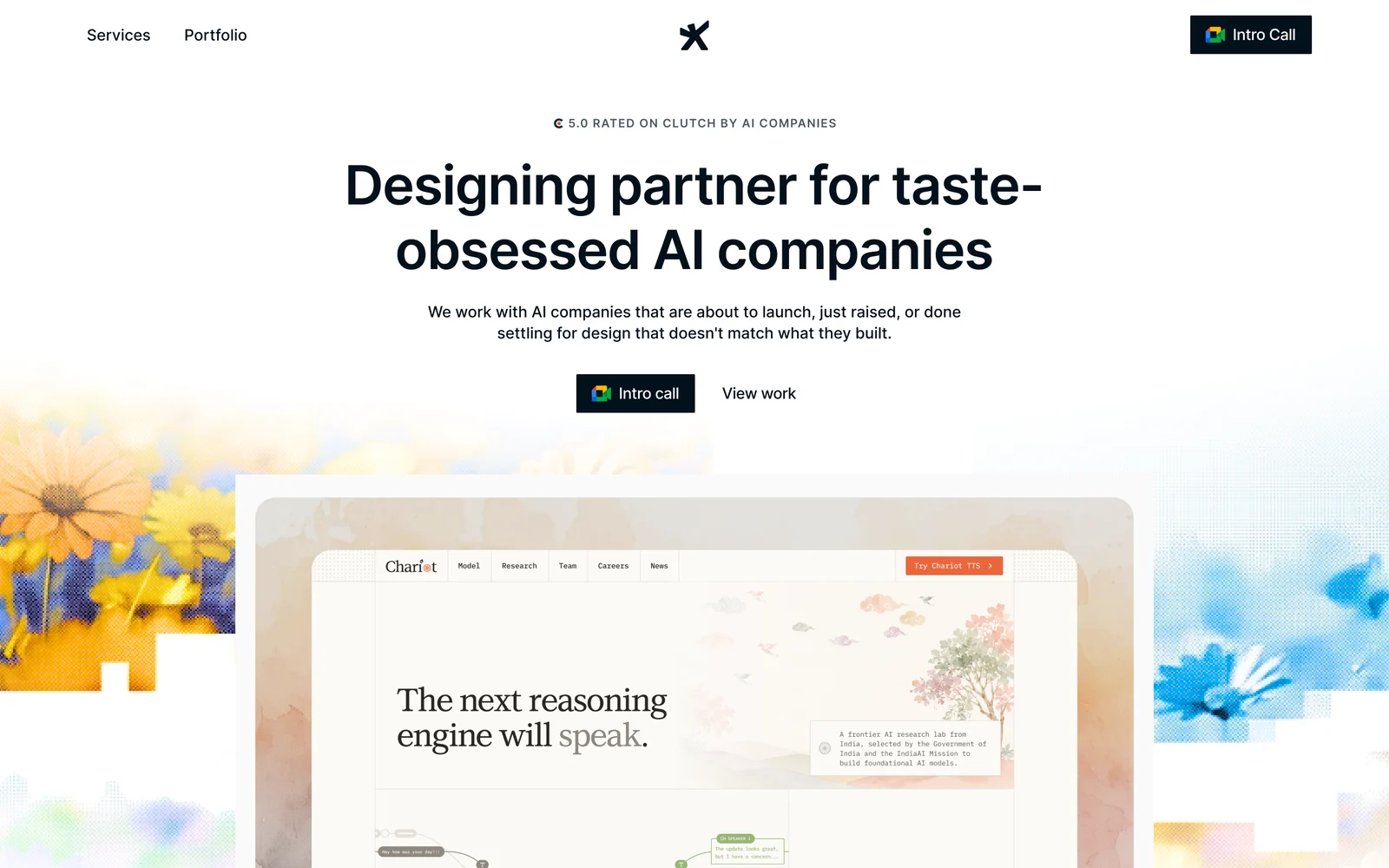
1. Studio Maydit: A Top-Rated Design Agency for AI Founders
One team covers both halves. Studio Maydit is a web and product design studio working with AI founders in the US, UK, and Europe, and the same people carry on into product design after the site ships rather than handing you to somebody else. At pre-seed that matters mostly because it removes a second procurement exercise you do not have time for. Builds happen in Framer, Webflow, or custom code, and the choice is made by who has to edit things afterwards, which at your stage is usually a founder at eleven at night.
Work is bought in two shapes, and the first is the relevant one here. A fixed scope runs three to four weeks, which is short enough to fit inside a runway calculation and small enough to leave room to be wrong. Teams that are shipping continuously take a monthly retainer instead, covering new pages, campaigns, and product design, with no long lock-in. Fixed-scope work closes with a diagnosis of what is leaking in the product, which for a pre-seed team is often the first structured outside read anyone has given it.
Dualite is the published outcome with a number attached. A repositioned ICP was chosen first, the product was designed for that narrower group, and 100,000+ users followed across seven months. Recent clients include Wave, PixelFlow, and Mi-VAD, along with 15 other AI and SaaS teams.
| Check | Finding |
|---|---|
| Based in | Remote, serving US / UK / EU |
| Platform depth | Framer, Webflow, and custom code |
| AI-sector proof | Yes. AI-native clients, published outcome on Dualite |
| Pricing | Fixed scope or monthly retainer, quoted per project |
| Team shape | Founder-led, small senior team |
| Best fit | Pre-seed teams buying one decision rather than a rebuild |
Worth a call if you want the smallest piece of work that would teach you something. Book a 30-minute call.

2. Flow Ninja
Flow Ninja is a Belgrade studio founded in 2018 with eleven to fifty people, working in Webflow. Costs in that market mean the same scope generally comes in lower than an equivalent American studio, and at pre-seed the difference between two quotes can be a month of runway.
No client names, no starting figure, and no AI case study are published, which is a real problem when you have limited time to evaluate, and a Webflow practice will not touch the product where your first users are getting stuck.
| Check | Finding |
|---|---|
| Based in | Belgrade, Serbia |
| Founded | 2018 |
| Team size | 11-50 |
| Primary platform | Webflow |
| AI-sector proof | Partial. Enterprise and SaaS clients, no AI case study |
| Named clients | Not published |
| Pricing | Not published |
| Best fit | Pre-seed teams stretching a small site budget further |
3. Foundey
Foundey is a San Francisco studio founded in 2021 working only in Figma, publishing AI client work and naming DemandIQ, Traycer, and Sero AI. Every one of those is a young AI company, so this is a team whose normal client looks like you rather than like a software company with a design department.
No team size or starting figure is published, and because nothing is built, the engagement only works if your engineers have capacity, which at pre-seed is the single scarcest resource you have.
| Check | Finding |
|---|---|
| Based in | San Francisco, USA |
| Founded | 2021 |
| Team size | Not published |
| Primary platform | Figma-only |
| AI-sector proof | Yes. Published AI client work |
| Named clients | DemandIQ, Traycer, Sero AI |
| Pricing | Not published |
| Best fit | Pre-seed teams with engineers who can build from files |
4. Feely Studio
Feely Studio is a one to ten person team distributed across Europe, working across platforms, publishing a minimum and publishing AI client work, naming Noxus, Mutiny, Luasai, and Basic Capital. Publishing a number and being small are both useful signals at your stage, since it means a quick conversation and no account manager between you and the work.
No founding year is published, a team that size has nothing in reserve if your timeline moves, and European hours will cost you most of an American afternoon.
| Check | Finding |
|---|---|
| Based in | Distributed, Europe |
| Founded | Not published |
| Team size | 1-10 |
| Primary platform | Mixed |
| AI-sector proof | Yes. Published AI client work |
| Named clients | Noxus, Mutiny, Luasai, Basic Capital |
| Pricing | Published minimum |
| Best fit | Pre-seed teams wanting senior work at a stated price |
5. Flowout
Flowout is a distributed Webflow studio publishing a minimum and naming Jasper, Kajabi, Riverside, and Sendlane. A monthly subscription with a pause option is an unusually sensible arrangement for a company that cannot forecast next quarter, since the commitment is short and the output is steady.
Their AI-sector proof is partial with no AI case study, no founding year or team size is published, and a request queue produces pages rather than the positioning decision that a pre-seed company usually needs first.
| Check | Finding |
|---|---|
| Based in | Distributed |
| Founded | Not published |
| Team size | Not published |
| Primary platform | Webflow |
| AI-sector proof | Partial. Enterprise and SaaS clients, no AI case study |
| Named clients | Jasper, Kajabi, Riverside, Sendlane |
| Pricing | Published minimum |
| Best fit | Pre-seed teams wanting small monthly output, no commitment |
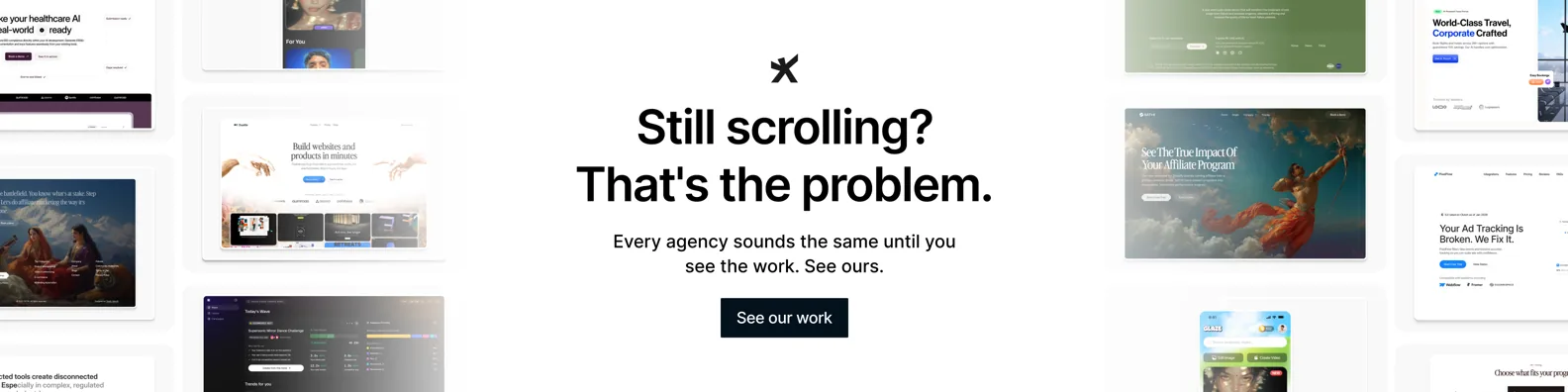
6. Fantasy
Fantasy has worked from San Francisco and New York since 1999, across platforms, publishing AI client work. Twenty-six years of practice buys judgement about sequencing, and at pre-seed the most valuable thing a studio can tell you is which of the five things on your list actually needs doing now.
No team size, no starting figure, and no named clients are published, which is a difficult combination when you must evaluate quickly, and a practice of that standing is unlikely to be priced for a pre-seed budget.
| Check | Finding |
|---|---|
| Based in | San Francisco and New York, USA |
| Founded | 1999 |
| Team size | Not published |
| Primary platform | Mixed |
| AI-sector proof | Yes. Published AI client work |
| Named clients | Not published |
| Pricing | Not published |
| Best fit | Pre-seed teams who can afford senior judgement early |
7. Engine Digital
Engine Digital has built in custom code from Vancouver and New York since 2002, naming Adidas, Autodesk, Goldman Sachs, and HP. Two decades of work at that scale means genuine engineering discipline, and if your product has an unusual technical surface that discipline is not easy to find elsewhere.
No team size or starting figure is published, their AI-sector proof is partial with no AI case study, and an engagement shaped for organisations of that size is far heavier and more expensive than a pre-seed company should be taking on.
| Check | Finding |
|---|---|
| Based in | Vancouver and New York |
| Founded | 2002 |
| Team size | Not published |
| Primary platform | Custom code |
| AI-sector proof | Partial. Enterprise and SaaS clients, no AI case study |
| Named clients | Adidas, Autodesk, Goldman Sachs, HP |
| Pricing | Not published |
| Best fit | Pre-seed teams with a genuinely hard technical build |
8. Refokus
Refokus has run remotely out of Germany since 2021 with eleven to fifty people, mainly in Webflow, naming Mural, BASF, Spotify, Yahoo, and BCG. A young studio with that client list has grown quickly by being good rather than by being established, which is worth noticing if you are trying to look credible without a history of your own.
Their AI-sector proof is partial with no AI case study, no starting figure is published, and clients of that size tend to set a price expectation that a pre-seed company will find uncomfortable.
| Check | Finding |
|---|---|
| Based in | Germany, remote |
| Founded | 2021 |
| Team size | 11-50 |
| Primary platform | Webflow |
| AI-sector proof | Partial. Enterprise and SaaS clients, no AI case study |
| Named clients | Mural, BASF, Spotify, Yahoo, BCG |
| Pricing | Not published |
| Best fit | Pre-seed teams who need to read as more established |
9. 8020
8020 has worked from San Francisco and New York since 2014 in Webflow, naming Wave, Superlist, Pilot.com, Vanta, and Circle. Several of those were small when the work started, so this is a studio that has repeatedly built the first serious site for a company nobody had heard of yet.
No team size and no starting figure are published, their AI-sector proof is partial with no AI case study, and a Webflow engagement leaves the product surface untouched at a stage when the product is the only thing that proves anything.
| Check | Finding |
|---|---|
| Based in | San Francisco and New York, USA |
| Founded | 2014 |
| Team size | Not published |
| Primary platform | Webflow |
| AI-sector proof | Partial. Enterprise and SaaS clients, no AI case study |
| Named clients | Wave, Superlist, Pilot.com, Vanta, Circle |
| Pricing | Not published |
| Best fit | Pre-seed teams wanting a credible first marketing site |
10. Edgar Allan
Edgar Allan has worked from Atlanta since 2014 at fifty-one to two hundred people, mainly in Webflow, naming Porsche, Duracell, and NCR. Brand work is the hardest thing to do internally with no designer and no budget, and this is a studio that does it seriously rather than decoratively.
No starting figure is published, their AI-sector proof is partial with no AI case study, and a full identity programme is exactly the kind of finished, expensive, hard-to-change purchase a pre-seed company should be avoiding for another year.
| Check | Finding |
|---|---|
| Based in | Atlanta, USA |
| Founded | 2014 |
| Team size | 51-200 |
| Primary platform | Webflow |
| AI-sector proof | Partial. Enterprise and SaaS clients, no AI case study |
| Named clients | Porsche, Duracell, NCR |
| Pricing | Not published |
| Best fit | Pre-seed teams with unusual budget and a brand-led plan |
How to choose between them
Sort by what you would learn, not by what you would own afterwards.
You are unsure who the product is for. Studio Maydit or Fantasy.
Users try it once and never return. Studio Maydit or Foundey.
Nobody takes the company seriously yet. Refokus or 8020.
You need steady small output on a short leash. Flowout or Feely Studio.
One test before you sign. Tell them your budget honestly, then ask what they would do with half of it. A studio that suits a pre-seed company will name one thing, explain why it comes first, and sound genuinely interested in the smaller version. A studio that responds by explaining why the full scope is necessary has told you that you are not the client they want, which is useful information delivered early and for free.