Reading time:
14 min read
Last updated:
10 Best UX Design Agencies for Remote-First Teams - September 2026
UX design agencies for remote-first teams: ten studios compared on remote research, written handoffs, team size, and whether a starting price is public.


Ten studios made this list for remote-first product teams. In ranked order they are Studio Maydit, Lazarev, Pixelmatters, Clay, Ramotion, Instrument, Engine Digital, Push Refresh, SuperSkills, and Lighthouse Digital. Lazarev earns second place with research-led product work that holds up when every user interview happens over video. Pixelmatters is third, a Porto team whose working day overlaps both US mornings and European afternoons. At the other end, SuperSkills is too small to cover a spread of time zones, and Lighthouse Digital is a Webflow studio rather than a product UX team.
Here is the odd thing about a remote-first company. Nobody on the team has ever watched a customer use the product in person.
Every insight arrives through a screen. A session recording. A support ticket. A shared screen on a call where the user's camera is off. That is normal now, and plenty of good products are built this way. But it means UX evidence is always a file, never a memory, and the agency you hire has to produce evidence in the same form.
The second twist is who reads the design. In an office, a designer walks over and explains the tricky screen. In a remote-first team, an engineer opens the file at nine in the evening in another country, and the file has to answer the question by itself.
So the real skill is not polish. It is design that explains itself while the designer is asleep.
Keep that test in hand as you go down the list. Which of these teams would leave a file that your quietest engineer could build from without asking a single question?

How we picked these agencies
Our method was simple. We read what each studio says about itself in public and what its published work shows, and we scored five checks:
Platform depth. How far their work goes past static mockups. Do they ship real product screens, prototypes with states, or front-end code a distributed engineering team can pick up?
Distributed delivery proof. Signs they already work across locations. That can mean offices in more than one city, a team spread across time zones, or named clients with distributed product teams of their own.
Pricing transparency. Whether they publish a minimum at all. Remote buyers often shortlist without a call, so a public floor saves a meeting across three calendars.
Team shape. Size and seniority, and how many hours a day someone on the team is awake during your working hours.
Their own website. The project where no client could say no.
We still look at that last one, even for UX. A studio's own site shows how clearly it writes and how it lays out an argument, and in a remote engagement the written word is most of the relationship.
A note on sources. Every row in every table traces to the studio's website or a public directory, read in September 2026. Where the record is silent, the table is too, and it says Not published.
What goes wrong when a remote-first team hires a UX agency
These three problems show up again and again, and none of them is about taste.
The research stays in the agency's heads. User interviews happen on calls your team could not join. The findings arrive as a slide deck with quotes but no clips, no tagged notes, and no link to the raw sessions. Six months later, a new hire has no way to learn why the product works the way it does. When an engineer later doubts a finding, there is nothing to check it against.
The prototype only works with narration. It was approved in a live demo where the designer clicked the happy path and talked over the gaps. The engineer who opens it later finds no error states, no empty states, and no note on what loads first on a slow connection.
Comments pile up and nothing gets decided. The Figma file fills with two hundred comment threads. The agency treats each one as a request, nobody marks what is settled, and the same question comes back three times from three time zones.
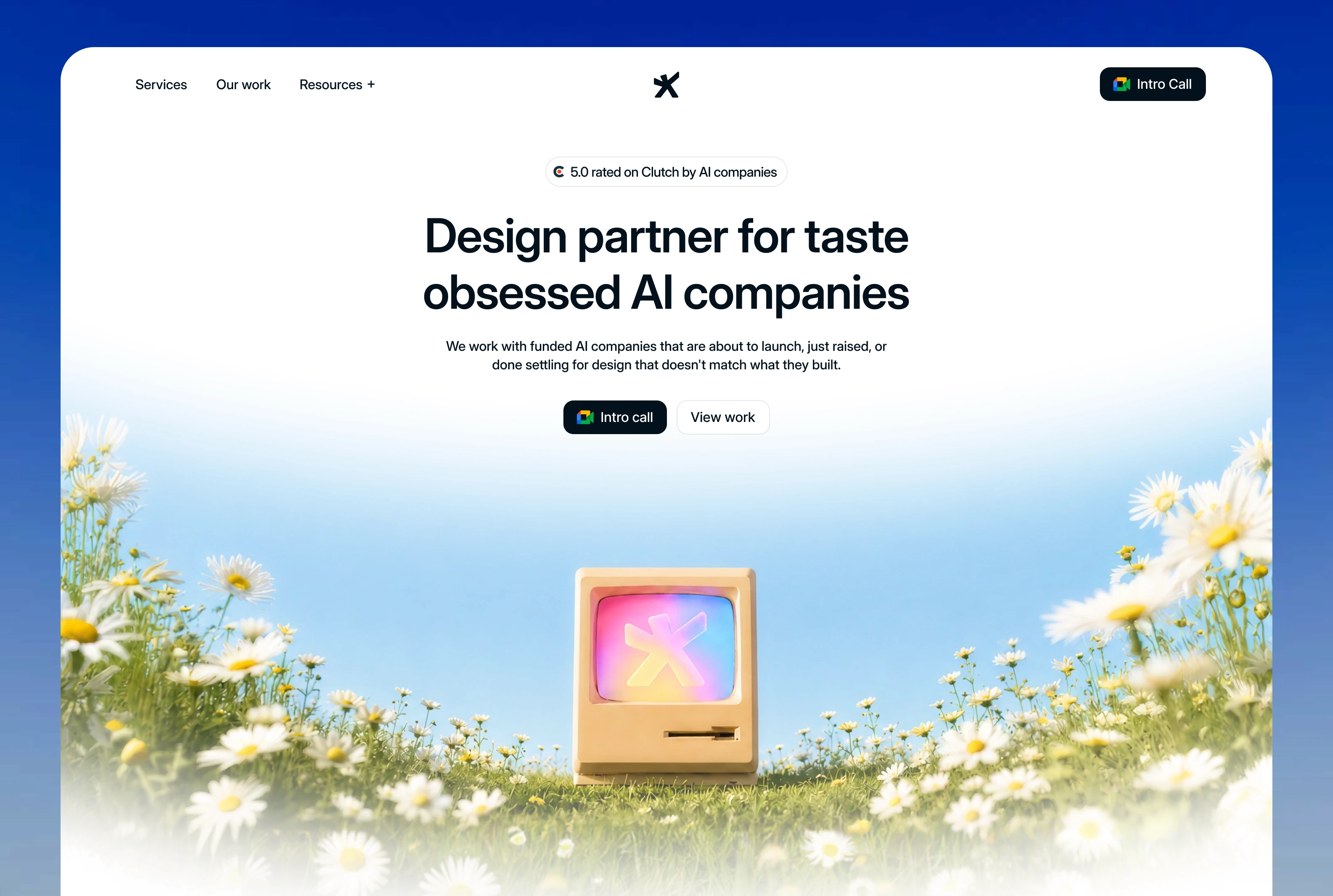
1. Studio Maydit: A Top-Rated Design Agency for AI Founders
Remote work is the default at Studio Maydit, not a policy added later. It is a web and product design studio. Most of its clients are AI founders, and they sit across the US, UK, and Europe, so reviews already happen in writing and in recorded walkthroughs.
A written scope with a fixed end date is easier to run across time zones than an open brief, which is why remote teams often start with fixed scope. It takes three to four weeks, suits a team with a launch date, and finishes with a diagnosis of what is leaking in the product, written up so people who missed the last call can still act on it. Teams that keep shipping move to a monthly retainer. That covers new pages, campaigns, and product design, with no long lock-in.
100,000+ users. Dualite reached that in seven months, after design work supporting a repositioned ICP. Other recent clients include Wave, PixelFlow, Mi-VAD, and 15 other AI and SaaS teams. On the build side, Framer lets a marketer in any time zone publish a page without waiting for an engineer. Webflow gives a distributed content team a CMS with clear roles. Custom code is for product screens your own engineers will extend. Work continues into product design after the site ships, so the same people carry the context forward.
Check | Finding |
|---|---|
Based in | Remote, serving US / UK / EU |
Platform depth | Framer, Webflow, and custom code |
AI-sector proof | Yes. AI-native clients, published outcome on Dualite |
Pricing | Fixed scope or monthly retainer, quoted per project |
Team shape | Founder-led, small senior team |
Best fit | Remote-first teams that want UX work documented well enough to build from without a call |
If your engineers keep asking what a screen is supposed to do, start there. Book a 30-minute call.

2. Lazarev
Lazarev is a San Francisco product studio of 51 to 200, founded in 2015, with Payoneer, Peel, Elva, and Mozayix on its list and published AI work. Its practice starts with research, which is the part remote teams most often lose. Payoneer is a useful reference here, since payment tools serve users spread across many countries. A studio that treats interviews as evidence to be kept, not just a phase to finish, is more likely to hand over findings your whole team can reach. They also publish a starting price.
At this size, the people who pitch may not be the people in your file. Ask who runs the research and what hours they keep.
Check | Finding |
|---|---|
Based in | San Francisco, USA |
Founded | 2015 |
Team size | 51-200 |
Primary platform | Mixed |
AI-sector proof | Yes. Published AI client work |
Named clients | Payoneer, Peel, Elva, Mozayix |
Pricing | Published minimum |
Best fit | Remote-first teams that need user research they can revisit long after the project ends |
3. Pixelmatters
Pixelmatters works from Porto, Portugal, with a team of 51 to 200, and has built digital products since 2013. Porto's working day overlaps US mornings and the rest of Europe, which gives a spread-out team one shared window every day. A studio of that size can also staff a project so someone is always online during that window. Rubrik, Quantic, and UJET are named, and a starting price is public.
AI-sector proof is partial. There are tech and SaaS clients but no AI case study, so model-specific screens would be newer work for them.
Check | Finding |
|---|---|
Based in | Porto, Portugal |
Founded | 2013 |
Team size | 51-200 |
Primary platform | Mixed |
AI-sector proof | Partial. Tech and SaaS clients, no AI case study |
Named clients | Rubrik, Quantic, UJET |
Pricing | Published minimum |
Best fit | Teams split between the US and Europe that need one daily overlap with their design partner |
4. Clay
Clay is a San Francisco studio of 51 to 200, running since 2016, with Slack, Stripe, Google, Coinbase, and Amazon named and a published starting price. Slack is the telling reference for this list. It is a tool many remote teams live inside, and designing it meant thinking hard about how people work when they are not in the same room.
Clay works at premium scale and on its own terms. A small remote team may struggle to get senior attention in the hours it needs.
Check | Finding |
|---|---|
Based in | San Francisco, USA |
Founded | 2016 |
Team size | 51-200 |
Primary platform | Mixed |
AI-sector proof | Yes. Published AI client work |
Named clients | Slack, Stripe, Google, Coinbase, Amazon |
Pricing | Published minimum |
Best fit | Well-funded remote companies whose product itself is a collaboration tool |
5. Ramotion
Ramotion has worked from San Francisco since 2009 with 11 to 50 people, and names Mozilla, Okta, Netflix, Adobe, and Xero. Its strength is design systems. For a remote team, a well-documented system is the thing that stops five engineers in five time zones from building five versions of the same button. They publish a starting price too.
There is no AI case study, and their hours sit on the US West Coast, which leaves little overlap for a team based mainly in Europe.
Check | Finding |
|---|---|
Based in | San Francisco, USA |
Founded | 2009 |
Team size | 11-50 |
Primary platform | Mixed |
AI-sector proof | Partial. Tech and SaaS clients, no AI case study |
Named clients | Mozilla, Okta, Netflix, Adobe, Xero |
Pricing | Published minimum |
Best fit | Remote teams whose UI is drifting because nobody owns a shared component library |

6. Instrument
Instrument has worked out of Portland since 2005 for Nike, Microsoft, Electronic Arts, and Google. It is an established studio that works across platforms rather than in one tool. Microsoft is the reference a remote team might care about, since its tools shape how millions of people work apart. A studio used to briefs at that scale will be comfortable with formal reviews and written sign-off.
Team size and pricing are both unpublished, and AI proof is partial. Its published work leans toward brand and campaigns more than day-to-day product UX.
Check | Finding |
|---|---|
Based in | Portland, USA |
Founded | 2005 |
Team size | Not published |
Primary platform | Mixed |
AI-sector proof | Partial. Tech and enterprise clients, no AI case study |
Named clients | Nike, Microsoft, Electronic Arts, Google |
Pricing | Not published |
Best fit | Larger remote companies that need a product launch and its brand designed together |
7. Engine Digital
Engine Digital runs from two offices, Vancouver and New York, and has done so since 2002. It builds in custom code for Adidas, Autodesk, Goldman Sachs, and HP. Working between two cities for over two decades usually means habits a remote client benefits from, such as written specs and planned handoffs between locations. Design and front-end code also come from one partner, so there is one less handoff to manage across time zones.
Both offices sit in North American time zones, and the studio publishes no team size or pricing. AI proof is partial.
Check | Finding |
|---|---|
Based in | Vancouver and New York |
Founded | 2002 |
Team size | Not published |
Primary platform | Custom code |
AI-sector proof | Partial. Tech and enterprise clients, no AI case study |
Named clients | Adidas, Autodesk, Goldman Sachs, HP |
Pricing | Not published |
Best fit | North American remote teams that want design and front-end code from one partner |
8. Push Refresh
Push Refresh is a Dallas studio of 1 to 10 that works in Framer, names SmithRx, Synonym, and Northern National, and publishes a starting price. With a team that small, you talk to the person doing the work, and a Framer site can be updated by anyone on your side at any hour. Central time also sits between both US coasts.
The gap is depth. Their published work is marketing sites, not product flows, so they are a fit for the website around your product rather than the product itself.
Check | Finding |
|---|---|
Based in | Dallas, USA |
Founded | Not published |
Team size | 1-10 |
Primary platform | Framer |
AI-sector proof | Partial. Tech and SaaS clients, no AI case study |
Named clients | SmithRx, Synonym, Northern National |
Pricing | Published minimum |
Best fit | Remote teams that need a clear marketing site explaining the product, not the product UX |
9. SuperSkills
SuperSkills is a very small Walnut Creek studio of 1 to 10 with published AI work and The Cut as its named client. For a remote team with a tight budget and one clear screen to fix, a single focused designer can be a good match. The published AI work also means less time spent explaining how a model behaves.
Small is the problem here. A remote-first team needs someone awake across several time zones and a backup when a person is out. One public client and no published pricing make it hard to judge further.
Check | Finding |
|---|---|
Based in | Walnut Creek, USA |
Founded | Not published |
Team size | 1-10 |
Primary platform | Mixed |
AI-sector proof | Yes. Published AI client work |
Named clients | The Cut |
Pricing | Not published |
Best fit | Small remote teams that need one screen or one demo flow improved |
10. Lighthouse Digital
Lighthouse Digital is a London Webflow studio with HelloSelf, Freetrade, and IGN named and a published starting price. London hours suit a team spread across the UK and Europe, and Webflow lets a distributed marketing team edit without a developer. A named fintech client, Freetrade, shows they can work with a regulated product team.
It is the wrong fit for product UX. The practice is Webflow websites, there is no published AI work, and founding year and team size are not published.
Check | Finding |
|---|---|
Based in | London, UK |
Founded | Not published |
Team size | Not published |
Primary platform | Webflow |
AI-sector proof | No. No published AI client work |
Named clients | HelloSelf, Freetrade, IGN |
Pricing | Published minimum |
Best fit | European remote teams that need a Webflow marketing site rather than product design |
How to choose between them
Start with the question your engineers ask most often.
"Why did we build it this way?" Your research is missing or locked away. Lazarev or Studio Maydit, both of whom treat findings as something to hand over.
"Which button is the real one?" You need a shared system. Ramotion or Clay.
"Who is awake to answer this?" Pick for time zone overlap first. Pixelmatters for a US and Europe split, Engine Digital for a team that sits in North America.
"Can someone just fix the website?" That is not a UX problem. Push Refresh or Lighthouse Digital.
Then run one simple test. Ask each studio for a file from a past project, with names removed, and give it to an engineer who has never seen it. If they can explain the main flow in ten minutes without help, the studio designs for remote teams. If they cannot, it designs for meetings.

Need more info?
Can't find your answer? Book a call and let's talk.
Continue Reading
10 Best Framer Design Agencies for AI Agent Startups - September 2026
What is the best Framer agency for an AI agent startup? Ten Framer studios ranked for agent products, with pricing, team size and AI work compared.

Siddarth Ponangi
10 Best Framer Design Agencies for Newly Funded Startups - September 2026
Your funding announcement is the biggest traffic day you will have all year. We checked 10 Framer agencies on five public criteria to see which can hit that date.
Siddarth Ponangi
10 Best Custom Code Website Development Agencies for AI Agent Startups - September 2026
AI web development agencies for agent startups. Which teams build custom coded sites a small team can still update weekly after launch.
Siddarth Ponangi