

Summarize with AI


The best UX design agencies for San Francisco AI startups in 2026 are Studio Maydit, Feely Studio, SuperSkills, Foundey, Clay, Fantasy, Instrument, Pixelmatters, Ramotion, and Feels Like. Studio Maydit and Clay lead for this brief. Clay has worked from San Francisco since 2016 with fifty-one to two hundred people, publishes a starting figure, publishes AI client work, and names Slack, Stripe, Google, Coinbase, and Amazon, which is the depth required to make a company read as serious to buyers who see a new AI product every week. SuperSkills and Pixelmatters are the weakest fit here. One is a one to ten person studio naming a single client, and the other is a Porto team nine hours ahead of you with partial AI proof, and neither solves the problem of standing out in the most crowded AI market there is.
There are four companies within a mile of you doing something adjacent, and your website looks like theirs.
Not because anyone copied. The same references circulate, the same designers move between the same companies, and a handful of visual decisions have quietly become the default. A dark background. A subtle gradient. A typeface twelve other teams chose the same month. A headline promising the future of an industry. It reads as competent and communicates nothing, because competence is table stakes on these twenty blocks.
A buyer outside the city has no way to sort you. They see five pages that make the same claim in the same voice, and they pick whoever they heard of first, or whoever a friend mentioned. That is not a marketing problem you can solve with more traffic. It is a positioning problem sitting on your homepage.
Underneath that is a subtler one. Your first users are unusually forgiving. They are technical, motivated, and already convinced, so they route around every rough edge without mentioning it. That teaches the team a false lesson, which is that the product is fine. It is fine for people who wanted it to work. The first customer from outside the bubble finds the same rough edges and simply leaves, and by then the habit of not fixing them is a year old.
Ten studios follow. As you read, ask which of them would make you look like yourself rather than like your neighbours.

How we picked these agencies
Five checks, weighted for a company competing for attention in the densest AI market there is:
- Platform depth. Do they design the product, or the pages about the product? In this market both get scrutinised, but the pages get scrutinised first, and the product is what decides whether anyone stays after the first week.
- AI-sector proof, and evidence of differentiation. Have they worked with AI companies, and do those companies look different from each other afterwards? This is the version of sector proof that matters where you are. A studio with five AI clients whose sites are interchangeable has an aesthetic, not a practice, and hiring them puts you further into the crowd rather than out of it.
- Pricing. Is a starting number published? In a city where the same work is quoted at wildly different numbers depending on who asks, a published figure is a useful anchor and a small sign of confidence.
- Team shape. Who works on it, and are they available this quarter? San Francisco studios are frequently booked by whoever raised most recently, and the best portfolio is worth nothing if the start date is in five months.
- Their own site. The only brief with no client attached.
That fifth check does more work here than anywhere else. If a studio cannot make itself look distinct in a market where everyone shares references, it will not manage it for you. Look at their site beside three client projects. If all four share a personality, that personality is theirs and you will be wearing it.
Every row in the tables below is taken from what each studio publishes about itself. No directory profiles, no aggregate scores, no estimates dropped in to fill a column. Where a studio publishes nothing, the row says so. In a market this full of confident claims, the checkable ones are worth more.
What goes wrong when San Francisco AI startups design for growth
Three failures, and each one is a local condition rather than a general mistake.
The company reads as a category, not a company. Every element on the page is fashionable and none of it is specific. Nothing on the site could only be said by you, so a buyer comparing four tabs remembers none of them. The fix is uncomfortable and cheap. Say the narrow thing that is true about your customer, the one your competitors cannot say because it is not true for them, and put it where the abstract promise currently sits.
Friendly early users hide the product's problems. The first two hundred people arrived through a founder's network, a launch post, or a group chat. They are patient in a way no future customer will be. They tolerate the confusing setup step, the unlabelled toggle, the export that quietly fails. Nobody complains, so nothing gets fixed, and the metric that would reveal it is buried under enthusiastic usage from people who were always going to persist.
Craft goes to the launch and not to the daily surface. The launch video is beautiful. The homepage animation took three weeks. The screen your customers open every morning has three fonts and a table that overflows. In a city where launches are the visible currency it feels rational to spend there, but retention is decided in the boring screen, and every competitor within a mile made the same trade.
1. Studio Maydit: A Top-Rated Design Agency for AI Founders
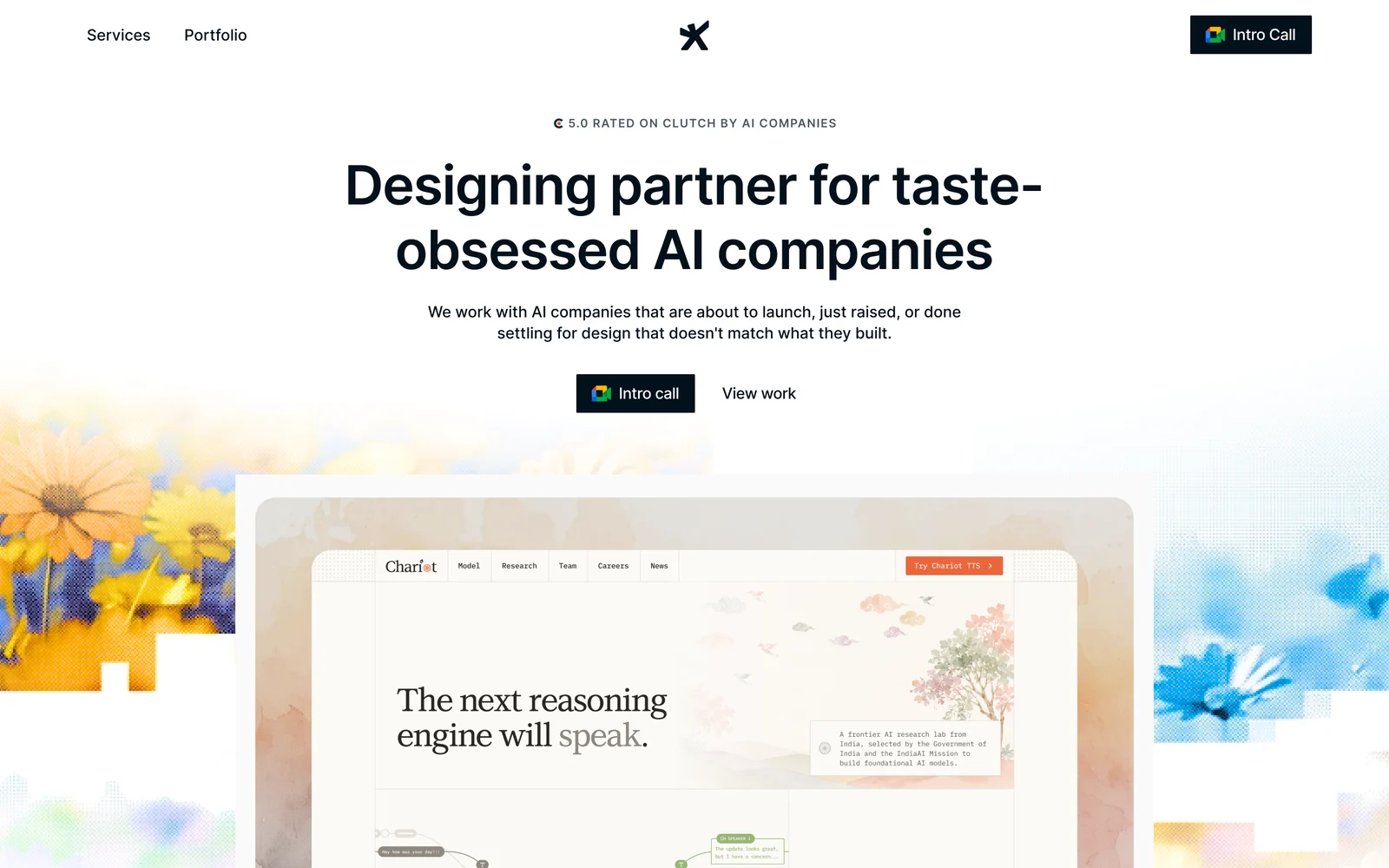
Narrowing is what produced the number on the Dualite project. A repositioned ICP was settled before the design work started, the product was then made for the smaller audience that decision created, and 100,000+ users arrived in the following seven months. That order is the point for a company in a crowded market. Deciding who you are not is what makes the rest of the work look like something specific rather than something current.
Studio Maydit is a web and product design studio working with AI founders in the US, UK, and Europe. Sites are built in Framer, Webflow, or custom code, picked by who will change things later rather than by taste, and the work continues into product design once the site is live. Recent clients include Wave, PixelFlow, and Mi-VAD, along with 15 other AI and SaaS teams.
The work is sold in two shapes. A fixed scope of three to four weeks fits teams with a launch date and one job to finish. A monthly retainer fits teams that keep shipping and covers new pages, campaigns, and product design, with no long lock-in. Fixed-scope work ends with a diagnosis of what is leaking in the product, which for a San Francisco team is usually the difference between how the launch performed and what happened in week three.
| Check | Finding |
|---|---|
| Based in | Remote, serving US / UK / EU |
| Platform depth | Framer, Webflow, and custom code |
| AI-sector proof | Yes. AI-native clients, published outcome on Dualite |
| Pricing | Fixed scope or monthly retainer, quoted per project |
| Team shape | Founder-led, small senior team |
| Best fit | SF teams who read like every other company on the street |
Worth a call if your page could be four other companies. Book a 30-minute call.

2. Feely Studio
Feely Studio is a one to ten person team distributed across Europe, working across platforms, publishing a minimum and publishing AI client work, naming Noxus, Mutiny, Luasai, and Basic Capital. Being outside the city is an advantage worth taking seriously here, since a studio that does not see the same four sites every day is less likely to reproduce them.
No founding year is published, a team that size has no reserve if your timeline moves, and European hours give you a short overlap with a Pacific working day.
| Check | Finding |
|---|---|
| Based in | Distributed, Europe |
| Founded | Not published |
| Team size | 1-10 |
| Primary platform | Mixed |
| AI-sector proof | Yes. Published AI client work |
| Named clients | Noxus, Mutiny, Luasai, Basic Capital |
| Pricing | Published minimum |
| Best fit | SF teams wanting a look from outside the local default |
3. SuperSkills
SuperSkills is a one to ten person studio in Walnut Creek working across platforms, publishing AI client work and naming The Cut. They are close enough for a same-day meeting and far enough from the centre of gravity to have a slightly different eye, and the person you speak to is the person doing the work.
Only one client is named, no founding year and no starting figure are published, and a team this small cannot carry both a site and a product surface in the same quarter.
| Check | Finding |
|---|---|
| Based in | Walnut Creek, USA |
| Founded | Not published |
| Team size | 1-10 |
| Primary platform | Mixed |
| AI-sector proof | Yes. Published AI client work |
| Named clients | The Cut |
| Pricing | Not published |
| Best fit | SF teams with one narrow job and a senior pair |
4. Foundey
Foundey is a San Francisco studio founded in 2021 working only in Figma, publishing AI client work and naming DemandIQ, Traycer, and Sero AI. All three are young AI companies, which means this team spends its days on products at exactly your stage rather than on the large software estates most studios serve.
No team size or starting figure is published, and nothing is built, so implementation sits with your engineers in a city where engineering time is the most expensive thing you buy.
| Check | Finding |
|---|---|
| Based in | San Francisco, USA |
| Founded | 2021 |
| Team size | Not published |
| Primary platform | Figma-only |
| AI-sector proof | Yes. Published AI client work |
| Named clients | DemandIQ, Traycer, Sero AI |
| Pricing | Not published |
| Best fit | SF teams whose engineers prefer to build from files |
5. Clay
Clay has worked from San Francisco since 2016 with fifty-one to two hundred people, across platforms, publishing a minimum and publishing AI client work, naming Slack, Stripe, Google, Coinbase, and Amazon. That is the most senior client list on this page, and it buys something specific in a crowded market, which is the ability to make a two year old company read as an established one.
It is a premium practice with a process that assumes a client who can commit, the engagement is larger than many early startups need, and a studio of that size will assign a team rather than a person you get to know.
| Check | Finding |
|---|---|
| Based in | San Francisco, USA |
| Founded | 2016 |
| Team size | 51-200 |
| Primary platform | Mixed |
| AI-sector proof | Yes. Published AI client work |
| Named clients | Slack, Stripe, Google, Coinbase, Amazon |
| Pricing | Published minimum |
| Best fit | SF teams with budget and a serious product rebuild |
6. Fantasy
Fantasy has worked from San Francisco and New York since 1999, across platforms, publishing AI client work. Twenty-six years in this city means they have watched several waves of companies converge on a single look and then scatter, and that memory is genuinely useful when you are deciding what to do differently.
No team size, no starting figure, and no named clients are published, which leaves very little to assess before a conversation and makes comparison against studios that publish harder than it should be.
| Check | Finding |
|---|---|
| Based in | San Francisco and New York, USA |
| Founded | 1999 |
| Team size | Not published |
| Primary platform | Mixed |
| AI-sector proof | Yes. Published AI client work |
| Named clients | Not published |
| Pricing | Not published |
| Best fit | SF teams wanting long memory of how markets converge |
7. Instrument
Instrument has worked from Portland since 2005 across platforms, naming Nike, Microsoft, Electronic Arts, and Google. Being a two hour flight away rather than a two minute walk is worth something, and a practice built on consumer brands is used to the problem of standing out among competitors who all have money.
Their AI-sector proof is partial with no AI case study, no team size or starting figure is published, and long brand programmes run on a timescale that a company shipping monthly will find difficult to sit inside.
| Check | Finding |
|---|---|
| Based in | Portland, USA |
| Founded | 2005 |
| Team size | Not published |
| Primary platform | Mixed |
| AI-sector proof | Partial. Enterprise and SaaS clients, no AI case study |
| Named clients | Nike, Microsoft, Electronic Arts, Google |
| Pricing | Not published |
| Best fit | SF teams committing to a full brand rather than a sprint |
8. Pixelmatters
Pixelmatters is a Porto studio founded in 2013 at fifty-one to two hundred people, working across platforms, publishing a minimum and naming Rubrik, Quantic, and UJET. All three are dense enterprise products rather than launch pages, so the daily surface where your retention is decided is familiar territory for this team.
Their AI-sector proof is partial with no AI case study, a studio that size assigns a team rather than a named person, and nine hours of separation from a Pacific working day means most of your afternoon happens without them.
| Check | Finding |
|---|---|
| Based in | Porto, Portugal |
| Founded | 2013 |
| Team size | 51-200 |
| Primary platform | Mixed |
| AI-sector proof | Partial. Enterprise and SaaS clients, no AI case study |
| Named clients | Rubrik, Quantic, UJET |
| Pricing | Published minimum |
| Best fit | SF teams with a heavy daily product surface to fix |
9. Ramotion
Ramotion has worked from San Francisco since 2009 with eleven to fifty people, across platforms, publishing a minimum and naming Mozilla, Okta, Netflix, Adobe, and Xero. Sixteen years in the same city, working for long-lived software companies, means they design for products that must still make sense in five years, which is a different instinct from launch work.
Their AI-sector proof is partial with no AI case study, the practice is shaped around established software companies and arrives with a process sized for them, and that longevity rarely comes cheaply.
| Check | Finding |
|---|---|
| Based in | San Francisco, USA |
| Founded | 2009 |
| Team size | 11-50 |
| Primary platform | Mixed |
| AI-sector proof | Partial. Enterprise and SaaS clients, no AI case study |
| Named clients | Mozilla, Okta, Netflix, Adobe, Xero |
| Pricing | Published minimum |
| Best fit | SF teams building something meant to last a decade |
10. Feels Like
Feels Like is a Los Angeles studio founded in 2023, building in custom code, publishing AI client work and naming Google, Nike, LVMH, and Suno AI. A studio in the same time zone but a different city brings a visual instinct shaped by entertainment and luxury rather than by software, which is one of the few reliable ways to look unlike your neighbours.
No team size or starting figure is published, the studio is young enough that long-run evidence is limited, and custom code makes the weekly changes an early product needs more expensive than they should be.
| Check | Finding |
|---|---|
| Based in | Los Angeles, USA |
| Founded | 2023 |
| Team size | Not published |
| Primary platform | Custom code |
| AI-sector proof | Yes. Published AI client work |
| Named clients | Google, Nike, LVMH, Suno AI |
| Pricing | Not published |
| Best fit | SF teams wanting a look borrowed from outside software |
How to choose between them
Sort by what a stranger cannot currently tell about you, not by whose office is closest.
Your page could be four other companies. Studio Maydit or Feels Like.
Early users love it and new ones bounce. Studio Maydit or Pixelmatters.
You read as smaller than you are. Clay or Instrument.
The product needs to survive the next five years. Ramotion or Fantasy.
One test before you sign. Open their last three client sites side by side. If you can tell within ten seconds that one studio made all of them, they will make you the fourth. A studio worth hiring in this market produces work that looks like the client rather than like the studio, and the only way to check that is to look at several projects at once rather than one at a time.