

Summarize with AI


The best UX design agencies for seed-stage AI startups in 2026 are Studio Maydit, basement.studio, Feely Studio, SuperSkills, 8020, Edgar Allan, Clay, Fantasy, Engine Digital, and Refokus. Studio Maydit and basement.studio lead for this brief. basement.studio has worked from Argentina and Los Angeles since 2018 with eleven to fifty people, builds in custom code, publishes a starting figure, and names Vercel, Cursor, ElevenLabs, Harvey AI, and Scale AI, which is a client list made almost entirely of companies that were seed-stage recently. Engine Digital and Edgar Allan are the weakest fit here. Both are built for large organisations with brand budgets and long approval chains, and neither shape survives contact with a team of seven deciding things in a group chat.
Every customer you have was closed by a founder on a call.
That is not a criticism. It is how seed-stage companies get their first ten customers and it works. But it means the product has never had to explain itself. Someone was always there to say what the screen meant, to skip the confusing part, to reframe an odd result as an early version. Every piece of evidence you have about whether the product is understandable was collected with a translator present.
The bill arrives at the same point for everyone. You try to sell without the call. A prospect signs up on a Tuesday, opens the product alone, and nobody is there to explain that the empty state is empty because they have not connected anything. They leave, no ticket is filed, and your dashboard records it as a signup.
There is a deadline attached, which is what makes seed different from earlier. You have somewhere between twelve and twenty months to produce evidence that the thing works without you. Not a bigger vision, not a nicer interface. Evidence that a stranger can arrive, understand what this is, and get a result.
Ten studios follow. As you read, ask which of them would sit and watch a stranger use your product before proposing anything.

How we picked these agencies
Five checks, weighted for a company with one round in the bank and a number to prove:
- Platform depth. Can they work on the product, or only on the page in front of it? At seed both matter, because the site has to sell a thing that is not finished while the product has to hold the people the site attracts. A studio that only does one half will do that half well and hand you back the gap.
- Proof with venture-backed companies at your stage. Have they worked with seed and Series A teams, not just funded ones? The distinction is real. A studio whose smallest client has forty people assumes a product manager, a researcher, and a quarter to decide things. You have none of those, and an engagement built on that stalls in week two.
- Pricing. Is a starting figure public? Your money is finite and dated. A studio that publishes a number lets you rule it in or out in a minute instead of after two calls and a proposal.
- Team shape. How many people, how senior, and who will actually be on your project? Seniority is the thing you are buying at this size, because you are paying for the decision, not for the hours.
- Their own site. Their only unbriefed piece of work.
Check five costs nothing and tells you a lot. Nobody constrained the studio's own site, so it shows what they do when they decide for themselves. Read it for clarity above all. If you cannot tell what the studio does within ten seconds, they will not make your product legible to a stranger in thirty.
Everything in the tables below comes from what each studio publishes about itself. No directory listings, no ranking sites, no gaps filled with a reasonable guess. Where nothing is published, the row says so. You are being asked to spend scarce money on this list, so it had better show its sources.
What goes wrong when seed-stage AI startups hire design
Three failures, and each one is a version of designing for the founder rather than for the stranger.
The rebrand arrives before the product is understood. New mark, new palette, a considered site, and the underlying confusion is untouched because nobody looked at it. It feels like progress and it photographs well. The test is simple. If the redesign does not change what a new user does in their first five minutes, it did not address your actual problem.
Onboarding is designed for people who already know. The team knows what the product does, so the empty state assumes context, the first screen offers eleven options, and the sample data is a case the founders find interesting rather than the one customers arrive with. Watch three strangers instead. The place they stop is the whole scope of the work.
The engagement outlives the company's certainty. A four-month plan is agreed in a month when the company believed one thing. Six weeks later the model changed, a customer said something inconvenient, and the plan is now describing a product nobody intends to build. At seed, buy in short increments that end with something shipped, and keep the right to change direction. Certainty here has a shelf life of about a fortnight.
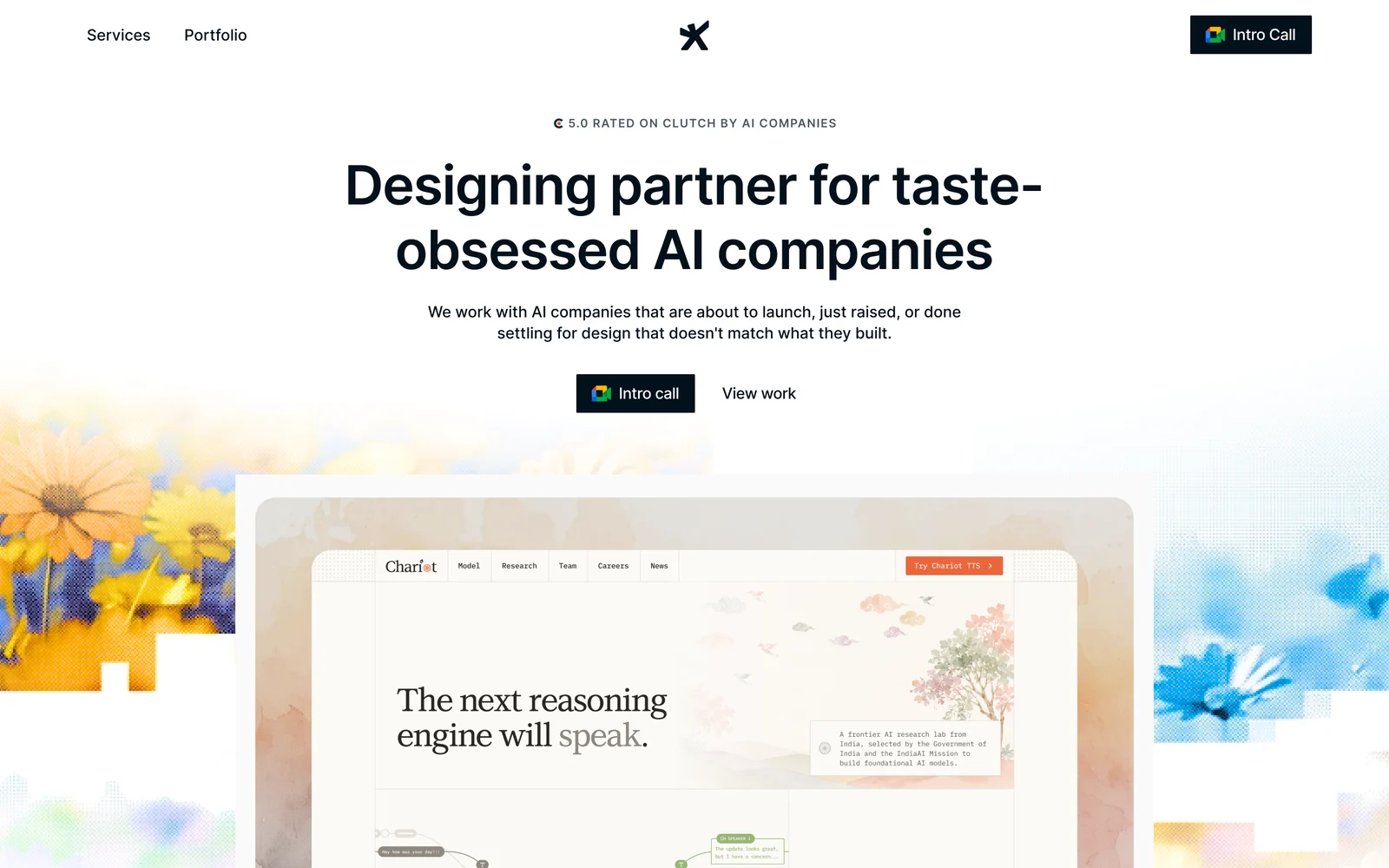
1. Studio Maydit: A Top-Rated Design Agency for AI Founders
The clearest evidence is Dualite. The engagement began with a repositioned ICP, which meant deciding which users the product would stop trying to serve, and the product was then designed for the ones who remained. It reached 100,000+ users in seven months. Recent clients include Wave, PixelFlow, and Mi-VAD, along with 15 other AI and SaaS teams.
Studio Maydit is a web and product design studio working with AI founders in the US, UK, and Europe. Builds happen in Framer, Webflow, or custom code, chosen by asking who has to edit the thing once the studio has gone. The same people continue into product design after the site ships, so the person who wrote your positioning is the person shaping the first screen a stranger sees.
For a company with a runway and a round to raise, the fixed scope is usually the right shape. It runs three to four weeks, ends on a date, and produces something shipped rather than a plan. Teams already shipping every week take a monthly retainer instead, covering new pages, campaigns, and product design, with no long lock-in. Either way, fixed-scope work finishes with a written diagnosis of what is leaking in the product, which at seed is normally two or three specific things rather than a strategy.
| Check | Finding |
|---|---|
| Based in | Remote, serving US / UK / EU |
| Platform depth | Framer, Webflow, and custom code |
| AI-sector proof | Yes. AI-native clients, published outcome on Dualite |
| Pricing | Fixed scope or monthly retainer, quoted per project |
| Team shape | Founder-led, small senior team |
| Best fit | Seed teams whose product has never been used without a founder present |
Worth a call if your signups are fine and your activation is not. Book a 30-minute call.

2. basement.studio
basement.studio has worked from Mar del Plata and Los Angeles since 2018 with eleven to fifty people, in custom code, publishing a starting figure and AI client work, and naming Vercel, Cursor, ElevenLabs, Harvey AI, and Scale AI. Nearly every one of those was a small AI company recently, so the studio has worked at your size rather than scaled a large-company process down to fit you.
Custom code means your team needs someone who can maintain what they build, and a studio with that client list is in demand, so the start date is often the constraint rather than the fee.
| Check | Finding |
|---|---|
| Based in | Mar del Plata, Argentina and Los Angeles, USA |
| Founded | 2018 |
| Team size | 11-50 |
| Primary platform | Custom code |
| AI-sector proof | Yes. Published AI client work |
| Named clients | Vercel, Cursor, ElevenLabs, Harvey AI, Scale AI |
| Pricing | Published minimum |
| Best fit | Seed AI teams who want work matching their peers' standard |
3. Feely Studio
Feely Studio is a one to ten person team distributed across Europe, working across platforms, publishing a starting figure and AI client work, and naming Noxus, Mutiny, Luasai, and Basic Capital. Small, senior and openly priced is the shape that fits a seven-person company best, because you get one person's judgement rather than a team's process, and you can decide in an afternoon.
No founding year is published, a team that size has no capacity in reserve if your scope moves, and the European working day leaves a short overlap for a US team that decides things after lunch.
| Check | Finding |
|---|---|
| Based in | Distributed, Europe |
| Founded | Not published |
| Team size | 1-10 |
| Primary platform | Mixed |
| AI-sector proof | Yes. Published AI client work |
| Named clients | Noxus, Mutiny, Luasai, Basic Capital |
| Pricing | Published minimum |
| Best fit | Seed teams wanting one senior opinion at a known price |
4. SuperSkills
SuperSkills is a one to ten person studio in Walnut Creek, California, working across platforms, publishing AI client work and naming The Cut. Being both small and on Pacific time is a practical combination for a US seed team, since questions get answered the same day rather than being queued for tomorrow morning.
One named client is thin evidence, no founding year or starting figure is published, and a studio this size cannot absorb a scope that grows, which at seed it usually does.
| Check | Finding |
|---|---|
| Based in | Walnut Creek, USA |
| Founded | Not published |
| Team size | 1-10 |
| Primary platform | Mixed |
| AI-sector proof | Yes. Published AI client work |
| Named clients | The Cut |
| Pricing | Not published |
| Best fit | US seed teams wanting same-day answers from a small studio |
5. 8020
8020 has worked from San Francisco and New York since 2014 in Webflow, naming Wave, Superlist, Pilot.com, Vanta, and Circle. That is a list of venture-backed software companies rather than enterprises, which means they have worked inside the constraint you are under, where the site has to be live before the product is finished.
No starting figure and no team size are published, their AI-sector proof is partial with no AI case study, and Webflow gets you an excellent site but leaves the product surface where activation is actually failing.
| Check | Finding |
|---|---|
| Based in | San Francisco and New York, USA |
| Founded | 2014 |
| Team size | Not published |
| Primary platform | Webflow |
| AI-sector proof | Partial. Enterprise and SaaS clients, no AI case study |
| Named clients | Wave, Superlist, Pilot.com, Vanta, Circle |
| Pricing | Not published |
| Best fit | Seed teams needing a credible site before the product is done |
6. Edgar Allan
Edgar Allan has worked from Atlanta since 2014 with fifty-one to two hundred people, mainly in Webflow, naming Porsche, Duracell, and NCR. A practice grounded in consumer brands is good at making an unfamiliar thing feel established, which is a real problem for a seed AI company asking a stranger to trust software that behaves differently every time.
No starting figure is published, their AI-sector proof is partial with no AI case study, and an agency at that headcount assumes a brand budget and a review cycle that a seven-person company does not have.
| Check | Finding |
|---|---|
| Based in | Atlanta, USA |
| Founded | 2014 |
| Team size | 51-200 |
| Primary platform | Webflow |
| AI-sector proof | Partial. Enterprise and SaaS clients, no AI case study |
| Named clients | Porsche, Duracell, NCR |
| Pricing | Not published |
| Best fit | Seed teams needing to look established to a cautious buyer |
7. Clay
Clay has worked from San Francisco since 2016 at fifty-one to two hundred people across platforms, publishing a starting figure and AI client work, and naming Slack, Stripe, Google, Coinbase, and Amazon. Those are products people learn to use without training, which is precisely the skill a seed company needs when it stops being able to demo every account personally.
That headcount means a team rather than a named senior person, and a studio with those clients is priced for companies several rounds ahead of you, so a full engagement is likely to consume more of a seed round than it should.
| Check | Finding |
|---|---|
| Based in | San Francisco, USA |
| Founded | 2016 |
| Team size | 51-200 |
| Primary platform | Mixed |
| AI-sector proof | Yes. Published AI client work |
| Named clients | Slack, Stripe, Google, Coinbase, Amazon |
| Pricing | Published minimum |
| Best fit | Seed teams with budget for product work at a senior standard |
8. Fantasy
Fantasy has worked from San Francisco and New York since 1999 across platforms and publishes AI client work. A studio operating since 1999 has watched several generations of interface convention arrive and leave, which is useful perspective when your whole category is inventing its conventions in public this year.
No named clients, no team size, and no starting figure are published. For a company that has to justify every line of spend to two or three people who all have opinions, three blank rows is a hard case to make.
| Check | Finding |
|---|---|
| Based in | San Francisco and New York, USA |
| Founded | 1999 |
| Team size | Not published |
| Primary platform | Mixed |
| AI-sector proof | Yes. Published AI client work |
| Named clients | Not published |
| Pricing | Not published |
| Best fit | Seed teams valuing long perspective over published evidence |
9. Engine Digital
Engine Digital has worked from Vancouver and New York since 2002 in custom code, naming Adidas, Autodesk, Goldman Sachs, and HP. Twenty-three years of building for organisations that cannot afford a broken release brings a rigour most young studios lack, and two-coast coverage is convenient.
No team size and no starting figure are published, their AI-sector proof is partial with no AI case study, and an agency shaped around enterprise programmes will propose a process built for a client with a procurement department.
| Check | Finding |
|---|---|
| Based in | Vancouver and New York |
| Founded | 2002 |
| Team size | Not published |
| Primary platform | Custom code |
| AI-sector proof | Partial. Enterprise and SaaS clients, no AI case study |
| Named clients | Adidas, Autodesk, Goldman Sachs, HP |
| Pricing | Not published |
| Best fit | Seed teams selling into large, risk-averse organisations |
10. Refokus
Refokus is an eleven to fifty person remote German studio founded in 2021, working in Webflow, naming Mural, BASF, Spotify, Yahoo, and BCG. Getting that client list within four years suggests a studio that produces distinctive work quickly, which is worth something in a category where every homepage looks the same.
No starting figure is published, their AI-sector proof is partial with no AI case study, and Webflow keeps the engagement on the marketing site, which is not where a seed-stage activation problem lives.
| Check | Finding |
|---|---|
| Based in | Germany, remote |
| Founded | 2021 |
| Team size | 11-50 |
| Primary platform | Webflow |
| AI-sector proof | Partial. Enterprise and SaaS clients, no AI case study |
| Named clients | Mural, BASF, Spotify, Yahoo, BCG |
| Pricing | Not published |
| Best fit | Seed teams who need to stop looking like every other AI site |
How to choose between them
Sort by which part of the funnel is quietly broken, not by which studio you would most like to work with.
Strangers sign up and never activate. Studio Maydit or basement.studio.
The site is not credible enough to get the meeting. 8020 or Refokus.
Your buyer is a cautious enterprise. Edgar Allan or Engine Digital.
You need one senior decision, quickly and cheaply. Feely Studio or SuperSkills.
One test before you sign. Ask them to watch a recording of one real user failing, then say what they would change. A studio worth hiring will name the moment it went wrong and what they would do about it. A studio that responds with a proposal for a brand refresh has told you it would rather design the thing you can approve than the thing that is costing you customers.