

Summarize with AI


The best UX design agencies for Series A AI startups in 2026 are Studio Maydit, Instrument, Ramotion, BX Studio, basement.studio, Phantom, Feels Like, Refokus, Feely Studio, and Fantasy. Studio Maydit and Ramotion lead for this brief. Ramotion has worked from San Francisco since 2009 with eleven to fifty people, works across platforms, publishes a starting figure, and names Mozilla, Okta, Netflix, Adobe, and Xero, all products that had to stay coherent while the teams behind them grew. Fantasy and Refokus are the weakest fit here. One publishes no clients, no team size, and no starting figure, and the other has partial AI proof with no AI case study and works only in Webflow, which leaves the product untouched.
You hired eleven people this year, and every one of them is making design decisions.
Not deliberately. An engineer picks the nearest component. A new product manager writes a modal because that was the pattern at their last company. Someone in sales asks for a settings toggle and gets it. Each choice is small, sensible, invisible, and none of them cross your desk any more.
This is the real transition at Series A and almost nobody names it. Before the round, the product was coherent because one or two people held all of it in their heads and could feel when something did not belong. That mechanism does not scale past about fifteen people, and it fails quietly. Nothing breaks. The product stops having a point of view, one screen at a time, and by the time it is obvious there is a quarter of work to undo.
The second change is who has to sell. Your first customers were closed by a founder who could talk around any rough edge. Now there are account executives with quotas who cannot, and everything that needed explaining becomes a reason a deal stalls. A sales team is an expensive way to find out which screens were never finished.
And the clock is different from last time. Seed money bought you the right to find out whether it works. This money is buying evidence that it repeats, without you.
Ten studios follow. As you read, ask which of them would leave your team able to make these decisions without asking.

How we picked these agencies
Five checks, chosen for a company that has just outgrown the person who used to decide everything:
- Platform depth. Can they design the product and the site, and leave a system behind? Finished screens are worth less than rules your team can apply on Thursday without asking. Beautiful files with no system is the commonest way to waste a Series A design budget.
- Proof with venture-backed companies growing through this exact size. Have they worked with a company between twenty and sixty people, and did the work survive the next year of hiring? A studio whose clients are all tiny or enormous has not seen this failure and will design for the company you are today rather than the one you will be in nine months.
- Pricing. Is a starting figure published? You now have a finance function and a board deck, and a studio that publishes a floor can be compared without a three-week procurement exercise you have never run before.
- Team shape. How senior, how many, and who leads it? At this size you need someone who will argue with your new head of product, not someone who takes notes and returns with options.
- Their own site. The only brief where they were the client.
That last one is quick and revealing. With nobody to please, a studio's own site shows whether it can hold a position, which is precisely what you are buying. Your problem is a company of reasonable people each making a defensible local choice. The fix is not more opinions, it is one opinion written down clearly enough for eleven new hires to follow.
Everything in the tables below comes from what each studio publishes about itself. No listing sites, no ranked directories, no blanks filled with a plausible guess. Where nothing is published, the row says so. You are spending investor money here, so it ought to be traceable.
What goes wrong when Series A AI startups scale their design
Three failures, and each one is caused by growth rather than by neglect.
Consistency is treated as a taste problem. Someone notices the product looks messy and asks for a visual refresh. Two months later it looks tidier and drifts again within a quarter, because nothing changed about how decisions get made. Inconsistency at this size is an ownership problem in a visual costume. Without a written rule and a person who owns it, every clean-up is temporary.
The design system is built as a library rather than as a set of decisions. Forty components arrive in a file, none say when to use which, and engineers keep building their own because looking it up is slower than writing it. A system is useful only when it answers questions. Which pattern for a destructive action. What happens when the model is unsure. Components without answers are decoration with version control.
Nobody owns the parts between teams. Growth splits the product into areas and each team designs its own. The gaps belong to nobody, which is why onboarding, upgrade, and error states are your worst screens. Those are the journeys sales relies on. Assign them to a person by name, because at this size anything owned by everyone is owned by no one.
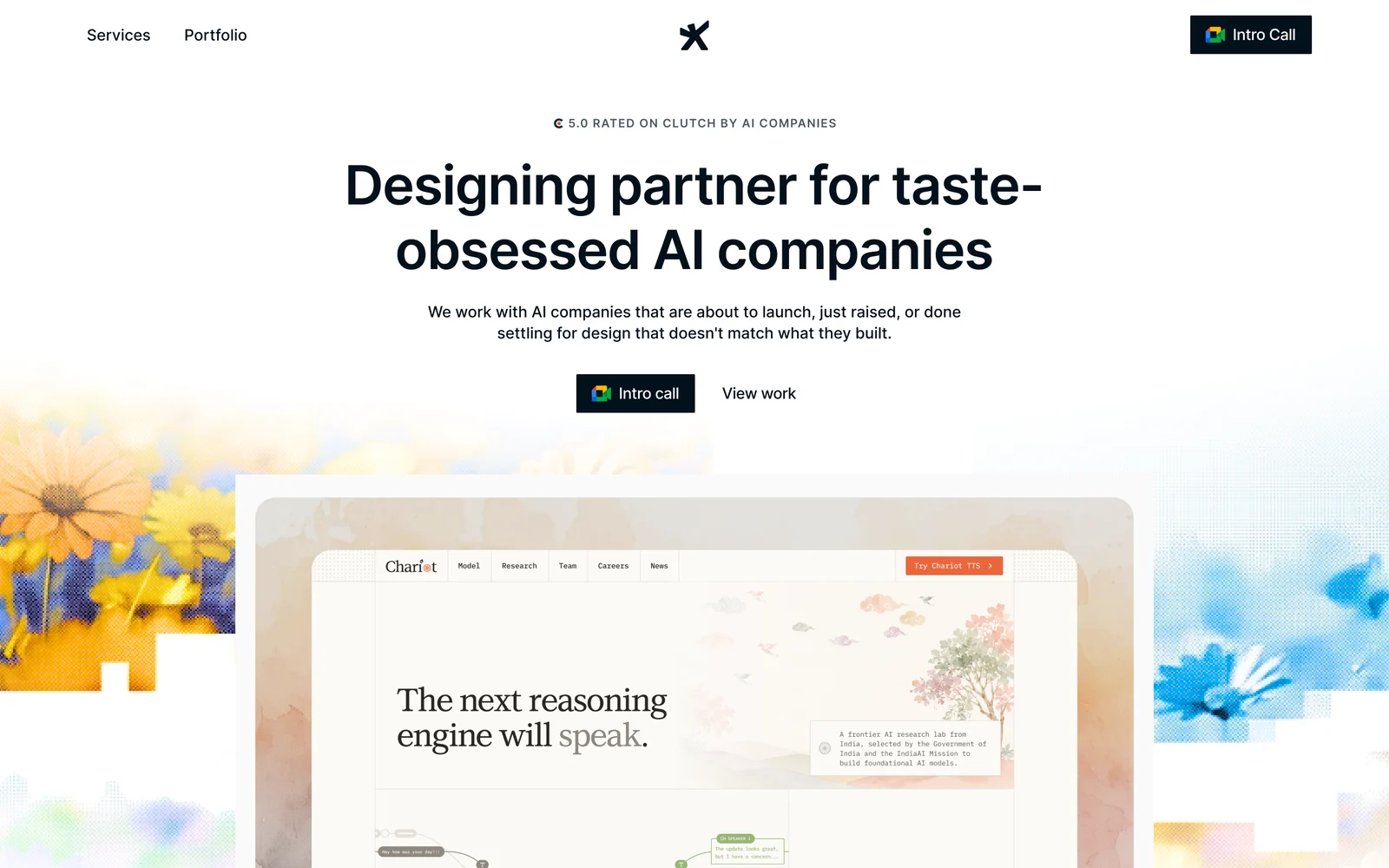
1. Studio Maydit: A Top-Rated Design Agency for AI Founders
The published outcome is Dualite. That work opened with a repositioned ICP, an explicit call about which users the product would stop serving, and everything after it was designed for the audience that remained. 100,000+ users arrived within seven months. Wave, PixelFlow, and Mi-VAD are among the recent clients, together with 15 other AI and SaaS teams.
There are two ways to buy. A fixed scope of three to four weeks suits a company with a specific surface to settle before a board meeting or a launch, and it ends with a written diagnosis of what is leaking in the product rather than a presentation. A monthly retainer suits teams shipping every week, covering new pages, campaigns, and product design, with no long lock-in, which is the shape that fits a company adding people faster than it adds process.
Studio Maydit is a web and product design studio working with AI founders in the US, UK, and Europe. Builds happen in Framer, Webflow, or custom code, and the platform is chosen by asking which of your growing team will be editing it. The studio continues into product design after the site ships, so the rules that govern the marketing surface are the same rules the product inherits instead of a second set nobody wrote down.
| Check | Finding |
|---|---|
| Based in | Remote, serving US / UK / EU |
| Platform depth | Framer, Webflow, and custom code |
| AI-sector proof | Yes. AI-native clients, published outcome on Dualite |
| Pricing | Fixed scope or monthly retainer, quoted per project |
| Team shape | Founder-led, small senior team |
| Best fit | Series A teams whose product lost its point of view during hiring |
Worth a call if your new hires keep asking you what the pattern is and there is no answer. Book a 30-minute call.

2. Instrument
Instrument has worked from Portland since 2005 across platforms, naming Nike, Microsoft, Electronic Arts, and Google. Twenty years with organisations that grew past individual oversight means they have seen which decisions hold a product together at scale and which are preferences with a strong advocate behind them.
Their AI-sector proof is partial with no AI case study, no team size or starting figure is published, and a long brand programme is a slow answer for a company that needs its onboarding fixed this quarter.
| Check | Finding |
|---|---|
| Based in | Portland, USA |
| Founded | 2005 |
| Team size | Not published |
| Primary platform | Mixed |
| AI-sector proof | Partial. Enterprise and SaaS clients, no AI case study |
| Named clients | Nike, Microsoft, Electronic Arts, Google |
| Pricing | Not published |
| Best fit | Series A teams needing judgement about what survives growth |
3. Ramotion
Ramotion has worked from San Francisco since 2009 with eleven to fifty people, across platforms, publishing a starting figure and naming Mozilla, Okta, Netflix, Adobe, and Xero. Those are products maintained by large teams over many years, so the studio has built systems that keep working after the people who commissioned them moved on, which is exactly your risk.
Their AI-sector proof is partial with no AI case study, sixteen years of practice is rarely cheap, and their engagements assume a longer commitment than a company mid-hire always wants to sign.
| Check | Finding |
|---|---|
| Based in | San Francisco, USA |
| Founded | 2009 |
| Team size | 11-50 |
| Primary platform | Mixed |
| AI-sector proof | Partial. Enterprise and SaaS clients, no AI case study |
| Named clients | Mozilla, Okta, Netflix, Adobe, Xero |
| Pricing | Published minimum |
| Best fit | Series A teams needing a system that outlasts its authors |
4. BX Studio
BX Studio is an eleven to fifty person New York team working in Webflow, publishing a starting figure and AI client work, naming Reddit, Headspace, ASAPP, and Verifone. ASAPP sells AI into large enterprises, which is where your new sales team is heading, and a studio that has made that case before knows what a cautious buyer needs to see before a second meeting.
No founding year is published, and Webflow keeps the engagement on the marketing site, which does nothing for the product inconsistency your engineers are compounding every sprint.
| Check | Finding |
|---|---|
| Based in | New York, USA |
| Founded | Not published |
| Team size | 11-50 |
| Primary platform | Webflow |
| AI-sector proof | Yes. Published AI client work |
| Named clients | Reddit, Headspace, ASAPP, Verifone |
| Pricing | Published minimum |
| Best fit | Series A teams equipping a new enterprise sales motion |
5. basement.studio
basement.studio has worked from Mar del Plata and Los Angeles since 2018 with eleven to fifty people, in custom code, publishing a starting figure and AI client work, naming Vercel, Cursor, ElevenLabs, Harvey AI, and Scale AI. Several of those passed through this exact stage recently, so the studio has worked with teams during the year everything got harder to keep consistent.
Custom code means your engineers inherit the build, and a studio with that client list is usually booked, so the start date is more often the obstacle than the fee.
| Check | Finding |
|---|---|
| Based in | Mar del Plata, Argentina and Los Angeles, USA |
| Founded | 2018 |
| Team size | 11-50 |
| Primary platform | Custom code |
| AI-sector proof | Yes. Published AI client work |
| Named clients | Vercel, Cursor, ElevenLabs, Harvey AI, Scale AI |
| Pricing | Published minimum |
| Best fit | Series A AI teams wanting peers' standard of execution |
6. Phantom
Phantom has worked from London and Auckland since 2013 at fifty-one to two hundred people, in custom code, publishing AI client work and naming Diageo, SAP, Financial Times, and Zendesk. SAP and Zendesk are sold through long committee processes, so the studio understands the difference between the person who uses the product and the person who approves it, and your sales team is meeting both for the first time.
No starting figure is published, that size means an assigned team rather than a named lead, and the agency's programmes assume a planning horizon longer than a company that just changed shape can commit to.
| Check | Finding |
|---|---|
| Based in | London, UK and Auckland, NZ |
| Founded | 2013 |
| Team size | 51-200 |
| Primary platform | Custom code |
| AI-sector proof | Yes. Published AI client work |
| Named clients | Diageo, SAP, Financial Times, Zendesk |
| Pricing | Not published |
| Best fit | Series A teams selling to committees for the first time |
7. Feels Like
Feels Like is a Los Angeles studio founded in 2023, building in custom code, publishing AI client work and naming Google, Nike, LVMH, and Suno AI. A practice that builds what it designs is useful here, because your engineers are committed to the roadmap and files nobody can build are a plan that quietly expires.
No team size and no starting figure are published, a studio founded in 2023 has a short record for a board to review, and craft-led work is an expensive route to a design system.
| Check | Finding |
|---|---|
| Based in | Los Angeles, USA |
| Founded | 2023 |
| Team size | Not published |
| Primary platform | Custom code |
| AI-sector proof | Yes. Published AI client work |
| Named clients | Google, Nike, LVMH, Suno AI |
| Pricing | Not published |
| Best fit | Series A teams whose engineers have no capacity to build it |
8. Refokus
Refokus is an eleven to fifty person remote German studio founded in 2021, working in Webflow, naming Mural, BASF, Spotify, Yahoo, and BCG. Winning that client list inside four years suggests work distinctive enough to be noticed, and at Series A the site has to do more than look competent, because candidates read it as closely as buyers do.
No starting figure is published, their AI-sector proof is partial with no AI case study, and Webflow leaves the product itself entirely alone.
| Check | Finding |
|---|---|
| Based in | Germany, remote |
| Founded | 2021 |
| Team size | 11-50 |
| Primary platform | Webflow |
| AI-sector proof | Partial. Enterprise and SaaS clients, no AI case study |
| Named clients | Mural, BASF, Spotify, Yahoo, BCG |
| Pricing | Not published |
| Best fit | Series A teams whose site now has to impress recruits too |
9. Feely Studio
Feely Studio is a one to ten person team distributed across Europe, working across platforms, publishing a starting figure and AI client work, naming Noxus, Mutiny, Luasai, and Basic Capital. A small senior team can settle one contained question fast, which suits a company that has forty open design problems and needs three of them decided rather than all of them surveyed.
No founding year is published, a team that size cannot take on a company-wide system alongside its other work, and European hours leave a narrow overlap for a US team that decides things in the afternoon.
| Check | Finding |
|---|---|
| Based in | Distributed, Europe |
| Founded | Not published |
| Team size | 1-10 |
| Primary platform | Mixed |
| AI-sector proof | Yes. Published AI client work |
| Named clients | Noxus, Mutiny, Luasai, Basic Capital |
| Pricing | Published minimum |
| Best fit | Series A teams needing a few decisions made quickly |
10. Fantasy
Fantasy has worked from San Francisco and New York since 1999 across platforms and publishes AI client work. Twenty-six years means a studio that has watched many companies pass through your exact stage, and that pattern recognition is worth something when everything feels unprecedented from the inside.
No named clients, no team size, and no starting figure are published. With a board now reviewing spending, three blank rows makes for an awkward paper, and you will spend the first call gathering what other studios publish freely.
| Check | Finding |
|---|---|
| Based in | San Francisco and New York, USA |
| Founded | 1999 |
| Team size | Not published |
| Primary platform | Mixed |
| AI-sector proof | Yes. Published AI client work |
| Named clients | Not published |
| Pricing | Not published |
| Best fit | Series A teams valuing long pattern recognition over evidence |
How to choose between them
Sort by which decision has stopped being made, not by which studio has the best reputation.
Eleven new people are each inventing their own patterns. Studio Maydit or Ramotion.
Sales cannot get through a demo without explaining a screen. BX Studio or Phantom.
Files exist but nobody has capacity to build them. Feels Like or basement.studio.
The site no longer matches the company's size. Refokus or Instrument.
One test before you sign. Ask what they would leave behind that lets your team decide without them. A studio worth hiring will describe rules, not files, and will name the three decisions your engineers make most often. A studio that answers with a component library and a handover session has told you what you will actually receive, which is forty tidy pieces and the same argument you are having now.