
Summarize with AI


The best UX design agencies for Series B AI startups in 2026 are Studio Maydit, Foundey, Instrument, Ramotion, Pixelmatters, Trueform, Phantom, basement.studio, Lighthouse Digital, and Kvalifik. Studio Maydit and Foundey lead for this brief. Foundey is a San Francisco studio founded in 2021, working in Figma, publishing AI client work and naming DemandIQ, Traycer, and Sero AI, which suits a company that already employs engineers and designers and needs a partner who hands over specifications rather than taking the whole thing away. Lighthouse Digital and Kvalifik suit this brief least. One publishes no AI work at all and the other is a Copenhagen Webflow practice, and both are shaped around marketing sites at a moment when the pressure is coming from inside the product.
By Series B the shortage is not design. It is agreement.
You have two or three designers now, maybe a design manager. Screens get made. What has gone missing is a single answer to what the product is, because the product grew in four directions at once and each direction was decided by whoever was closest to it that quarter.
You can see it in the seams. The onboarding was designed in the first year and still speaks to a curious individual. The admin console was built for the first enterprise deal and speaks to a security reviewer. Billing was added in a hurry. Nothing is broken exactly, but a new user crossing three of those surfaces meets three different companies.
The pressure is new too. At Series A a rough edge reads as speed. At Series B the same edge reads as a company that has not worked out what it is, and the people asking are now enterprise buyers, analysts, and your next round. None of them will say the word design. They will say the product feels early.
So the useful question when reading the ten studios below is not who makes the prettiest work. It is which of them will still be useful to a company that already has designers.

How we picked these agencies
Five checks, weighted for a company with money, a team, and a coherence problem.
- Platform depth. Can they work on the product and the site, or only one? At this stage the two have drifted apart, and a partner who can only fix half will make the gap more obvious rather than less.
- Proof with funded companies. Have they worked with venture-backed teams that already had staff designers? That is a different job from working with a founder who has none. It means arriving into an existing system, an existing opinion, and someone whose work you are about to touch.
- Pricing. Is a number published, or does it start with a call? Neither is wrong. A published floor tells you they are used to being compared, and an unpublished one usually means the work is scoped case by case.
- Team shape. How many people, how senior, and who actually turns up? A Series B budget can afford a large agency, which is exactly why it is worth asking whether the people in the pitch are the people in the file.
- Their own site. The one brief they wrote themselves.
Weight that last check heavily at your stage. A studio's own site shows what they do when nobody is negotiating with them, and by Series B you are buying judgement rather than production capacity. If their site avoids a point of view, expect the same politeness applied to your product.
Every finding below comes from what a studio publishes about itself. Directories were not used and nothing was estimated to fill a gap. Where a studio says nothing, the row says Not published, which is a real answer and often a useful one.
What goes wrong when Series B AI startups hire a design agency
Three failures, each specific to having a team already.
The agency is hired to do what your designers already do. Extra hands sound like the obvious purchase when the backlog is long. What actually happens is two groups producing screens against the same backlog with different instincts, and your design manager spending the quarter reconciling them. The agency is worth buying for the thing nobody inside has time to do, which is usually the system underneath, not the next twelve screens.
A redesign gets bought when a system was needed. There is money now, so the answer looks like a refresh. Six months later the new visual language has been applied to the surfaces that were rebuilt and not to the ones that were not, and the seams are in different places than before. The durable purchase is a component set, a set of rules, and a written argument for why the product looks the way it does.
The old surfaces stay old. New work gets the attention because new work is visible. The onboarding flow from year one, the settings page, the admin console, all stay exactly as they were, and those are precisely the screens an enterprise buyer walks through during evaluation. The oldest screen in your product is the one most likely to be seen by the person with the largest budget.
1. Studio Maydit: A Top-Rated Design Agency for AI Founders
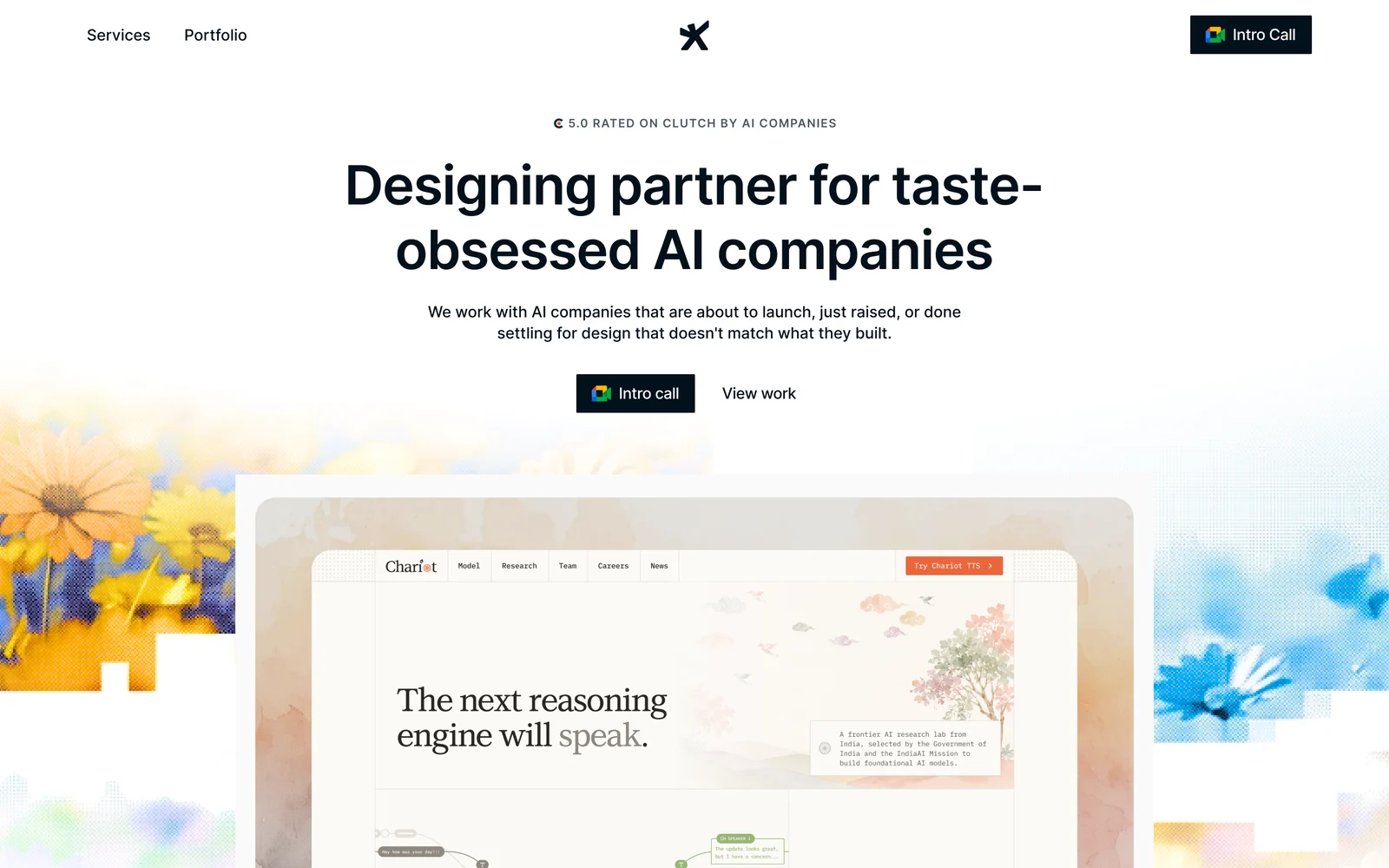
Studio Maydit is a web and product design studio. It works with AI founders in the US, UK, and Europe. What matters for a Series B team is where the work does not stop. A site gets built in Framer, Webflow, or custom code depending on who has to edit it afterwards, and then the studio carries on into product design, which is where a company at your stage has its actual problem.
The engagement with a public number attached is Dualite. It started with a repositioned ICP, meaning a decision about which users would no longer be served, and every screen after that was designed for the group left standing. 100,000+ users followed over seven months. Recent clients include Wave, PixelFlow, and Mi-VAD, alongside 15 other AI and SaaS teams.
Two shapes of engagement exist. A fixed scope of three to four weeks fits a company with a launch, a board meeting, or one surface that has to be right, and it closes with a written diagnosis of what is leaking in the product, which is a useful artefact to hand an in-house team. A monthly retainer fits a company shipping continuously and covers new pages, campaigns, and product design, with no long lock-in, so it can sit alongside staff designers instead of competing with them.
| Check | Finding |
|---|---|
| Based in | Remote, serving US / UK / EU |
| Platform depth | Framer, Webflow, and custom code |
| AI-sector proof | Yes. AI-native clients, published outcome on Dualite |
| Pricing | Fixed scope or monthly retainer, quoted per project |
| Team shape | Founder-led, small senior team |
| Best fit | Series B teams whose product has grown four different design eras |
Worth a call if your onboarding and your admin console feel like separate companies. Book a 30-minute call.

2. Foundey
Foundey is a San Francisco studio founded in 2021, working in Figma, publishing AI client work and naming DemandIQ, Traycer, and Sero AI. A Figma-only engagement is a poor fit for a founder with no engineers and a good one for you, because your team can build, and what you are short of is the thinking that arrives before the build.
No team size and no starting figure are published, so scale and cost both require a call, and handing files to your engineers only works if there is room in their quarter to take them.
| Check | Finding |
|---|---|
| Based in | San Francisco, USA |
| Founded | 2021 |
| Team size | Not published |
| Primary platform | Figma-only |
| AI-sector proof | Yes. Published AI client work |
| Named clients | DemandIQ, Traycer, Sero AI |
| Pricing | Not published |
| Best fit | Series B teams with engineers who want specifications, not a build |
3. Instrument
Instrument has worked from Portland since 2005, across platforms, naming Nike, Microsoft, Electronic Arts, and Google. Twenty years of work for organisations with many internal teams is directly relevant, because your coherence problem is one large companies have permanently, and Instrument's practice is built around imposing one story across surfaces owned by different people.
Their AI-sector proof is partial with no AI case study, no team size or starting figure is published, and an agency of that standing brings a process sized for clients considerably larger than a Series B company.
| Check | Finding |
|---|---|
| Based in | Portland, USA |
| Founded | 2005 |
| Team size | Not published |
| Primary platform | Mixed |
| AI-sector proof | Partial. Enterprise and SaaS clients, no AI case study |
| Named clients | Nike, Microsoft, Electronic Arts, Google |
| Pricing | Not published |
| Best fit | Series B teams needing one story imposed across many surfaces |
4. Ramotion
Ramotion has worked from San Francisco since 2009 at eleven to fifty people, across platforms, publishing a starting figure and naming Mozilla, Okta, Netflix, Adobe, and Xero. Okta and Xero are the useful references here. Both are products with an admin layer, a permissions model, and a buyer who is not the user, which is the shape your product just grew.
Their AI-sector proof is partial with no AI case study, a practice of that age is rarely cheap, and their engagements assume a longer commitment than a single quarter's problem.
| Check | Finding |
|---|---|
| Based in | San Francisco, USA |
| Founded | 2009 |
| Team size | 11-50 |
| Primary platform | Mixed |
| AI-sector proof | Partial. Enterprise and SaaS clients, no AI case study |
| Named clients | Mozilla, Okta, Netflix, Adobe, Xero |
| Pricing | Published minimum |
| Best fit | Series B teams designing an admin and permissions layer |
5. Pixelmatters
Pixelmatters is a Porto studio founded in 2013 at fifty-one to two hundred people, across platforms, publishing a starting figure and naming Rubrik, Quantic, and UJET. A team that size can run a system project and a product stream at once, which is the combination a Series B backlog usually needs, and European hours give a US team a long shared morning.
Their AI-sector proof is partial with no AI case study, a studio of that size assigns a team rather than a named designer, and the engagement is sized for companies with a budget line rather than a discretionary spend.
| Check | Finding |
|---|---|
| Based in | Porto, Portugal |
| Founded | 2013 |
| Team size | 51-200 |
| Primary platform | Mixed |
| AI-sector proof | Partial. Enterprise and SaaS clients, no AI case study |
| Named clients | Rubrik, Quantic, UJET |
| Pricing | Published minimum |
| Best fit | Series B teams running a system project and product work together |
6. Trueform
Trueform is a Swiss studio founded in 2022, working in Framer, publishing a starting figure and AI client work, naming Miro, Morning Brew, Bilt Rewards, and Gather. Framer suits the half of your problem that keeps changing, since a Series B marketing team ships pages weekly and should not need an engineer for each one.
Framer also caps the engagement at the marketing surface, the studio is young enough that its record is short, and no team size is published.
| Check | Finding |
|---|---|
| Based in | Wil, Switzerland |
| Founded | 2022 |
| Team size | Not published |
| Primary platform | Framer |
| AI-sector proof | Yes. Published AI client work |
| Named clients | Miro, Morning Brew, Bilt Rewards, Gather |
| Pricing | Published minimum |
| Best fit | Series B teams whose marketing site needs to move weekly |
7. Phantom
Phantom works from London and Auckland, founded in 2013 at fifty-one to two hundred people, in custom code, publishing AI client work and naming Diageo, SAP, Financial Times, and Zendesk. SAP and Zendesk are enterprise software with long evaluation cycles, and a studio that has designed for that kind of buyer knows which screens get inspected rather than admired.
No starting figure is published, that headcount means an assigned team and an account layer, and offices in London and Auckland give a US company an awkward overlap.
| Check | Finding |
|---|---|
| Based in | London, UK and Auckland, NZ |
| Founded | 2013 |
| Team size | 51-200 |
| Primary platform | Custom code |
| AI-sector proof | Yes. Published AI client work |
| Named clients | Diageo, SAP, Financial Times, Zendesk |
| Pricing | Not published |
| Best fit | Series B teams being evaluated by enterprise buyers |
8. basement.studio
basement.studio works from Mar del Plata and Los Angeles, founded in 2018 at eleven to fifty people, in custom code, publishing a starting figure and naming Vercel, Cursor, ElevenLabs, Harvey AI, and Scale AI. That is the most AI-native client list here, and those are the companies your board compares you to, so the reference points need no explanation.
Custom code means a build your engineers inherit, the studio's public work leans toward marketing surfaces rather than deep product, and a team of that size books out well in advance.
| Check | Finding |
|---|---|
| Based in | Mar del Plata, Argentina and Los Angeles, USA |
| Founded | 2018 |
| Team size | 11-50 |
| Primary platform | Custom code |
| AI-sector proof | Yes. Published AI client work |
| Named clients | Vercel, Cursor, ElevenLabs, Harvey AI, Scale AI |
| Pricing | Published minimum |
| Best fit | Series B teams benchmarking against well-known AI companies |
9. Lighthouse Digital
Lighthouse Digital is a London studio working in Webflow, publishing a starting figure and naming HelloSelf, Freetrade, and IGN. Freetrade is a regulated consumer product where clarity is a legal requirement rather than a preference, and that discipline transfers well to a product whose claims are about to be read carefully.
Their AI-sector proof is none published, no founding year or team size is published, and a Webflow practice cannot reach the product surfaces where your coherence problem actually sits.
| Check | Finding |
|---|---|
| Based in | London, UK |
| Founded | Not published |
| Team size | Not published |
| Primary platform | Webflow |
| AI-sector proof | No. No published AI client work |
| Named clients | HelloSelf, Freetrade, IGN |
| Pricing | Published minimum |
| Best fit | Series B teams needing a clear, compliant marketing site |
10. Kvalifik
Kvalifik is a Copenhagen studio founded in 2015 at eleven to fifty people, working in Webflow, publishing AI client work and naming Veo, Maersk, and Relesys. Maersk is the interesting reference, since designing for an organisation that size teaches you how work gets approved by people who never attend the design review.
No starting figure is published, Webflow keeps the engagement on the marketing site, and Copenhagen hours leave a West Coast team a narrow window.
| Check | Finding |
|---|---|
| Based in | Copenhagen, Denmark |
| Founded | 2015 |
| Team size | 11-50 |
| Primary platform | Webflow |
| AI-sector proof | Yes. Published AI client work |
| Named clients | Veo, Maersk, Relesys |
| Pricing | Not published |
| Best fit | European Series B teams selling into large organisations |
How to choose between them
Sort by which seam is costing you most, not by which studio your investors have heard of.
Your product reads as four different products. Studio Maydit or Instrument.
Your engineers can build but nobody is deciding. Foundey or Ramotion.
Enterprise buyers are inspecting your admin and settings screens. Phantom or Kvalifik.
Marketing needs to ship pages without an engineer. Trueform or Lighthouse Digital.
One test before you sign. Ask each studio to spend an hour in your product and then tell you which two screens contradict each other. A studio worth hiring at this stage will name them, explain which one is right, and say what it would cost to make the other agree. A studio that is not will send a proposal describing their process. The exercise costs you an afternoon and it tells you whether you are buying judgement or capacity.