

Summarize with AI


The best UX design agencies for venture-backed AI startups in 2026 are Studio Maydit, BX Studio, Phantom, Kvalifik, Trueform, SuperSkills, Clay, Foundey, Lazarev, and Feely Studio. Studio Maydit and Clay lead for this brief. Clay has designed from San Francisco since 2016 at fifty-one to two hundred people, publishes a starting figure, publishes AI client work, and names Slack, Stripe, Google, Coinbase, and Amazon, which is a list of companies that took money and had to keep proving it, so the studio has worked to this clock before. Kvalifik and Phantom fit this brief least well. One is a Webflow practice whose strongest references are enterprise brands, the other runs an enterprise process at an enterprise pace, and neither is shaped for a product that has to show a different number in eleven weeks.
Taking money changes the calendar before it changes anything else.
Your product now gets reviewed in quarters, because that is when the board meets. Every design decision has to be explainable in a slide roughly four weeks after you make it, and anything that will not have moved a number by then is hard to defend in the room.
That pressure has a predictable effect on what gets built. Teams ship the feature that demonstrates well and postpone the one that quietly keeps people. A new surface with a screenshot beats an onboarding fix with a chart, right up until the retention slide arrives and nobody can explain it.
There is a second distortion, and it is about who you are suddenly designing for. Before the round your users were the people who found you. After it, your investors introduce you to buyers three sizes larger, and those buyers open the product expecting permissions, an audit trail, and somewhere to put a team. The product they meet was built for one person with a personal account.
Neither problem is solved by more design. They are solved by deciding, early and out loud, which of the next two quarters is for the demo and which is for the retention. A studio that has worked with funded teams will ask you that in the first hour. A studio that has not will ask about your brand.
Read the ten below with your next board date in mind, and ask what each one could realistically finish before it.

How we picked these agencies
Five checks, all of which can be settled from public material without a call.
- Platform depth. Do they design the product, or the pages around it? A funded team's hardest surfaces are settings, permissions, and the second week of use. A studio whose portfolio stops at the marketing site can only help with the half you can already screenshot.
- Proof with venture-backed software. Have they worked with a company answering to a board? This is a specific discipline. It means scoping to a date somebody else set, and knowing which parts of a design can ship half-finished without embarrassing anyone.
- Pricing. Is a starting figure public, or does it appear after a call? Funded teams often care less about the number and more about how fast they can get one, because approval cycles are the thing that eats the quarter.
- Team shape. How many, how senior, and who is on your account in week three? Small teams are faster and riskier. Larger ones absorb a departure and cost more per week.
- Their own site. The one brief nobody paid them to get right.
That last check matters here because it shows their relationship with deadlines. A studio whose own site still advertises a service they stopped offering has the same discipline problem your quarter cannot afford.
Every table below carries only what each studio publishes about itself. No aggregator data, no rankings, and no gap filled in with something that sounds right. Where a studio has published nothing, the row says so.
What goes wrong after an AI startup raises
Three failures, all of them scheduling problems wearing design clothes.
The roadmap becomes a demo reel. Work is chosen for how it will look in the next update rather than for what it changes. Six months of this produces a product with an impressive surface area and a flat activation curve, and the fix is expensive because the foundations were skipped while everyone was shipping features.
The product meets buyers it was not built for. Investor introductions arrive faster than the product matures. An enterprise evaluator opens an account designed for an individual, finds no roles, no shared workspace, and no record of who did what, and quietly leaves. Nobody logs this as lost, so it never reaches the roadmap.
Design becomes the last two weeks of every quarter. Engineering starts, design is asked to make it presentable near the end, and the result is a product where every screen was reasonable on its own and none of them agree. This shows up as support load rather than as a design complaint, which is why it survives so long.
1. Studio Maydit: A Top-Rated Design Agency for AI Founders
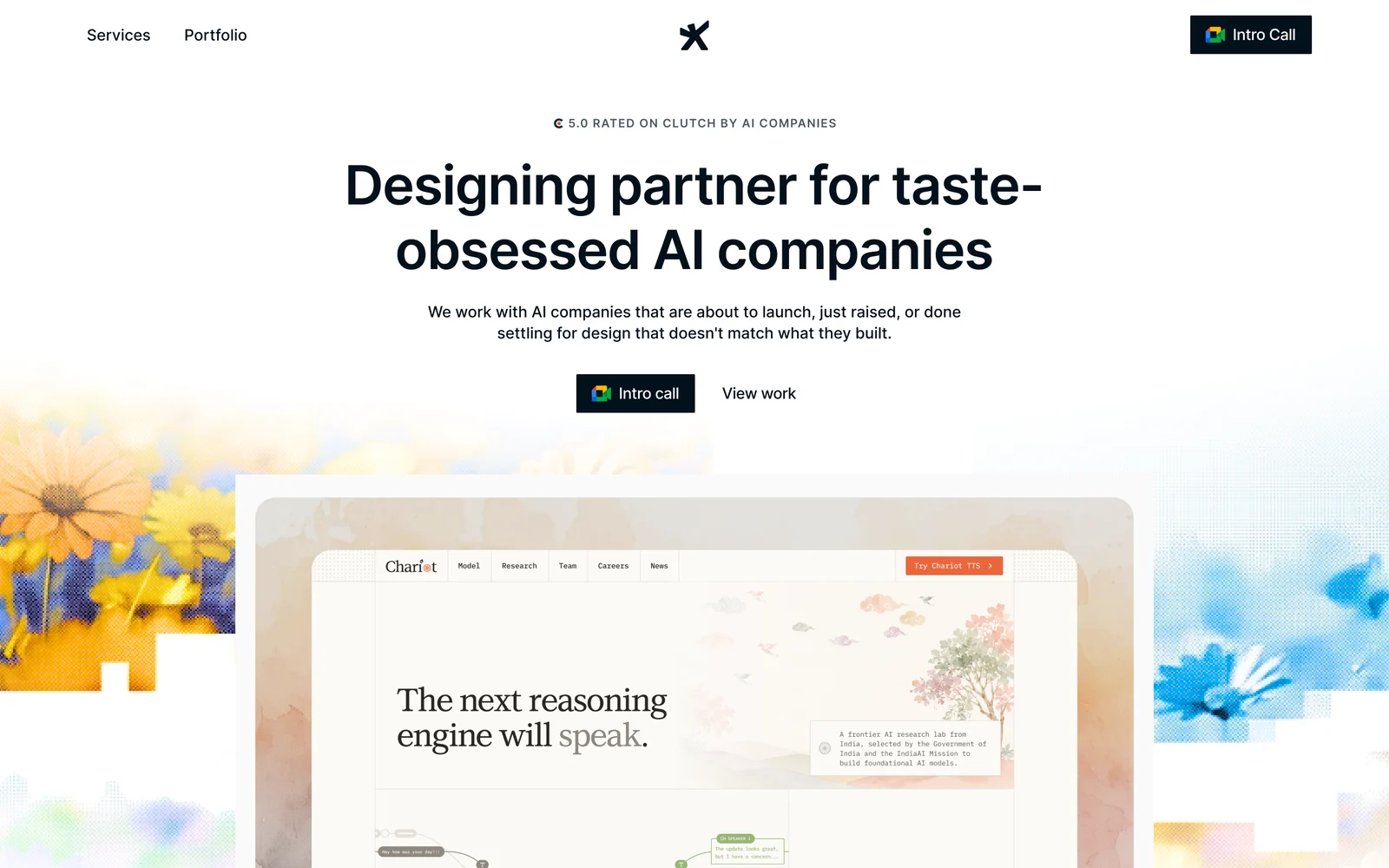
Studio Maydit is a web and product design studio working with AI founders in the US, UK, and Europe. For a funded team the relevant part is the fixed scope: three to four weeks, sized for a company that already has a date on the calendar and needs the work to land before it rather than around it. Websites are built in Framer, Webflow, or custom code, and the work continues into product design once the site ships.
Dualite is the published result, and the sequence is the point. A repositioned ICP came first, which is a decision about who to stop designing for, and the product work then served the narrower group. 100,000+ users followed in seven months. Funded teams tend to do this in the wrong order, widening the product because the round implied a bigger market. Recent clients include Wave, PixelFlow, Mi-VAD, and 15 other AI and SaaS teams.
Every fixed-scope project ends with a written diagnosis of what is leaking in the product, which is a more useful artefact for a board meeting than a set of files. For teams whose quarters do not end, the alternative is a monthly retainer covering new pages, campaigns, and product design, with no long lock-in.
| Check | Finding |
|---|---|
| Based in | Remote, serving US / UK / EU |
| Platform depth | Framer, Webflow, and custom code |
| AI-sector proof | Yes. AI-native clients, published outcome on Dualite |
| Pricing | Fixed scope or monthly retainer, quoted per project |
| Team shape | Founder-led, small senior team |
| Best fit | Funded teams with a board date and one quarter to move a number |
Worth a call if the next quarter has to show retention rather than surface area. Book a 30-minute call.

2. BX Studio
BX Studio is a New York practice of eleven to fifty people working in Webflow, publishing a starting figure and AI client work, and naming Reddit, Headspace, ASAPP, and Verifone. ASAPP is an AI company selling into large organisations, which is the exact transition a funded startup makes after its first enterprise introduction, and a published starting figure shortens the approval cycle that usually costs a funded team two weeks.
No founding year is published, so the length of the record is unclear. The practice is Webflow-first, which points at marketing surfaces rather than the product screens where a funded team's retention problem actually lives.
| Check | Finding |
|---|---|
| Based in | New York, USA |
| Founded | Not published |
| Team size | 11-50 |
| Primary platform | Webflow |
| AI-sector proof | Yes. Published AI client work |
| Named clients | Reddit, Headspace, ASAPP, Verifone |
| Pricing | Published minimum |
| Best fit | Funded teams whose next milestone is a credible public face |
3. Phantom
Phantom works from London and Auckland, founded in 2013 at fifty-one to two hundred people, in custom code, publishing AI client work and naming Diageo, SAP, Financial Times, and Zendesk. SAP and Zendesk are products with permissions, roles, and administrators, and a studio fluent in that structure understands the shape a funded startup has to grow into.
No starting figure is published, that headcount brings an account layer and a timeline built for larger clients, and a London and Auckland base gives a US team a narrow morning. None of that suits a quarter with a fixed end.
| Check | Finding |
|---|---|
| Based in | London, UK and Auckland, NZ |
| Founded | 2013 |
| Team size | 51-200 |
| Primary platform | Custom code |
| AI-sector proof | Yes. Published AI client work |
| Named clients | Diageo, SAP, Financial Times, Zendesk |
| Pricing | Not published |
| Best fit | Later-stage teams building for administrators as well as users |
4. Kvalifik
Kvalifik is a Copenhagen studio founded in 2015 at eleven to fifty people, working in Webflow, with published AI client work and Veo, Maersk, and Relesys named. Maersk is a serious operational client, and a studio that has satisfied a buyer of that size knows what an evaluator looks for when your investor makes the introduction.
No starting figure is published, the practice is Webflow-first rather than product-first, and Copenhagen gives a US team a few hours in the morning. For a UX brief on a funded product, the platform is the real limitation.
| Check | Finding |
|---|---|
| Based in | Copenhagen, Denmark |
| Founded | 2015 |
| Team size | 11-50 |
| Primary platform | Webflow |
| AI-sector proof | Yes. Published AI client work |
| Named clients | Veo, Maersk, Relesys |
| Pricing | Not published |
| Best fit | European funded teams who need the site before the product |
5. Trueform
Trueform is a Swiss studio founded in 2022 working in Framer, publishing a starting figure and AI client work, and naming Miro, Morning Brew, Bilt Rewards, and Gather. Framer means your team can change the public story the week the strategy changes, which happens more often after a round than before one.
The studio is young with a short public record, no team size is published, and Framer keeps the engagement on the marketing surface. If your quarter is about activation rather than announcement, that is the wrong side of the product.
| Check | Finding |
|---|---|
| Based in | Wil, Switzerland |
| Founded | 2022 |
| Team size | Not published |
| Primary platform | Framer |
| AI-sector proof | Yes. Published AI client work |
| Named clients | Miro, Morning Brew, Bilt Rewards, Gather |
| Pricing | Published minimum |
| Best fit | Funded teams whose positioning is still moving every few weeks |
6. SuperSkills
SuperSkills is a one to ten person studio in Walnut Creek with published AI client work and The Cut named. At that scale there is no account layer, so the person you brief is the person who designs, and a quarter loses less time to relay than it does with a larger practice.
The public record is short. One named client, no founding year, and no starting figure, so most of the evaluation happens in conversation. Capacity is the other risk, since a team that size cannot absorb a second urgent request.
| Check | Finding |
|---|---|
| Based in | Walnut Creek, USA |
| Founded | Not published |
| Team size | 1-10 |
| Primary platform | Mixed |
| AI-sector proof | Yes. Published AI client work |
| Named clients | The Cut |
| Pricing | Not published |
| Best fit | One focused scope inside a quarter with no time for handoffs |
7. Clay
Clay has designed from San Francisco since 2016 at fifty-one to two hundred people, across platforms, publishing a starting figure and AI client work, and naming Slack, Stripe, Google, Coinbase, and Amazon. Every one of those took venture money and then had to keep answering for it, so the studio has worked inside the reporting rhythm rather than around it.
The size means a rate and a process built for larger engagements, the practice spans platforms rather than specialising, and a studio with that client list will not put its most senior people on a single quarter's scope.
| Check | Finding |
|---|---|
| Based in | San Francisco, USA |
| Founded | 2016 |
| Team size | 51-200 |
| Primary platform | Mixed |
| AI-sector proof | Yes. Published AI client work |
| Named clients | Slack, Stripe, Google, Coinbase, Amazon |
| Pricing | Published minimum |
| Best fit | Well-funded teams who want a studio used to board-level scrutiny |
8. Foundey
Foundey is a San Francisco studio founded in 2021 working Figma-only, with published AI client work and DemandIQ, Traycer, and Sero AI named. Those are young AI companies rather than enterprises, so the studio is used to products still deciding what they are, which describes most of what a funded team is doing in its first year after a round.
Figma-only means the engagement ends at the file and your engineers carry it from there. No team size or starting figure is published, so capacity and cost both have to be established before you can plan a quarter around them.
| Check | Finding |
|---|---|
| Based in | San Francisco, USA |
| Founded | 2021 |
| Team size | Not published |
| Primary platform | Figma-only |
| AI-sector proof | Yes. Published AI client work |
| Named clients | DemandIQ, Traycer, Sero AI |
| Pricing | Not published |
| Best fit | Teams with engineering capacity who need product screens quickly |
9. Lazarev
Lazarev has worked from San Francisco since 2015 at fifty-one to two hundred people, across platforms, publishing a starting figure and AI client work, and naming Payoneer, Peel, Elva, and Mozayix. Payoneer is a product people are inside daily, and daily-use software is where the retention question a board asks actually gets answered.
That headcount brings an assigned team and coordination overhead, the practice is broad rather than specialised, and a studio of that size prices for engagements longer than a single quarter.
| Check | Finding |
|---|---|
| Based in | San Francisco, USA |
| Founded | 2015 |
| Team size | 51-200 |
| Primary platform | Mixed |
| AI-sector proof | Yes. Published AI client work |
| Named clients | Payoneer, Peel, Elva, Mozayix |
| Pricing | Published minimum |
| Best fit | Funded teams whose metric is weekly use rather than signups |
10. Feely Studio
Feely Studio is a distributed European team of one to ten people, publishing a starting figure and AI client work, and naming Noxus, Mutiny, Luasai, and Basic Capital. These are AI-native companies at roughly the stage you are, which means the studio is solving current problems rather than remembering older ones.
No founding year is published, the team is small enough that your quarter competes with somebody else's, and a European base leaves a US company one working window a day. On work that needs frequent short approvals, that window is the constraint.
| Check | Finding |
|---|---|
| Based in | Distributed, Europe |
| Founded | Not published |
| Team size | 1-10 |
| Primary platform | Mixed |
| AI-sector proof | Yes. Published AI client work |
| Named clients | Noxus, Mutiny, Luasai, Basic Capital |
| Pricing | Published minimum |
| Best fit | Funded teams comfortable working asynchronously with a senior pair |
How to choose between them
Sort by what the next board meeting will ask about, not by which portfolio impresses you.
Signups are fine and week two is empty. Studio Maydit or Lazarev.
An enterprise evaluator is coming and the product has no roles. Phantom or Clay.
The public story no longer matches the product. BX Studio or Trueform.
Engineering is ahead and design is the bottleneck. Foundey or SuperSkills.
One test before you sign. Give three studios your last board deck's product slide and ask each what they would build to make the next version of that slide true. A studio used to funded teams will name one thing, say what it will not touch, and put it inside your quarter. A studio that is not will propose a discovery phase, which is a real method and not one your calendar has room for. It costs an hour and it sorts the list.