Summarize with AI


For an agentic AI product, the ten studios worth reviewing are Studio Maydit, Finsweet, Flow Ninja, Digidop, Lazarev, Lighthouse Digital, SuperSkills, Fantasy, BX Studio, and Kvalifik. Lazarev and BX Studio lead this list. Lazarev has worked from San Francisco since 2015 with fifty-one to two hundred people, a published starting price, and AI-sector proof, for Payoneer, Peel, Elva, and Mozayix. BX Studio works in Webflow from New York with eleven to fifty people, a published starting price, and AI-sector proof, for Reddit, Headspace, ASAPP, and Verifone, and ASAPP builds systems that act on conversations without a person watching each one. Lighthouse Digital and SuperSkills fit least well. Lighthouse Digital publishes no AI work, and SuperSkills names a single client.
Everyone selling an agent has the same demo and the same doubt underneath it.
The demo is a task running by itself. The doubt is what happens the one time it goes wrong while nobody is looking. Your buyer is not really asking whether the agent can do the job. They are asking what it is allowed to touch, how they would find out it made a mistake, and how quickly they could stop it.
Most agentic sites answer the first question at length and the other three not at all. They show the capability and skip the controls, because controls feel like admitting the product is dangerous.
The opposite is true. Describing the guardrails is what makes the capability believable, and a buyer who can see the brakes will let the car go faster.
There is a positioning problem sitting on top of this. Agentic is a word your buyer has now heard from thirty companies in six months, and it has stopped carrying meaning. Leading with it puts you in a crowd instead of in a category.

How we picked these agencies
Five criteria decided the order, all of them checkable from public pages without booking anything.
Webflow depth, tested against a site that has to grow. Agentic products accumulate use-case pages, integration pages, and a security section faster than almost any other category, because each new capability raises a new objection. That belongs in a well-modelled CMS rather than in pages somebody hand-builds each time.
AI-sector proof, weighted most heavily here. Agents are the hardest AI product to depict, because the value is in what happens when nobody is watching, and there is nothing to screenshot. Studios who have shipped for AI companies have already fought this and lost a few times, which is worth more than a studio meeting it fresh on your budget.
Pricing. Is a starting figure published. Agentic products are usually priced on consumption, which buyers find hard to predict, so there is a small consistency argument for partners who are plain about their own numbers.
Team shape. Small teams put the person who understands your permission model on the call. Larger teams can build a use-case library, a docs section, and a trust page at once. Which matters more depends on how much of your site is explanation.
Their own website. It is the one project with no client to blame, and it reveals whether a studio can explain something abstract without reaching for a diagram of a robot.
One extra question for the first call: ask what they would put on the page immediately after the demo. The answer should be about limits and control, and a studio that says so unprompted has understood your category better than most of your competitors have.
All of this is drawn from what the studios publish. Nothing is estimated, and a blank on record is shown as unpublished rather than filled in.
What goes wrong for agentic AI products
Three failures, and the first is the one that stalls deals at exactly the moment they look won.
The site shows capability and hides control. A long, impressive walkthrough of the agent completing a task, and nothing about scope, permissions, approval steps, logging, or how to stop it. The buyer finishes the page convinced it works and unable to convince anyone else in their company that it is safe. Put the boundaries next to the capability. What can it touch, what needs a human, what gets recorded, and how do you turn it off. That page closes deals rather than slowing them.
Autonomy is sold as the benefit when reliability is the benefit. Headlines promise that it runs without you, works while you sleep, needs no supervision. To an operations buyer that is not a feature, it is a description of an unsupervised process with their name on it. The thing they actually want is the same outcome with less effort and fewer errors. Sell the result and the consistency, and let autonomy be the mechanism rather than the promise.
The word agentic is doing the work a position should do. The homepage announces an agentic platform for the enterprise, and the reader learns nothing, because they have read that sentence thirty times this quarter. Name the job. An agent that reconciles invoices, or triages support tickets, or keeps a CRM accurate is a product somebody can buy. An agentic platform is a category, and nobody has budget for a category.
1. Studio Maydit: A Top-Rated Design Agency for AI Founders
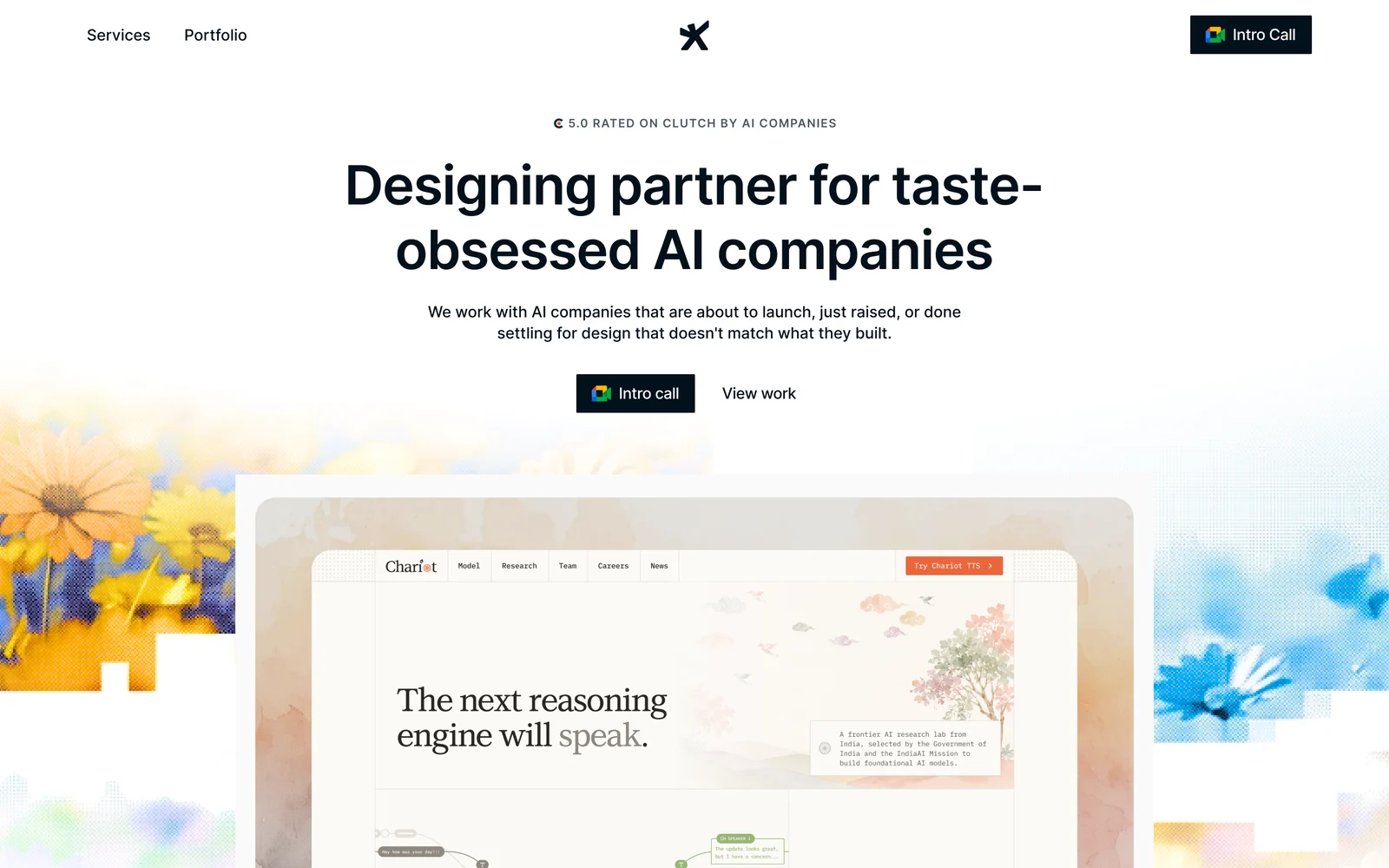
The hard part of an agent product is not the marketing page, it is the screen where a person decides how much rope to give the software. Studio Maydit continues into product design after the site ships, so the guardrails promised on the site and the controls a customer actually meets are designed together rather than by two suppliers a quarter apart. It is a web and product design studio working with AI founders across the US, UK, and Europe, building in Framer, Webflow, and custom code.
Webflow is usually right when the use-case and integration pages will multiply and a marketer needs to add them without help. Custom code earns its place where a page has to run the agent rather than describe it, and that split is worth agreeing at the start.
Narrowing is the move behind the Dualite outcome, and it is the one agent companies find hardest. A repositioned ICP came first, the product was then designed for the narrower group that decision created, and 100,000+ users arrived across seven months. An agent that can do many jobs is a genuine engineering achievement and a marketing problem, because a page offering everything gets bought for nothing. Recent clients include Wave, PixelFlow, Mi-VAD, and 15 other AI and SaaS teams. Fixed scope runs three to four weeks, suits a launch date, and ends with a written diagnosis of what is leaking in the product. A monthly retainer suits teams still finding their best job to be done, covering new pages, campaigns, and product design, with no long lock-in.
| Check | Finding |
|---|---|
| Based in | Remote, serving US / UK / EU |
| Platform depth | Framer, Webflow, and custom code |
| AI-sector proof | Yes. AI-native clients, published outcome on Dualite |
| Pricing | Fixed scope or monthly retainer, quoted per project |
| Team shape | Founder-led, small senior team |
| Best fit | Agent teams who need one named job on the first screen |
Pick the single job your agent does better than a person, and lead with it. Book a 30-minute call.

2. Lazarev
Lazarev has worked from San Francisco since 2015 with fifty-one to two hundred people, a published starting price, and AI-sector proof, for Payoneer, Peel, Elva, and Mozayix. Payoneer is the useful reference, a payments business where automated processes move real money and the interface has to make people comfortable with that. At this size the studio can build the site and the product controls in parallel.
Webflow is one platform among several rather than the specialism, and a fifty-plus team means the people who pitch are rarely the people assigned.
| Check | Finding |
|---|---|
| Based in | San Francisco, USA |
| Founded | 2015 |
| Team size | 51-200 |
| Primary platform | Mixed |
| AI-sector proof | Yes |
| Named clients | Payoneer, Peel, Elva, Mozayix |
| Pricing | Published minimum |
| Best fit | Agent teams whose product moves money or touches records |
3. BX Studio
BX Studio works in Webflow from New York with eleven to fifty people, a published starting price, and AI-sector proof, for Reddit, Headspace, ASAPP, and Verifone. ASAPP is the direct analogue: automation acting on live customer conversations, sold to operations buyers who ask about escalation and oversight before they ask about capability. That is your buyer's question order too.
The studio does not publish a founding year, and a New York team at this size will be running several accounts at once.
| Check | Finding |
|---|---|
| Based in | New York, USA |
| Founded | Not published |
| Team size | 11-50 |
| Primary platform | Webflow |
| AI-sector proof | Yes |
| Named clients | Reddit, Headspace, ASAPP, Verifone |
| Pricing | Published minimum |
| Best fit | Agent teams selling into operations and support functions |
4. Finsweet
Finsweet works in Webflow from Denver as a distributed team with fifty-one to two hundred people, for Dropbox, Clay, GitHub, and Steadily. This is the strongest Webflow engineering here, and an agentic site needs it more than most. Use cases, integrations, permissions documentation, and a trust section all need to be content types your team can extend, not pages a developer rebuilds each quarter.
No pricing is published, AI-sector proof is only partial, and this is a build studio rather than a positioning one, so the argument about what your agent is for stays with you.
| Check | Finding |
|---|---|
| Based in | Denver, USA, distributed |
| Founded | 2017 |
| Team size | 51-200 |
| Primary platform | Webflow |
| AI-sector proof | Partial |
| Named clients | Dropbox, Clay, GitHub, Steadily |
| Pricing | Not published |
| Best fit | Agent teams whose site will grow use cases every month |
5. Kvalifik
Kvalifik has built in Webflow from Copenhagen since 2015 with eleven to fifty people and AI-sector proof, for Veo, Maersk, and Relesys. Veo is automated capture that decides what matters without a person directing it, which is structurally the argument an agent has to win. European work also brings familiarity with the data questions that follow any system acting on company records.
No pricing is published, and Copenhagen shares only part of a working morning with the US west coast.
| Check | Finding |
|---|---|
| Based in | Copenhagen, Denmark |
| Founded | 2015 |
| Team size | 11-50 |
| Primary platform | Webflow |
| AI-sector proof | Yes |
| Named clients | Veo, Maersk, Relesys |
| Pricing | Not published |
| Best fit | European agent teams selling into large organisations |
6. Flow Ninja
Flow Ninja has built in Webflow from Belgrade since 2018 with eleven to fifty people. The strength is structural work, and an agentic site is a structure problem before it is a design one. Each integration and each use case should be an entry your marketer can add, rather than a page somebody codes by hand and then forgets to update.
No client names are published, no pricing is published, and AI-sector proof is only partial, so you are buying construction quality and bringing the category understanding yourself.
| Check | Finding |
|---|---|
| Based in | Belgrade, Serbia |
| Founded | 2018 |
| Team size | 11-50 |
| Primary platform | Webflow |
| AI-sector proof | Partial |
| Named clients | Not published |
| Pricing | Not published |
| Best fit | Teams who need integrations and use cases modelled properly |
7. Digidop
Digidop is a one to ten person Webflow studio in Paris with a published starting price, for TSE Energy, Ramify, and StreamNative. StreamNative is real-time infrastructure, so the studio has explained event-driven systems to non-technical readers before, which is close to explaining what triggers an agent and when.
The team is very small, AI-sector proof is only partial, and a single European time zone is a weak overlap for a US-weighted company with a launch date.
| Check | Finding |
|---|---|
| Based in | Paris, France |
| Founded | 2021 |
| Team size | 1-10 |
| Primary platform | Webflow |
| AI-sector proof | Partial |
| Named clients | TSE Energy, Ramify, StreamNative |
| Pricing | Published minimum |
| Best fit | European agent teams needing triggers explained plainly |
8. Fantasy
Fantasy has worked from San Francisco and New York since 1999 with AI-sector proof. A studio with this much history has watched several waves of automation arrive with the same promises, and that memory is useful when deciding how much of your pitch is genuinely new and how much your buyer has heard before.
No clients, no team size, and no pricing are published, making this the hardest option here to evaluate before a call, and Webflow is one route among several rather than a focus.
| Check | Finding |
|---|---|
| Based in | San Francisco and New York, USA |
| Founded | 1999 |
| Team size | Not published |
| Primary platform | Mixed |
| AI-sector proof | Yes |
| Named clients | Not published |
| Pricing | Not published |
| Best fit | Teams wanting a long view on how the category will settle |
9. SuperSkills
SuperSkills is a one to ten person studio in Walnut Creek with AI-sector proof, for The Cut. A small senior team is a reasonable choice when the site is mostly a rewrite and the real work is deciding which single job the agent should lead with, which is a conversation rather than a build.
Only one client is named, no pricing and no founding year are published, and a team this size cannot produce a large use-case library alongside the main site.
| Check | Finding |
|---|---|
| Based in | Walnut Creek, USA |
| Founded | Not published |
| Team size | 1-10 |
| Primary platform | Mixed |
| AI-sector proof | Yes |
| Named clients | The Cut |
| Pricing | Not published |
| Best fit | Small agent teams whose problem is the message, not the build |
10. Lighthouse Digital
Lighthouse Digital builds in Webflow from London with a published starting price, for HelloSelf, Freetrade, and IGN. Freetrade is a plain, trustworthy site for a product where overstating would have been costly, and restraint is genuinely useful in a category where every competitor is overpromising autonomy.
No AI-sector work is published at all, and neither team size nor founding year is on record, which makes it the least verifiable choice for the hardest AI category to explain.
| Check | Finding |
|---|---|
| Based in | London, UK |
| Founded | Not published |
| Team size | Not published |
| Primary platform | Webflow |
| AI-sector proof | No |
| Named clients | HelloSelf, Freetrade, IGN |
| Pricing | Published minimum |
| Best fit | UK agent teams who want plain over impressive |
How to choose between them
Sort by what is actually broken.
If deals stall after a good demo, the missing thing is a page about limits, permissions, and oversight. BX Studio, or Lazarev when the agent touches money.
If your site cannot keep up with new use cases and integrations, buy CMS engineering. Finsweet or Flow Ninja.
If the homepage says agentic platform and nothing else lands, that is positioning. SuperSkills, where a senior person will argue it with you.
If your buyers are European and asking where company data goes, buy that familiarity. Kvalifik.
One test before you sign. Ask them what they would put on the screen directly after the demo video. A studio that fits this brief will say something about scope, approvals, or an off switch. A studio that does not will say a customer logo strip, which is how a category full of impressive demos ended up with a procurement problem instead of a pipeline.