

Summarize with AI


For an AI agent startup buying Webflow work, the ten studios worth reviewing are Studio Maydit, BX Studio, Kvalifik, Refokus, SuperSkills, Fantasy, Lighthouse Digital, Lazarev, Clay, and Feely Studio. BX Studio and Kvalifik lead here. BX Studio works in Webflow from New York with a published starting price and has built for ASAPP, Reddit, Headspace, and Verifone, and Kvalifik is a Copenhagen Webflow team with AI-sector proof and a client list of Veo, Maersk, and Relesys. Fantasy and Lighthouse Digital are the wrong fit. Fantasy publishes no client list, no team size, and no price, and Lighthouse Digital has no AI-sector proof at all.
Your product has almost nothing to show, and that is the entire brief.
An agent does its work while nobody is watching. It reads a queue, takes a few hundred actions, and files the result somewhere else. There is no screen where the value happens, which is why so many agent websites end up as a picture of a chat box. The chat box is the least interesting part of what you built, and it is the one part every competitor also has.
Then there is the trust problem, and it is sharper for agents than for any other kind of AI product. You are asking a buyer to let software act on their behalf inside systems they are responsible for. Before they care how good it is, they want to know what it is allowed to touch, what happens when it gets something wrong, and who finds out.
The third thing is speed of change. Agent scope moves faster than any other category right now. What the thing could do in June is not what it can do in September, and a site written around June's boundaries starts quietly undercharging for the product by autumn.

How we picked these agencies
Five checks, each answerable from public pages before you book a single call.
Webflow depth first. This is a Webflow brief, so the question is not whether a studio can use the tool but how much of the site your own team will control afterwards. Agent products change what they do frequently, and a site you cannot edit becomes a monthly invoice. Ask who publishes a new page in month four, and how long it takes them.
Proof with AI and agent products. Has this studio explained an autonomous or model-driven product to a sceptical buyer before? That is the check carrying the most weight on this page, because the writing problem here is unusually hard. Naming customers in adjacent AI companies counts. A single machine learning logo from four years ago does not.
Pricing. Is there a starting figure in public. In a category this hot, quotes drift upward with the word agent in the brief, and a published number is the only fixed reference you get before a sales call.
Team shape. Headcount tells you how many people your explanation travels through before it reaches whoever writes the actual page. For a product this hard to describe, every extra layer costs you accuracy.
Their own website. No client, no deadline, no compromise to hide behind. If a studio cannot make its own homepage say something specific, it will not rescue yours.
One extra probe that separates studios quickly here. Ask how they would show your agent working without a video and without a chat window. A studio that has done this reaches for logs, diffs, before and after states, or a queue emptying. A studio that has not will suggest an animated gradient.
Every row in the tables below is repeated from what each studio publishes about itself. Nothing has been estimated, and where a cell says a thing is not published, that means the studio chose not to state it.
What goes wrong for AI agent startups
Three failures, and the first is what happens when a team designs around the only screen it has.
The site becomes a picture of a chat box. It is the one part of an agent you can screenshot, so it takes the hero, and the buyer draws the obvious conclusion. They have seen a text input on a dark background six times this quarter, and they file you next to the other five. The interesting artefact is almost always the output, meaning the pull request, the resolved ticket, the reconciled row, the inbox that is now empty. Show the result and the work behind it, not the prompt.
The page argues for autonomy when the buyer is worried about control. Founders write about how much the agent can do alone, because that is the achievement. The person signing is thinking about what happens at three in the morning when it does the wrong thing to a live system. Permissions, limits, an audit trail, a way to undo. Answer that on the page and the demo call starts one step further along.
The site describes a version of the product that has been superseded. Agent capability moves in weeks. The homepage still lists the three integrations you had at launch, the sales team is demoing eleven, and inbound leads arrive with a smaller idea of what you sell than the truth. No redesign fixes this, because it is not a design problem. It is a publishing problem, and it needs someone whose job is to keep the page level with the product.
1. Studio Maydit: A Top-Rated Design Agency for AI Founders
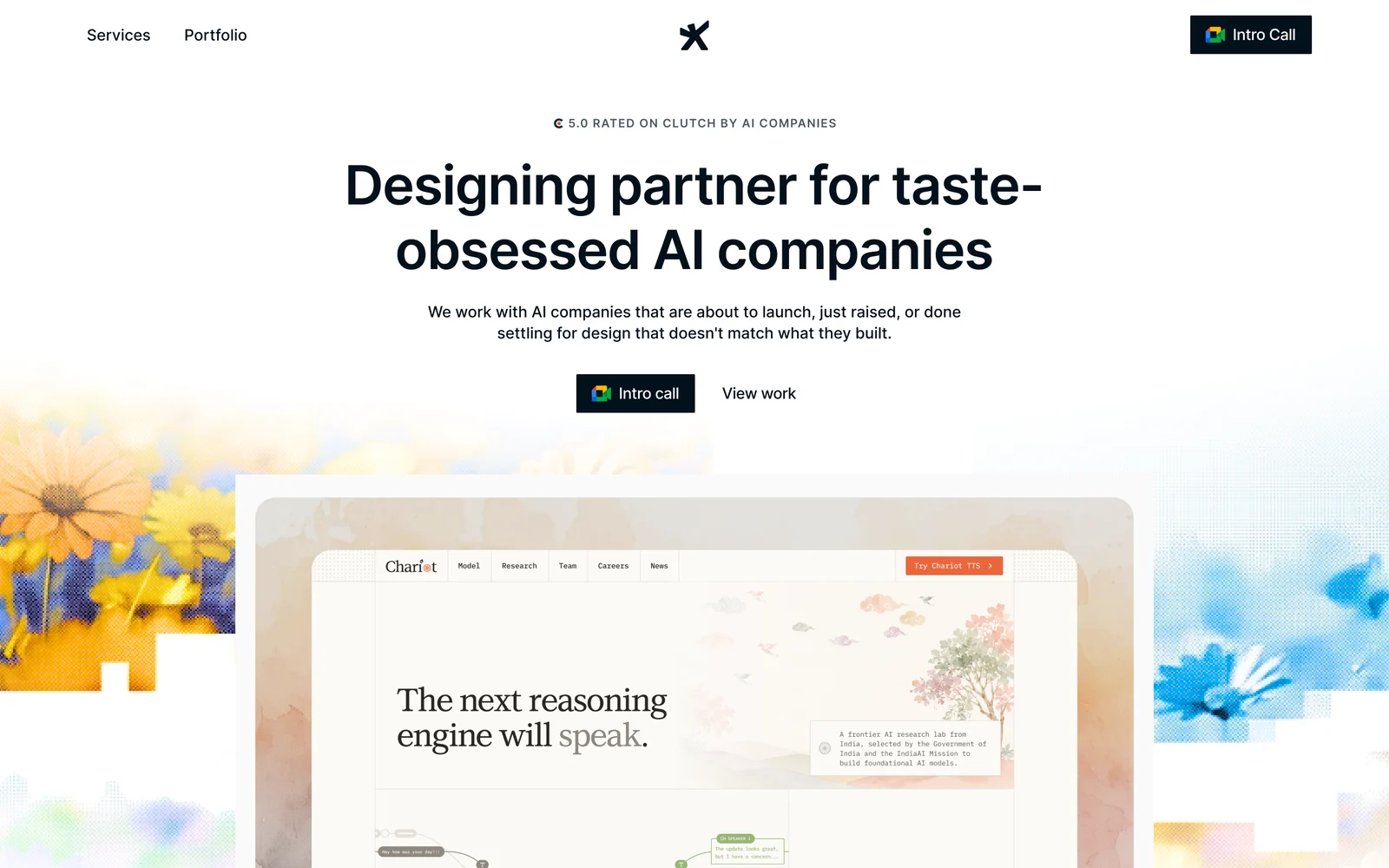
The hard part of an agent site is deciding which single thing the product should be famous for, and that decision comes before any page is designed. Studio Maydit is a web and product design studio. Its clients are AI founders, working across the US, UK, and Europe. Webflow is the right call when a marketing hire needs to own publishing, Framer when the page changes weekly, and custom code when the product refuses to fit either. The work carries on into product design once the site is live, which matters for agent teams because the surface people judge you on is often inside the product, not on the marketing page.
A repositioned ICP came first at Dualite. The design work then served only the narrower group that choice created, rather than everyone who might conceivably buy. 100,000+ users arrived across seven months. Agent startups face the same fork early, usually as a temptation to claim every workflow the agent could theoretically run, and the narrowing is what makes the page legible. Recent clients include Wave, PixelFlow, Mi-VAD, and 15 other AI and SaaS teams.
A fixed-scope project here ends with a written diagnosis of what is leaking in the product, not a handover call, which is useful when the signup completes and activation does not. That option runs three to four weeks and suits a launch or a funding date. The other option is a monthly retainer with no long lock-in, covering new pages, campaigns, and product design, and it is the honest answer for a team whose integration list grows every sprint.
| Check | Finding |
|---|---|
| Based in | Remote, serving US / UK / EU |
| Platform depth | Framer, Webflow, and custom code |
| AI-sector proof | Yes. AI-native clients, published outcome on Dualite |
| Pricing | Fixed scope or monthly retainer, quoted per project |
| Team shape | Founder-led, small senior team |
| Best fit | Agent teams whose homepage still shows a chat box |
If your best screenshot is a text input, the site is not showing the product yet. Book a 30-minute call.

2. BX Studio
BX Studio is a New York Webflow team of eleven to fifty people with a published starting price, working for Reddit, Headspace, ASAPP, and Verifone. ASAPP is the relevant one on this page, because it is an AI company selling automation into contact centres, which is close to the explaining problem an agent startup has.
The founding year is not published, and a team this size will be running several accounts at once, so ask who is actually on yours.
| Check | Finding |
|---|---|
| Based in | New York, USA |
| Founded | Not published |
| Team size | 11-50 |
| Primary platform | Webflow |
| AI-sector proof | Yes |
| Named clients | Reddit, Headspace, ASAPP, Verifone |
| Pricing | Published minimum |
| Best fit | Agent teams wanting a US Webflow studio with AI writing experience |
3. Kvalifik
Kvalifik has worked from Copenhagen since 2015 with eleven to fifty people in Webflow, for Veo, Maersk, and Relesys. Veo is a computer vision product and Maersk is a logistics operation with real operational complexity, so this is a team used to products where the value is a process rather than a screen.
No pricing is published, and the client list leans Nordic enterprise rather than early software, so the reference points may not match your stage.
| Check | Finding |
|---|---|
| Based in | Copenhagen, Denmark |
| Founded | 2015 |
| Team size | 11-50 |
| Primary platform | Webflow |
| AI-sector proof | Yes |
| Named clients | Veo, Maersk, Relesys |
| Pricing | Not published |
| Best fit | Agent products whose value is an operational outcome |
4. Refokus
Refokus is a remote German Webflow studio founded in 2021 with eleven to fifty people, for Mural, BASF, Spotify, Yahoo, and BCG. The craft level is high and the Webflow builds are more ambitious than most, which helps if you want the site itself to feel like evidence of taste.
The AI-sector proof is partial, no pricing is published, and the client list is large brands rather than early-stage software, so expect a process built for that.
| Check | Finding |
|---|---|
| Based in | Germany, remote |
| Founded | 2021 |
| Team size | 11-50 |
| Primary platform | Webflow |
| AI-sector proof | Partial |
| Named clients | Mural, BASF, Spotify, Yahoo, BCG |
| Pricing | Not published |
| Best fit | Teams who want the site to be the taste argument |
5. SuperSkills
SuperSkills is a one to ten person team in Walnut Creek working across platforms, with AI-sector proof and The Cut as a named client. A team this small means the person you brief is the person who builds, which removes the accuracy loss that kills agent copy.
Only one client is named and no price is published, so you are buying on conversation rather than on evidence, and capacity will be the constraint.
| Check | Finding |
|---|---|
| Based in | Walnut Creek, USA |
| Founded | Not published |
| Team size | 1-10 |
| Primary platform | Mixed |
| AI-sector proof | Yes |
| Named clients | The Cut |
| Pricing | Not published |
| Best fit | Founders who want to brief one person and get one page |
6. Fantasy
Fantasy has run from San Francisco and New York since 1999 across platforms, and it carries AI-sector proof. Twenty-six years of product and interface work is a genuinely deep bench, and the strategic thinking is a level above most studios on this page.
Almost nothing else is public. No client list, no team size, no price, and the platform is mixed rather than Webflow, so a Webflow brief may not be the shape they want.
| Check | Finding |
|---|---|
| Based in | San Francisco and New York, USA |
| Founded | 1999 |
| Team size | Not published |
| Primary platform | Mixed |
| AI-sector proof | Yes |
| Named clients | Not published |
| Pricing | Not published |
| Best fit | Larger companies buying strategy alongside design |
7. Lighthouse Digital
Lighthouse Digital is a London Webflow studio with a published starting price, for HelloSelf, Freetrade, and IGN. Freetrade is a regulated fintech, so this is a team that has worked where claims have to be careful, and the published figure means a budget conversation can happen immediately.
There is no AI-sector proof here, and neither the founding year nor the team size is published, so the agent explanation problem would be new to them.
| Check | Finding |
|---|---|
| Based in | London, UK |
| Founded | Not published |
| Team size | Not published |
| Primary platform | Webflow |
| AI-sector proof | No |
| Named clients | HelloSelf, Freetrade, IGN |
| Pricing | Published minimum |
| Best fit | UK teams who want a known number before the first call |
8. Lazarev
Lazarev has worked from San Francisco since 2015 with fifty-one to two hundred people, publishes a starting price, and carries AI-sector proof, for Payoneer, Peel, Elva, and Mozayix. It is the largest studio here with both a published number and AI experience, which is a rare combination.
The platform is mixed rather than Webflow specifically, and at this size the senior people you meet may not be the ones who do the work.
| Check | Finding |
|---|---|
| Based in | San Francisco, USA |
| Founded | 2015 |
| Team size | 51-200 |
| Primary platform | Mixed |
| AI-sector proof | Yes |
| Named clients | Payoneer, Peel, Elva, Mozayix |
| Pricing | Published minimum |
| Best fit | Funded teams wanting scale and a published number together |
9. Clay
Clay has designed from San Francisco since 2016 with fifty-one to two hundred people and a published starting price, for Slack, Stripe, Google, Coinbase, and Amazon. That is the strongest client list on this page by some distance, and the AI-sector proof is there too.
The work is scaled for companies with internal brand and marketing teams to receive it, and the platform is mixed rather than Webflow, so a small agent startup may be buying a process built for somebody much larger.
| Check | Finding |
|---|---|
| Based in | San Francisco, USA |
| Founded | 2016 |
| Team size | 51-200 |
| Primary platform | Mixed |
| AI-sector proof | Yes |
| Named clients | Slack, Stripe, Google, Coinbase, Amazon |
| Pricing | Published minimum |
| Best fit | Later-stage teams buying a full brand and product system |
10. Feely Studio
Feely Studio is a distributed European team of one to ten people with a published starting price and AI-sector proof, for Noxus, Mutiny, Luasai, and Basic Capital. Noxus and Mutiny are both AI-native software companies, so the reference points are the closest to your stage of anyone here, and a published figure from a team this small is unusual.
Capacity is the obvious limit, the founding year is not published, and the platform is mixed rather than Webflow, so confirm the build tool before scoping.
| Check | Finding |
|---|---|
| Based in | Distributed, Europe |
| Founded | Not published |
| Team size | 1-10 |
| Primary platform | Mixed |
| AI-sector proof | Yes |
| Named clients | Noxus, Mutiny, Luasai, Basic Capital |
| Pricing | Published minimum |
| Best fit | Early agent teams wanting AI-native peers and a known price |
How to choose between them
Sort by what is actually broken.
If the site cannot show the agent doing anything, the problem is the argument, not the layout, and it should lead. BX Studio or Feely Studio, briefed on what the output artefact is before any page is drawn.
If the integration list grows every sprint, buy the ability to publish rather than a bigger project. A Webflow-first team is the point, so Kvalifik or Lighthouse Digital, with your own marketing hire owning the CMS.
If the site has to look like the work of a serious company because you are raising, that is craft, and it is worth paying for. Refokus or Lazarev.
If nobody outside the founding team can explain what the agent does, keep the chain short. SuperSkills, where the person briefed is the person building.
One test before you sign. Ask them to describe your agent in two sentences after a fifteen minute call. If the description is a chat interface, they heard the demo and missed the product.