
Summarize with AI


The best Webflow design agencies for AI cybersecurity startups in 2026 are Studio Maydit, BX Studio, Digidop, Lighthouse Digital, Kvalifik, 8020, Flowout, Edgar Allan, Refokus, and Flow Ninja. Studio Maydit and BX Studio lead for this brief. BX Studio is an eleven to fifty person New York practice working in Webflow, publishing a starting figure and AI client work, and naming Reddit, Headspace, ASAPP, and Verifone, which covers both an AI company and a payments company, the two kinds of buyer who read a vendor site suspiciously. Flow Ninja and Lighthouse Digital fit this brief least well. One publishes no client names at all, the other publishes no AI work, and a security buyer who evaluates vendors on disclosed evidence will notice both gaps immediately.
Your website is the first thing your buyer audits.
Not consciously, and not as a formal step. But the person evaluating you does this for a living, and they will open the network tab, notice the eleven third-party scripts, look for a security page and not find one, and form an opinion before they ever reach your pricing. Every other category gets to have a website. You have an artefact that is judged by the standard you sell.
The contradictions are usually small and completely fatal. A data protection company running six analytics tools. A vendor selling zero trust whose cookie banner defaults everything to on. A page promising rigorous supply chain controls, served with a font from someone else's domain. None of these are security incidents. All of them are evidence about how the company thinks when nobody is watching.
Then there is the naming problem. Your best customers will not let you name them, because being publicly listed as a security vendor's client tells attackers what you run. So the logo wall that every other startup leans on is unavailable, and most security sites respond by going vague, which reads as having nothing.
The ten studios below are worth reading with that in mind. Ask which of them could build you a site that survives being inspected by someone who inspects things professionally.

How we picked these agencies
Five checks, each answerable from public material before you speak to anyone.
- Platform depth. How deep does their Webflow practice go, and can they reach past the marketing site? Security companies usually need a trust page, a documentation entry point, and a resources library, and a studio that only builds five-page sites will hand you three of those as afterthoughts.
- Proof with cautious buyers. Have they worked for a company sold into regulated, financial, or security-conscious organisations? That reader behaves differently from a growth buyer. They look for what is missing, they distrust confident claims, and they check whether the page practises what it argues.
- Pricing. Is a starting figure public? For a category where evaluation is itself the product, a studio that hides its own number is an odd advertisement for transparency, though plenty of good ones do it.
- Team shape. How many people, how senior, and where? A small team means the person who understands your threat model is the person building the page. A large one means capacity when the news cycle demands three pages in a week.
- Their own site. The single project they controlled entirely.
Apply that last check the way your buyer will apply it to you. Open their site, look at what loads, count what is tracking you, and read whether their claims are specific or decorative. A studio that has not thought about this on their own domain will not think about it on yours, and you are the client who cannot afford that.
Each row records only what a studio states publicly about itself. No directory data, no scraped rankings, and no figure inferred to fill a gap. Where nothing is published, the table says Not published and leaves it there, which in this category is closer to a virtue than a defect.
What goes wrong when AI cybersecurity startups build a marketing site
Three failures, and every one of them is visible to the buyer before the first call.
The site contradicts the product. The company sells careful handling of other people's data, and the homepage ships a dozen trackers, an embedded chat widget with broad permissions, and a consent banner that pretends to ask. Nobody on the team decided this. It accumulated, one growth experiment at a time. But a practitioner reads it as a statement about internal discipline, and they are not entirely wrong to.
Anonymity becomes vagueness. You cannot name the bank, so the case study says a leading financial institution, and the numbers get rounded into meaninglessness. The result persuades nobody, because the reader has seen four hundred of these. The fix is not more anonymity. It is specificity about the problem, the environment, and what changed, which can all be published without identifying anyone.
The site cannot move at the speed of the news. A widely reported breach happens on a Tuesday and for about six days everyone in your category is searching. If publishing a response page needs an engineer with a free afternoon, you miss it, every time. The companies that win those weeks are not the ones with more to say. They are the ones whose marketing team can publish without asking permission.
1. Studio Maydit: A Top-Rated Design Agency for AI Founders
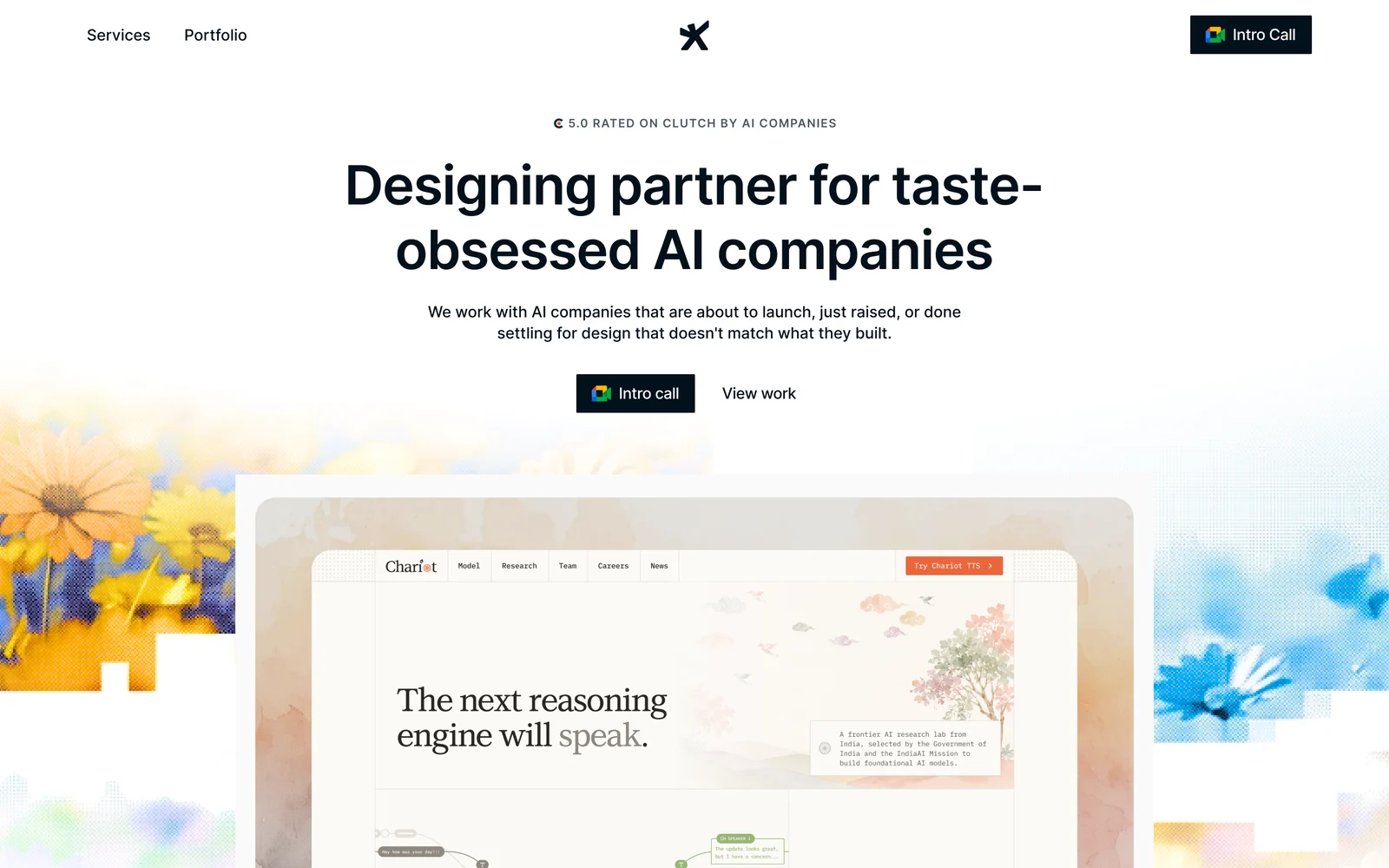
Studio Maydit is a web and product design studio working with AI founders across the US, UK, and Europe. Platform choice starts with a question rather than a preference: who has to publish a page the morning after an incident. Webflow when a marketing team needs to own that without a queue. Framer when the site changes week to week. Custom code when the product will not fit inside either. The studio then continues into product design after launch, which for a security company is where the harder explaining actually happens.
The published outcome is Dualite. It began with a repositioned ICP, a decision about which users the product would stop serving, and everything designed afterwards was aimed at the remaining group. 100,000+ users arrived in seven months. Recent clients include Wave, PixelFlow, and Mi-VAD, along with 15 other AI and SaaS teams.
Engagements come in two shapes. A fixed scope of three to four weeks fits a company with a launch, a funding announcement, or a compliance milestone, and it closes with a written diagnosis of what is leaking in the product rather than a handover pack. A monthly retainer fits a company that has to respond to its own market constantly, covering new pages, campaigns, and product design, with no long lock-in, which matters when the thing you need next week is a page nobody planned.
| Check | Finding |
|---|---|
| Based in | Remote, serving US / UK / EU |
| Platform depth | Framer, Webflow, and custom code |
| AI-sector proof | Yes. AI-native clients, published outcome on Dualite |
| Pricing | Fixed scope or monthly retainer, quoted per project |
| Team shape | Founder-led, small senior team |
| Best fit | Security teams whose site has to survive being inspected |
Worth a call if your marketing team cannot publish a page without an engineer. Book a 30-minute call.

2. BX Studio
BX Studio is an eleven to fifty person New York practice working in Webflow, publishing a starting figure and AI client work, naming Reddit, Headspace, ASAPP, and Verifone. Verifone handles payments and ASAPP is an AI company, so the studio has written for readers who check claims rather than absorb them, and a published minimum means you can assess them before disclosing anything about yourself.
No founding year is published, their record leans toward consumer and enterprise brands rather than security specifically, and a team of that size books capacity in advance rather than turning around a page this week.
| Check | Finding |
|---|---|
| Based in | New York, USA |
| Founded | Not published |
| Team size | 11-50 |
| Primary platform | Webflow |
| AI-sector proof | Yes. Published AI client work |
| Named clients | Reddit, Headspace, ASAPP, Verifone |
| Pricing | Published minimum |
| Best fit | Security teams wanting a studio they can evaluate before disclosing |
3. Digidop
Digidop is a one to ten person Paris studio founded in 2021, working in Webflow, publishing a starting figure and naming TSE Energy, Ramify, and StreamNative. Ramify is regulated finance and StreamNative is infrastructure sold to engineers, which between them cover the compliance reader and the technical reader you have to satisfy on the same page.
Their AI-sector proof is partial with no AI case study, a team of that size has little slack when your news cycle demands three pages at once, and European hours narrow the window for a US team.
| Check | Finding |
|---|---|
| Based in | Paris, France |
| Founded | 2021 |
| Team size | 1-10 |
| Primary platform | Webflow |
| AI-sector proof | Partial. Enterprise and SaaS clients, no AI case study |
| Named clients | TSE Energy, Ramify, StreamNative |
| Pricing | Published minimum |
| Best fit | European security teams serving compliance and technical readers |
4. Lighthouse Digital
Lighthouse Digital is a London studio working in Webflow, publishing a starting figure and naming HelloSelf, Freetrade, and IGN. HelloSelf handles clinical data and Freetrade is regulated, so the studio has worked where a wrong sentence on a page is a regulatory matter rather than a marketing one, which is closer to your position than most references here.
Their AI-sector proof is none published, no founding year or team size is published, and a security company evaluating on evidence will find the public record thin.
| Check | Finding |
|---|---|
| Based in | London, UK |
| Founded | Not published |
| Team size | Not published |
| Primary platform | Webflow |
| AI-sector proof | No. No published AI client work |
| Named clients | HelloSelf, Freetrade, IGN |
| Pricing | Published minimum |
| Best fit | Security teams whose claims carry regulatory weight |
5. Kvalifik
Kvalifik is a Copenhagen studio founded in 2015 at eleven to fifty people, working in Webflow, with published AI client work and Veo, Maersk, and Relesys named. Maersk is the useful signal, since designing for an organisation of that size means writing for people who forward a page to a committee, which is how enterprise security purchases actually get decided.
No starting figure is published, their published work is not security specific, and Danish hours leave a West Coast team a short overlap when something urgent lands.
| Check | Finding |
|---|---|
| Based in | Copenhagen, Denmark |
| Founded | 2015 |
| Team size | 11-50 |
| Primary platform | Webflow |
| AI-sector proof | Yes. Published AI client work |
| Named clients | Veo, Maersk, Relesys |
| Pricing | Not published |
| Best fit | Security teams selling into large European organisations |
6. 8020
8020 works from San Francisco and New York, founded in 2014, in Webflow, naming Wave, Superlist, Pilot.com, Vanta, and Circle. Vanta is the closest reference in this entire list, a compliance company selling to security teams, so the studio has already solved the exact problem of writing confidently for a reader trained to distrust confidence.
No team size or starting figure is published, their AI-sector proof is partial with no AI case study, and Webflow keeps the engagement on the marketing site rather than the product.
| Check | Finding |
|---|---|
| Based in | San Francisco and New York, USA |
| Founded | 2014 |
| Team size | Not published |
| Primary platform | Webflow |
| AI-sector proof | Partial. Enterprise and SaaS clients, no AI case study |
| Named clients | Wave, Superlist, Pilot.com, Vanta, Circle |
| Pricing | Not published |
| Best fit | Security teams selling to other security teams |
7. Flowout
Flowout is a distributed Webflow practice publishing a starting figure and naming Jasper, Kajabi, Riverside, and Sendlane. A production model built for volume is genuinely useful in this category, because responding to your market means publishing often rather than publishing once, and this is the cheapest way in the list to keep pages coming.
No founding year or team size is published, their AI-sector proof is partial with no AI case study, and volume production gives you competent pages rather than an argument tuned to a suspicious reader.
| Check | Finding |
|---|---|
| Based in | Distributed |
| Founded | Not published |
| Team size | Not published |
| Primary platform | Webflow |
| AI-sector proof | Partial. Enterprise and SaaS clients, no AI case study |
| Named clients | Jasper, Kajabi, Riverside, Sendlane |
| Pricing | Published minimum |
| Best fit | Security teams needing frequent pages at the lowest cost |
8. Edgar Allan
Edgar Allan has worked from Atlanta since 2014 at fifty-one to two hundred people, mainly in Webflow, naming Porsche, Duracell, and NCR. NCR builds payment and banking hardware, an industry where trust is established through decades rather than adjectives, and that instinct is a good counterweight to a security startup tempted to sound bigger than it is.
No starting figure is published, their AI-sector proof is partial with no AI case study, and a full brand programme at agency scale is slow if your immediate need is a site that can respond within days.
| Check | Finding |
|---|---|
| Based in | Atlanta, USA |
| Founded | 2014 |
| Team size | 51-200 |
| Primary platform | Webflow |
| AI-sector proof | Partial. Enterprise and SaaS clients, no AI case study |
| Named clients | Porsche, Duracell, NCR |
| Pricing | Not published |
| Best fit | Security teams who need to look established rather than loud |
9. Refokus
Refokus is an eleven to fifty person remote German studio founded in 2021, working in Webflow, naming Mural, BASF, Spotify, Yahoo, and BCG. BASF is a chemicals group with genuine operational risk and BCG advises on it, so the studio has produced work for organisations that read every published sentence for liability before it goes live.
No starting figure is published, their AI-sector proof is partial with no AI case study, and their strength is distinctive visual work, which needs a firm hand in a category where distinctiveness can tip into looking unserious.
| Check | Finding |
|---|---|
| Based in | Germany, remote |
| Founded | 2021 |
| Team size | 11-50 |
| Primary platform | Webflow |
| AI-sector proof | Partial. Enterprise and SaaS clients, no AI case study |
| Named clients | Mural, BASF, Spotify, Yahoo, BCG |
| Pricing | Not published |
| Best fit | Security teams who need to stop looking like every other vendor |
10. Flow Ninja
Flow Ninja is an eleven to fifty person Belgrade studio founded in 2018, working in Webflow. A mid-sized Webflow team at Serbian rates is the practical option when your site needs continuous output and your budget is committed elsewhere, which describes a lot of early security companies.
No named clients and no starting figure are published, and their AI-sector proof is partial with no AI case study. For a buyer whose whole discipline is verification, a supplier with almost no public record is a difficult recommendation.
| Check | Finding |
|---|---|
| Based in | Belgrade, Serbia |
| Founded | 2018 |
| Team size | 11-50 |
| Primary platform | Webflow |
| AI-sector proof | Partial. Enterprise and SaaS clients, no AI case study |
| Named clients | Not published |
| Pricing | Not published |
| Best fit | Security teams prioritising steady output over public evidence |
How to choose between them
Sort by which part of the evaluation you are losing, not by which site looks best.
Practitioners bounce before they reach pricing. Studio Maydit or 8020.
Compliance and legal readers stall the deal. Lighthouse Digital or Digidop.
Your site looks identical to every other vendor's. Refokus or Edgar Allan.
You need pages published weekly and cannot wait for anyone. Flowout or Flow Ninja.
One test before you sign. Send three studios your homepage and ask each what a security practitioner would distrust about it. A studio that has done this work names something concrete, usually an unsupported claim or a script that should not be there. A studio that has not will talk about your visual identity. This costs a single email and it sorts the list faster than any portfolio review.