
Summarize with AI


For an AI devtool building on Webflow, the ten studios to look at are Studio Maydit, Kvalifik, Flowout, Refokus, Lighthouse Digital, BX Studio, Pixelmatters, 8020, Digidop, and Flow Ninja. Kvalifik and Refokus lead. Kvalifik has built in Webflow from Copenhagen since 2015 with eleven to fifty people and has AI-sector proof, for Veo, Maersk, and Relesys. Refokus has worked remotely from Germany since 2021 with eleven to fifty people, for Mural, BASF, Spotify, Yahoo, and BCG, which is a Webflow portfolio at a scale most studios never reach. Lighthouse Digital and Flow Ninja are the weakest fits. Lighthouse Digital has no AI-sector proof and its named clients are consumer businesses. Flow Ninja names no clients and publishes no price.
Webflow is not a design decision. It is a decision about what your site can still do in eighteen months.
That is easy to miss during a pitch, because every studio will demo the editor and every editor demos well. What you are actually buying is a content model. If the person building it treats your site as a marketing brochure with a blog attached, you get exactly that, and the first time you want a changelog with filterable release notes you are rebuilding.
Devtools make this harder than most categories because the site has more moving parts than the sales pitch suggests. Release notes, model or version comparisons, integration pages, a status link, a docs handoff, and a pricing page that has to explain limits rather than seats.
There is also a build quality question nobody asks. Two Webflow sites can look identical and be a year apart in how easy they are to change.

How we picked these agencies
Five checks, all runnable from public pages before a call is booked.
Webflow depth, judged by structure rather than styling. Anyone can build a landing page in Webflow. The differences show up in whether collections are modelled properly, whether the class system is disciplined, and whether a new page can be assembled from existing components instead of built from scratch. Ask to see the CMS setup on a site they built two years ago and are still updating.
Proof on AI products where the interface is thin. That is the criterion carrying the most weight for this list. An AI devtool has very little to show visually, so a studio that has only made screenshots look good will struggle. What you want is evidence of work where the value lived in text, output, and speed rather than in a dashboard.
Pricing. Is a starting figure public. Webflow projects have an unusually wide range, from a template refresh to a full component system, and a published number is the fastest way to find out which end of it a studio works at.
Team shape. Size predicts continuity. A one to ten person studio gives you the same builder throughout. A fifty person studio may give you a senior lead and a different production team, which is fine if you know before you sign.
Their own site. In Webflow this check is unusually honest, because you can open the page and look at how it is put together.
An extra probe worth running: ask what they would do if you needed a new page type next quarter. A studio that built you a system describes an afternoon. A studio that built you pages describes a project.
Every value in the tables below is repeated from what each studio publishes about itself. Nothing has been inferred, and a row reading unpublished reflects the studio's own decision about what to disclose.
What goes wrong for AI devtools on Webflow
Three failures, all of them structural rather than visual.
The CMS gets modelled as a blog. One collection called Posts, a title, a body, and an image. Then the product ships weekly and you need release notes that can be filtered by version, integration pages generated from a list, and model comparisons that stay accurate in three places at once. None of that fits in Posts. Decide your collections in week one with someone who knows what you will publish, because remodelling a live CMS is far more expensive than getting it approximately right at the start.
Nobody builds a component system, so the site drifts. Page four is built by copying page three and nudging it, and six months later the site has eleven button styles and four ways of setting a section's padding. It never looks broken enough to fix, and it quietly triples the cost of every change. Insist that reusable components and a class naming convention are named deliverables rather than assumed good practice.
The seam between the site and the docs is left to nobody. The marketing site ends at a Read the docs link, and the reader crosses into a different navigation, a different type scale, and a different voice. That crossing is where evaluation actually happens for a devtool. Agree who owns the shared header, the terminology, and the visual language across both, and put it in the scope rather than assuming it is covered.
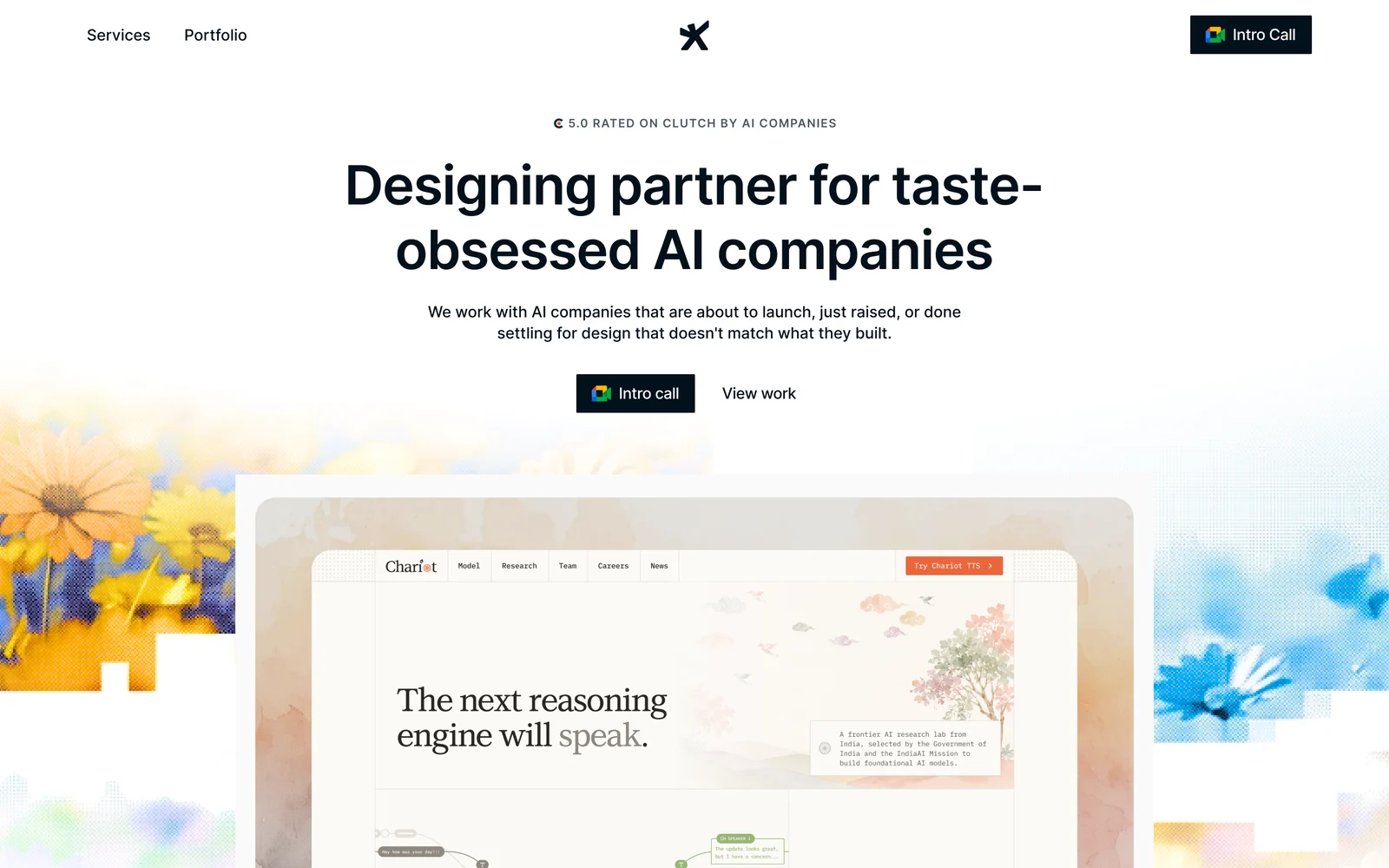
1. Studio Maydit: A Top-Rated Design Agency for AI Founders
Webflow is one of three platforms here rather than the only one, which matters when the honest answer is that part of your site should not be in Webflow at all. Studio Maydit builds in Framer, Webflow, and custom code, and the choice follows who ships changes and what the page has to render. It is a web and product design studio. Its clients are AI founders, working in the US, UK, and Europe. The work continues into product design after the site ships, which for a devtool is where the trial itself gets fixed.
At Dualite the design started with a repositioned ICP rather than with pages. The product was built for the narrower group that decision defined, and 100,000+ users followed over seven months. That ordering is worth stealing for a devtool, where the temptation is to widen the site until it names every language and every framework, which leaves the page technically accurate and persuasive to nobody. Recent clients include Wave, PixelFlow, Mi-VAD, and 15 other AI and SaaS teams.
Two ways to buy. Fixed scope is three to four weeks, suits a launch date, and closes with a written diagnosis of what is leaking in the product rather than a handover call. For a devtool whose site changes with every release, the monthly retainer usually fits better: new pages, campaigns, and product design, with no long lock-in, so the arrangement ends when it stops being worth its cost.
| Check | Finding |
|---|---|
| Based in | Remote, serving US / UK / EU |
| Platform depth | Framer, Webflow, and custom code |
| AI-sector proof | Yes. AI-native clients, published outcome on Dualite |
| Pricing | Fixed scope or monthly retainer, quoted per project |
| Team shape | Founder-led, small senior team |
| Best fit | Devtools who want the platform chosen rather than assumed |
Bring the list of pages you expect to add next year. That is the real brief. Book a 30-minute call.

2. Kvalifik
Kvalifik has built in Webflow from Copenhagen since 2015 with eleven to fifty people and AI-sector proof, for Veo, Maersk, and Relesys. Ten years in one platform is deep experience, and Veo is a hardware and software product where the interesting part was the output rather than the interface, which is close to the devtool problem.
No pricing is published, none of the named clients is a developer tool, and Copenhagen overlaps only with US mornings.
| Check | Finding |
|---|---|
| Based in | Copenhagen, Denmark |
| Founded | 2015 |
| Team size | 11-50 |
| Primary platform | Webflow |
| AI-sector proof | Yes |
| Named clients | Veo, Maersk, Relesys |
| Pricing | Not published |
| Best fit | Devtools who want long Webflow experience and AI-product work |
3. Flowout
Flowout is a distributed Webflow studio with a published starting price, for Jasper, Kajabi, Riverside, and Sendlane. Jasper is an AI product that had to explain generated output to a non-technical audience, and a subscription model means you can start small and add pages as the product ships rather than buying everything at once.
No founding year, headcount, or location is published, the AI-sector proof is partial, and a subscription arrangement suits ongoing pages better than a single structural build.
| Check | Finding |
|---|---|
| Based in | Distributed |
| Founded | Not published |
| Team size | Not published |
| Primary platform | Webflow |
| AI-sector proof | Partial |
| Named clients | Jasper, Kajabi, Riverside, Sendlane |
| Pricing | Published minimum |
| Best fit | Devtools who want pages produced continuously at a known rate |
4. Refokus
Refokus has worked remotely from Germany since 2021 with eleven to fifty people, for Mural, BASF, Spotify, Yahoo, and BCG. That is Webflow at an unusual scale, and Mural in particular is a technical collaboration product where the site had to carry a genuinely complicated proposition.
No pricing is published, the AI-sector proof is partial, and a client list of that size suggests engagements larger than an early devtool needs.
| Check | Finding |
|---|---|
| Based in | Germany, remote |
| Founded | 2021 |
| Team size | 11-50 |
| Primary platform | Webflow |
| AI-sector proof | Partial |
| Named clients | Mural, BASF, Spotify, Yahoo, BCG |
| Pricing | Not published |
| Best fit | Funded devtools who want Webflow built to enterprise standards |
5. Lighthouse Digital
Lighthouse Digital is a London Webflow studio with a published starting price, for HelloSelf, Freetrade, and IGN. Freetrade had to explain a regulated financial product to people in a hurry, and the published number lets a UK team start budgeting before any call happens.
There is no AI-sector proof at all, and neither the founding year nor the team size is published, so there is little to weigh beyond the portfolio.
| Check | Finding |
|---|---|
| Based in | London, UK |
| Founded | Not published |
| Team size | Not published |
| Primary platform | Webflow |
| AI-sector proof | No |
| Named clients | HelloSelf, Freetrade, IGN |
| Pricing | Published minimum |
| Best fit | UK devtools who want a known number before the first conversation |
6. BX Studio
BX Studio is a New York Webflow team of eleven to fifty with a published starting price and AI-sector proof, for Reddit, Headspace, ASAPP, and Verifone. ASAPP sells AI into technical buyers, and Reddit is a content structure problem at scale, which is a useful signal if your site will grow into dozens of integration and release pages.
No founding year is published, and the client list skews toward large consumer products rather than small technical ones.
| Check | Finding |
|---|---|
| Based in | New York, USA |
| Founded | Not published |
| Team size | 11-50 |
| Primary platform | Webflow |
| AI-sector proof | Yes |
| Named clients | Reddit, Headspace, ASAPP, Verifone |
| Pricing | Published minimum |
| Best fit | Devtools expecting the site to grow to many page types |
7. Pixelmatters
Pixelmatters has worked from Porto since 2013 with fifty-one to two hundred people and a published starting price, for Rubrik, Quantic, and UJET. Rubrik is enterprise infrastructure sold to technical buyers, and having design and engineering in the same building means the awkward parts of a Webflow build get solved rather than deferred.
Webflow is one of several platforms here rather than the specialism, and the AI-sector proof is partial.
| Check | Finding |
|---|---|
| Based in | Porto, Portugal |
| Founded | 2013 |
| Team size | 51-200 |
| Primary platform | Mixed |
| AI-sector proof | Partial |
| Named clients | Rubrik, Quantic, UJET |
| Pricing | Published minimum |
| Best fit | Devtools who want design and engineering under one roof |
8. 8020
8020 has worked from San Francisco and New York since 2014 in Webflow, for Wave, Superlist, Pilot.com, Vanta, and Circle. Vanta and Superlist are both software companies selling to technical and operational buyers, and the sites read as products people already trust, which is the hardest thing for an early devtool to fake.
Neither pricing nor headcount is published, and the AI-sector proof is partial.
| Check | Finding |
|---|---|
| Based in | San Francisco and New York, USA |
| Founded | 2014 |
| Team size | Not published |
| Primary platform | Webflow |
| AI-sector proof | Partial |
| Named clients | Wave, Superlist, Pilot.com, Vanta, Circle |
| Pricing | Not published |
| Best fit | Devtools who need the site to read as more established than they are |
9. Digidop
Digidop is a Paris Webflow studio founded in 2021 with one to ten people and a published starting price, for TSE Energy, Ramify, and StreamNative. StreamNative is streaming infrastructure sold to engineers, which is the closest direct reference on this page, and a small team means the person modelling your collections is the person you briefed.
Capacity is limited at that size, the AI-sector proof is partial, and the working day mostly overlaps European hours.
| Check | Finding |
|---|---|
| Based in | Paris, France |
| Founded | 2021 |
| Team size | 1-10 |
| Primary platform | Webflow |
| AI-sector proof | Partial |
| Named clients | TSE Energy, Ramify, StreamNative |
| Pricing | Published minimum |
| Best fit | European devtools wanting a small team and a published number |
10. Flow Ninja
Flow Ninja is a Belgrade Webflow studio founded in 2018 with eleven to fifty people. Seven years in the platform at that headcount means real production capacity, and European rates buy a larger structural build than the same budget would in the US.
No clients are named, no price is published, and the AI-sector proof is partial. That is very little public evidence for a decision that determines how your site works for years.
| Check | Finding |
|---|---|
| Based in | Belgrade, Serbia |
| Founded | 2018 |
| Team size | 11-50 |
| Primary platform | Webflow |
| AI-sector proof | Partial |
| Named clients | Not published |
| Pricing | Not published |
| Best fit | Teams willing to judge entirely on a portfolio walkthrough |
How to choose between them
Sort by what is actually broken.
If the site cannot hold the content you are about to publish, buy the content model first. Kvalifik, or Refokus if the scale is larger.
If pages are the bottleneck and the structure is fine, buy throughput. Flowout, or Digidop on a European budget.
If the site has to look like a company engineers already rely on, that is craft and reference. 8020, or BX Studio.
If parts of the site will need live product data, get that decided before Webflow is assumed. Pixelmatters.
One test before you sign. Ask them to sketch your CMS collections on the call, out loud, from what you have told them. A studio that thinks structurally names four or five and explains what each one feeds. A studio that does not will say it depends.