
Summarize with AI


The best Webflow design agencies for AI HR tech startups in 2026 are Studio Maydit, Kvalifik, BX Studio, Refokus, 8020, Edgar Allan, Finsweet, Lighthouse Digital, Feely Studio, and Fantasy. Studio Maydit and Kvalifik lead for this brief. Kvalifik has worked from Copenhagen since 2015 at eleven to fifty people in Webflow with published AI client work, naming Veo, Maersk, and Relesys, and Maersk is exactly the kind of employer whose HR function buys carefully and asks for documentation before anything else. Lighthouse Digital and Fantasy fit this brief least well. One publishes no AI client work at all, which is the central credibility question here, and the other names no clients and no starting figure and is not primarily a Webflow practice.
Your buyer is personally accountable for what your model decides, and your website is where they start deciding whether to risk it.
HR technology sits in an unusual position. The person evaluating you is a Head of People or a Talent lead, and if your screening model produces a biased outcome, it is their name on the process, their legal exposure, and their conversation with the works council. That changes what a website has to do. Most AI companies are selling efficiency. You are selling efficiency to somebody whose main worry is not slowness.
So the trust content is not a compliance afterthought here. It is the product page. What data the model was trained on, what it does not decide, how a human stays in the loop, how a candidate can contest an outcome, and what happens under EU and US employment rules. Most AI HR sites bury all of this behind a legal link and lead with time saved per hire, which speaks to a real benefit while ignoring the actual blocker.
There is a second audience nobody designs for. Candidates read these sites too. When a company adopts your tool, applicants look you up, and increasingly they write about what they find. A site that talks only about filtering people out reads very differently to the person being filtered, and that reputational risk is now something your buyer weighs.
Then there is the demo problem. Screening and matching produce a ranked list, and a ranked list of made-up candidates is not persuasive. It is also the one thing you cannot show honestly with real data, which is why so many AI HR sites fall back on an abstract graphic where the product should be.
Read the ten below as a question about whether a studio can write a trust page that converts.

How we picked these agencies
Five checks, all of them verifiable before a call.
- Platform depth. Webflow is the brief, so how deep does it go? An HR tech site accumulates policy pages, security documentation, regional variants, and a candidate FAQ, and every one of those has to be editable by someone who is not a developer.
- Proof with regulated or high-scrutiny buyers. Have they built for a client whose customers had a compliance department? That experience transfers directly. Consumer brand work does not.
- Pricing. Is a starting figure published? For a company that will be asked to publish its own model documentation, how a supplier handles disclosure is a small but real signal.
- Team shape. Size and seniority decide whether a nuanced argument about accountability gets written by someone senior or handed to a junior copywriter with a brief.
- Their own site. The page nobody commissioned and nobody chased.
For this brief, look at whether a studio has ever written a page whose job was to reduce fear rather than build excitement. Those are different crafts. A studio that only knows how to make things feel exciting will make your screening product sound more autonomous than you want it to, which is the opposite of helpful with this buyer.
Everything in the tables is what each studio publishes about itself. No directory data, no ranking sites, and no assumption used to fill a blank. Where a studio publishes nothing, the row says so.
What goes wrong on AI HR tech websites
Three failures, and each one loses a deal at a different stage.
The headline promises autonomy the buyer does not want. Copy about automatically screening thousands of applicants reads as leverage to a founder and as liability to a Head of People. The same product described as helping a team review more candidates consistently, with a person deciding, sells better to the person who actually signs. The technology has not changed. The sentence has.
Trust content is filed as legal. Model documentation, bias auditing, data retention, and candidate rights end up on a policy page linked from the footer. Meanwhile the buyer's blocking question is exactly that, so they either ask it in a call that could have been avoided or quietly rank you below a competitor who answered on the page.
The candidate is invisible. Every word is written for the employer, and the person on the other side of the process appears only as volume to be reduced. Buyers notice, because they are the ones who will face the complaint. A short section on how candidates are treated does more for enterprise conversion than another efficiency statistic.
1. Studio Maydit: A Top-Rated Design Agency for AI Founders
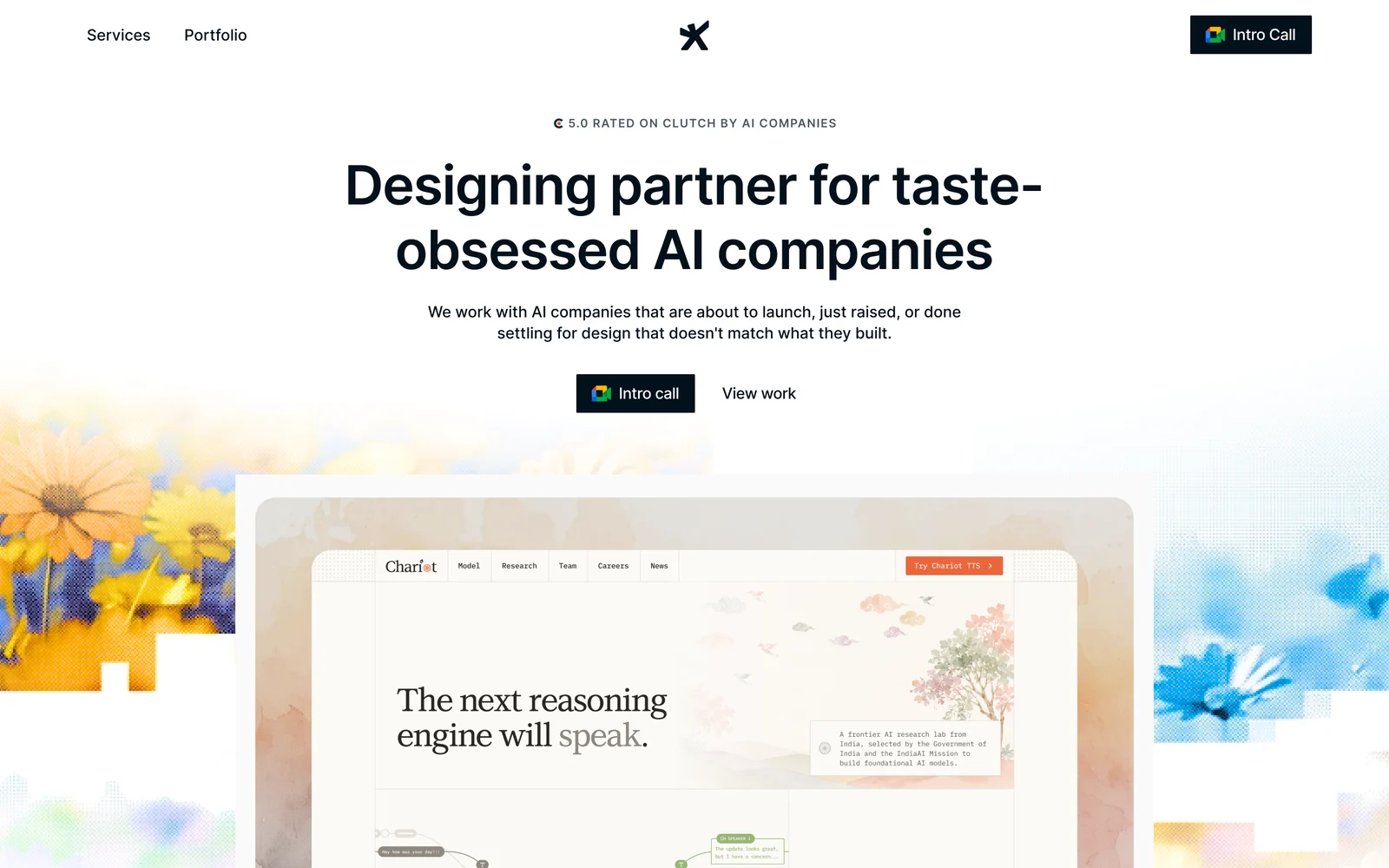
Studio Maydit is a web and product design studio working with AI founders in the US, UK, and Europe. Working across both regions is the everyday condition here rather than an occasional project, which matters for HR technology, since the rules a buyer answers to in Berlin are not the rules a buyer answers to in Boston and the site usually has to satisfy both.
Sites get built in Framer, Webflow, and custom code, picked by who maintains the pages afterwards. For a company that will be adding regional policy pages and security documentation for years, that decision is the difference between a marketing hire publishing on Tuesday and a developer ticket. After launch the work continues into product design, which is where the reviewer's screen and the audit trail live.
The published outcome is Dualite, where design work supporting a repositioned ICP helped the product reach 100,000+ users in seven months, and the change that mattered was narrowing who the product spoke to. Recent clients include Wave, PixelFlow, Mi-VAD, and 15 other AI and SaaS teams. Fixed scope runs three to four weeks where a date is set and ends with a written diagnosis of what is leaking in the product. A monthly retainer suits teams whose documentation grows every quarter, with no long lock-in.
| Check | Finding |
|---|---|
| Based in | Remote, serving US / UK / EU |
| Platform depth | Framer, Webflow, and custom code |
| AI-sector proof | Yes. AI-native clients, published outcome on Dualite |
| Pricing | Fixed scope or monthly retainer, quoted per project |
| Team shape | Founder-led, small senior team |
| Best fit | HR tech teams whose trust page has to do the selling |
Worth a call if buyers keep asking questions your homepage should have answered. Book a 30-minute call.

2. Kvalifik
Kvalifik has worked from Copenhagen since 2015 at eleven to fifty people in Webflow, with published AI client work and Veo, Maersk, and Relesys named. Relesys builds employee communication software, which puts the studio inside the HR technology category itself, and Maersk is an employer whose procurement and works council processes are as demanding as any you will meet.
No starting figure is published, so cost is unknown before a conversation. A Copenhagen base also gives a US team only the morning, which is manageable but worth planning around during a compressed launch.
| Check | Finding |
|---|---|
| Based in | Copenhagen, Denmark |
| Founded | 2015 |
| Team size | 11-50 |
| Primary platform | Webflow |
| AI-sector proof | Yes. Published AI client work |
| Named clients | Veo, Maersk, Relesys |
| Pricing | Not published |
| Best fit | AI HR companies selling into European employers first |
3. BX Studio
BX Studio works from New York at eleven to fifty people in Webflow, publishing a starting figure and AI client work, and naming Reddit, Headspace, ASAPP, and Verifone. Headspace is the useful reference. It is a product used by employers for their staff, where tone had to be careful and human, which is the register an HR product needs and rarely finds.
No founding year is published, so the length of the record is unclear. At eleven to fifty people expect an account layer, and Webflow keeps the engagement on the marketing surface rather than the reviewer interface.
| Check | Finding |
|---|---|
| Based in | New York, USA |
| Founded | Not published |
| Team size | 11-50 |
| Primary platform | Webflow |
| AI-sector proof | Yes. Published AI client work |
| Named clients | Reddit, Headspace, ASAPP, Verifone |
| Pricing | Published minimum |
| Best fit | AI HR companies who need a human tone rather than an efficiency pitch |
4. Refokus
Refokus is a remote German Webflow studio founded in 2021 at eleven to fifty people, naming Mural, BASF, Spotify, Yahoo, and BCG. BASF and BCG are organisations with substantial HR functions and rigorous internal review, so the studio has produced work that had to pass committees rather than charm a founder.
No starting figure is published and their AI-sector proof is partial with no case study, which is a gap when the AI question is the buying question. A German base also means European working hours for a US-led launch.
| Check | Finding |
|---|---|
| Based in | Germany, remote |
| Founded | 2021 |
| Team size | 11-50 |
| Primary platform | Webflow |
| AI-sector proof | Partial. Enterprise and SaaS clients, no AI case study |
| Named clients | Mural, BASF, Spotify, Yahoo, BCG |
| Pricing | Not published |
| Best fit | AI HR companies whose site must survive an enterprise review |
5. 8020
8020 has worked from San Francisco and New York since 2014 in Webflow, naming Wave, Superlist, Pilot.com, Vanta, and Circle. Vanta is the standout for this brief. It is a compliance product that had to make security documentation into a reason to buy rather than a legal appendix, which is structurally the same problem as your model documentation.
No team size and no starting figure are published. Their AI-sector proof is partial with no published AI case study, so the specific vocabulary of model accountability is not evidenced in the record.
| Check | Finding |
|---|---|
| Based in | San Francisco and New York, USA |
| Founded | 2014 |
| Team size | Not published |
| Primary platform | Webflow |
| AI-sector proof | Partial. SaaS clients, no AI case study |
| Named clients | Wave, Superlist, Pilot.com, Vanta, Circle |
| Pricing | Not published |
| Best fit | AI HR companies turning compliance content into a selling page |
6. Edgar Allan
Edgar Allan has worked from Atlanta since 2014 at fifty-one to two hundred people in Webflow, naming Porsche, Duracell, and NCR. It is a substantial Webflow practice with real brand capability, and an HR tech company that has decided its problem is category positioning rather than trust content would find a capable partner.
The named work is consumer and enterprise brand rather than regulated software, no starting figure is published, and the AI-sector proof is partial with no case study. Nothing in the public record shows a page written to reduce a buyer's legal anxiety.
| Check | Finding |
|---|---|
| Based in | Atlanta, USA |
| Founded | 2014 |
| Team size | 51-200 |
| Primary platform | Webflow |
| AI-sector proof | Partial. Enterprise clients, no AI case study |
| Named clients | Porsche, Duracell, NCR |
| Pricing | Not published |
| Best fit | AI HR companies running a brand programme alongside the product |
7. Finsweet
Finsweet is a Denver-based distributed Webflow practice founded in 2017 at fifty-one to two hundred people, naming Dropbox, Clay, GitHub, and Steadily. The Webflow depth here is unusual, and an HR tech site that will grow regional policy pages, a security centre, and a candidate FAQ needs a build that stays maintainable rather than one that looks good on launch day.
No starting figure is published and their AI-sector proof is partial with no case study. The practice is also sized for larger builds, so a lean first site may not be the natural engagement.
| Check | Finding |
|---|---|
| Based in | Denver, USA, distributed |
| Founded | 2017 |
| Team size | 51-200 |
| Primary platform | Webflow |
| AI-sector proof | Partial. SaaS clients, no AI case study |
| Named clients | Dropbox, Clay, GitHub, Steadily |
| Pricing | Not published |
| Best fit | AI HR companies whose documentation library will keep expanding |
8. Lighthouse Digital
Lighthouse Digital is a London Webflow studio publishing a starting figure and naming HelloSelf, Freetrade, and IGN. Both HelloSelf and Freetrade sell regulated products to individuals, so the studio has written pages where a reader had to be reassured before they would act, which is the right instinct for a candidate-facing section.
They publish no AI client work at all, which is a direct gap for a company whose entire buying objection is about the model. No founding year and no team size are published either, so the scale of the practice is unclear.
| Check | Finding |
|---|---|
| Based in | London, UK |
| Founded | Not published |
| Team size | Not published |
| Primary platform | Webflow |
| AI-sector proof | No. No published AI client work |
| Named clients | HelloSelf, Freetrade, IGN |
| Pricing | Published minimum |
| Best fit | AI HR companies focused on the candidate-facing side of the site |
9. Feely Studio
Feely Studio is a distributed European team of one to ten people working across platforms, publishing a starting figure and AI client work, and naming Noxus, Mutiny, Luasai, and Basic Capital. A European studio with AI-native clients and a published number is easy to shortlist, and at that size the senior people write the words themselves, which matters for careful copy.
Webflow is not the primary platform, so the specific brief here is a partial match. No founding year is published, and one to ten people is a real constraint if you need a policy centre and a redesign in the same quarter.
| Check | Finding |
|---|---|
| Based in | Distributed, Europe |
| Founded | Not published |
| Team size | 1-10 |
| Primary platform | Mixed |
| AI-sector proof | Yes. Published AI client work |
| Named clients | Noxus, Mutiny, Luasai, Basic Capital |
| Pricing | Published minimum |
| Best fit | European AI HR teams wanting senior attention on the core pages |
10. Fantasy
Fantasy has run from San Francisco and New York since 1999, works across platforms, and publishes AI client work. A quarter century of product and interface work means the studio has designed for complex, consequential systems long before AI became the framing.
For this brief the public record is thin and the platform is wrong. No clients are named, no team size and no starting figure are published, and Webflow is not the primary platform. A shortlist built on evidence has very little to work with here.
| Check | Finding |
|---|---|
| Based in | San Francisco and New York, USA |
| Founded | 1999 |
| Team size | Not published |
| Primary platform | Mixed |
| AI-sector proof | Yes. Published AI client work |
| Named clients | Not published |
| Pricing | Not published |
| Best fit | Larger AI HR companies running a full product design programme |
How to choose between them
Sort by which objection is costing you deals.
Buyers stall on bias and accountability questions. Studio Maydit or 8020.
Your product sounds more autonomous than you want it to. BX Studio or Feely Studio.
You are selling into European employers with works councils. Kvalifik or Refokus.
Your documentation library is outgrowing the build. Finsweet or Edgar Allan.
One test before you sign. Send three studios your homepage and ask each one what they would put on the page to answer a Head of People worried about a discrimination claim. A studio that understands this category will restructure the page so the answer appears before the efficiency numbers. A studio that does not will suggest adding a trust badge row. Both are real answers. Only one of them addresses the reason you are losing the deal.