

Summarize with AI


An AI infrastructure company choosing a Webflow studio should look at Studio Maydit, Kvalifik, Flow Ninja, Finsweet, Digidop, 8020, Refokus, Flowout, Edgar Allan, and Lighthouse Digital. Kvalifik and Finsweet lead here. Kvalifik has built in Webflow from Copenhagen since 2015 with eleven to fifty people and has AI-sector proof, for Veo, Maersk, and Relesys. Finsweet has worked from Denver since 2017 as a distributed team of fifty-one to two hundred, for Dropbox, Clay, GitHub, and Steadily, and is the studio other Webflow teams learn technique from. Edgar Allan and Lighthouse Digital fit least well. Edgar Allan's work is brand programmes for large consumer companies, and Lighthouse Digital has no AI-sector proof at all.
Somebody is going to put you in a spreadsheet, and the columns are already decided.
Latency at a given load. Cost per unit at volume. Regions. Uptime over the last quarter. Whether the data leaves their environment. Your prospective buyer will build that sheet whether or not you help, and they will fill the cells from whatever they can find. Where your site is silent, the sheet gets a blank, and a blank next to a competitor's number is a decision.
This is the part that separates infrastructure from the rest of software. The buyer is an engineering team spending real budget, and they are not persuaded by a story about the future of compute. They are checking whether the numbers hold at their scale.
Webflow can do most of this well. It can also become the reason a pricing calculator never gets built, and that trade needs deciding before anyone starts designing.

How we picked these agencies
Five checks, each answerable from public pages before booking a call.
Webflow depth, tested against the thing you actually need rather than against a template. An infrastructure site is not a set of pages, it is a benchmark table that updates, a calculator, a regions map, a status link, and a docs handoff. Some of that Webflow handles natively, some needs custom code inside it, and some belongs elsewhere. Ask which parts they would put where, and listen for whether they name the boundary.
Proof with technical products whose buyers spend real budget. This criterion decides most of the list. Selling to an engineering team that runs a procurement process is not the same as selling to a marketer, and it shows up in whether a studio treats a number as a design element or as a claim that has to survive scrutiny.
Pricing. Is a starting figure published. It is also a small consistency check: a company selling to buyers who expect transparent unit pricing may not want a partner whose own price is hidden until the third call.
Team shape. Headcount tells you who builds the awkward parts. Calculators and live tables are where Webflow projects overrun, and a small studio that has done it before beats a large one that has not.
Their own site. Open it and look at how it is put together, because in Webflow you can. It is the most direct evidence available anywhere on this page.
An extra question worth asking: what happens when a benchmark changes. If the answer involves them, the site will be out of date within a quarter.
Nothing in the tables below has been estimated. Each row records what the studio states publicly about itself, and unpublished means that studio has chosen not to disclose the figure rather than that it could not be found.
What goes wrong for AI infrastructure companies
Three failures, and each one costs you the same evaluation.
Benchmarks are presented as marketing instead of as data. A large number in a coloured box, no methodology, no hardware named, no date, no way to reproduce it. An infrastructure buyer discounts that entirely, and often discounts the rest of the page with it. Publish the conditions alongside the result, say when it was measured, and say where you lose. A benchmark with an honest weakness is worth more than three without one.
Pricing hides behind a contact form when unit economics are the decision. The buyer needs to know what a million units costs at their volume, and they need it before they will speak to anyone. Contact us reads as expensive, and in infrastructure it reads as a company that intends to price by how much you need it. If the model is genuinely complicated, build the calculator. That page will do more work than the homepage.
Reliability is invisible. No status page, no incident history, no architecture diagram, nothing about regions or failover. Every engineer evaluating you has been let down by a provider before, so the absence is not read as neutral. Link the status page from the navigation, publish the last twelve months, and describe what happens when a region goes down. Companies that hide this are assumed to be hiding something.
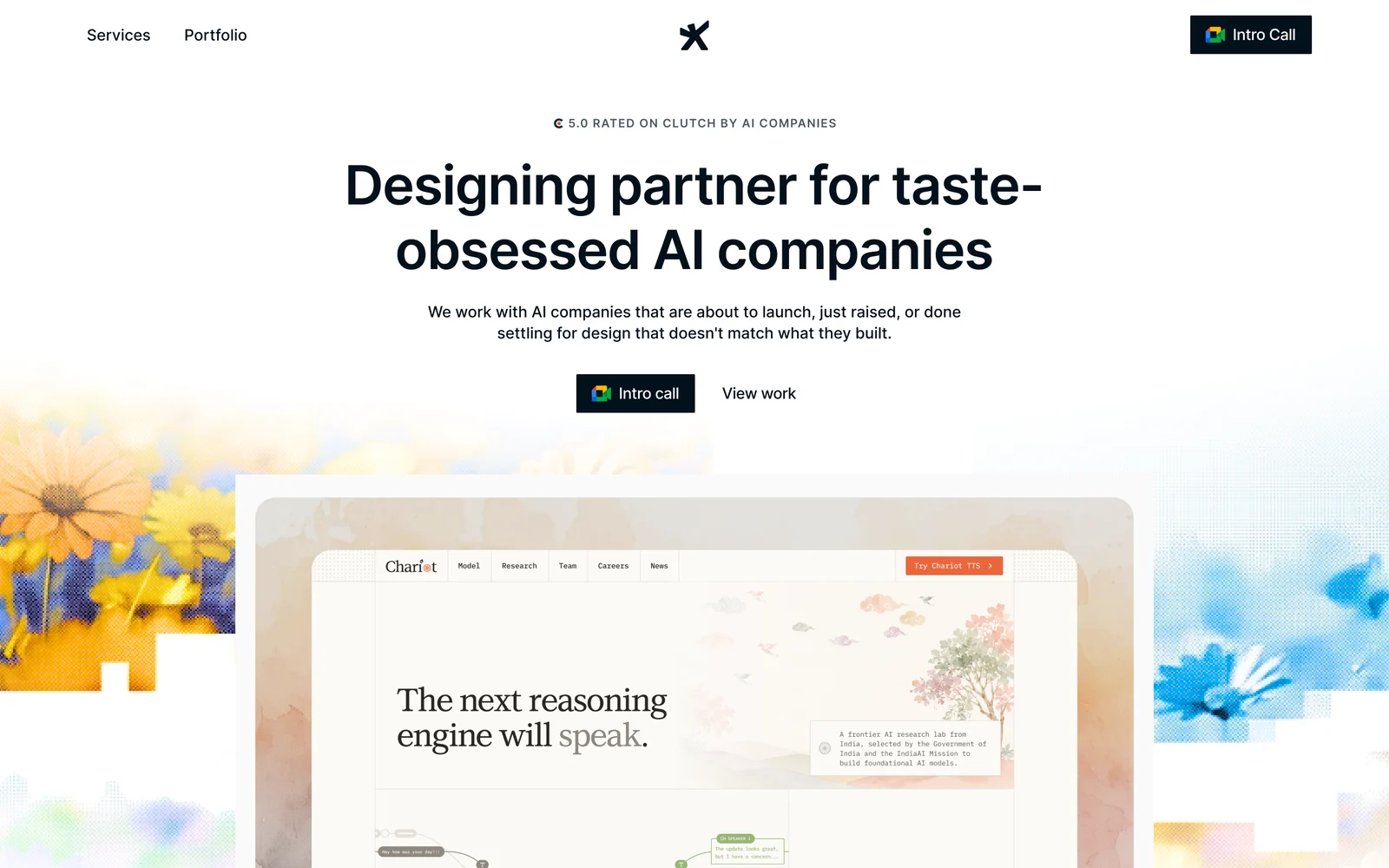
1. Studio Maydit: A Top-Rated Design Agency for AI Founders
Some of an infrastructure site does not belong in Webflow, and it helps to hear that from somebody who builds in more than one place. Studio Maydit works in Framer, Webflow, and custom code, so the calculator, the live benchmark table, and the marketing pages can each sit where they actually work. It is a web and product design studio. Its clients are AI founders, spread across the US, UK, and Europe. Design continues into the product after the site ships, which for infrastructure usually means the console, where the real evaluation happens.
At Dualite the order was deliberate: a repositioned ICP first, then a product designed for the narrower group that decision defined, then 100,000+ users across seven months. Infrastructure companies feel constant pressure to describe a platform that serves every workload and every team size, and the result is a page a specific engineer cannot see themselves in. Narrowing is what makes the numbers on the page mean something. Recent clients include Wave, PixelFlow, Mi-VAD, and 15 other AI and SaaS teams.
Every fixed scope engagement ends with a written diagnosis of what is leaking in the product, and for an infrastructure company that leak is almost always between the signup and the first successful request. Those engagements run three to four weeks and suit a general availability date. The alternative is a monthly retainer, which fits better once benchmarks, regions, and prices start moving faster than a project can absorb: new pages, campaigns, and product design, with no long lock-in on either side.
| Check | Finding |
|---|---|
| Based in | Remote, serving US / UK / EU |
| Platform depth | Framer, Webflow, and custom code |
| AI-sector proof | Yes. AI-native clients, published outcome on Dualite |
| Pricing | Fixed scope or monthly retainer, quoted per project |
| Team shape | Founder-led, small senior team |
| Best fit | Infrastructure teams who need parts of the site outside Webflow |
Bring the spreadsheet your buyers build. The site should fill it. Book a 30-minute call.

2. Kvalifik
Kvalifik has built in Webflow from Copenhagen since 2015 with eleven to fifty people and AI-sector proof, for Veo, Maersk, and Relesys. Ten years inside one platform is unusual depth, and Maersk is a logistics operation where the interesting problems were systems rather than styling, which is the right instinct for an infrastructure brief.
No pricing is published, none of the named clients is a developer infrastructure product, and Copenhagen shares only a morning with the US west coast.
| Check | Finding |
|---|---|
| Based in | Copenhagen, Denmark |
| Founded | 2015 |
| Team size | 11-50 |
| Primary platform | Webflow |
| AI-sector proof | Yes |
| Named clients | Veo, Maersk, Relesys |
| Pricing | Not published |
| Best fit | Infrastructure teams wanting deep Webflow and AI-product experience |
3. Finsweet
Finsweet has worked from Denver since 2017 as a distributed team of fifty-one to two hundred, in Webflow, for Dropbox, Clay, GitHub, and Steadily. GitHub and Dropbox are both infrastructure products at enormous scale, and Finsweet is the team that publishes the techniques other Webflow studios rely on, which matters when the site needs a filterable benchmark table rather than a hero image.
No pricing is published, the AI-sector proof is partial, and at that size the senior people may not be the ones on a smaller project.
| Check | Finding |
|---|---|
| Based in | Denver, USA, distributed |
| Founded | 2017 |
| Team size | 51-200 |
| Primary platform | Webflow |
| AI-sector proof | Partial |
| Named clients | Dropbox, Clay, GitHub, Steadily |
| Pricing | Not published |
| Best fit | Teams pushing Webflow past what it does out of the box |
4. Flow Ninja
Flow Ninja is a Belgrade Webflow studio founded in 2018 with eleven to fifty people. Seven years and that headcount means genuine production capacity, and European rates buy the extra build days a calculator or a live table always turns out to need.
No clients are named, no price is published, and the AI-sector proof is partial. For a buyer who evaluates everything on published evidence, that absence is worth noticing.
| Check | Finding |
|---|---|
| Based in | Belgrade, Serbia |
| Founded | 2018 |
| Team size | 11-50 |
| Primary platform | Webflow |
| AI-sector proof | Partial |
| Named clients | Not published |
| Pricing | Not published |
| Best fit | Teams who need build capacity and will judge on a portfolio call |
5. Digidop
Digidop is a Paris Webflow studio founded in 2021 with one to ten people and a published starting price, for TSE Energy, Ramify, and StreamNative. StreamNative is streaming infrastructure sold to engineers, which makes it the most directly comparable reference on this page, and a small team means the person who understood your architecture is the person building the page.
Capacity is the constraint at that size, the AI-sector proof is partial, and the working day is mostly European.
| Check | Finding |
|---|---|
| Based in | Paris, France |
| Founded | 2021 |
| Team size | 1-10 |
| Primary platform | Webflow |
| AI-sector proof | Partial |
| Named clients | TSE Energy, Ramify, StreamNative |
| Pricing | Published minimum |
| Best fit | European infrastructure teams wanting a direct reference |
6. 8020
8020 has worked from San Francisco and New York since 2014 in Webflow, for Wave, Superlist, Pilot.com, Vanta, and Circle. Vanta sells compliance to engineering and security teams, which is close to your buyer, and the sites read as products already trusted at scale. That perception is most of what an early infrastructure company is trying to buy.
Neither pricing nor headcount is published, and the AI-sector proof is partial.
| Check | Finding |
|---|---|
| Based in | San Francisco and New York, USA |
| Founded | 2014 |
| Team size | Not published |
| Primary platform | Webflow |
| AI-sector proof | Partial |
| Named clients | Wave, Superlist, Pilot.com, Vanta, Circle |
| Pricing | Not published |
| Best fit | Infrastructure teams who need to read as established quickly |
7. Refokus
Refokus has worked remotely from Germany since 2021 with eleven to fifty people, for Mural, BASF, Spotify, Yahoo, and BCG. BASF and Spotify are both organisations with heavy technical requirements behind a marketing site, and this is Webflow production at a scale very few studios reach.
No pricing is published, the AI-sector proof is partial, and engagements at that level are sized for companies with internal marketing teams.
| Check | Finding |
|---|---|
| Based in | Germany, remote |
| Founded | 2021 |
| Team size | 11-50 |
| Primary platform | Webflow |
| AI-sector proof | Partial |
| Named clients | Mural, BASF, Spotify, Yahoo, BCG |
| Pricing | Not published |
| Best fit | Funded teams wanting Webflow built to a large-company standard |
8. Flowout
Flowout is a distributed Webflow studio with a published starting price, for Jasper, Kajabi, Riverside, and Sendlane. A subscription arrangement fits an infrastructure company well, because the site is never finished: new regions, new models, and revised numbers arrive continuously and each one is a page rather than a project.
No founding year, headcount, or location is published, the AI-sector proof is partial, and a subscription is better at producing pages than at solving a hard structural build.
| Check | Finding |
|---|---|
| Based in | Distributed |
| Founded | Not published |
| Team size | Not published |
| Primary platform | Webflow |
| AI-sector proof | Partial |
| Named clients | Jasper, Kajabi, Riverside, Sendlane |
| Pricing | Published minimum |
| Best fit | Teams publishing continuously rather than launching once |
9. Edgar Allan
Edgar Allan has worked from Atlanta since 2014 with fifty-one to two hundred people, in Webflow, for Porsche, Duracell, and NCR. They pair writing with design, and if your problem is that nobody can tell what your product does in one sentence, that is the right service to buy.
The client list is large consumer and industrial brands rather than technical products, no pricing is published, and the AI-sector proof is partial. A benchmark table is not the work they are known for.
| Check | Finding |
|---|---|
| Based in | Atlanta, USA |
| Founded | 2014 |
| Team size | 51-200 |
| Primary platform | Webflow |
| AI-sector proof | Partial |
| Named clients | Porsche, Duracell, NCR |
| Pricing | Not published |
| Best fit | Companies whose core problem is the words rather than the numbers |
10. Lighthouse Digital
Lighthouse Digital is a London Webflow studio with a published starting price, for HelloSelf, Freetrade, and IGN. The published number is useful and the work is solid consumer-facing Webflow.
There is no AI-sector proof, no founding year, and no team size published, and none of the named clients sells to an engineering team. For an infrastructure brief that is a long way from the target.
| Check | Finding |
|---|---|
| Based in | London, UK |
| Founded | Not published |
| Team size | Not published |
| Primary platform | Webflow |
| AI-sector proof | No |
| Named clients | HelloSelf, Freetrade, IGN |
| Pricing | Published minimum |
| Best fit | Consumer-facing UK companies wanting a known starting number |
How to choose between them
Sort by what is actually broken.
If the site cannot hold a calculator or a live benchmark table, buy technical Webflow depth. Finsweet, or Digidop on a smaller budget.
If buyers cannot tell whether you are safe to build on, that is credibility and structure. 8020.
If numbers change faster than pages get updated, buy throughput rather than a project. Flowout.
If the product is sound and the explanation is not, buy the writing. Edgar Allan.
One test before you sign. Show them your pricing model and ask how they would put it on a page. A studio that fits this brief starts drawing inputs and outputs. A studio that does not will suggest three tiers and a contact button.