

Summarize with AI


For an AI martech startup building in Webflow, the ten studios worth a shortlist are Studio Maydit, BX Studio, Kvalifik, Refokus, 8020, Feely Studio, Clay, Lighthouse Digital, Pixelmatters, and Digidop. Studio Maydit and BX Studio lead this list, because both work in Webflow and both have shipped for AI companies, which is the combination this brief needs. Lighthouse Digital and Pixelmatters are the wrong fit here. Lighthouse publishes no AI-sector work, and Pixelmatters is strong but works across platforms rather than in Webflow specifically.
Your buyer is a marketer. That means they are a professional critic of websites, and yours is the first work sample they see.
Nobody else has this problem in quite the same way. A legaltech buyer judges your product on accuracy. An infrastructure buyer judges it on reliability. A marketer opens your homepage and forms an opinion about whether your company understands marketing, and that opinion is formed before they reach the product page. If the site converts badly, the implicit argument that your product improves conversion has already lost.
The second difficulty is that your category has stopped differentiating. Every martech tool added AI to its homepage in the same eighteen months. The words personalisation, intelligence, and automation now carry almost no information, and a page built from them reads as one of forty tabs the buyer has open.
Third, marketers buy by trying. They want to see the product, ideally without talking to anyone, and a site built around a demo request form loses to one that shows the thing working. That is a design decision about what the page is for.
Webflow is the right platform here for a reason your buyer would recognise. You will run campaigns, publish comparisons, and test landing pages constantly, and a site that needs a developer for any of that is a tax on the function you are selling into.

How we picked these agencies
Five checks, all verifiable from a studio's public material before a call is booked.
Platform depth. How well does the studio know Webflow, and can it build a content model rather than a set of pages? A martech company publishes comparison pages, integration pages, and campaign landing pages continuously, and that volume needs structure from day one.
Proof in the AI sector. Has the studio built for a company whose product is a model? In a category where every competitor claims the same capability, saying something specific about what your model actually does is the entire differentiation problem.
Pricing. Is a starting figure public? Marketers are used to evaluating vendors quickly, and it will not escape your notice that a studio hiding its price is doing the thing your own buyers dislike.
Team shape. Size and seniority determine who writes the page. In this category the copy carries the differentiation, so a studio treating writing as a downstream task is weaker than its portfolio suggests.
Their own site. For a studio selling to marketers, this is not a soft signal. It is the whole argument.
For this brief, add one more read. Look at whether the studio has built a comparison page or a competitor-alternative page for anyone. Those pages are where martech deals are actually won, they are hard to do without sounding defensive, and very few studios have made one.
Every entry in the tables comes from what each studio publishes about itself. Nothing is drawn from directories or ranking sites, and no unknown is filled with a sensible guess. Where a studio has published nothing on a point, the row says so.
What goes wrong on AI martech sites
Three failures, and each one is visible to the exact person you are trying to sell to.
The page describes the category, not the product. Homepages open with a claim about the future of marketing, then a feature grid that would fit any competitor. A marketer scanning it cannot answer what this replaces or who it is for, so they leave. The specific fix is naming the workflow you remove and the tool you replace, which almost nobody does because it feels narrow, and narrow is exactly what converts here.
The product is hidden behind a form. Teams gate everything, reasoning that a demo call converts better. It does, for the small number who book. Marketers evaluating four tools in an afternoon will simply not book four calls, so you are filtering for patience rather than for fit. Showing real interface, real output, and a real workflow costs a page and returns more qualified conversations than it loses.
Nobody plans for the volume of pages that comes next. The site launches with eight pages and needs sixty within a year: integrations, comparisons, use cases, campaign landings. Without a content model built for that, each new page becomes a one-off, the design drifts, and by the second quarter the site is visibly assembled by three different people, which for a martech company is an argument against your own competence.
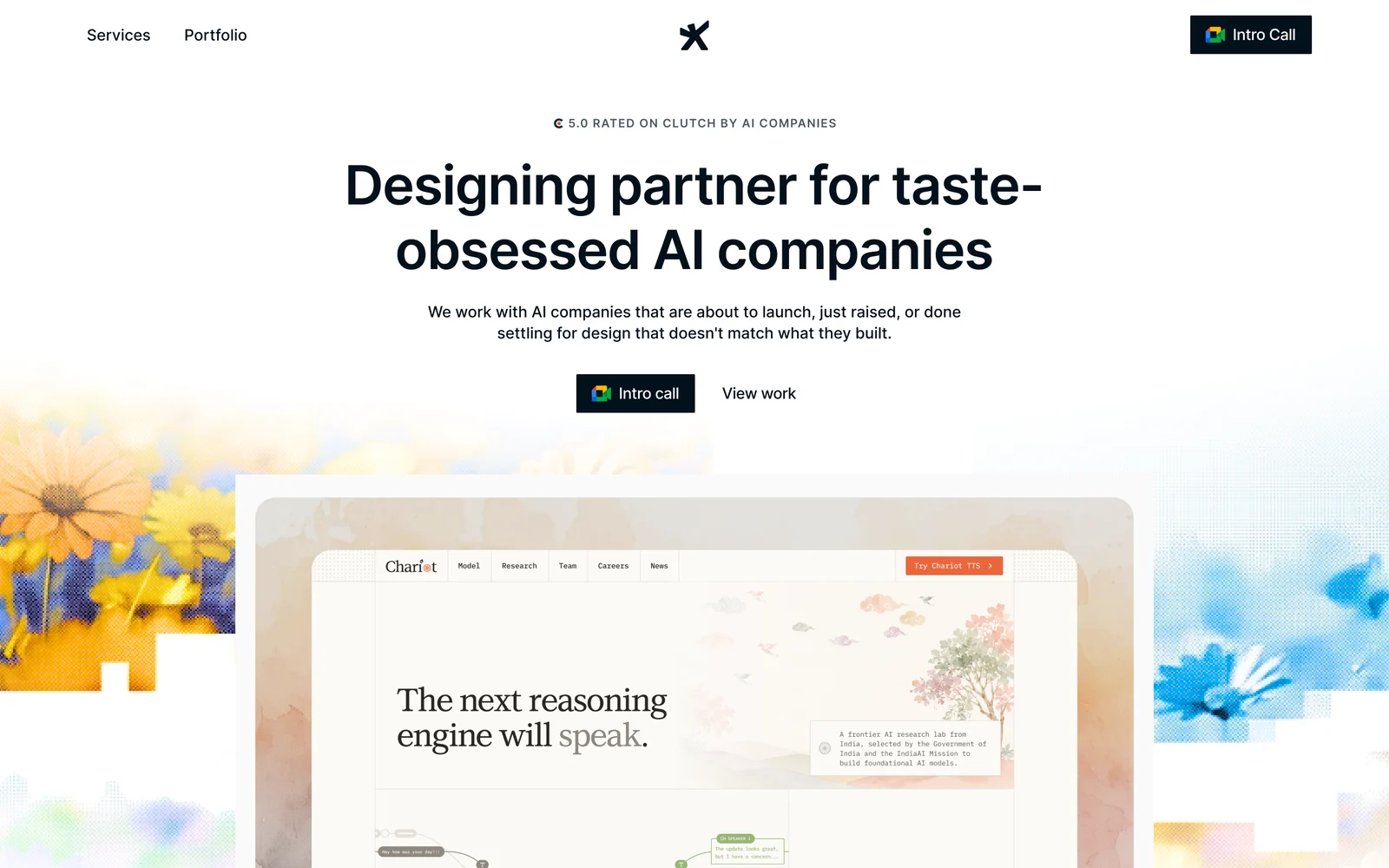
1. Studio Maydit: A Top-Rated Design Agency for AI Founders
On Dualite, design work supporting a repositioned ICP helped the product reach 100,000+ users in seven months. The relevant part for a martech company is what the work actually was: choosing one audience in a crowded category and making every page say the same specific thing, rather than widening the claim until it stopped meaning anything. Recent clients include Wave, PixelFlow, Mi-VAD, and 15 other AI and SaaS teams.
Studio Maydit is a web and product design studio working with AI founders in the US, UK, and Europe. Sites get built in Framer, Webflow, and custom code, decided by who runs the site afterwards, which for a martech team is a growth marketer who will be shipping landing pages weekly. The engagement continues into product design once the marketing site is live.
Martech teams usually take the monthly retainer, because the page count never stops growing and campaigns need design continuously. That covers new pages, campaigns, and product design, with no long lock-in. Fixed scope is the alternative where a launch is already dated, running three to four weeks and closing with a written diagnosis of what is leaking in the product rather than a handover email.
| Check | Finding |
|---|---|
| Based in | Remote, serving US / UK / EU |
| Platform depth | Framer, Webflow, and custom code |
| AI-sector proof | Yes. AI-native clients, published outcome on Dualite |
| Pricing | Fixed scope or monthly retainer, quoted per project |
| Team shape | Founder-led, small senior team |
| Best fit | Martech teams whose site is judged as a work sample by their own buyers |
If your homepage could belong to any of your competitors, that is the problem worth solving first. Book a 30-minute call.

2. BX Studio
BX Studio is a New York team of eleven to fifty working in Webflow, with Reddit, Headspace, ASAPP, and Verifone among its clients. ASAPP is an AI company and Reddit is an advertising platform, so the studio has worked on both sides of the problem this brief describes.
They publish a starting price, and Webflow is their primary platform rather than one of several, which matters for the content volume a martech site generates. The weakness is that they publish no founding date, so the length of the track record is unclear.
| Check | Finding |
|---|---|
| Based in | New York, USA |
| Founded | Not published |
| Team size | 11-50 |
| Primary platform | Webflow |
| AI-sector proof | Yes |
| Named clients | Reddit, Headspace, ASAPP, Verifone |
| Pricing | Published minimum |
| Best fit | US martech teams wanting Webflow depth and AI-sector familiarity |
3. Kvalifik
Kvalifik is a Copenhagen studio founded in 2015, eleven to fifty people, working in Webflow, with Veo, Maersk, and Relesys as clients. They have genuine AI-sector proof and sit in a European timezone, which suits a martech company selling into EU marketing teams.
The limitation is disclosure and portfolio shape. No published pricing, and their named clients are large established organisations rather than fast-moving software companies running weekly campaigns.
| Check | Finding |
|---|---|
| Based in | Copenhagen, Denmark |
| Founded | 2015 |
| Team size | 11-50 |
| Primary platform | Webflow |
| AI-sector proof | Yes |
| Named clients | Veo, Maersk, Relesys |
| Pricing | Not published |
| Best fit | European martech teams wanting AI experience in a nearby timezone |
4. Refokus
Refokus is a remote German studio founded in 2021, eleven to fifty people, working in Webflow, with Mural, BASF, Spotify, Yahoo, and BCG among its clients. Mural and Spotify are both products marketers use, and the craft standard is among the highest on this page.
For this brief the gaps are that AI-sector proof is partial and pricing is unpublished. Their portfolio also leans toward large brand work rather than the high-volume campaign pages a martech site runs on.
| Check | Finding |
|---|---|
| Based in | Germany, remote |
| Founded | 2021 |
| Team size | 11-50 |
| Primary platform | Webflow |
| AI-sector proof | Partial |
| Named clients | Mural, BASF, Spotify, Yahoo, BCG |
| Pricing | Not published |
| Best fit | Teams wanting brand-grade craft on a Webflow build |
5. 8020
8020 works from San Francisco and New York, founded in 2014, building in Webflow, with Wave, Superlist, Pilot.com, Vanta, and Circle as clients. That client list is full of companies that grew through content and comparison pages, which is the exact motion a martech company needs the site to support.
The gap is disclosure. No published pricing and no published team size, and their AI-sector proof is partial rather than native.
| Check | Finding |
|---|---|
| Based in | San Francisco and New York, USA |
| Founded | 2014 |
| Team size | Not published |
| Primary platform | Webflow |
| AI-sector proof | Partial |
| Named clients | Wave, Superlist, Pilot.com, Vanta, Circle |
| Pricing | Not published |
| Best fit | Teams building a content-led growth motion on Webflow |
6. Feely Studio
Feely Studio is a distributed European team of one to ten working across platforms, with Noxus, Mutiny, Luasai, and Basic Capital among its clients. Mutiny is the standout reference on this page, since it is a martech product built around website personalisation, so the studio has already worked inside this exact category.
They publish a starting price and have AI-sector proof. The constraints are capacity, given the team size, and a mixed platform focus rather than Webflow specialisation.
| Check | Finding |
|---|---|
| Based in | Distributed, Europe |
| Founded | Not published |
| Team size | 1-10 |
| Primary platform | Mixed |
| AI-sector proof | Yes |
| Named clients | Noxus, Mutiny, Luasai, Basic Capital |
| Pricing | Published minimum |
| Best fit | Martech teams wanting senior attention and direct category experience |
7. Clay
Clay is a San Francisco studio founded in 2016, fifty-one to two hundred people, working across platforms, with Slack, Stripe, Google, Coinbase, and Amazon among its clients. They publish a starting price and have real AI-sector work, and a portfolio at that level does useful work when your own buyers are judging your taste.
The caveats are fit rather than quality. Their published minimum targets funded companies, the studio works across platforms rather than specialising in Webflow, and the process is heavier than a weekly campaign cadence usually tolerates.
| Check | Finding |
|---|---|
| Based in | San Francisco, USA |
| Founded | 2016 |
| Team size | 51-200 |
| Primary platform | Mixed |
| AI-sector proof | Yes |
| Named clients | Slack, Stripe, Google, Coinbase, Amazon |
| Pricing | Published minimum |
| Best fit | Funded martech teams buying a recognisable name and high craft |
8. Lighthouse Digital
Lighthouse Digital is a London Webflow studio with HelloSelf, Freetrade, and IGN among its clients. They publish a starting figure and work in the right platform, which covers two of the five checks cleanly.
The gap is the one that matters most here. Their published AI-sector proof is none, so in a category where the whole difficulty is saying something specific about what your model does, you would be supplying that thinking yourself.
| Check | Finding |
|---|---|
| Based in | London, UK |
| Founded | Not published |
| Team size | Not published |
| Primary platform | Webflow |
| AI-sector proof | No |
| Named clients | HelloSelf, Freetrade, IGN |
| Pricing | Published minimum |
| Best fit | UK teams with settled positioning who need a clean Webflow build |
9. Pixelmatters
Pixelmatters is a Porto studio founded in 2013, fifty-one to two hundred people, working across platforms, with Rubrik, Quantic, and UJET as clients. UJET is customer experience software, which is adjacent to martech and sold to a similar operational buyer.
They publish a starting price and have real scale. For this brief the mismatches are platform, since they work across several rather than specialising in Webflow, and partial AI-sector proof.
| Check | Finding |
|---|---|
| Based in | Porto, Portugal |
| Founded | 2013 |
| Team size | 51-200 |
| Primary platform | Mixed |
| AI-sector proof | Partial |
| Named clients | Rubrik, Quantic, UJET |
| Pricing | Published minimum |
| Best fit | Larger programmes where platform choice is still open |
10. Digidop
Digidop is a Paris studio founded in 2021, one to ten people, working in Webflow, with TSE Energy, Ramify, and StreamNative among its clients. Small, transparent about price, and working in the right platform, which suits an early martech team with a contained brief.
They sit last for this audience on capacity and sector. A one to ten person studio cannot easily support the page volume a growing martech site demands, and their AI-sector proof is partial.
| Check | Finding |
|---|---|
| Based in | Paris, France |
| Founded | 2021 |
| Team size | 1-10 |
| Primary platform | Webflow |
| AI-sector proof | Partial |
| Named clients | TSE Energy, Ramify, StreamNative |
| Pricing | Published minimum |
| Best fit | Early European martech teams with a single focused project |
How to choose between them
Sort by what is actually broken.
If your homepage could be swapped with a competitor's without anyone noticing, the problem is positioning and copy. Buy a studio that will name the workflow you replace and refuse to widen the claim, and treat the words as the deliverable rather than the layout.
If traffic arrives and nobody reaches the product, the problem is that everything sits behind a form. That is a structural fix, showing real interface and real output, and it is cheaper than a redesign.
If you are already publishing comparison and integration pages by hand, the problem is the content model. Buy Webflow depth specifically, and ask to see a site where somebody else has published sixty pages into the structure.
If your buyers are marketers who will judge the craft, weight the studio's own site heavily. In this one category, their homepage is a legitimate proxy for what yours will look like.
One test before you sign. Ask each studio how they would write your comparison page against your closest competitor. It is the page that decides martech deals, it is genuinely hard to write without sounding defensive, and the answer separates studios that understand this market from studios that make attractive pages.