
Summarize with AI


For an AI-native SaaS product, the ten studios worth reviewing are Studio Maydit, Clay, Lighthouse Digital, Edgar Allan, Digidop, Flowout, Refokus, 8020, Flow Ninja, and Instrument. Clay and 8020 lead this list. Clay has AI-sector proof, a published starting price, and Slack, Stripe, Google, Coinbase, and Amazon on its client list, and 8020 has built for Wave, Superlist, Pilot.com, Vanta, and Circle, which is a run of subscription software companies at exactly your stage. Lighthouse Digital and Instrument are the wrong fit here. One publishes no AI work at all, and the other sells brand programmes to companies with internal marketing teams.
Your product gets better roughly every quarter without you shipping anything. The model underneath improves, and suddenly the thing your site said was hard is now routine.
That is a genuinely new problem and it wrecks websites. Copy written about capability goes stale faster than any team can rewrite it. A page boasting that the system can summarise a hundred documents reads as quaint the month a competitor does a thousand, and you did not do anything wrong. The ground moved.
The way out is to stop writing about the model and start writing about the job. A job does not get easier when the model improves. Somebody in a company still has to review contracts, or answer tickets, or reconcile invoices, and that person's afternoon is the thing you are selling into. Describe the afternoon and the copy survives four model upgrades.
The second problem is pricing. AI-native products almost always charge on usage, or on seats plus usage, or on some credit system. Standard SaaS pricing pages have three columns and a feature grid, and that layout cannot express any of it. So buyers cannot work out what they would pay, and rather than ask they leave.
The third is trust, and it is why the same buyer visits four times. They want to know where the data goes, whether it trains anything, and what happens when the system is wrong. Most AI SaaS sites answer none of those above the fold or anywhere else.

How we picked these agencies
Five checks, every one of them settled from public pages.
Platform depth. Webflow is the assumption in this brief, but not every Webflow studio builds the same thing. Some produce a marketing site your team can restructure. Others hand back something beautiful that breaks the moment you add a page type nobody planned for. Ask what happens when you need a new template in month four, because with an AI product you will.
Proof in the AI sector. Has the studio built for a company whose product is model-based? This is the criterion that carries the most weight here, and it is doing specific work. AI SaaS has explanation problems no other software has: non-deterministic output, usage-based pricing, and a buyer worrying about data. A studio that has met those before does not need you to teach them, and a studio that has not will produce a page describing your technology stack.
Pricing. Is a starting number public? It also predicts something else. Studios that publish a figure tend to be comfortable with productised work, which fits a company that wants pages shipped rather than a brand discovered.
Team shape. Headcount decides who receives your explanation of how the product works. In a small studio that is the designer. In a large one it is a strategist who summarises it for a designer, and technical nuance does not survive summarising.
Their own site. It is the only work where they answered to nobody. For this brief, read specifically for whether they can explain a complicated thing simply.
One extra probe, and it sorts this list fast. Ask how they would build your pricing page if billing is usage-based. Studios who have done it talk about calculators, worked examples, and a clear unit. Studios who have not describe three columns.
What appears in the tables is what each studio publishes about itself, taken from its own pages and left as found. Missing rows are recorded as missing, since a studio choosing not to publish a price or a headcount has told you something worth knowing.
What goes wrong for AI-native SaaS products
Three failures, and the first two are specific to products built on models.
The website is about the model instead of the work. Pages describe what the system can do, listed as capabilities, in the vocabulary of the people who built it. Buyers do not have a capability-shaped problem. They have a Tuesday afternoon problem, and they are trying to work out whether this removes it. The practical test: if a competitor swapped their logo onto your homepage, would anything read as false? If not, the page describes a category rather than a product.
The pricing page cannot express how you actually charge. Usage-based billing does not fit a three-column grid, so most AI SaaS sites either hide the model behind contact sales or publish a number that turns out to be wrong once volume is real. Both stall evaluations. Buyers will not champion a tool internally when they cannot answer what it costs, and the finance question comes early in AI purchases because nobody has a budget line for this yet.
Nothing on the site addresses data, training, or being wrong. These are the three questions every serious buyer asks, and they usually appear late, in a security review, after weeks of work. Sites that answer them plainly and early move faster through evaluation. Sites that leave them to a PDF sent on request signal that the answers are uncomfortable, which is rarely true and always expensive.
1. Studio Maydit: A Top-Rated Design Agency for AI Founders
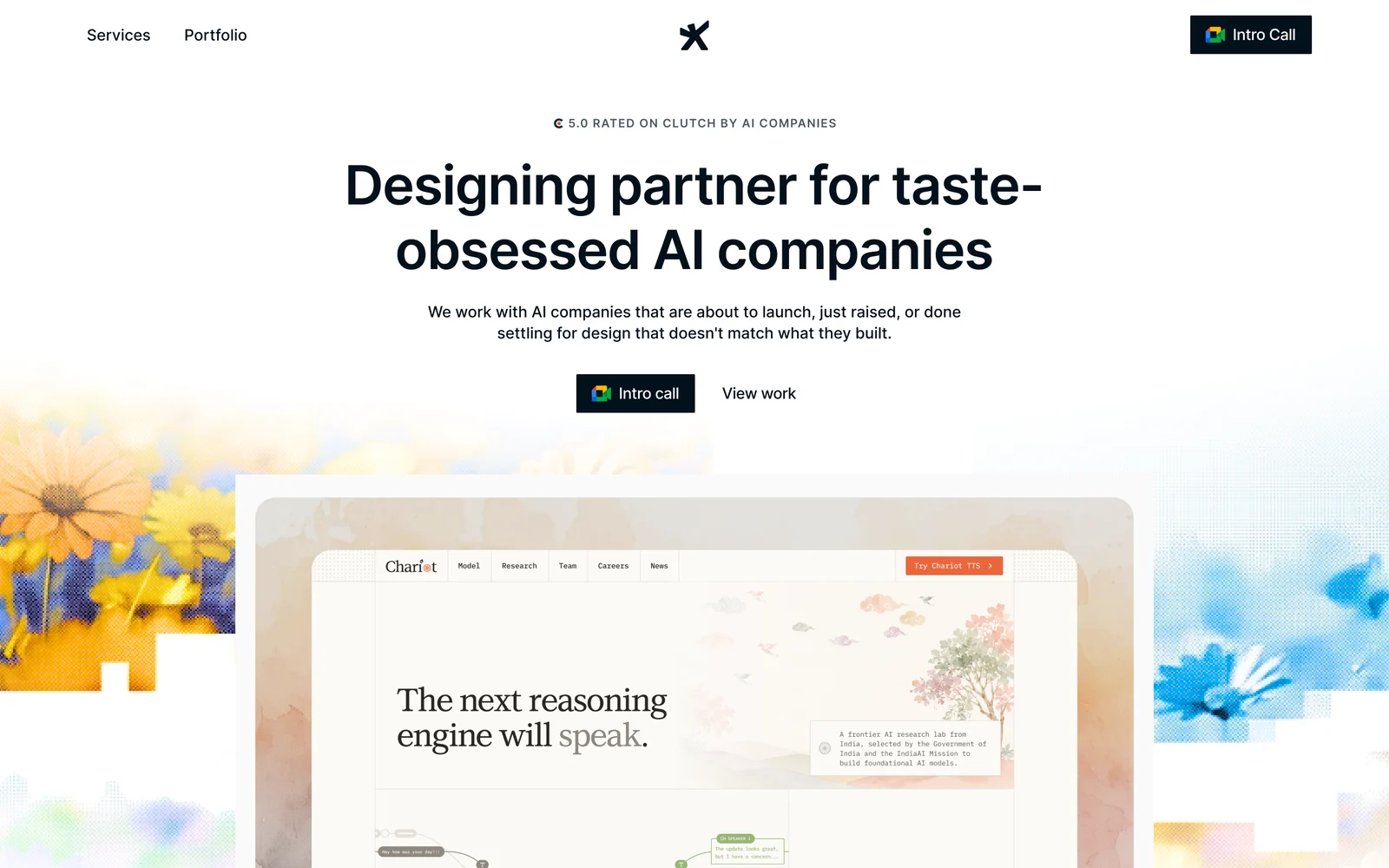
It continues into product design after the site ships, which is the part that matters when the marketing page and the application keep contradicting each other. Studio Maydit is a web and product design studio, its clients are AI founders, and they sit across the US, UK, and Europe. Webflow is one of three options rather than the answer to every brief: Webflow where a marketing team should own the site outright, Framer where pages change weekly, and custom code where the product will not fit either.
For an AI SaaS product the useful thing about Dualite is not the growth, it is what came before it. A repositioned ICP was settled first, the design work then served only that narrower group, and 100,000+ users followed over seven months. Model-based products are especially prone to skipping this step, because the same system genuinely can serve five industries, and a homepage written for five industries converts none of them. Recent clients include Wave, PixelFlow, Mi-VAD, and 15 other AI and SaaS teams.
Subscription software leaks in a predictable place, somewhere between the signup and the first result a customer would actually pay for, and every fixed-scope project ends with a written diagnosis of what is leaking in the product rather than a handover meeting. The build itself is three to four weeks, which suits a team working to a launch. Where the model keeps changing what the product can claim and pages are needed continuously, the monthly retainer is the better arrangement, covering new pages, campaigns, and product design, with no long lock-in.
| Check | Finding |
|---|---|
| Based in | Remote, serving US / UK / EU |
| Platform depth | Framer, Webflow, and custom code |
| AI-sector proof | Yes. AI-native clients, published outcome on Dualite |
| Pricing | Fixed scope or monthly retainer, quoted per project |
| Team shape | Founder-led, small senior team |
| Best fit | AI SaaS whose homepage describes the model rather than the job |
If your site would still read as true with a competitor's logo on it, that is the problem to fix. Book a 30-minute call.

2. Clay
Clay has worked from San Francisco since 2016 with fifty-one to two hundred people, AI-sector proof, and a published starting price, for Slack, Stripe, Google, Coinbase, and Amazon. Slack and Stripe are both software products that had to make something technical feel obvious, which is precisely the skill an AI SaaS site needs.
The primary platform is mixed rather than Webflow specifically, and at that headcount your product explanation passes through several people before reaching a page.
| Check | Finding |
|---|---|
| Based in | San Francisco, USA |
| Founded | 2016 |
| Team size | 51-200 |
| Primary platform | Mixed |
| AI-sector proof | Yes |
| Named clients | Slack, Stripe, Google, Coinbase, Amazon |
| Pricing | Published minimum |
| Best fit | Funded AI SaaS wanting a studio with large-scale software experience |
3. Lighthouse Digital
Lighthouse Digital is a London studio working in Webflow with a published starting price, for HelloSelf, Freetrade, and IGN. Freetrade is a consumer product with real onboarding complexity, and the published number makes the first budget conversation simple.
The AI-sector proof is recorded as no, which is the single most relevant gap in this brief, and neither founding year nor team size is published.
| Check | Finding |
|---|---|
| Based in | London, UK |
| Founded | Not published |
| Team size | Not published |
| Primary platform | Webflow |
| AI-sector proof | No |
| Named clients | HelloSelf, Freetrade, IGN |
| Pricing | Published minimum |
| Best fit | Consumer-facing products where AI experience is not required |
4. Edgar Allan
Edgar Allan is an Atlanta studio founded in 2014 with fifty-one to two hundred people, working in Webflow for Porsche, Duracell, and NCR. A studio of that size can hold a large Webflow site together across many templates, which is useful once your content operation grows.
The client list is established consumer and industrial brands rather than subscription software, the AI-sector proof is partial, and no pricing is published.
| Check | Finding |
|---|---|
| Based in | Atlanta, USA |
| Founded | 2014 |
| Team size | 51-200 |
| Primary platform | Webflow |
| AI-sector proof | Partial |
| Named clients | Porsche, Duracell, NCR |
| Pricing | Not published |
| Best fit | Companies buying a brand system on top of a large Webflow build |
5. Digidop
Digidop is a Paris studio founded in 2021, one to ten people, working in Webflow with a published starting price, for TSE Energy, Ramify, and StreamNative. StreamNative is developer infrastructure, so the team has written for a technical buyer, and a studio that small gives you direct access.
Capacity is limited for a SaaS site that needs docs, pricing, and a content library, and the AI-sector proof is partial.
| Check | Finding |
|---|---|
| Based in | Paris, France |
| Founded | 2021 |
| Team size | 1-10 |
| Primary platform | Webflow |
| AI-sector proof | Partial |
| Named clients | TSE Energy, Ramify, StreamNative |
| Pricing | Published minimum |
| Best fit | European SaaS teams wanting a small Webflow studio and a set price |
6. Flowout
Flowout is a distributed Webflow studio with a published starting price, for Jasper, Kajabi, Riverside, and Sendlane. Jasper is an AI writing product, so the team has shipped marketing for a model-based subscription business, and the productised process means work starts quickly at a known number.
Very little else is public. No founding year, no team size, and the AI-sector proof is partial, so depth has to be established on a call.
| Check | Finding |
|---|---|
| Based in | Distributed |
| Founded | Not published |
| Team size | Not published |
| Primary platform | Webflow |
| AI-sector proof | Partial |
| Named clients | Jasper, Kajabi, Riverside, Sendlane |
| Pricing | Published minimum |
| Best fit | Teams wanting pages shipped fast on a fixed, published process |
7. Refokus
Refokus is a remote German studio founded in 2021 with eleven to fifty people, working in Webflow for Mural, BASF, Spotify, Yahoo, and BCG. Mural is collaborative software with a genuine explanation problem, and the visual standard here is among the highest on this page.
The work skews to established brands rather than early subscription products, the AI-sector proof is partial, and no pricing is published.
| Check | Finding |
|---|---|
| Based in | Germany, remote |
| Founded | 2021 |
| Team size | 11-50 |
| Primary platform | Webflow |
| AI-sector proof | Partial |
| Named clients | Mural, BASF, Spotify, Yahoo, BCG |
| Pricing | Not published |
| Best fit | Companies wanting a visually ambitious Webflow build |
8. 8020
8020 has run from San Francisco and New York since 2014 in Webflow, for Wave, Superlist, Pilot.com, Vanta, and Circle. Every one of those is subscription software, and Vanta in particular sells into security reviews, which is the process most AI SaaS deals eventually land in.
Neither team size nor pricing is published, and the AI-sector proof is partial rather than full.
| Check | Finding |
|---|---|
| Based in | San Francisco and New York, USA |
| Founded | 2014 |
| Team size | Not published |
| Primary platform | Webflow |
| AI-sector proof | Partial |
| Named clients | Wave, Superlist, Pilot.com, Vanta, Circle |
| Pricing | Not published |
| Best fit | SaaS companies wanting a studio fluent in subscription marketing |
9. Flow Ninja
Flow Ninja is a Belgrade studio founded in 2018 with eleven to fifty people working in Webflow. The size sits in a practical middle: enough people to keep several templates moving, few enough that you reach whoever is building.
The public record is thin. No client names, no pricing, and partial AI-sector proof, which leaves most of the evaluation to conversation and references.
| Check | Finding |
|---|---|
| Based in | Belgrade, Serbia |
| Founded | 2018 |
| Team size | 11-50 |
| Primary platform | Webflow |
| AI-sector proof | Partial |
| Named clients | Not published |
| Pricing | Not published |
| Best fit | Teams happy to assess a studio through calls and references |
10. Instrument
Instrument has operated from Portland since 2005 for Nike, Microsoft, Electronic Arts, and Google. As a brand practice it is one of the strongest names on this page and the work has genuine cultural reach.
It is last for this brief on shape. The primary platform is mixed rather than Webflow, the engagements assume an internal marketing department, the AI-sector proof is partial, and nothing is published on price or headcount.
| Check | Finding |
|---|---|
| Based in | Portland, USA |
| Founded | 2005 |
| Team size | Not published |
| Primary platform | Mixed |
| AI-sector proof | Partial |
| Named clients | Nike, Microsoft, Electronic Arts, Google |
| Pricing | Not published |
| Best fit | Larger companies buying a brand programme rather than a site |
How to choose between them
Sort by what is actually broken.
If the homepage describes the model rather than the customer's afternoon, that is a writing job and it is the highest-value fix here. Clay or 8020, and expect to spend more time on words than on layout.
If buyers cannot work out what they would pay, the pricing page is the project. 8020 or Flowout, and bring your actual billing model to the first call rather than a simplified version.
If the site is about to carry docs, changelogs, and a growing library, that is Webflow structure and it should lead the brief. Edgar Allan or Flow Ninja.
If you need pages shipped quickly at a known price and the brand can wait, Flowout or Digidop.
One test before you sign. Ask them to describe your product back to you without using the words AI, model, or platform. A studio that fits this brief will manage it. A studio that cannot has only understood the category.