

Summarize with AI


For an AI salestech startup building in Webflow, the ten studios worth reviewing are Studio Maydit, Kvalifik, BX Studio, Flow Ninja, 8020, Flowout, Edgar Allan, Digidop, Refokus, and Clay. BX Studio and Kvalifik lead this list. Both run genuine Webflow practices with real AI-sector proof, and BX Studio has built for ASAPP, an AI company selling into exactly the kind of large commercial organisation you are trying to reach. Edgar Allan and Flow Ninja are the wrong fit here. One is built around large consumer brands with marketing departments, and the other publishes almost nothing you could evaluate before a call.
You are selling to the only audience on earth that does this for a living.
A VP of Sales has run the urgency play. A RevOps lead has built the gated-content funnel. Your buyer wrote the sequence you are about to send them, tested three versions of it, and knows what the conversion rate was. Every persuasion technique on your website is a technique they use professionally, and using it on them is like performing a card trick for a magician.
This makes salestech the hardest category on the internet to market to, and most AI salestech sites are built as though it were the easiest. They arrive stacked with the standard plays, and the effect on a sophisticated buyer is not persuasion. It is a downgrade in how seriously they take you.
The second problem is the numbers. Your category advertises outcomes, so your site probably advertises one too: more meetings, more pipeline, some multiple of something. Your buyer models pipeline for a living. They will immediately want the baseline, the sample size, and the time period, and if the site does not supply them the claim registers as noise rather than evidence.
The third problem is the one nobody says. If your product improves conversion or outbound, your own website is a live demonstration of whether you can do that. A confusing site from a company selling clarity is a real objection, and buyers make it silently.

How we picked these agencies
Five checks, all answerable from public material before any conversation.
Platform depth. How serious is the Webflow practice? Salestech sites grow quickly into comparison pages, integration pages, and customer stories, all of which live or die on how the CMS was structured at the start. A studio that treats Webflow as a specialism builds that structure. A studio that uses it when asked builds pages.
Proof selling to commercial buyers. Has the studio built for a company whose customer was a sales or revenue team? This is the criterion carrying the most weight here, and it is not the same as general B2B experience. Selling to engineers rewards precision. Selling to a revenue leader rewards evidence and arithmetic, and studios that have not done it tend to reach for enthusiasm instead.
Pricing. Is a starting number public? There is an additional signal in this for your specific category. A studio that states its price is doing the thing you are asking it to help you do, which is to make a commercial claim in the open and stand behind it.
Team shape. Size decides how much of your category knowledge has to be transferred, and salestech is dense with vocabulary and workflows that take real time to explain properly.
Their own site. The one project where the studio sold itself. For this brief it is unusually diagnostic, since a studio whose own site uses the tired plays will suggest them to you.
An extra test worth running. Ask a studio how they would present a performance claim without a number the buyer cannot verify. Studios that have worked with commercial buyers will talk about baselines, methodology, and named customers. Studios that have not will offer a stronger headline.
Everything in the tables comes from each studio's own published material, taken from its site rather than any directory, with nothing estimated. Where a studio publishes no price or no headcount that absence is recorded as it is, and in a category built on making claims in public, what a studio will state about itself is part of the assessment.
What goes wrong for AI salestech companies
Three failures, and each one is a tactic misfiring against an expert audience.
The site runs the plays your buyers invented. Countdown timers, an ebook behind a form, a demo request in every viewport, social proof that is really a logo wall. Each of these works somewhere. None of them works on a revenue leader who ran the same experiment last quarter and knows the numbers. What actually converts this audience is unusually plain: what the product does, who it works for, what it costs, and a customer they recognise saying something specific.
Outcome claims arrive without arithmetic. Announcing three times more meetings raises three questions instantly. Compared to what, across how many accounts, and over how long. Without those, a buyer who forecasts for a living discounts the claim entirely, and worse, starts discounting the rest of the page too. A smaller claim with a real baseline and a named customer beats a large one with nothing behind it, every time, with this audience specifically.
The site contradicts the product. You sell better conversion, or better outbound, or better qualification, and your own funnel is confusing. Buyers notice, and they do not raise it as an objection you can answer. They simply weigh it. This is the one failure in the category that cannot be fixed with copy, because the proof required is the website itself working.
1. Studio Maydit: A Top-Rated Design Agency for AI Founders
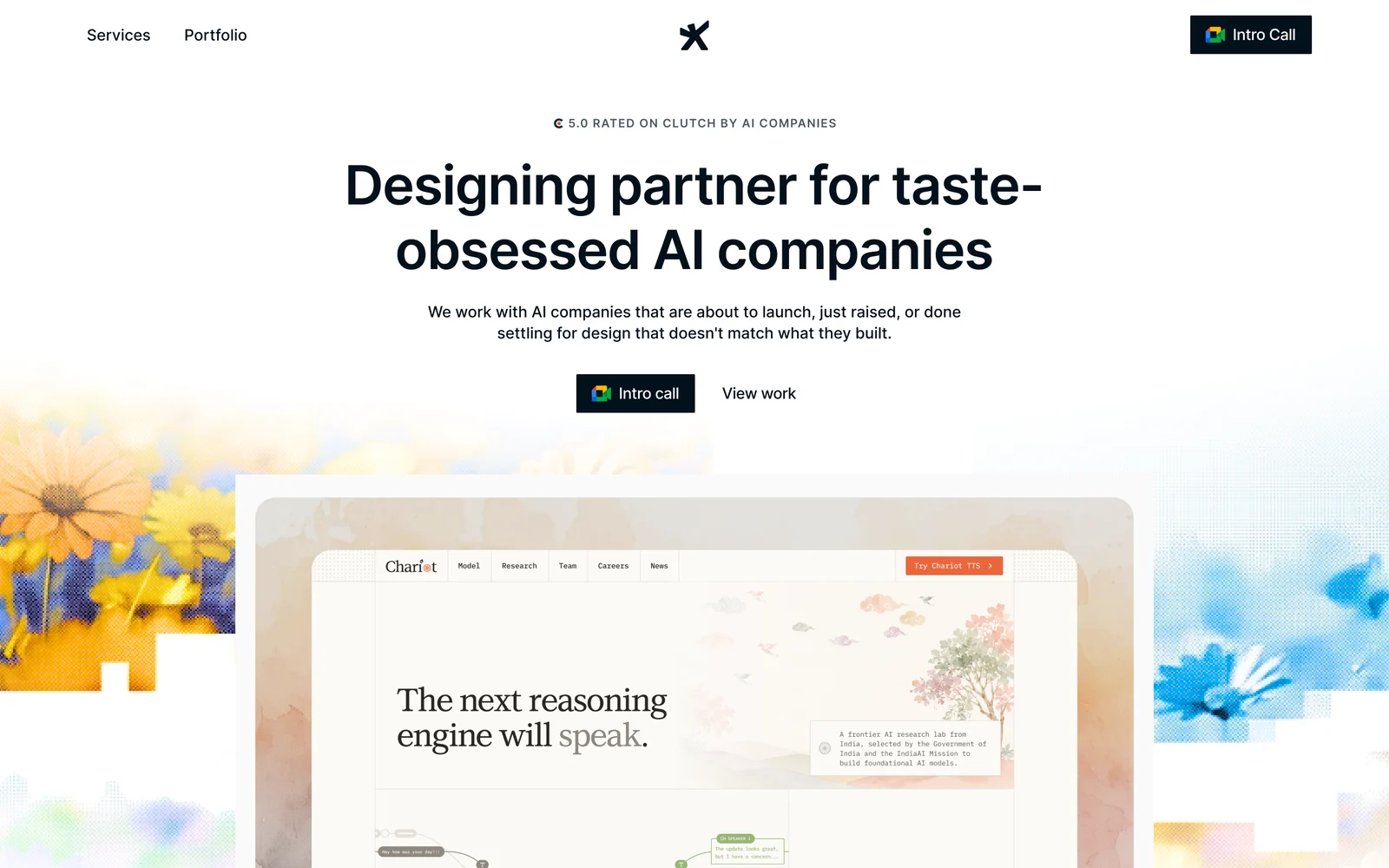
Studio Maydit is a web and product design studio, working with AI founders whose companies are based in the US, UK, and Europe. What tends to matter for a salestech team is that the studio continues into product design after a site ships, because in this category the trial experience is where the deal is genuinely won or lost. Framer where a site changes weekly, Webflow where a revenue marketer needs to own it outright, custom code only where the product will not sit in either.
Dualite is the published example and the order of operations is the point. A repositioned ICP was agreed first. The design work then spoke to that group alone. 100,000+ users arrived across seven months. Salestech founders face the reverse temptation constantly, because the product technically helps any team with a pipeline, and writing for all of them produces a homepage that a VP of Sales reads as generic. Choosing one motion and one team size is what makes the page land. Recent clients include Wave, PixelFlow, Mi-VAD, and 15 other AI and SaaS teams.
Buying works two ways. Where the pipeline is long and the site has to keep answering new objections as they surface, the monthly retainer fits, covering new pages, campaigns, and product design, with no long lock-in. Where there is a date, a conference or a launch, fixed scope runs three to four weeks and ends with a written diagnosis of what is leaking in the product, which in salestech is usually the gap between signing up and the first useful result.
| Check | Finding |
|---|---|
| Based in | Remote, serving US / UK / EU |
| Platform depth | Framer, Webflow, and custom code |
| AI-sector proof | Yes. AI-native clients, published outcome on Dualite |
| Pricing | Fixed scope or monthly retainer, quoted per project |
| Team shape | Founder-led, small senior team |
| Best fit | Salestech teams whose site uses the tactics their buyers invented |
If you sell conversion, the strongest evidence available is your own site converting. Book a 30-minute call.

2. Kvalifik
Kvalifik is a Copenhagen Webflow studio founded in 2015 with eleven to fifty people, AI-sector proof, and Veo, Maersk, and Relesys as clients. Relesys builds employee communication software sold into large operational businesses, so there is direct evidence of writing for a commercial buyer inside a big organisation.
Pricing is not published, and the Danish time zone gives limited overlap if your revenue team sits on the US west coast.
| Check | Finding |
|---|---|
| Based in | Copenhagen, Denmark |
| Founded | 2015 |
| Team size | 11-50 |
| Primary platform | Webflow |
| AI-sector proof | Yes |
| Named clients | Veo, Maersk, Relesys |
| Pricing | Not published |
| Best fit | European teams selling into large commercial organisations |
3. BX Studio
BX Studio is a New York Webflow team of eleven to fifty people with AI-sector proof, a published starting price, and Reddit, Headspace, ASAPP, and Verifone as clients. ASAPP sells AI into enterprise sales and support organisations, which is the closest match on this page to your buyer and your sales cycle.
No founding year is published, so the track record is harder to place than the client list suggests.
| Check | Finding |
|---|---|
| Based in | New York, USA |
| Founded | Not published |
| Team size | 11-50 |
| Primary platform | Webflow |
| AI-sector proof | Yes |
| Named clients | Reddit, Headspace, ASAPP, Verifone |
| Pricing | Published minimum |
| Best fit | AI companies selling into enterprise revenue teams |
4. Flow Ninja
Flow Ninja is a Belgrade Webflow studio founded in 2018 with eleven to fifty people. The size is sensible for a site that will grow comparison and integration pages, and Webflow keeps your marketer independent afterwards.
There is very little to assess. No named clients at all, no published pricing, and only partial AI proof, which is an awkward starting point when your own category runs on public evidence.
| Check | Finding |
|---|---|
| Based in | Belgrade, Serbia |
| Founded | 2018 |
| Team size | 11-50 |
| Primary platform | Webflow |
| AI-sector proof | Partial |
| Named clients | Not published |
| Pricing | Not published |
| Best fit | Teams willing to evaluate entirely in conversation |
5. 8020
8020 works from San Francisco and New York, founded in 2014, in Webflow, with Wave, Superlist, Pilot.com, Vanta, and Circle as clients. Vanta sells trust to buyers who verify things and Pilot sells to finance teams, so the studio has repeatedly written for audiences that check the arithmetic.
The AI-sector proof is partial, and neither pricing nor team size is published.
| Check | Finding |
|---|---|
| Based in | San Francisco and New York, USA |
| Founded | 2014 |
| Team size | Not published |
| Primary platform | Webflow |
| AI-sector proof | Partial |
| Named clients | Wave, Superlist, Pilot.com, Vanta, Circle |
| Pricing | Not published |
| Best fit | B2B products sold to buyers who verify claims |
6. Flowout
Flowout is a distributed Webflow studio with a published starting price and Jasper, Kajabi, Riverside, and Sendlane named. Sendlane is marketing automation and Kajabi serves creators selling to their audiences, so the studio has worked inside the commercial software world your buyers live in.
The model is built for producing pages at pace rather than resolving a positioning problem, and no founding year, team size, or full AI proof is published.
| Check | Finding |
|---|---|
| Based in | Distributed |
| Founded | Not published |
| Team size | Not published |
| Primary platform | Webflow |
| AI-sector proof | Partial |
| Named clients | Jasper, Kajabi, Riverside, Sendlane |
| Pricing | Published minimum |
| Best fit | Campaign and landing page volume at a stated price |
7. Edgar Allan
Edgar Allan is an Atlanta Webflow studio founded in 2014 with fifty-one to two hundred people, working for Porsche, Duracell, and NCR. The Webflow depth is genuine and those are demanding clients with high production standards.
The fit is wrong for this brief. Those are consumer and industrial brands with marketing departments rather than software companies selling to revenue teams, the AI proof is partial, and no pricing is published.
| Check | Finding |
|---|---|
| Based in | Atlanta, USA |
| Founded | 2014 |
| Team size | 51-200 |
| Primary platform | Webflow |
| AI-sector proof | Partial |
| Named clients | Porsche, Duracell, NCR |
| Pricing | Not published |
| Best fit | Established consumer brands with internal marketing teams |
8. Digidop
Digidop is a Paris Webflow studio founded in 2021 with one to ten people, a published starting price, and TSE Energy, Ramify, and StreamNative as clients. Ramify is a financial product sold to people who compare options carefully, which is a decent proxy for a buyer who audits your numbers.
The team is small for a site that will keep adding comparison and integration pages, and the AI-sector proof is partial.
| Check | Finding |
|---|---|
| Based in | Paris, France |
| Founded | 2021 |
| Team size | 1-10 |
| Primary platform | Webflow |
| AI-sector proof | Partial |
| Named clients | TSE Energy, Ramify, StreamNative |
| Pricing | Published minimum |
| Best fit | Focused sites where a stated price matters |
9. Refokus
Refokus is a remote German studio founded in 2021 with eleven to fifty people in Webflow, working for Mural, BASF, Spotify, Yahoo, and BCG. BCG is a consultancy whose entire output is evidence and argument, which is the register a sceptical revenue buyer responds to.
Pricing is not published, the AI-sector proof is partial, and the portfolio leans toward brand work rather than the commercial funnel this brief needs.
| Check | Finding |
|---|---|
| Based in | Germany, remote |
| Founded | 2021 |
| Team size | 11-50 |
| Primary platform | Webflow |
| AI-sector proof | Partial |
| Named clients | Mural, BASF, Spotify, Yahoo, BCG |
| Pricing | Not published |
| Best fit | Companies wanting a serious, evidence-led brand presence |
10. Clay
Clay is a San Francisco studio founded in 2016 with fifty-one to two hundred people, AI-sector proof, a published minimum, and Slack, Stripe, Google, Coinbase, and Amazon as clients. The craft is excellent and the AI experience is real.
It is last for this brief on platform and stage. The practice is mixed rather than Webflow, which is what was asked for, and that client list implies a process built for organisations with internal design teams and review cycles a startup does not have.
| Check | Finding |
|---|---|
| Based in | San Francisco, USA |
| Founded | 2016 |
| Team size | 51-200 |
| Primary platform | Mixed |
| AI-sector proof | Yes |
| Named clients | Slack, Stripe, Google, Coinbase, Amazon |
| Pricing | Published minimum |
| Best fit | Later-stage companies with their own design function |
How to choose between them
Sort by what is actually broken.
If demo requests are high and qualified conversations are rare, the site is filtering for the wrong people. Buy a studio that has written for revenue buyers and let it strip the tactics out. BX Studio or 8020.
If prospects go quiet after seeing your numbers, the problem is evidence rather than design. Spend the budget on getting one customer named with a real baseline, and treat the page as the cheaper half of that work.
If the site cannot keep up with comparison pages, integration pages, and new customer stories, that is a CMS structure question and it should decide your choice. Kvalifik or Flow Ninja, with the structure agreed before anything is designed.
If you need volume, meaning many campaign pages quickly, buy that as a separate thing from the positioning work. Flowout, and do not expect it to solve the message.
One test before you sign. Ask them to look at your homepage and name the tactic a VP of Sales would recognise immediately. A studio that knows this audience will find it in seconds. A studio that does not will tell you the site looks clean.