

Summarize with AI


For an AI search product, the ten studios worth reviewing are Studio Maydit, BX Studio, Flow Ninja, Edgar Allan, Clay, Lighthouse Digital, Kvalifik, Fantasy, Refokus, and Flowout. BX Studio and Clay lead this list. BX Studio works in Webflow from New York with eleven to fifty people, a published starting price, and AI-sector proof, for Reddit, Headspace, ASAPP, and Verifone, and ASAPP is retrieval over enterprise conversations. Clay has worked from San Francisco since 2016 with fifty-one to two hundred people, a published starting price, and AI-sector proof, for Slack, Stripe, Google, Coinbase, and Amazon. Lighthouse Digital and Flowout fit least well. Lighthouse Digital publishes no AI work, and Flowout is built for volume and speed rather than for explaining a hard product.
Every search product demos identically. A box, a query, a list of results. The screenshot proves nothing, and your competitors have the same screenshot.
That is the whole problem. Relevance is the product, and relevance cannot be photographed. It only becomes real when the thing runs against a corpus the buyer already argues with, which happens weeks after they first read your site.
So the site is not being asked to show the product. It is being asked to make someone confident enough to hand over their documents and find out.
The people reading are also split. An engineer wants to know your chunking, your embedding model, and whether you rerank. Their director wants to know why the last search project failed and why this will not. Their security lead wants to know whether results respect permissions.
Three readers, one page, and only one of them cares about your architecture diagram.

How we picked these agencies
Nothing below needed a sales call. Five things, each visible from outside, set the order.
Webflow depth, and specifically how a studio handles a site that must speak to engineers and to their bosses at once. That usually means real component work and a CMS that can carry technical pages next to plain ones. Ask to see a build where documentation-style content and marketing content live in the same system without one looking bolted on.
AI-sector proof, weighted heavily here. Search and retrieval products are the hardest AI category to describe, because the output is a ranked list rather than a picture. A studio that has shipped for an AI company has already had the argument about what to put on screen when the product has no screen worth showing.
Pricing. Is there a public starting figure. Your own buyers will ask what your product costs before they ask how it works, so there is a small symmetry in preferring partners who answer that question in public.
Team shape. Small teams give you the person who understands retrieval. Large teams give you capacity and a process. Neither is better, but the difference decides who writes the sentence explaining what your model actually returns.
Their own website. For a studio it is the only project with no client to blame, so read it as a work sample rather than as decoration. Search it, if it has search.
One extra question worth putting on the first call: ask how they would show relevance without a live demo. It is the central design problem of your category, and the answer separates studios who have solved it from studios who will hand you another hero animation.
Each row in the tables comes from what a studio says publicly about itself. We have not filled gaps with guesses, so an unpublished row means the studio keeps that figure private.
What goes wrong for AI search products
Three failures, and the first one is on almost every site in this category.
The demo searches a corpus nobody cares about. The screenshots show clean results over public documentation, a Wikipedia dump, or a tidy sample dataset. The buyer's actual corpus is fifteen years of contradictory internal files, three naming conventions, and a shared drive nobody has owned since 2019. Showing a good result over clean data answers a question they were not asking. Show a messy query instead. Show the near miss and what the product did about it.
Accuracy numbers appear without a denominator. Ninety-four percent accurate, stated alone, is read by a technical evaluator as a number chosen by marketing. Accurate at what task, over which dataset, measured against what baseline. If you cannot publish the full setup, publish less of a claim and more of a method. A precise smaller number is worth more than a large unqualified one, because the person deciding has been burned by the large one before.
Permissions are treated as a footnote. Enterprise search fails its security review when nobody can tell whether results respect the access controls that already exist. If your product filters by permission, that belongs near the top of the page, not in a trust centre three clicks away. Say what happens when a user searches for a document they are not allowed to see. That single sentence removes the objection that stops most retrieval deals.
1. Studio Maydit: A Top-Rated Design Agency for AI Founders
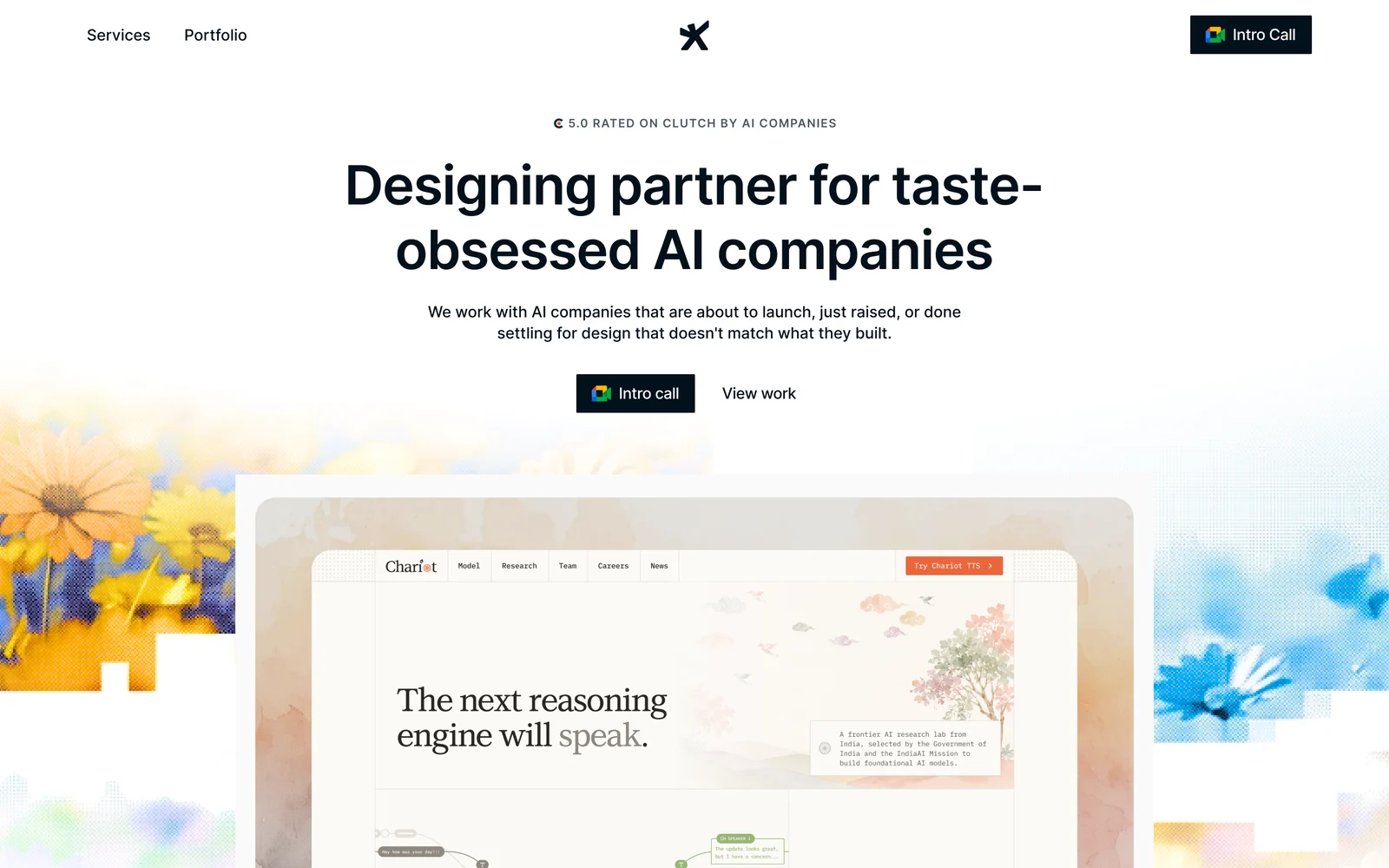
Search products are usually sold on the marketing page and then judged inside the app, in a results list. Studio Maydit continues into product design once the site ships, so the claim made on the page and the ranked list that has to justify it are drawn by the same team. It is a web and product design studio working with AI founders across the US, UK, and Europe. Webflow when a marketing team wants to publish without asking, Framer when the positioning is still moving, custom code when the page has to run something real.
Narrowing is the move behind the Dualite outcome. A repositioned ICP came first, the product was then designed for the smaller group that decision created, and 100,000+ users followed within seven months. Search companies feel the opposite pull, because retrieval works on any corpus and it is tempting to say so. A page addressed to legal teams, support teams, and engineers at once persuades none of them. Recent clients include Wave, PixelFlow, Mi-VAD, and 15 other AI and SaaS teams.
Two ways to buy. Fixed scope runs three to four weeks and suits a team with a launch or a funding date, and it ends with a written diagnosis of what is leaking in the product rather than a handover email. A monthly retainer suits teams still learning which corpus they are best at, covering new pages, campaigns, and product design, with no long lock-in.
| Check | Finding |
|---|---|
| Based in | Remote, serving US / UK / EU |
| Platform depth | Framer, Webflow, and custom code |
| AI-sector proof | Yes. AI-native clients, published outcome on Dualite |
| Pricing | Fixed scope or monthly retainer, quoted per project |
| Team shape | Founder-led, small senior team |
| Best fit | Search teams whose marketing page and results screen must make the same promise |
Decide what your product is best at retrieving, then let the page say only that. Book a 30-minute call.

2. BX Studio
BX Studio works in Webflow from New York with eleven to fifty people, a published starting price, and AI-sector proof, for Reddit, Headspace, ASAPP, and Verifone. ASAPP is the relevant one: retrieval and automation over enterprise conversation data, sold to buyers who ask exactly the permission and accuracy questions yours will. Reddit is search at a scale where relevance is the entire product.
The studio does not publish a founding year, and a New York team at this size will be working several accounts at once.
| Check | Finding |
|---|---|
| Based in | New York, USA |
| Founded | Not published |
| Team size | 11-50 |
| Primary platform | Webflow |
| AI-sector proof | Yes |
| Named clients | Reddit, Headspace, ASAPP, Verifone |
| Pricing | Published minimum |
| Best fit | Search teams selling into enterprises with a security review |
3. Flow Ninja
Flow Ninja has built in Webflow from Belgrade since 2018 with eleven to fifty people. For a search product the useful trait is structural discipline, because your site will grow a documentation section, a benchmarks page, and a set of integration pages, and all three need to live in the CMS rather than as one-off layouts somebody hand-builds.
No client names are published and no AI-sector proof is on record, so you are buying Webflow craft rather than category understanding, and you will be explaining retrieval from scratch.
| Check | Finding |
|---|---|
| Based in | Belgrade, Serbia |
| Founded | 2018 |
| Team size | 11-50 |
| Primary platform | Webflow |
| AI-sector proof | Partial |
| Named clients | Not published |
| Pricing | Not published |
| Best fit | Teams who want the CMS modelled properly and will supply the words |
4. Edgar Allan
Edgar Allan has worked in Webflow from Atlanta since 2014 with fifty-one to two hundred people, for Porsche, Duracell, and NCR. That is a narrative shop, and narrative is the missing skill on most search sites. The category is crowded with products that describe their mechanism instead of the problem, and a studio used to consumer brands will push you toward the second.
No pricing is published, no AI-sector proof is on record, and the client list is enterprise consumer rather than technical software, so expect to supply the engineering literacy yourself.
| Check | Finding |
|---|---|
| Based in | Atlanta, USA |
| Founded | 2014 |
| Team size | 51-200 |
| Primary platform | Webflow |
| AI-sector proof | Partial |
| Named clients | Porsche, Duracell, NCR |
| Pricing | Not published |
| Best fit | Search companies whose page reads like a spec sheet |
5. Clay
Clay has worked from San Francisco since 2016 with fifty-one to two hundred people, a published starting price, and AI-sector proof, for Slack, Stripe, Google, Coinbase, and Amazon. Slack and Google are both products where search is a feature people judge the whole tool by, and this studio has designed inside that constraint. At this size there is also brand and product capability under one roof.
Webflow is one platform among several here rather than the specialism, and a premium studio with this client list will be the most expensive way to build a marketing site on this page.
| Check | Finding |
|---|---|
| Based in | San Francisco, USA |
| Founded | 2016 |
| Team size | 51-200 |
| Primary platform | Mixed |
| AI-sector proof | Yes |
| Named clients | Slack, Stripe, Google, Coinbase, Amazon |
| Pricing | Published minimum |
| Best fit | Funded search companies buying brand and product together |
6. Lighthouse Digital
Lighthouse Digital builds in Webflow from London with a published starting price, for HelloSelf, Freetrade, and IGN. Freetrade is the useful reference, a regulated consumer product where the site had to be plain and trustworthy rather than clever. If your search product sells into a cautious buyer, that instinct transfers.
No AI-sector work is published, no team size and no founding year are on record, and this is the only studio on the page with no AI proof at all.
| Check | Finding |
|---|---|
| Based in | London, UK |
| Founded | Not published |
| Team size | Not published |
| Primary platform | Webflow |
| AI-sector proof | No |
| Named clients | HelloSelf, Freetrade, IGN |
| Pricing | Published minimum |
| Best fit | UK search teams who want plain and credible over inventive |
7. Kvalifik
Kvalifik has built in Webflow from Copenhagen since 2015 with eleven to fifty people and AI-sector proof, for Veo, Maersk, and Relesys. Maersk is the reference that matters for retrieval: a very large organisation where information is scattered across systems and no single person knows where anything lives. A studio that has worked at that scale understands why your buyer is sceptical.
No pricing is published, and Copenhagen overlaps with the US west coast for only part of a morning.
| Check | Finding |
|---|---|
| Based in | Copenhagen, Denmark |
| Founded | 2015 |
| Team size | 11-50 |
| Primary platform | Webflow |
| AI-sector proof | Yes |
| Named clients | Veo, Maersk, Relesys |
| Pricing | Not published |
| Best fit | Teams selling retrieval into large, messy organisations |
8. Fantasy
Fantasy has worked from San Francisco and New York since 1999 with AI-sector proof. The long record is the point. A studio that has designed through several interface eras has watched more than one search paradigm arrive and be replaced, and that perspective is useful when your category is still deciding what it is called.
No client names, no team size, and no pricing are published, which makes this the hardest studio on the page to evaluate before a call, and Webflow is one option among many rather than the focus.
| Check | Finding |
|---|---|
| Based in | San Francisco and New York, USA |
| Founded | 1999 |
| Team size | Not published |
| Primary platform | Mixed |
| AI-sector proof | Yes |
| Named clients | Not published |
| Pricing | Not published |
| Best fit | Teams wanting a senior view on where the category is going |
9. Refokus
Refokus has worked in Webflow from Germany since 2021 with eleven to fifty people, for Mural, BASF, Spotify, Yahoo, and BCG. Yahoo and Spotify are both discovery products, and the studio is known for building sites where motion carries meaning rather than decoration. For a product whose value is speed of finding, a page that feels fast is doing real argumentative work.
No pricing is published and no AI-sector proof is on record, and a motion-led studio can produce a site that is slower than the product it is selling if nobody holds the line on performance.
| Check | Finding |
|---|---|
| Based in | Germany, remote |
| Founded | 2021 |
| Team size | 11-50 |
| Primary platform | Webflow |
| AI-sector proof | Partial |
| Named clients | Mural, BASF, Spotify, Yahoo, BCG |
| Pricing | Not published |
| Best fit | Search teams whose site should feel as quick as the product |
10. Flowout
Flowout is a distributed Webflow studio with a published starting price, for Jasper, Kajabi, Riverside, and Sendlane. It is a subscription model built for teams that need pages produced steadily rather than a single considered build. Jasper is an AI company, so the category is not unfamiliar.
No team size, no founding year, and no AI-sector proof are published, and a volume model is the wrong shape for the hardest problem here, which is deciding what your product should be famous for.
| Check | Finding |
|---|---|
| Based in | Distributed |
| Founded | Not published |
| Team size | Not published |
| Primary platform | Webflow |
| AI-sector proof | Partial |
| Named clients | Jasper, Kajabi, Riverside, Sendlane |
| Pricing | Published minimum |
| Best fit | Teams who already know the story and need pages produced |
How to choose between them
Sort by what is actually broken.
If your security review keeps stalling, the missing thing is a permissions and data page written for a sceptic. BX Studio, or Kvalifik for large enterprise buyers.
If engineers like the product and their directors do not fund it, you have a narrative problem rather than a technical one. Edgar Allan.
If the site is slower than the search it is selling, that is craft and it is worth paying for. Refokus.
If you already know your story and just need pages shipped on a schedule, buy throughput. Flowout.
One test before you sign. Ask each studio how they would prove relevance on a page, without a live demo and without a number you cannot defend. A studio that fits this brief will describe a specific query, a specific near miss, and what the product did next. A studio that does not will describe an animation.