

Summarize with AI


For an AI voice product, the ten studios worth reviewing are Studio Maydit, BX Studio, Kvalifik, Edgar Allan, Digidop, Flow Ninja, Refokus, 8020, Flowout, and Lazarev. BX Studio and Lazarev lead this list. BX Studio works in Webflow from New York with eleven to fifty people, a published starting price, and AI-sector proof, for Reddit, Headspace, ASAPP, and Verifone, and ASAPP builds voice and conversation systems for contact centres. Lazarev has worked from San Francisco since 2015 with fifty-one to two hundred people, a published starting price, and AI-sector proof, for Payoneer, Peel, Elva, and Mozayix. Flowout and Flow Ninja fit least well. Flowout is a volume subscription model, and Flow Ninja publishes no client names at all.
Your product is audio and your website is silent. Everything else follows from that.
A screenshot cannot carry a voice product. The thing people judge is latency, whether the interruption handling feels natural, and whether the synthetic voice crosses into unpleasant. None of that survives being written down, and all of it is decided in about four seconds of listening.
So the site has one real job, which is getting somebody to press play. Most voice sites bury that button under a hero animation and a paragraph about conversational intelligence.
The audience is split in a way that makes this harder. A developer wants to know your latency numbers, your language coverage, and whether streaming is supported. A buyer wants to know whether customers will hang up. A compliance reader wants to know whether calls are recorded and whether the caller is told they are speaking to a machine.
Three people, three questions, and only the first one is impressed by an architecture diagram.

How we picked these agencies
Five criteria, all of them checkable from public pages before a call is booked.
Webflow depth, tested against a site that has to carry audio well. Voice sites need embedded players, sample libraries, and comparison pages, and all of those should live in the CMS so your team can add a new sample without a build. Ask to see a Webflow project where media is a first-class content type rather than a one-off embed.
AI-sector proof, weighted heavily here. Voice is one of the hardest AI categories to present, because the demo is the product and the product is not visual. A studio that has shipped for AI companies has already argued about what to put on a page when the interesting part is audible.
Pricing. Is a starting figure published. Voice products are usually sold on usage-based pricing that buyers find hard to model, so there is a small consistency argument for working with a partner willing to be plain about its own numbers.
Team shape. Small teams put the person who understands your latency story on the call. Larger teams bring capacity for a sample library, a docs section, and a launch at once. The right answer depends on how much of your site is media.
Their own site. It is the one project with no client to blame. Check how fast it loads, because a slow page selling a low-latency product undermines the claim before anyone reads it.
One extra question for the first call: ask where they would put the play button and why. It sounds trivial. It is the single most important layout decision on a voice website, and a studio that has thought about it will have an opinion with a reason attached.
The tables report public claims only. An unpublished row is a genuine gap in what the studio discloses, and we have left it as a gap.
What goes wrong for AI voice products
Three failures, and the first one costs you most of your visitors.
The demo is three clicks deep. The homepage explains conversational AI, shows a waveform graphic, and offers a book a demo button. The actual sample sits on a separate page, or behind a form, or inside a video that autoplays muted. Every step between arriving and hearing the voice loses people, and they leave without the one piece of information that would have convinced them. Put a working sample above the fold and let it play on one tap.
The samples are all easy conversations. A clean caller, a quiet room, a request the system handles perfectly. Anybody evaluating voice has heard demos like this and discounts them automatically, because they know the hard parts are interruptions, accents, background noise, and the moment a caller says something unexpected. Publish a difficult sample. Showing the system handle a messy call convincingly is worth more than five perfect ones.
Nobody says whether the caller is told it is a machine. Disclosure rules for synthetic voice are tightening in several markets, and this is now an early question from any serious buyer rather than a legal footnote. If your product discloses, say so plainly and say how. If it is configurable, say that. Leaving it unaddressed reads as evasion to exactly the cautious enterprise buyer you want, and it turns a selling point into a doubt.
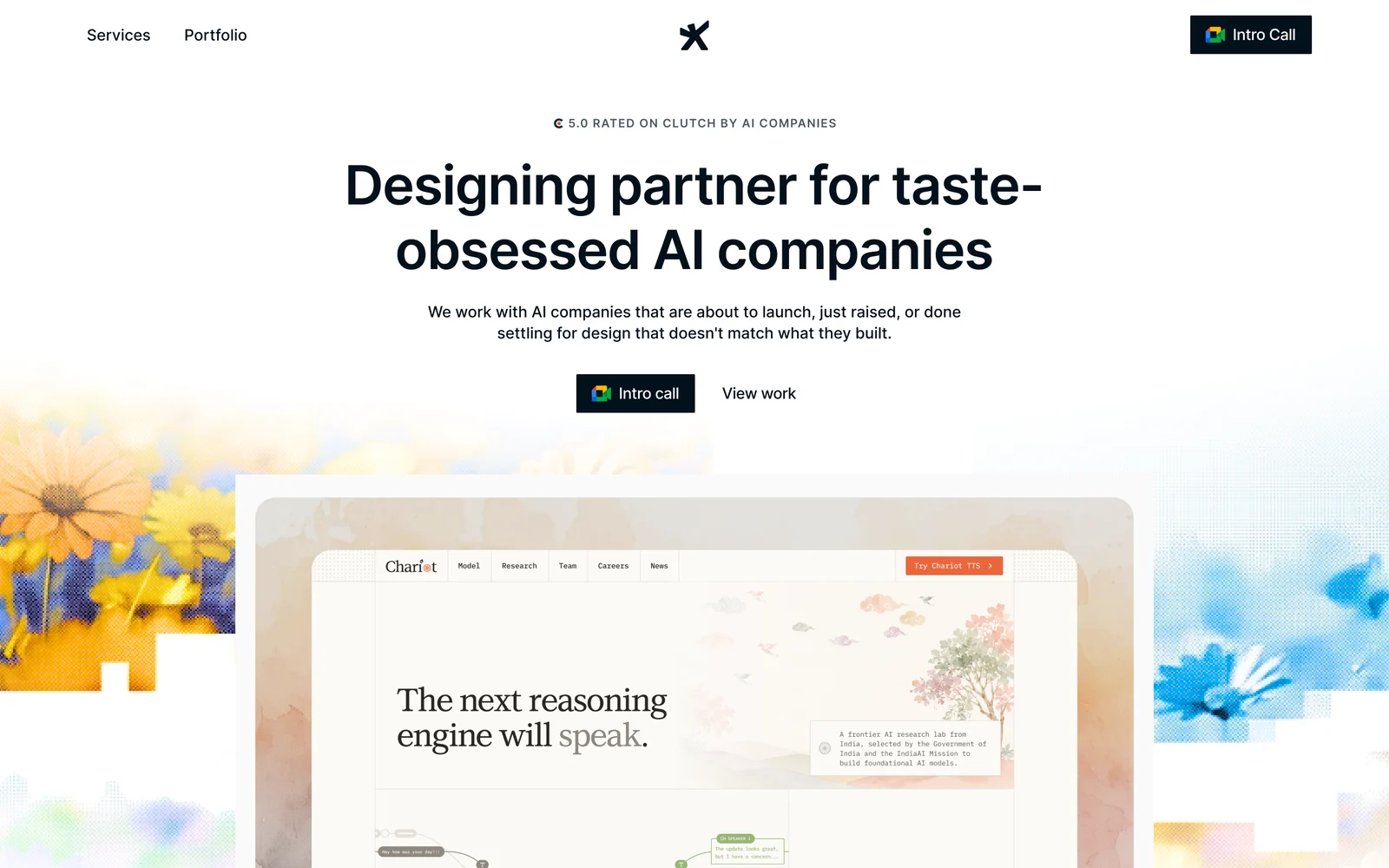
1. Studio Maydit: A Top-Rated Design Agency for AI Founders
A voice product is judged in the first few seconds of audio, which makes the gap between the marketing page and the real experience unusually dangerous. Studio Maydit continues into product design after the site ships, so the sample chosen for the homepage and the interface a customer meets afterwards are decided by the same team. It is a web and product design studio working with AI founders across the US, UK, and Europe, building in Framer, Webflow, and custom code.
Webflow is the usual answer when a marketing team needs to add samples and pages on its own schedule. Custom code earns its place when the page has to run a live call rather than play a recording, and that distinction is worth settling before a build starts rather than halfway through it.
Dualite is the published outcome. A repositioned ICP came first, the product was designed for the narrower group that decision created, and 100,000+ users arrived inside seven months. Voice companies feel the opposite pull particularly strongly, because the technology genuinely works for support, sales, scheduling, and accessibility, and a page that offers all four convinces nobody. Recent clients include Wave, PixelFlow, Mi-VAD, and 15 other AI and SaaS teams. Fixed scope runs three to four weeks for a team with a launch date and finishes with a written diagnosis of what is leaking in the product. A monthly retainer suits teams still finding their best use case, covering new pages, campaigns, and product design, with no long lock-in.
| Check | Finding |
|---|---|
| Based in | Remote, serving US / UK / EU |
| Platform depth | Framer, Webflow, and custom code |
| AI-sector proof | Yes. AI-native clients, published outcome on Dualite |
| Pricing | Fixed scope or monthly retainer, quoted per project |
| Team shape | Founder-led, small senior team |
| Best fit | Voice teams whose homepage should be a play button |
Pick the one call your product handles best, and build the page around hearing it. Book a 30-minute call.

2. BX Studio
BX Studio works in Webflow from New York with eleven to fifty people, a published starting price, and AI-sector proof, for Reddit, Headspace, ASAPP, and Verifone. ASAPP is the direct reference: conversation and voice automation sold into contact centres, where buyers ask about containment rates and escalation before anything else. Headspace adds experience with audio as the core of a product rather than a garnish.
The studio does not publish a founding year, and a New York team of this size will be running several accounts at once.
| Check | Finding |
|---|---|
| Based in | New York, USA |
| Founded | Not published |
| Team size | 11-50 |
| Primary platform | Webflow |
| AI-sector proof | Yes |
| Named clients | Reddit, Headspace, ASAPP, Verifone |
| Pricing | Published minimum |
| Best fit | Voice teams selling into contact centres and enterprise support |
3. Lazarev
Lazarev has worked from San Francisco since 2015 with fifty-one to two hundred people, a published starting price, and AI-sector proof, for Payoneer, Peel, Elva, and Mozayix. At this size the studio can build the marketing site, the sample library, and the product interface in parallel, which suits a voice company where those three things have to agree with each other.
Webflow is one platform among several rather than the specialism, and a team of fifty-plus means the people who pitch are unlikely to be the people who build.
| Check | Finding |
|---|---|
| Based in | San Francisco, USA |
| Founded | 2015 |
| Team size | 51-200 |
| Primary platform | Mixed |
| AI-sector proof | Yes |
| Named clients | Payoneer, Peel, Elva, Mozayix |
| Pricing | Published minimum |
| Best fit | Funded voice teams building site and product together |
4. Kvalifik
Kvalifik has built in Webflow from Copenhagen since 2015 with eleven to fifty people and AI-sector proof, for Veo, Maersk, and Relesys. Veo is the useful one, a product built around automated capture of live events, where the value is in what the system notices without a person directing it. That is close to the argument a voice product has to make.
No pricing is published, and Copenhagen shares only part of a morning with the US west coast, which matters if your buyers and your studio are both spread out.
| Check | Finding |
|---|---|
| Based in | Copenhagen, Denmark |
| Founded | 2015 |
| Team size | 11-50 |
| Primary platform | Webflow |
| AI-sector proof | Yes |
| Named clients | Veo, Maersk, Relesys |
| Pricing | Not published |
| Best fit | European voice teams selling automation into large organisations |
5. Edgar Allan
Edgar Allan has worked in Webflow from Atlanta since 2014 with fifty-one to two hundred people, for Porsche, Duracell, and NCR. This is a narrative studio, and voice is a category badly served by narrative. Most voice sites describe a mechanism instead of a moment, and a shop used to consumer brands will push you toward the moment, which is where the product is actually persuasive.
No pricing is published, AI-sector proof is only partial, and the named clients are consumer brands rather than technical software, so the latency conversation will be yours to lead.
| Check | Finding |
|---|---|
| Based in | Atlanta, USA |
| Founded | 2014 |
| Team size | 51-200 |
| Primary platform | Webflow |
| AI-sector proof | Partial |
| Named clients | Porsche, Duracell, NCR |
| Pricing | Not published |
| Best fit | Voice teams whose site reads like documentation |
6. Refokus
Refokus has worked in Webflow from Germany since 2021 with eleven to fifty people, for Mural, BASF, Spotify, Yahoo, and BCG. Spotify is the reference that counts here, a product where audio is the whole experience and the interface exists to get out of its way. A studio that has designed around listening understands that a voice page should be quiet and fast rather than busy.
No pricing is published and AI-sector proof is only partial, and a motion-led studio needs holding to a performance budget on a site whose entire pitch is low latency.
| Check | Finding |
|---|---|
| Based in | Germany, remote |
| Founded | 2021 |
| Team size | 11-50 |
| Primary platform | Webflow |
| AI-sector proof | Partial |
| Named clients | Mural, BASF, Spotify, Yahoo, BCG |
| Pricing | Not published |
| Best fit | Voice teams who want the page to feel as quick as the product |
7. 8020
8020 works in Webflow from San Francisco and New York, for Wave, Superlist, Pilot.com, Vanta, and Circle. That is a list of modern software companies with clear, restrained sites, which is the right instinct for a product that should be demonstrated rather than described. Vanta in particular sells to buyers who read the compliance page first.
No pricing and no team size are published, and AI-sector proof is only partial, so category familiarity with voice specifically is not evidenced.
| Check | Finding |
|---|---|
| Based in | San Francisco and New York, USA |
| Founded | 2014 |
| Team size | Not published |
| Primary platform | Webflow |
| AI-sector proof | Partial |
| Named clients | Wave, Superlist, Pilot.com, Vanta, Circle |
| Pricing | Not published |
| Best fit | Voice teams who want restraint and a strong compliance page |
8. Digidop
Digidop is a one to ten person Webflow studio in Paris with a published starting price, for TSE Energy, Ramify, and StreamNative. StreamNative is real-time data infrastructure, so the studio has had to explain latency and streaming to a non-technical reader before. A small team with public pricing also makes for a fast, uncomplicated engagement.
The team is very small, AI-sector proof is only partial, and a single European time zone is a weak overlap if your buyers and your team sit in the US.
| Check | Finding |
|---|---|
| Based in | Paris, France |
| Founded | 2021 |
| Team size | 1-10 |
| Primary platform | Webflow |
| AI-sector proof | Partial |
| Named clients | TSE Energy, Ramify, StreamNative |
| Pricing | Published minimum |
| Best fit | European voice teams who need latency explained plainly |
9. Flow Ninja
Flow Ninja has built in Webflow from Belgrade since 2018 with eleven to fifty people. The strength is structural Webflow work, which is exactly what a growing sample library needs. A voice site accumulates audio examples by language, use case, and voice persona, and that belongs in a properly modelled CMS rather than in hand-built pages.
No client names are published, no pricing is published, and AI-sector proof is only partial, so you are buying build quality and supplying the category knowledge yourself.
| Check | Finding |
|---|---|
| Based in | Belgrade, Serbia |
| Founded | 2018 |
| Team size | 11-50 |
| Primary platform | Webflow |
| AI-sector proof | Partial |
| Named clients | Not published |
| Pricing | Not published |
| Best fit | Teams who need a sample library modelled properly |
10. Flowout
Flowout is a distributed Webflow studio with a published starting price, for Jasper, Kajabi, Riverside, and Sendlane. Riverside is a recording product, so audio content is familiar territory, and the subscription model suits a team that needs a steady stream of pages rather than one considered build.
No team size, no founding year, and no AI-sector proof are published, and a volume model is the wrong shape for the hardest decision here, which is choosing the single call your product should be famous for.
| Check | Finding |
|---|---|
| Based in | Distributed |
| Founded | Not published |
| Team size | Not published |
| Primary platform | Webflow |
| AI-sector proof | Partial |
| Named clients | Jasper, Kajabi, Riverside, Sendlane |
| Pricing | Published minimum |
| Best fit | Voice teams who know the story and need pages produced steadily |
How to choose between them
Sort by what is actually broken.
If visitors never reach the demo, the problem is layout and hierarchy rather than copy. BX Studio.
If enterprise buyers stall on recording, consent, and disclosure, buy someone who builds trust pages properly. 8020, or Kvalifik for large European accounts.
If the site is slower than the latency you advertise, that is craft and it is undermining the claim. Refokus.
If your sample library is growing faster than your pages can hold it, buy CMS engineering. Flow Ninja.
One test before you sign. Play them your worst sample, the messy call with the interruption, and ask what they would do with it. A studio that fits this brief will want it on the site. A studio that does not will suggest using the clean one, which is how every other voice company on the internet ended up sounding identical and unbelievable.