
Summarize with AI


Which Webflow studio should an AI startup in Amsterdam hire? Our ranked answer is Studio Maydit, Kvalifik, Refokus, Digidop, Feely Studio, BX Studio, Lighthouse Digital, Finsweet, Flow Ninja, and Instrument. Of the nine outside studios, Kvalifik and Refokus lead. Kvalifik is a Copenhagen Webflow team of eleven to fifty, founded in 2015, with direct AI-sector proof and Maersk among its clients. Refokus is a remote Webflow studio based in Germany, founded in 2021, with partial AI proof and Spotify, BCG, and Mural on its list. Both work on Amsterdam's clock, and neither shows a price. Flow Ninja and Instrument fit least. Flow Ninja names no clients, and Instrument treats Webflow as one platform among several from Portland, nine hours behind.
Search for "ai agency amsterdam" and the first problem shows up fast. Many of the results are firms that build chatbots and automations for other companies. Few of them design websites. A founder has to dig past people selling AI to find people who can sell theirs.
There is a second snag. Amsterdam is Framer's home city, so plenty of local designers will point you there first. That can be a fine choice. This list is for teams that have already picked Webflow, usually because a marketer, not a founder, will run the site.
Picture a twelve-person startup near the Zuidas that sells a model for reading shipping documents. In one quarter it ships three model updates, two customer stories, a Dutch page for a pilot with a Dutch logistics firm, and six job posts for engineers moving from abroad. Every one of those is a CMS item, a translated page, or a form.
The studio that builds the site decides whether the one marketer can publish all of that alone. So the real brief is not a look. It is a site that reads well in English and Dutch, holds up in front of EU privacy teams, and moves as fast as the product.

How the nine were ranked
Each studio faced the same five checks. All of them can be run from public pages.
- Platform depth. Is Webflow the studio's main tool, or one item on a long menu? An AI startup's site lives in its CMS: release notes, customer stories, job posts, and a second language. Studios that build in Webflow now and then tend to hand over pages. Webflow-first studios tend to hand over a system your marketer can extend.
- Proof with teams like yours. No public record shows which studio has built for Amsterdam startups, and we did not guess. We looked for the nearest signal instead: named clients among European software and AI companies, plus direct or partial AI work. A studio that has explained a model to European buyers needs less teaching from you.
- Pricing transparency. A published starting price lets a seed-stage team sort the list in one sitting. Where a studio keeps that number back, the table says so.
- Team shape and hours. Copenhagen, Paris, Belgrade, and teams in Germany share Amsterdam's time zone. London is one hour behind. New York opens after lunch in Amsterdam, and Denver and Portland open near the end of the Amsterdam day. We also noted size, since a team of one to ten and a team of fifty run very different projects.
- The agency's own website. Try its language switch, if it has one. Read its privacy page. Open a case study and check whether it looks like part of a real CMS or a page built once by hand.
Checks one and four carried the most weight here, because an Amsterdam team feels both every week. The studio's own site broke ties. It is the one project where no client overruled the designers, so it shows the best you can expect.
A note on sources. Nothing in the tables came from a sales call, a review site, or our own estimate. Each value is what the studio says about itself in public, and where it says nothing, the cell reads Not published.
What goes wrong when an Amsterdam AI startup builds on Webflow
Every word gets translated, including the product. The studio switches on Webflow's localization and runs the whole site through machine translation. Model names, feature labels, and terms like fine-tuning come back as stiff Dutch. The buyer at a Dutch logistics firm reads English tech terms all day, so the Dutch page now feels less expert than the English one. Keep product and technical terms in English on Dutch pages. Translate the parts a Dutch reader wants in Dutch: the main promise, pricing notes, legal pages, and the demo form.
Each model release becomes a hand-built page. At launch the studio designs a strong page for version one. When version two ships, the marketer copies that page, edits it by hand, and breaks the mobile layout. By version four there are four slightly different designs and no page that lists them all. Ask for a Releases collection in the CMS from day one, with fields for date, what changed, and a link to the docs. A release then becomes a form to fill in.
The Webflow workspace belongs to the studio. The site, the hosting plan, and the form entries all sit in the studio's account. That feels simple until your privacy lead lists every company that holds personal data for you, and the demo form data sits under someone else's name. Adding an editor seat also waits on the studio. Put the workspace, site plan, and domain in your company's name before the build starts, and invite the studio in as a guest.
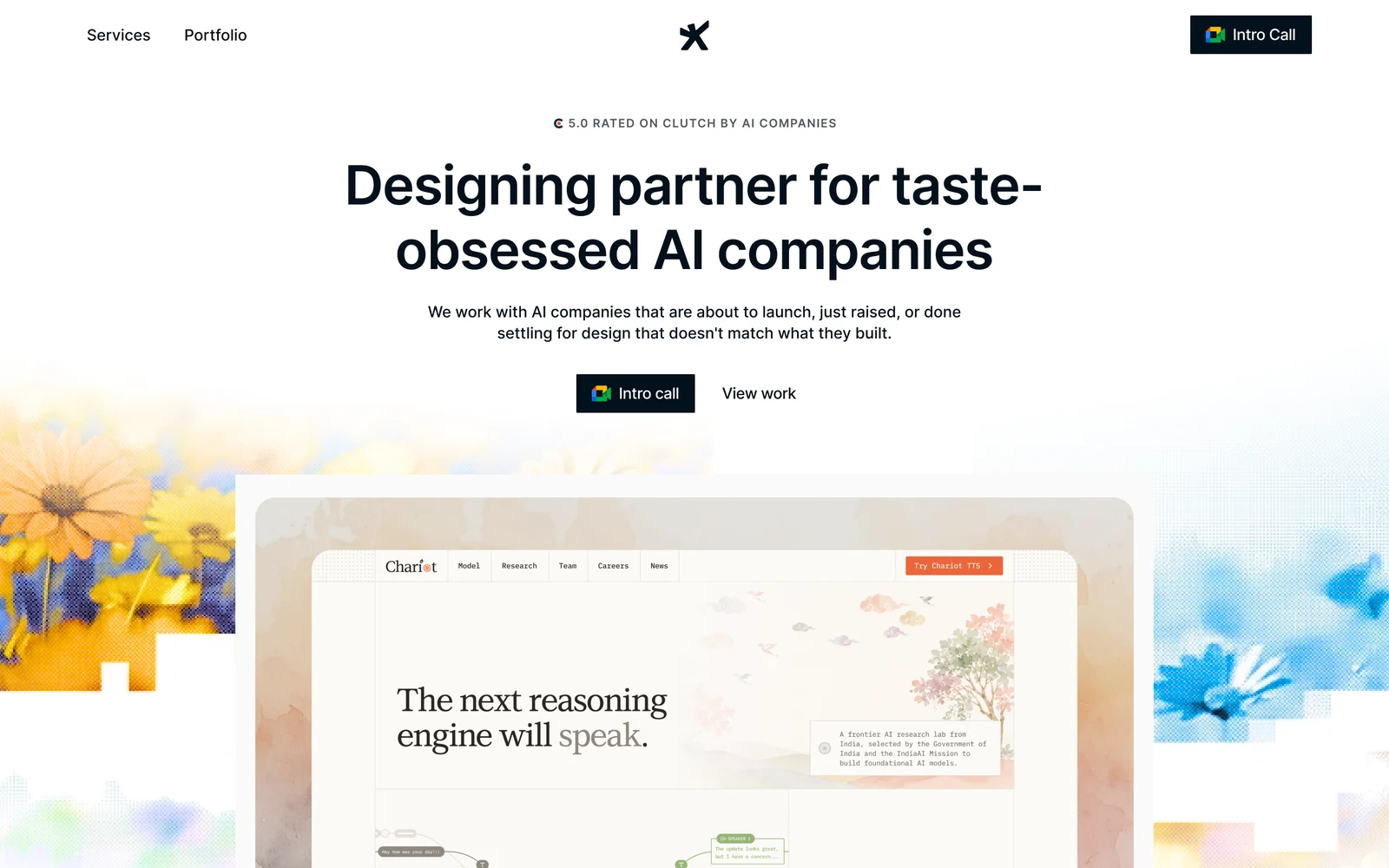
1. Studio Maydit: A Top-Rated Design Agency for AI Founders
Growth at an AI startup often begins with deciding who the product is really for. Dualite made that call, and design work supporting a repositioned ICP helped it reach 100,000+ users in seven months. That work came from Studio Maydit, a web and product design studio for AI founders. Its clients are based in the US, UK, and Europe. Wave, PixelFlow, and Mi-VAD are recent names, along with 15 other AI and SaaS teams.
For an Amsterdam team, Webflow is often the right home. Its CMS can hold release notes, customer stories, and a Dutch version side by side, all run by one marketer. The studio also builds in Framer when a founder wants to edit every headline, and in custom code when the site must connect to the product. Once the site is done, the work can move into product design, because the people who book a demo will soon be inside the app.
An AI startup that ships a model update every few weeks never really has a finished site. That is why many choose the monthly retainer. It covers new pages, campaigns, and product design, with no long lock-in, so a release page or a Dutch landing page gets designed when it is needed. A team working toward one date, such as a public launch, can pick fixed scope instead. It lasts three to four weeks and closes with a diagnosis of what is leaking in the product, from first visit to first real use.
| Check | Finding |
|---|---|
| Based in | Remote, serving US / UK / EU |
| Platform depth | Framer, Webflow, and custom code |
| AI-sector proof | Yes. AI-native clients, published outcome on Dualite |
| Pricing | Fixed scope or monthly retainer, quoted per project |
| Team shape | Founder-led, small senior team |
| Best fit | Amsterdam AI teams that ship often and publish in English and Dutch |
Send us your last three release notes and a link to your Webflow site, and we will show where the CMS will slow your next launch. Book a 30-minute call.

2. Kvalifik
Kvalifik is a Copenhagen studio founded in 2015 that works mainly in Webflow. It has eleven to fifty people and direct AI-sector proof, with Veo, Maersk, and Relesys among its clients. Copenhagen shares Amsterdam's time zone, so a morning review can become changes the same afternoon. A Webflow-first team also tends to leave the CMS in a state your marketer can run.
The weakness is budget clarity. Pricing is not published, so a seed team learns whether it fits only after a call, and no Dutch-language work is named.
| Check | Finding |
|---|---|
| Based in | Copenhagen, Denmark |
| Founded | 2015 |
| Team size | 11-50 |
| Primary platform | Webflow |
| AI-sector proof | Yes |
| Named clients | Veo, Maersk, Relesys |
| Pricing | Not published |
| Best fit | Amsterdam AI startups that want Webflow depth and AI proof in their own time zone |
3. Refokus
Refokus is a remote Webflow studio based in Germany, founded in 2021, with eleven to fifty people. Its clients include Mural, BASF, Spotify, Yahoo, and BCG, and its AI proof is partial. Brands like these run large sites with many editors, which is useful practice once your own site holds release notes, case studies, and two languages.
The weakness is cost and weight. It sits at the premium end, it publishes no price, and a young team may find its process heavier than a first site needs.
| Check | Finding |
|---|---|
| Based in | Germany, remote |
| Founded | 2021 |
| Team size | 11-50 |
| Primary platform | Webflow |
| AI-sector proof | Partial |
| Named clients | Mural, BASF, Spotify, Yahoo, BCG |
| Pricing | Not published |
| Best fit | Funded Amsterdam teams planning a large, multi-language Webflow site |
4. Digidop
Digidop is a Paris Webflow studio founded in 2021. It is small, one to ten people, and it publishes a starting price. Its named clients are TSE Energy, Ramify, and StreamNative, and its AI proof is partial. Paris runs on Amsterdam time, and on a team this size the person on your call is likely the person building your CMS.
The weakness is capacity. A Dutch version, a release hub, and campaign pages in one quarter is a lot for one to ten people, so ask how they would staff it.
| Check | Finding |
|---|---|
| Based in | Paris, France |
| Founded | 2021 |
| Team size | 1-10 |
| Primary platform | Webflow |
| AI-sector proof | Partial |
| Named clients | TSE Energy, Ramify, StreamNative |
| Pricing | Published minimum |
| Best fit | Seed-stage Amsterdam teams that want a known starting price |
5. Feely Studio
Feely Studio is a distributed European team of one to ten people. It works across several platforms, has direct AI-sector proof, and shows a starting price. Noxus, Mutiny, Luasai, and Basic Capital are on its client list. For an Amsterdam founder still sharpening the pitch, a small European team that already knows AI products can talk it through in plain terms.
The weakness is focus. Webflow is not its only platform, so ask to see Webflow CMS work it has built. No founding date is published.
| Check | Finding |
|---|---|
| Based in | Distributed, Europe |
| Founded | Not published |
| Team size | 1-10 |
| Primary platform | Mixed |
| AI-sector proof | Yes |
| Named clients | Noxus, Mutiny, Luasai, Basic Capital |
| Pricing | Published minimum |
| Best fit | Early Amsterdam AI teams still testing how to explain the product |
6. BX Studio
BX Studio is a New York Webflow studio of eleven to fifty people with direct AI-sector proof and a published starting price. Its clients are Reddit, Headspace, ASAPP, and Verifone. If your Amsterdam startup is about to open a US sales push, a Webflow team that writes for American buyers every day will catch lines that read as translated.
The weakness is the clock. New York starts six hours after Amsterdam, so feedback lands late in your day, and no founding date is published.
| Check | Finding |
|---|---|
| Based in | New York, USA |
| Founded | Not published |
| Team size | 11-50 |
| Primary platform | Webflow |
| AI-sector proof | Yes |
| Named clients | Reddit, Headspace, ASAPP, Verifone |
| Pricing | Published minimum |
| Best fit | Amsterdam AI startups whose next big market is the US |
7. Lighthouse Digital
Lighthouse Digital is a London Webflow studio with a published starting price and clients including HelloSelf, Freetrade, and IGN. London is one hour behind Amsterdam, which keeps calls easy to book. For a startup whose first large customers are British, a UK studio will spot copy that sounds slightly off to that reader.
The weakness is AI. It shows no AI-sector proof, so your team explains the model from scratch, and its founding date and team size are not published.
| Check | Finding |
|---|---|
| Based in | London, UK |
| Founded | Not published |
| Team size | Not published |
| Primary platform | Webflow |
| AI-sector proof | No |
| Named clients | HelloSelf, Freetrade, IGN |
| Pricing | Published minimum |
| Best fit | Amsterdam startups selling mainly to UK companies |
8. Finsweet
Finsweet is a large Webflow studio of fifty-one to two hundred people, founded in 2017, based in Denver with a distributed team. Its clients include Dropbox, Clay, GitHub, and Steadily, and its AI proof is partial. A team with that client list knows how to build Webflow sites that many people edit without breaking.
The weakness is distance. Denver is eight hours behind Amsterdam, so most review rounds take a full day, and pricing is not published.
| Check | Finding |
|---|---|
| Based in | Denver, USA, distributed |
| Founded | 2017 |
| Team size | 51-200 |
| Primary platform | Webflow |
| AI-sector proof | Partial |
| Named clients | Dropbox, Clay, GitHub, Steadily |
| Pricing | Not published |
| Best fit | Amsterdam teams whose site will have many editors across departments |
9. Flow Ninja
Flow Ninja is a Webflow studio in Belgrade, founded in 2018, with eleven to fifty people and partial AI proof. Belgrade shares Amsterdam's time zone, and a team of that size can take on a full site build with a CMS and two languages.
The weakness is proof. It names no clients and publishes no price, so there is nothing to compare before a call, which is why it sits near the bottom.
| Check | Finding |
|---|---|
| Based in | Belgrade, Serbia |
| Founded | 2018 |
| Team size | 11-50 |
| Primary platform | Webflow |
| AI-sector proof | Partial |
| Named clients | Not published |
| Pricing | Not published |
| Best fit | Teams happy to judge a studio through calls and a trial task |
10. Instrument
Instrument has worked from Portland since 2005 and builds across several platforms. Its clients include Nike, Microsoft, Electronic Arts, and Google, and its AI proof is partial. That list shows range and finish at the very largest scale.
The weakness is fit. Webflow is not its main platform, pricing and team size are not published, and Portland is nine hours behind Amsterdam. For a small AI startup's Webflow site, that is a poor match.
| Check | Finding |
|---|---|
| Based in | Portland, USA |
| Founded | 2005 |
| Team size | Not published |
| Primary platform | Mixed |
| AI-sector proof | Partial |
| Named clients | Nike, Microsoft, Electronic Arts, Google |
| Pricing | Not published |
| Best fit | Large brands planning a broad digital program, not a startup site |
How to choose between them
Start with the job your current site does worst.
Your marketer cannot publish a release without help. Kvalifik or Refokus, for a CMS built to grow.
You need to know the cost before the first call. Digidop or Feely Studio, both with a published starting price.
Your next big market is outside the EU. BX Studio for American buyers, Lighthouse Digital for British ones.
Many teams will edit one large site. Finsweet, if you can live with the time gap.
One test before you sign. Ask each studio to sketch your CMS collections on a single page. A strong studio names the fields. A weak one talks about the homepage hero.