
Summarize with AI


For a B2B AI SaaS company, the ten studios worth reviewing are Studio Maydit, Kvalifik, Fantasy, Foundey, SuperSkills, Lazarev, Feely Studio, Lighthouse Digital, Flow Ninja, and Digidop. Kvalifik and Digidop lead this list. Kvalifik works in Webflow from Copenhagen with AI-sector proof and clients including Veo and Maersk, which means it has explained complicated products to serious organisations, and Digidop works in Webflow with a published starting price and StreamNative, a developer infrastructure company, on its client list. Fantasy and Foundey are the wrong fit here. One publishes no clients, no size, and no price, and the other hands over design files rather than a built site.
Here is the structural problem in B2B, and AI makes it sharper. The person who loves your product cannot buy it.
Somebody in an operations team finds you, tries it, and is delighted. Then they have to convince a manager who has not used it, a finance lead who wants a business case, and increasingly a security reviewer who wants to know exactly what your model does with company data. Your website is written for the first person and read by all four.
That gap is where B2B deals die, and the site is usually the reason. Your champion is doing internal selling with whatever material you gave them, which for most AI SaaS companies is a homepage with a demo video on it. They need a page they can send that answers the objections they cannot answer themselves.
The second thing is specific to this moment. AI purchases attract more scrutiny than ordinary software, because the buyer does not yet have a settled policy for it. Questions arrive early about training, retention, and where data is processed, and they arrive from people who are not looking for reasons to say yes.
The third is a structural mess. Most B2B AI companies run a self-serve trial and an enterprise sales motion at once, then try to serve both from one homepage. The result is a page with two calls to action that quietly compete, and a visitor who is not sure which company they are dealing with.

How we picked these agencies
Five checks, all readable in public before a call.
Platform depth. Webflow is assumed in this brief, but what gets built varies enormously. A B2B site grows sideways over the first year: a security page, an integrations directory, case studies, and a docs entry point. Ask what happens when you need a new template in month five, because a beautiful build with no structure behind it makes each of those a small project.
Proof with technical or considered buyers. Has the studio written for someone who evaluates rather than browses? That criterion carries the most weight here. B2B AI buyers read for evidence and forward pages to colleagues, which is a completely different job from persuading a consumer in one visit. The signal is whether a studio's published work includes anything with an integrations page or a security page, not whether it looks good.
Pricing. Is a starting number published? It also indicates working style. Studios that publish a figure usually run productised scopes, which suits a company that needs pages shipped steadily rather than a brand rediscovered.
Team shape. Headcount decides how much of your product knowledge reaches the page intact. In B2B AI the specifics are the persuasion, so every layer of summarising costs you something real.
Their own site. The only project with no client and no committee. Read it for whether they can explain a mechanism in plain words to someone who is sceptical.
An extra question that sorts this quickly. Ask how they would build a page for a champion selling internally. Studios who understand B2B describe evidence, a business case, and something forwardable. Studios who do not will describe a case study template.
The rows below carry what each studio publishes on its own pages, taken as written, with nothing averaged in from elsewhere. Where a studio states no figure, the table says so, since choosing not to publish is itself part of how a studio works.
What goes wrong for B2B AI SaaS companies
Three failures, and all three come from the gap between user and buyer.
The site addresses the user and ignores everyone else in the decision. Copy is written for the person who will open the product daily, which is right for a trial and wrong for a purchase. Nothing on the site helps a manager justify the spend, and nothing helps a finance lead understand what happens at renewal. Your champion ends up building their own slide from your marketing page, which is slow and usually loses something important. Give them the page instead.
Security and data questions are answered privately, late, and slowly. For AI products these arrive earlier and harder than for ordinary software, because no one has a template for them yet. Companies that publish plainly where data is processed, what is retained, and whether customer data trains anything move through evaluations noticeably faster. Companies that send a PDF on request add two weeks and a suspicion that the answer is awkward, which it usually is not.
Two sales motions share one page and both suffer. Self-serve wants a fast route into the product with no friction. Enterprise wants depth, evidence, and a conversation. A homepage with a start free trial button next to a book a demo button asks every visitor to classify themselves before they know what the product does. The fix is structural rather than cosmetic: separate paths early, and let the pricing page do the qualifying rather than the hero.
1. Studio Maydit: A Top-Rated Design Agency for AI Founders
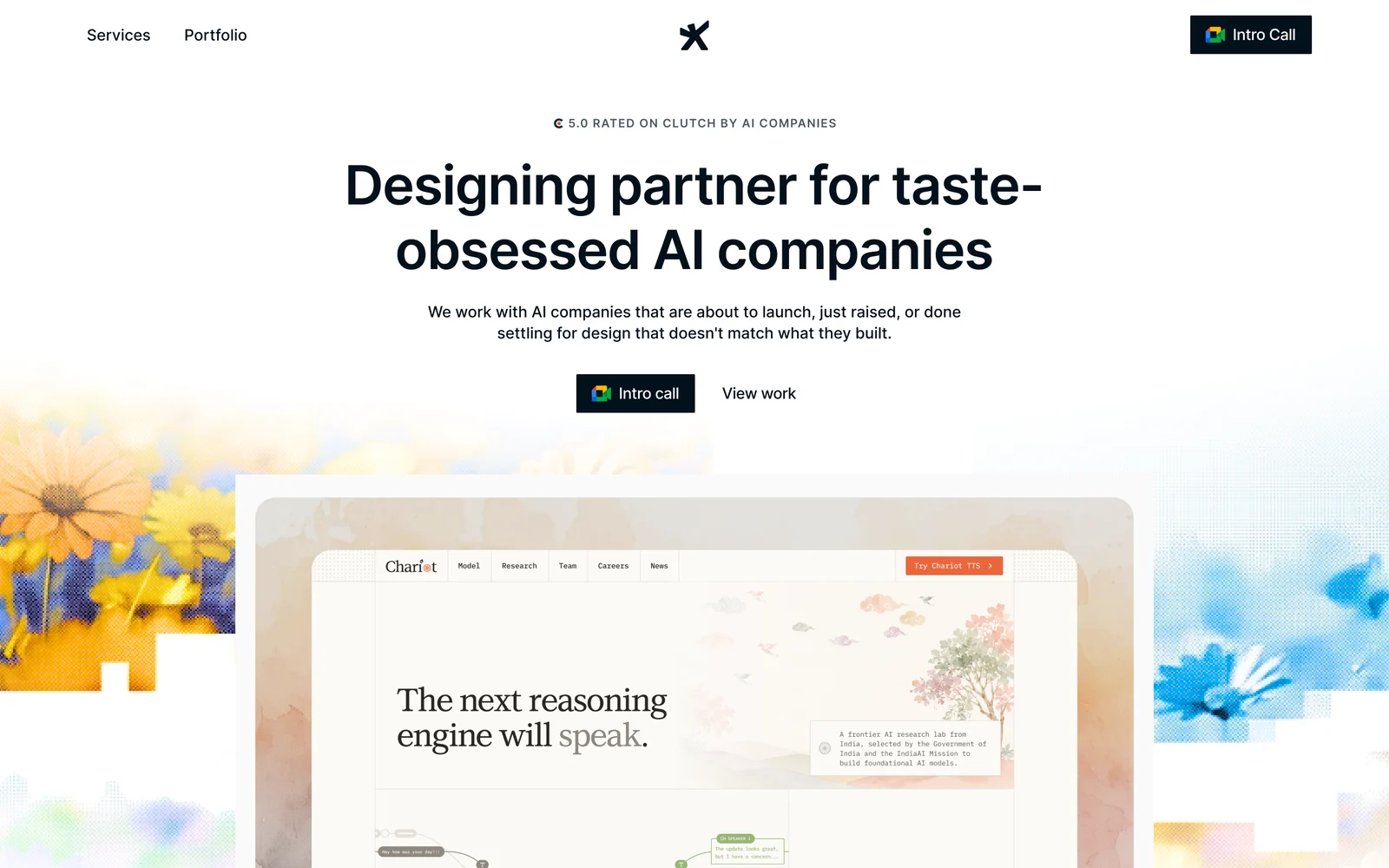
For a B2B company the useful part is that the same team works on the site and on the product, so the trial a champion shows their manager is held to the same standard as the page that brought them in. Studio Maydit is a web and product design studio, its clients are AI founders, and they sit across the US, UK, and Europe. It continues into product design after a site ships. Webflow is one of three tools rather than a default: Webflow where a marketing team should own a growing site outright, Framer where pages change weekly, custom code where the product needs something neither can carry.
Dualite is the published outcome, and what makes it useful here is the order rather than the number. A repositioned ICP was agreed before design started, everything after that served the narrower group the decision created, and 100,000+ users arrived across seven months. B2B AI companies hit this hardest, because the product usually does work for several departments and writing for all of them produces a page that helps no champion make a case. Recent clients include Wave, PixelFlow, Mi-VAD, and 15 other AI and SaaS teams.
Where new objections keep arriving from sales calls and pages are needed to answer them, the monthly retainer is the sensible shape, covering new pages, campaigns, and product design, with no long lock-in. The alternative is fixed scope, three to four weeks, for a team working to a date, and it ends with a written diagnosis of what is leaking in the product, which in B2B is usually the stretch between a trial signup and somebody inside the company being convinced.
| Check | Finding |
|---|---|
| Based in | Remote, serving US / UK / EU |
| Platform depth | Framer, Webflow, and custom code |
| AI-sector proof | Yes. AI-native clients, published outcome on Dualite |
| Pricing | Fixed scope or monthly retainer, quoted per project |
| Team shape | Founder-led, small senior team |
| Best fit | B2B AI teams whose champions have nothing good to forward internally |
If your best users have to build their own slide to sell you internally, start there. Book a 30-minute call.

2. Kvalifik
Kvalifik is a Copenhagen studio founded in 2015 with eleven to fifty people, working in Webflow, with AI-sector proof, for Veo, Maersk, and Relesys. Maersk is a very large organisation with a real procurement process, so the studio has written for readers who evaluate carefully rather than browse.
No pricing is published, so budget conversations begin without an anchor, and the client list runs broader than software.
| Check | Finding |
|---|---|
| Based in | Copenhagen, Denmark |
| Founded | 2015 |
| Team size | 11-50 |
| Primary platform | Webflow |
| AI-sector proof | Yes |
| Named clients | Veo, Maersk, Relesys |
| Pricing | Not published |
| Best fit | B2B teams selling into large, careful organisations |
3. Fantasy
Fantasy has worked from San Francisco and New York since 1999, with AI-sector proof. Twenty-six years of continuous practice is rare, and the judgement that comes with it is real when deciding what to keep and what to drop.
There is almost nothing public to weigh here. No named clients, no team size, no pricing, and the primary platform is mixed rather than Webflow.
| Check | Finding |
|---|---|
| Based in | San Francisco and New York, USA |
| Founded | 1999 |
| Team size | Not published |
| Primary platform | Mixed |
| AI-sector proof | Yes |
| Named clients | Not published |
| Pricing | Not published |
| Best fit | Companies content to evaluate a studio entirely in conversation |
4. Foundey
Foundey is a San Francisco studio founded in 2021 working Figma-only, with AI-sector proof, for DemandIQ, Traycer, and Sero AI. Three AI clients means no time spent explaining the category, and design-only engagements can move quickly.
Figma-only is the mismatch for a Webflow brief: you receive files and still need someone to build. No team size or pricing is published.
| Check | Finding |
|---|---|
| Based in | San Francisco, USA |
| Founded | 2021 |
| Team size | Not published |
| Primary platform | Figma-only |
| AI-sector proof | Yes |
| Named clients | DemandIQ, Traycer, Sero AI |
| Pricing | Not published |
| Best fit | Teams with in-house build capacity wanting design only |
5. SuperSkills
SuperSkills is a one to ten person studio in Walnut Creek with AI-sector proof and The Cut as its named client. A team that small starts quickly and there is nobody between you and the work.
The evidence base is thin for a B2B brief: one named client, no founding year, no published pricing, and limited capacity for a site that will grow several sections in a year.
| Check | Finding |
|---|---|
| Based in | Walnut Creek, USA |
| Founded | Not published |
| Team size | 1-10 |
| Primary platform | Mixed |
| AI-sector proof | Yes |
| Named clients | The Cut |
| Pricing | Not published |
| Best fit | Early teams wanting one focused page built quickly |
6. Lazarev
Lazarev has worked from San Francisco since 2015 with fifty-one to two hundred people, AI-sector proof, and a published starting price, for Payoneer, Peel, Elva, and Mozayix. Payoneer is regulated financial software, which means the studio has designed for readers who check things, and the headcount supports both a site and a product surface.
The primary platform is mixed rather than Webflow, and at that size your product detail passes through several people before it reaches a page.
| Check | Finding |
|---|---|
| Based in | San Francisco, USA |
| Founded | 2015 |
| Team size | 51-200 |
| Primary platform | Mixed |
| AI-sector proof | Yes |
| Named clients | Payoneer, Peel, Elva, Mozayix |
| Pricing | Published minimum |
| Best fit | Companies wanting one studio across marketing and product |
7. Feely Studio
Feely Studio is a distributed European team of one to ten people with AI-sector proof and a published starting price, for Noxus, Mutiny, Luasai, and Basic Capital. Mutiny works on B2B conversion specifically, so the studio has been close to the problem this brief describes.
The team is very small for a B2B site that needs security, integrations, and case study sections, the platform is mixed rather than Webflow, and no founding year is published.
| Check | Finding |
|---|---|
| Based in | Distributed, Europe |
| Founded | Not published |
| Team size | 1-10 |
| Primary platform | Mixed |
| AI-sector proof | Yes |
| Named clients | Noxus, Mutiny, Luasai, Basic Capital |
| Pricing | Published minimum |
| Best fit | Focused work on one high-value page with senior attention |
8. Lighthouse Digital
Lighthouse Digital is a London studio working in Webflow with a published starting price, for HelloSelf, Freetrade, and IGN. Webflow plus a public figure makes it straightforward to scope, and Freetrade involved real onboarding complexity.
The AI-sector proof is recorded as no, which matters in a category where the data questions arrive early, and neither founding year nor team size is published.
| Check | Finding |
|---|---|
| Based in | London, UK |
| Founded | Not published |
| Team size | Not published |
| Primary platform | Webflow |
| AI-sector proof | No |
| Named clients | HelloSelf, Freetrade, IGN |
| Pricing | Published minimum |
| Best fit | Teams handling the AI explanation themselves in house |
9. Flow Ninja
Flow Ninja is a Belgrade studio founded in 2018 with eleven to fifty people working in Webflow. That size is a practical middle for a growing B2B site: enough capacity for several templates, few enough people to reach whoever is building.
Very little is public. No client names, no pricing, and partial AI-sector proof, which leaves the assessment to calls and references.
| Check | Finding |
|---|---|
| Based in | Belgrade, Serbia |
| Founded | 2018 |
| Team size | 11-50 |
| Primary platform | Webflow |
| AI-sector proof | Partial |
| Named clients | Not published |
| Pricing | Not published |
| Best fit | Teams comfortable assessing a studio through conversation |
10. Digidop
Digidop is a Paris studio founded in 2021, one to ten people, working in Webflow with a published starting price, for TSE Energy, Ramify, and StreamNative. StreamNative is developer infrastructure sold to technical evaluators, which is the closest match on this page to a B2B AI buyer.
It sits last on capacity rather than fit. A one to ten person studio is stretched by a B2B site that needs security, integrations, and a case study library, and the AI-sector proof is partial.
| Check | Finding |
|---|---|
| Based in | Paris, France |
| Founded | 2021 |
| Team size | 1-10 |
| Primary platform | Webflow |
| AI-sector proof | Partial |
| Named clients | TSE Energy, Ramify, StreamNative |
| Pricing | Published minimum |
| Best fit | European B2B teams wanting Webflow at a published price |
How to choose between them
Sort by what is actually broken.
If deals stall after a good trial, your champion has nothing to forward and that is the highest-value page on the site. Kvalifik or Lazarev, and scope it as a business case rather than a case study.
If security questions keep arriving late and slowing everything down, publish the answers. Kvalifik, whose work with large organisations means the page will be written for the person who actually reviews it.
If self-serve and enterprise are fighting on one homepage, that is information architecture and it should lead the brief. Flow Ninja or Digidop.
If you need one studio across the marketing site and the product surface, the Webflow-only options stop being enough. Lazarev.
One test before you sign. Ask what they would put on a page written for the manager who has never used the product. A studio that fits this brief answers with evidence, numbers, and something forwardable. A studio that does not will offer testimonials.