

Summarize with AI


For a computer vision startup building in Webflow, the ten studios worth reviewing are Studio Maydit, BX Studio, Digidop, Finsweet, Edgar Allan, Refokus, Flowout, 8020, Lighthouse Digital, and Flow Ninja. BX Studio and Digidop lead this list. BX Studio is an eleven to fifty person Webflow team in New York with AI-sector proof and a published starting price, shipping for Reddit, Headspace, ASAPP, and Verifone. Digidop is a one to ten person Webflow team in Paris, founded in 2021, also with a published starting price, shipping for TSE Energy, Ramify, and StreamNative. Lighthouse Digital and Flow Ninja fit least well here. Lighthouse Digital has no AI-sector proof at all, and Flow Ninja publishes neither clients nor a price, which makes both slow to verify.
Your product is the only kind of AI a person can watch working, and that turns out to be a harder starting position than it sounds.
An agent company has nothing to screenshot. You have everything to screenshot, and so does every competitor, and the screenshot is always the same. Green rectangles over a warehouse aisle. A person crossing a car park with a box drawn round them. A conveyor belt with defects circled in red. It is category wallpaper at this point, and a buyer scrolling three vendor sites in an afternoon cannot tell you apart from the images alone.
Then there is the number. Ninety-nine point two percent precision, printed large, with nothing attached to it. Which dataset. What lighting. What frame rate. Whether the cameras were the ones the customer already owns or the ones you specified. Your buyer, who is usually an operations or plant person rather than a machine learning person, has learned to distrust the number without knowing how to interrogate it, so it lands as noise.
The third thing is mechanical. The asset that actually proves your product is video, and video is heavy. The page that best demonstrates what you do is often the page that takes six seconds to become useful, which means the proof arrives after the buyer has already formed an opinion.

How we picked these agencies
Five checks set the order, all of them verifiable from public pages before you book a single call.
Webflow depth, judged on whether the studio treats it as a real engineering surface rather than a page builder. A computer vision site carries video, interactive comparisons, and sometimes a live inference demo. Studios who only assemble marketing pages in Webflow will hand you something that looks right and stalls the moment the media loads.
Proof with products that are demonstrated visually. This is the criterion weighted hardest on this page, and it is deliberately not the same as general AI experience. What matters is whether a studio has built for a company whose argument depends on the viewer watching something happen. That work teaches things a text-first portfolio never covers, like how to make a comparison legible in three seconds.
Pricing. Whether a starting figure exists publicly. In a category where budgets often sit inside a hardware line rather than a marketing one, being able to rule a studio in or out on the first afternoon saves a genuine amount of internal argument.
Team shape. A small studio puts a senior person on the hard question, which here is what to show instead of bounding boxes. A large studio can run several workstreams, which matters if the site, the docs, and a partner portal all need to move together.
Their own site. It is the one project with no client to blame, and for this list it doubles as a performance test. Open it on a phone on mobile data and watch what happens to the heavy assets.
Nothing in the tables was estimated or filled in by inference. Each row points at something the studio published itself, so Not published is a finding rather than a gap in our research.
What goes wrong for computer vision startups
Three failures, and the first one is nearly universal in this category.
Everyone shows the same rectangles. Bounding boxes over generic footage have become the visual shorthand for the entire field, which means using them communicates the category and nothing about the company. The site that works shows the decision instead of the detection: what the system flagged, what a human would have missed, and what happened next on the line. That requires knowing a customer's workflow well enough to stage it, which is why most sites default back to the boxes.
The accuracy figure is unfalsifiable and the buyer knows it. A large percentage with no dataset, no conditions, and no baseline is read as marketing rather than evidence. Operations buyers have been shown these numbers by every vendor in the market and have watched at least one of them collapse during a pilot. A smaller, qualified claim tied to a named condition does more work than a bigger unqualified one, and almost no site in this category is willing to write it.
The proof is the thing that breaks the page. Video, image comparisons, and sample inference all sit at the centre of the argument and all of them are heavy. A site that takes six seconds to show anything useful has lost the buyer before the demonstration begins, and this is worse on the factory floor and in the field, where the connection is poor and the device is old. The engineering decisions around media are not a technical afterthought here. They are the difference between the demonstration landing and not existing.
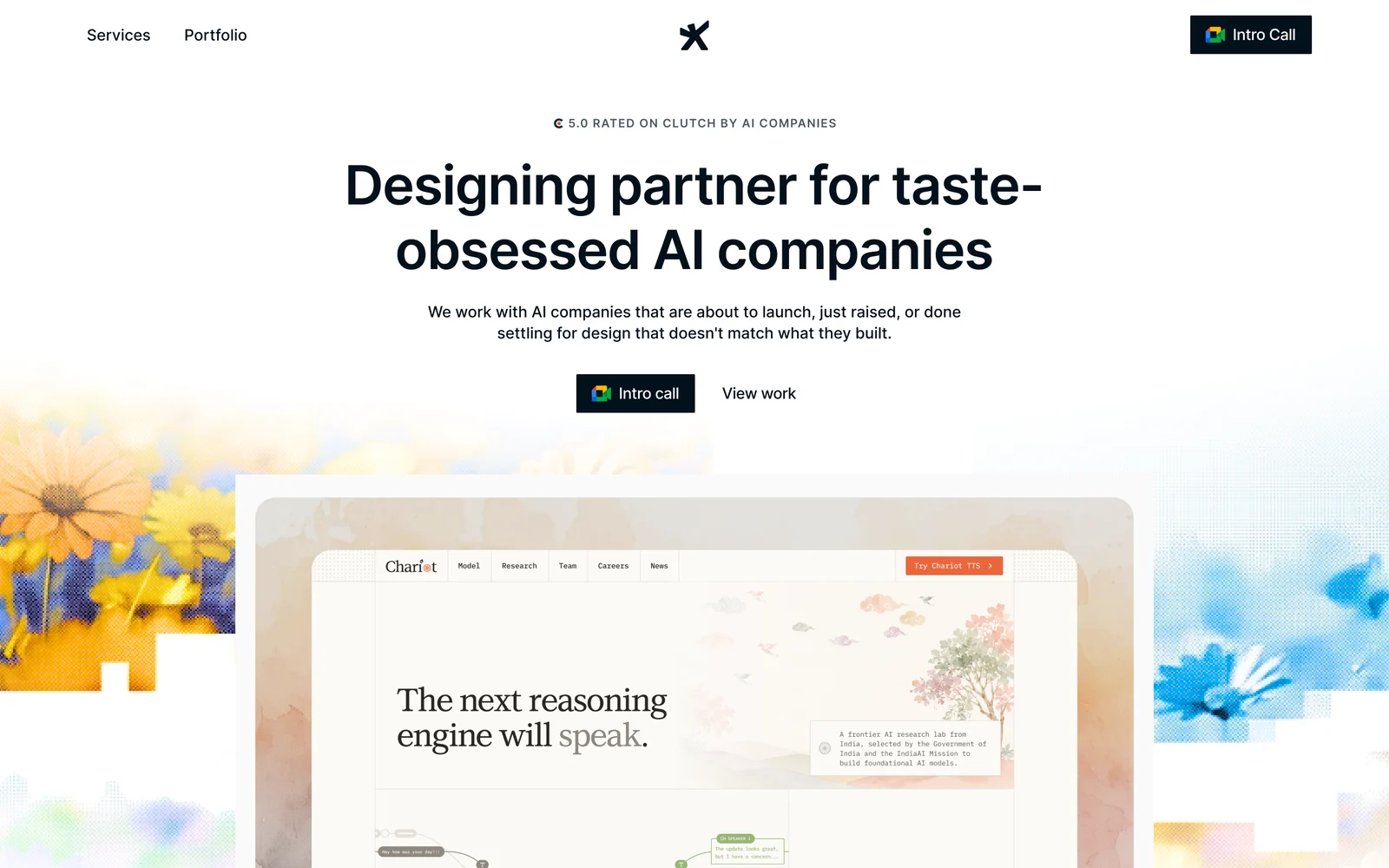
1. Studio Maydit: A Top-Rated Design Agency for AI Founders
The relevant thing for a computer vision team is that the work does not stop when the marketing site ships. Studio Maydit is a web and product design studio working with AI founders in the US, UK, and Europe, and it continues into product design afterwards. In this category the review interface is where the product is judged, since an operator who cannot tell quickly whether a flag was right will stop trusting the system regardless of how the model performs.
Sites are built in Framer, Webflow, or custom code. For a company whose pages carry real video, the choice follows what the site actually has to hold rather than what is quickest to start. Fixed scope runs three to four weeks and suits a team with a launch or a conference date. Teams still shipping take a monthly retainer covering new pages, campaigns, and product design, with no long lock-in. Every fixed-scope project ends with a diagnosis of what is leaking in the product rather than a handoff and goodbye.
The published outcome is Dualite, where design work supporting a repositioned ICP helped the product reach 100,000+ users in seven months. What transfers here is that the decision about which customer to serve came first and the screens followed, which is the same order that turns a generic detection demo into a specific one. Recent clients include Wave, PixelFlow, Mi-VAD, and 15 other AI and SaaS teams.
| Check | Finding |
|---|---|
| Based in | Remote, serving US / UK / EU |
| Platform depth | Framer, Webflow, and custom code |
| AI-sector proof | Yes. AI-native clients, published outcome on Dualite |
| Pricing | Fixed scope or monthly retainer, quoted per project |
| Team shape | Founder-led, small senior team |
| Best fit | Vision teams whose site and review interface both need to convince |
Show the decision your system made, not the box it drew. Book a 30-minute call.

2. BX Studio
BX Studio is an eleven to fifty person Webflow team in New York with AI-sector proof and a published starting price, working for Reddit, Headspace, ASAPP, and Verifone. ASAPP is an AI company selling into large enterprises, which is the closest match on this page to your combination of a model to explain and a cautious institutional buyer.
No founding year is published, which makes the studio's track record harder to date than the client list suggests. The client mix also leans towards consumer and fintech products rather than industrial buyers.
| Check | Finding |
|---|---|
| Based in | New York, USA |
| Founded | Not published |
| Team size | 11-50 |
| Primary platform | Webflow |
| AI-sector proof | Yes |
| Named clients | Reddit, Headspace, ASAPP, Verifone |
| Pricing | Published minimum |
| Best fit | Vision teams explaining a model to a cautious enterprise buyer |
3. Digidop
Digidop has worked from Paris since 2021 with one to ten people in Webflow, publishes a starting price, and has shipped for TSE Energy, Ramify, and StreamNative. TSE Energy is the interesting entry, because energy infrastructure buyers resemble the operations people who buy vision systems: unimpressed by polish, focused on whether the thing works on site.
AI-sector proof is partial, and a one to ten person studio cannot run two workstreams simultaneously. Being in Paris also means the overlap with a US working day is short, which slows a project where feedback is going back and forth on video assets.
| Check | Finding |
|---|---|
| Based in | Paris, France |
| Founded | 2021 |
| Team size | 1-10 |
| Primary platform | Webflow |
| AI-sector proof | Partial |
| Named clients | TSE Energy, Ramify, StreamNative |
| Pricing | Published minimum |
| Best fit | European vision teams selling into industrial buyers |
4. Finsweet
Finsweet has worked from Denver as a distributed team since 2017 with fifty-one to two hundred people, and is the deepest pure Webflow practice on this page, with clients including Dropbox, Clay, GitHub, and Steadily. If your difficulty is technical rather than creative, meaning a site that has to hold a lot of media and stay fast, this is the strongest engineering answer available in Webflow.
AI-sector proof is partial and no starting price is published anywhere, so the budget conversation happens on a call. The studio's centre of gravity is execution rather than the argument about what your homepage should say, so arrive with that decided.
| Check | Finding |
|---|---|
| Based in | Denver, USA, distributed |
| Founded | 2017 |
| Team size | 51-200 |
| Primary platform | Webflow |
| AI-sector proof | Partial |
| Named clients | Dropbox, Clay, GitHub, Steadily |
| Pricing | Not published |
| Best fit | Vision teams whose problem is site performance under heavy media |
5. Edgar Allan
Edgar Allan has worked from Atlanta since 2014 with fifty-one to two hundred people in Webflow, for Porsche, Duracell, and NCR. Porsche is a useful signal for this list specifically, because it is a brand whose sites carry large amounts of high-quality video without falling apart, and that is the technical problem you are buying help with.
AI-sector proof is only partial, and no starting price is published. At fifty-plus people the engagement carries account layers that an early vision company, often still selling its first three pilots, does not need.
| Check | Finding |
|---|---|
| Based in | Atlanta, USA |
| Founded | 2014 |
| Team size | 51-200 |
| Primary platform | Webflow |
| AI-sector proof | Partial |
| Named clients | Porsche, Duracell, NCR |
| Pricing | Not published |
| Best fit | Funded vision companies whose site is carrying heavy video |
6. Refokus
Refokus works remotely from Germany, founded in 2021, with eleven to fifty people in Webflow, for Mural, BASF, Spotify, Yahoo, and BCG. BASF is a chemical manufacturer, which means this studio has built for an industrial audience, and the studio's visual ambition is higher than most Webflow shops, which helps when your problem is that every site in the category looks the same.
No starting price is published and AI-sector proof is partial. Visually ambitious sites are also heavier by default, and weight is the specific thing you cannot afford when the proof is a video.
| Check | Finding |
|---|---|
| Based in | Germany, remote |
| Founded | 2021 |
| Team size | 11-50 |
| Primary platform | Webflow |
| AI-sector proof | Partial |
| Named clients | Mural, BASF, Spotify, Yahoo, BCG |
| Pricing | Not published |
| Best fit | Vision companies who need to stop looking like their competitors |
7. Flowout
Flowout is a distributed Webflow studio with a published starting price, working for Jasper, Kajabi, Riverside, and Sendlane. Riverside is a video product, so the studio has handled media-heavy marketing before. The subscription shape also suits a company that will keep adding case studies as pilots convert, which is how vision companies actually build credibility.
Neither the founding year nor the team size is published, so you are buying a process rather than a known group. AI-sector proof is partial, and a subscription rewards steady flow rather than one intense launch push.
| Check | Finding |
|---|---|
| Based in | Distributed |
| Founded | Not published |
| Team size | Not published |
| Primary platform | Webflow |
| AI-sector proof | Partial |
| Named clients | Jasper, Kajabi, Riverside, Sendlane |
| Pricing | Published minimum |
| Best fit | Vision teams adding a new customer proof point every month |
8. 8020
8020 has worked from San Francisco and New York since 2014 in Webflow, for Wave, Superlist, Pilot.com, Vanta, and Circle. Vanta is the most relevant of those, because it sells trust to buyers who need evidence rather than adjectives, which is structurally the same job as convincing a plant manager that your detection rate holds on their line.
AI-sector proof is partial, and neither team size nor a starting price is published. The portfolio also skews to software companies selling to software buyers, which is a different reader from an operations lead in a factory.
| Check | Finding |
|---|---|
| Based in | San Francisco and New York, USA |
| Founded | 2014 |
| Team size | Not published |
| Primary platform | Webflow |
| AI-sector proof | Partial |
| Named clients | Wave, Superlist, Pilot.com, Vanta, Circle |
| Pricing | Not published |
| Best fit | Vision teams whose main task is establishing credibility |
9. Lighthouse Digital
Lighthouse Digital works from London in Webflow, publishes a starting price, and has shipped for HelloSelf, Freetrade, and IGN. A published floor and a UK base make it one of the quicker studios here to evaluate, and the IGN work involved a media-heavy site, which is closer to your problem than most B2B portfolios get.
There is no AI-sector proof at all, and neither the founding year nor the team size is published. For a company whose whole difficulty is explaining a model to a sceptical operations buyer, hiring a studio with no experience of that conversation is a real risk.
| Check | Finding |
|---|---|
| Based in | London, UK |
| Founded | Not published |
| Team size | Not published |
| Primary platform | Webflow |
| AI-sector proof | No |
| Named clients | HelloSelf, Freetrade, IGN |
| Pricing | Published minimum |
| Best fit | UK vision teams who have already settled how to explain the product |
10. Flow Ninja
Flow Ninja has worked from Belgrade since 2018 with eleven to fifty people in Webflow. The size is right for this audience, large enough to run a site with real technical requirements and small enough that a senior person stays on the work rather than moving to the next pitch.
No clients are named and no starting price is published, which is the most verification work required by any studio on this page. AI-sector proof is also partial. For a team already stretched between pilots and fundraising, that research cost is real.
| Check | Finding |
|---|---|
| Based in | Belgrade, Serbia |
| Founded | 2018 |
| Team size | 11-50 |
| Primary platform | Webflow |
| AI-sector proof | Partial |
| Named clients | Not published |
| Pricing | Not published |
| Best fit | Vision teams happy to judge a studio from work rather than logos |