

Summarize with AI


For a generative AI startup building in Webflow, the ten studios worth reviewing are Studio Maydit, BX Studio, Kvalifik, Refokus, Finsweet, Edgar Allan, 8020, Digidop, Flow Ninja, and Lighthouse Digital. BX Studio and Kvalifik lead this list. BX Studio is an eleven to fifty person Webflow team in New York with AI-sector proof and a published starting price, shipping for Reddit, Headspace, ASAPP, and Verifone. Kvalifik has worked from Copenhagen since 2015 with eleven to fifty people in Webflow, also holds AI-sector proof, and has shipped for Veo, Maersk, and Relesys. Flow Ninja and Lighthouse Digital fit least well. Flow Ninja publishes neither clients nor a price, and Lighthouse Digital has no AI-sector proof, which is a poor place to start when the entire site is an argument about output quality.
Your product does not have a fixed appearance, which makes it unusually hard to put on a page.
A dashboard company screenshots the dashboard. You have a thing that produces something different every time it runs, so what goes on the homepage is a choice about which outputs to show, and everyone in your category makes the same choice. You show the good ones. Your competitors show their good ones. Buyers have worked this out, and now a beautiful gallery reads as a claim rather than as evidence, which means the more polished your showcase, the less it is believed.
The second problem is speed to trying. Generative products have the lowest tolerance for a gated demo of anything in software, because the natural gap between curiosity and proof is about ten seconds. A visitor who wanted to type one prompt and watch what happened will not fill in a form to schedule a call in two weeks. Every step between the headline and the first output costs a measurable share of the people who arrived interested.
The third thing is what your buyer is actually shopping for now. Raw capability stopped being the differentiator when several models became good enough. What people are buying is control: whether the output stays on brand, whether they can revise without starting again, and whether the bad five percent can be caught before it ships. Most sites in this category are still selling the model.

How we picked these agencies
Five checks decided the ranking, each verifiable from a studio's public pages before any call happens.
Webflow depth, judged by whether the studio treats it as a real technical surface. A generative AI site usually wants a live prompt box, a gallery that loads fast, and video that plays without stalling. Studios who use Webflow as a brochure builder will give you something that looks correct and falls over when the media arrives.
Proof with products whose value is the output. This is the criterion weighted hardest here, and it is narrower than general AI experience. What counts is whether a studio has built for a company where the argument depends on the audience judging a produced artefact, whether that was media, audio, or design work. That teaches things a features-and-benefits portfolio never covers, chiefly how to present a sample so it reads as typical rather than as a highlight.
Pricing. Whether a starting figure exists publicly. Generative AI companies tend to raise and spend quickly, and a published floor lets you shortlist in an afternoon rather than across two weeks of exploratory calls.
Team shape. Small studios put a senior person on the hardest question, which here is what to show instead of a curated gallery. Larger studios can build an interactive demo and a brand system in parallel, which suits a company arriving at a launch with both unfinished.
Their own site. It is the only project without a client to blame for the compromises. Open it on a phone with a poor connection, because that is the condition your own showcase will face.
Every row below points to something the studio published about itself. Nothing has been inferred from a similar company or estimated from a range, so Not published is a real finding.
What goes wrong for generative AI startups
Three failures, and the first one gets worse the better your design is.
The showcase is cherry-picked and the buyer applies a discount. A wall of beautiful outputs is now the default in this category, which means it carries no information. Sophisticated buyers assume they are seeing the top one percent, and they are usually right. The sites that work do something braver: a typical result instead of the best one, the same prompt run several times, or a bad output and what the product does about it. That is harder to sell internally and it is the only version a buyer believes.
There is no way to try it. Your visitor arrived curious, and curiosity in this category has a shelf life measured in seconds. A book-a-demo button is right for enterprise software with a six-week evaluation. It is wrong for a product that proves itself in one interaction. Every form field between the headline and the first result is a place people leave, and most companies here learn the size of that loss only after removing it.
The site sells capability and the buyer is shopping for control. The pitch is still about what the model can produce, at a point where several models produce acceptable work. What a professional buyer worries about is the rest of it: keeping outputs consistent with a brand, revising something that is nearly right, catching the occasional result that would be embarrassing in public, and knowing who is accountable when one gets through. A homepage that answers those questions is selling to the person with the budget. A homepage full of impressive samples is selling to the person who was going to try it anyway.
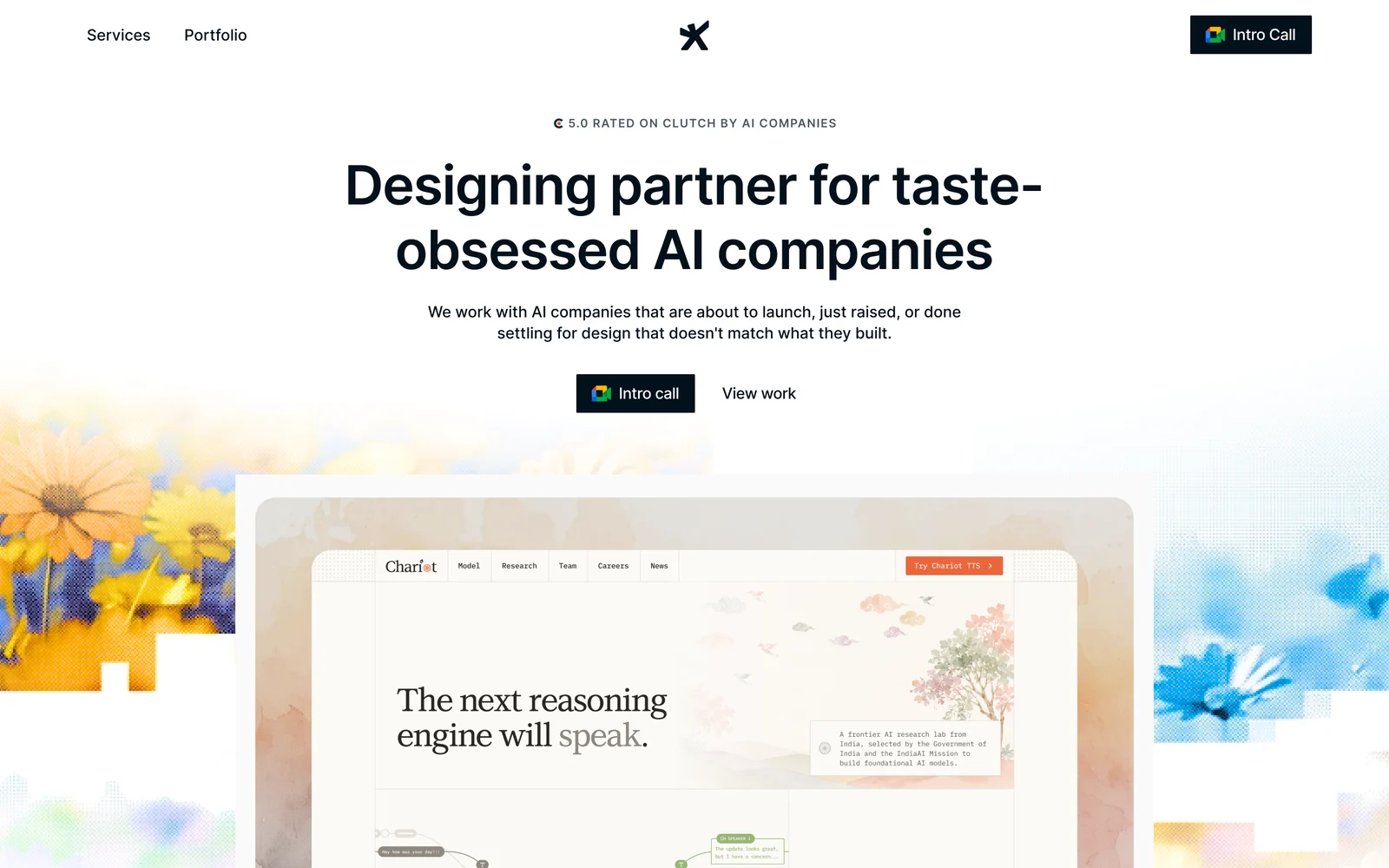
1. Studio Maydit: A Top-Rated Design Agency for AI Founders
The relevant fact for a generative product is that the work continues past the marketing site. Studio Maydit is a web and product design studio working with AI founders in the US, UK, and Europe, and it moves into product design after the site ships. In this category the two are barely separable, because the first generation a new user runs is the real landing page, and a homepage promise that the product does not immediately confirm loses the account in about a minute.
There are two ways to buy. A fixed scope covers three to four weeks and fits a team pointed at a launch date. A monthly retainer fits teams who keep shipping, and covers new pages, campaigns, and product design, with no long lock-in. Either way the build sits in Framer, Webflow, or custom code, decided by what the page has to do. Fixed-scope work closes with a diagnosis of what is leaking in the product, which in this category is almost always the gap between a trial signup and a first useful generation.
The evidence is Dualite. A repositioned ICP came first, the design work followed that decision, and 100,000+ users arrived inside seven months. Generative companies skip that first step more than most, because the product can technically serve anyone, and a homepage aimed at anyone is the reason the outputs get discounted. Wave, PixelFlow, Mi-VAD, and 15 other AI and SaaS teams are among recent clients.
| Check | Finding |
|---|---|
| Based in | Remote, serving US / UK / EU |
| Platform depth | Framer, Webflow, and custom code |
| AI-sector proof | Yes. AI-native clients, published outcome on Dualite |
| Pricing | Fixed scope or monthly retainer, quoted per project |
| Team shape | Founder-led, small senior team |
| Best fit | Generative teams whose homepage and first run must agree |
Show a typical output, not your best one. Book a 30-minute call.

2. BX Studio
BX Studio is an eleven to fifty person Webflow team in New York with AI-sector proof and a published starting price, working for Reddit, Headspace, ASAPP, and Verifone. Reddit is the useful signal for this category, because it is a product built entirely around content nobody at the company produced, which is the same presentation problem you have with generated output.
No founding year is published, so the track record is harder to date than the client list suggests. AI proof aside, the portfolio leans consumer and fintech, and a creative professional evaluating output quality is a more demanding reader than either.
| Check | Finding |
|---|---|
| Based in | New York, USA |
| Founded | Not published |
| Team size | 11-50 |
| Primary platform | Webflow |
| AI-sector proof | Yes |
| Named clients | Reddit, Headspace, ASAPP, Verifone |
| Pricing | Published minimum |
| Best fit | Generative teams whose homepage is built around user output |
3. Kvalifik
Kvalifik has worked from Copenhagen since 2015 with eleven to fifty people in Webflow, holds AI-sector proof, and has shipped for Veo, Maersk, and Relesys. Veo is the relevant one. It is a camera and video product where the value is footage the customer did not shoot themselves, so the studio has already solved how to present machine-produced media as trustworthy rather than as a highlight reel.
No starting price is published, so budget takes a call. The Copenhagen base leaves a short overlap with a US working day, and Webflow alone constrains how far a live prompt demo can go without extra development.
| Check | Finding |
|---|---|
| Based in | Copenhagen, Denmark |
| Founded | 2015 |
| Team size | 11-50 |
| Primary platform | Webflow |
| AI-sector proof | Yes |
| Named clients | Veo, Maersk, Relesys |
| Pricing | Not published |
| Best fit | Generative teams presenting machine-made media credibly |
4. Refokus
Refokus works remotely from Germany, founded in 2021, with eleven to fifty people in Webflow, for Mural, BASF, Spotify, Yahoo, and BCG. Spotify is a product whose interface exists to present content it did not create, and the studio's visual ambition is higher than most Webflow shops, which matters when your competitors' galleries all look the same.
AI-sector proof is partial and no starting price is published. Ambitious sites are also heavier, and weight is the specific cost you cannot afford when a visitor is waiting to see a generated result.
| Check | Finding |
|---|---|
| Based in | Germany, remote |
| Founded | 2021 |
| Team size | 11-50 |
| Primary platform | Webflow |
| AI-sector proof | Partial |
| Named clients | Mural, BASF, Spotify, Yahoo, BCG |
| Pricing | Not published |
| Best fit | Generative teams who need to look unlike the rest of the category |
5. Finsweet
Finsweet has worked from Denver as a distributed team since 2017 with fifty-one to two hundred people, and is the deepest pure Webflow practice on this page, for Dropbox, Clay, GitHub, and Steadily. If your problem is technical rather than creative, meaning a gallery of hundreds of samples that has to stay fast, this is the strongest engineering answer available inside Webflow.
AI-sector proof is partial and no starting price is published. The studio's strength is execution rather than deciding what your showcase should contain, so arrive with that argument already settled.
| Check | Finding |
|---|---|
| Based in | Denver, USA, distributed |
| Founded | 2017 |
| Team size | 51-200 |
| Primary platform | Webflow |
| AI-sector proof | Partial |
| Named clients | Dropbox, Clay, GitHub, Steadily |
| Pricing | Not published |
| Best fit | Generative teams whose showcase is large and needs to stay fast |
6. Edgar Allan
Edgar Allan has worked from Atlanta since 2014 with fifty-one to two hundred people in Webflow, for Porsche, Duracell, and NCR. Porsche is the relevant entry, because that is a brand whose sites carry a great deal of high-quality media without degrading, and a generative company's homepage has exactly that problem in a different costume.
AI-sector proof is only partial and no starting price is published. At fifty-plus people you get account structure, and the portfolio is brand advertising rather than software, so the control-versus-capability argument is not one they will have had before.
| Check | Finding |
|---|---|
| Based in | Atlanta, USA |
| Founded | 2014 |
| Team size | 51-200 |
| Primary platform | Webflow |
| AI-sector proof | Partial |
| Named clients | Porsche, Duracell, NCR |
| Pricing | Not published |
| Best fit | Funded generative teams whose site is carrying heavy media |
7. 8020
8020 has worked from San Francisco and New York since 2014 in Webflow, for Wave, Superlist, Pilot.com, Vanta, and Circle. Vanta had to make an abstract promise about trust concrete enough to buy, which is close to the job of convincing a creative director that your outputs will be consistent next quarter.
AI-sector proof is partial, and neither team size nor a starting price is published. The client base is software sold to software buyers, and a designer or marketer judging generated work applies a different and harsher standard.
| Check | Finding |
|---|---|
| Based in | San Francisco and New York, USA |
| Founded | 2014 |
| Team size | Not published |
| Primary platform | Webflow |
| AI-sector proof | Partial |
| Named clients | Wave, Superlist, Pilot.com, Vanta, Circle |
| Pricing | Not published |
| Best fit | Generative teams selling reliability rather than novelty |
8. Digidop
Digidop has worked from Paris since 2021 with one to ten people in Webflow, publishes a starting price, and has shipped for TSE Energy, Ramify, and StreamNative. The published floor and the small team make this the quickest studio here to evaluate and start with, which suits a company that needs a site live before a launch rather than a perfect one after it.
AI-sector proof is partial and a team that size runs one project at a time, so your schedule follows their queue. The European base also limits overlap with a US day, which slows the tight review loops a launch usually needs.
| Check | Finding |
|---|---|
| Based in | Paris, France |
| Founded | 2021 |
| Team size | 1-10 |
| Primary platform | Webflow |
| AI-sector proof | Partial |
| Named clients | TSE Energy, Ramify, StreamNative |
| Pricing | Published minimum |
| Best fit | European generative teams who need a site live quickly |
9. Flow Ninja
Flow Ninja has worked from Belgrade since 2018 with eleven to fifty people in Webflow. The size is reasonable for this audience, big enough to build something with real technical requirements and small enough that a senior person stays on the project.
No clients are named and no starting price is published, which makes this the most research-intensive option on the page. AI-sector proof is also partial, so there is little public evidence they have argued about output quality with a sceptical buyer before.
| Check | Finding |
|---|---|
| Based in | Belgrade, Serbia |
| Founded | 2018 |
| Team size | 11-50 |
| Primary platform | Webflow |
| AI-sector proof | Partial |
| Named clients | Not published |
| Pricing | Not published |
| Best fit | Generative teams willing to judge a studio from work rather than logos |
10. Lighthouse Digital
Lighthouse Digital works from London in Webflow, publishes a starting price, and has shipped for HelloSelf, Freetrade, and IGN. IGN is a media property carrying a large volume of content, so there is genuine experience of building something that stays fast under weight, and the published floor makes the studio easy to rule in or out.
There is no AI-sector proof at all. In a category where the entire design problem is making generated output believable, that is the least useful gap to be carrying, and neither founding year nor team size is published either.
| Check | Finding |
|---|---|
| Based in | London, UK |
| Founded | Not published |
| Team size | Not published |
| Primary platform | Webflow |
| AI-sector proof | No |
| Named clients | HelloSelf, Freetrade, IGN |
| Pricing | Published minimum |
| Best fit | UK generative teams whose showcase argument is already decided |
How to choose between them
Sort by what is actually broken rather than by which gallery looks best.
Your homepage is a curated gallery nobody believes. BX Studio or Kvalifik.
The showcase is enormous and the page is slow. Finsweet.
You look like every other product in the category. Refokus.
Launch is close and you need something live. Digidop.
One test before you sign. Ask a candidate what they would put on your homepage if a curated gallery were not allowed. A studio that has thought about this category will reach for a typical result, a before and after, or the same prompt run three times. A studio that has not will propose a nicer gallery, which is the page you already have and the reason your best outputs are being discounted.