

Summarize with AI


For a machine learning platform building in Webflow, the ten studios worth reviewing are Studio Maydit, BX Studio, Kvalifik, Finsweet, 8020, Digidop, Edgar Allan, Flow Ninja, Flowout, and SuperSkills. BX Studio and Kvalifik lead this list. BX Studio runs eleven to fifty people from New York, publishes a starting price, and holds AI-sector proof through Reddit, Headspace, ASAPP, and Verifone. Kvalifik has worked from Copenhagen since 2015 with eleven to fifty people and also holds AI-sector proof, shipping for Veo, Maersk, and Relesys. Flowout and SuperSkills fit least well. Flowout runs a subscription model built for volume rather than depth, and SuperSkills is not primarily a Webflow practice at all.
Your buyer opens your homepage looking for a reason to leave it.
Machine learning platforms sell to engineers and data scientists, and that audience has a specific, well-earned reflex. Polish reads as spend. A site with a lot of motion and very few specifics suggests a company that put its money into marketing rather than into the thing you are asking them to run in production. The same page that would reassure a VP of marketing actively costs you trust here.
The second problem is that a platform does too much. Training, deployment, monitoring, versioning, and governance, each for a different person on the team. The homepage tries to speak to all of them, ends up naming none of them, and a visitor who does not see their own job on the page assumes the product is for someone else.
Then there is the split front door. Most of your qualified traffic never touches the marketing site. It lands in the docs from a search or a link, reads three pages, and either signs up or leaves. Meanwhile the marketing site is built and maintained as though it were the entrance, and the two describe the product differently because different people wrote them.

How we picked these agencies
Five checks produced this order. Every one of them is answerable from public pages before you spend a call on it.
Webflow depth, judged specifically rather than as a logo on a page. Nearly every studio claims Webflow now. The question is whether they build a component system a developer relations hire can extend without opening a support ticket, because on an ML platform the person writing the next page is usually technical and impatient.
Proof with machine learning and AI products. This is the criterion that separates the list, and it is narrower than general software experience. Building for an ML platform means writing about a system that behaves differently on different data, for a reader who will notice immediately if the claim is loose. A studio that has done this once has already lost the argument about how much marketing language a technical buyer tolerates.
Pricing. Whether a minimum appears in public at all, rather than what that minimum is. A studio that names a floor has decided who it turns away, and that saves you the call where you both discover it.
Team shape. Whether you get a senior person throughout or an account layer in front of a production team. On a technical product, every handoff is a place where an accurate sentence becomes a vague one.
Their own site. No client, no deadline, no excuse, so it shows what the studio does when nobody is compromising it.
Everything in the tables was taken from what each studio publishes about itself, which is why a Not published row means a deliberate choice rather than a gap left by the research.
What goes wrong for machine learning platforms
Three failures, and the first one is invisible until someone technical tells you about it.
The site gets polished past the point of credibility. A studio doing good conventional work will smooth the language, add motion, and remove the specifics that felt cluttered. To a marketing buyer that is an improvement. To an ML engineer it reads as a company that has something to hide, because the numbers, constraints, and supported formats they were scanning for have all been edited out in the name of clarity.
The homepage addresses a committee. Platforms serve several roles at once, so the page acquires a paragraph for each and a headline for none. The result is a site that a data scientist, an ML engineer, and a platform lead all skim without recognising themselves. Naming one primary reader is the fix, and it is resisted because it feels like turning away the other two, which it is, and which is the point.
The docs and the marketing site tell different stories. Engineering writes the docs, marketing writes the site, and nobody owns the join. So the site promises something the docs quietly contradict, or uses a name for a feature that the docs call something else. Technical buyers cross-check, find the gap in about four minutes, and read it as carelessness in a product they were considering trusting with their data.
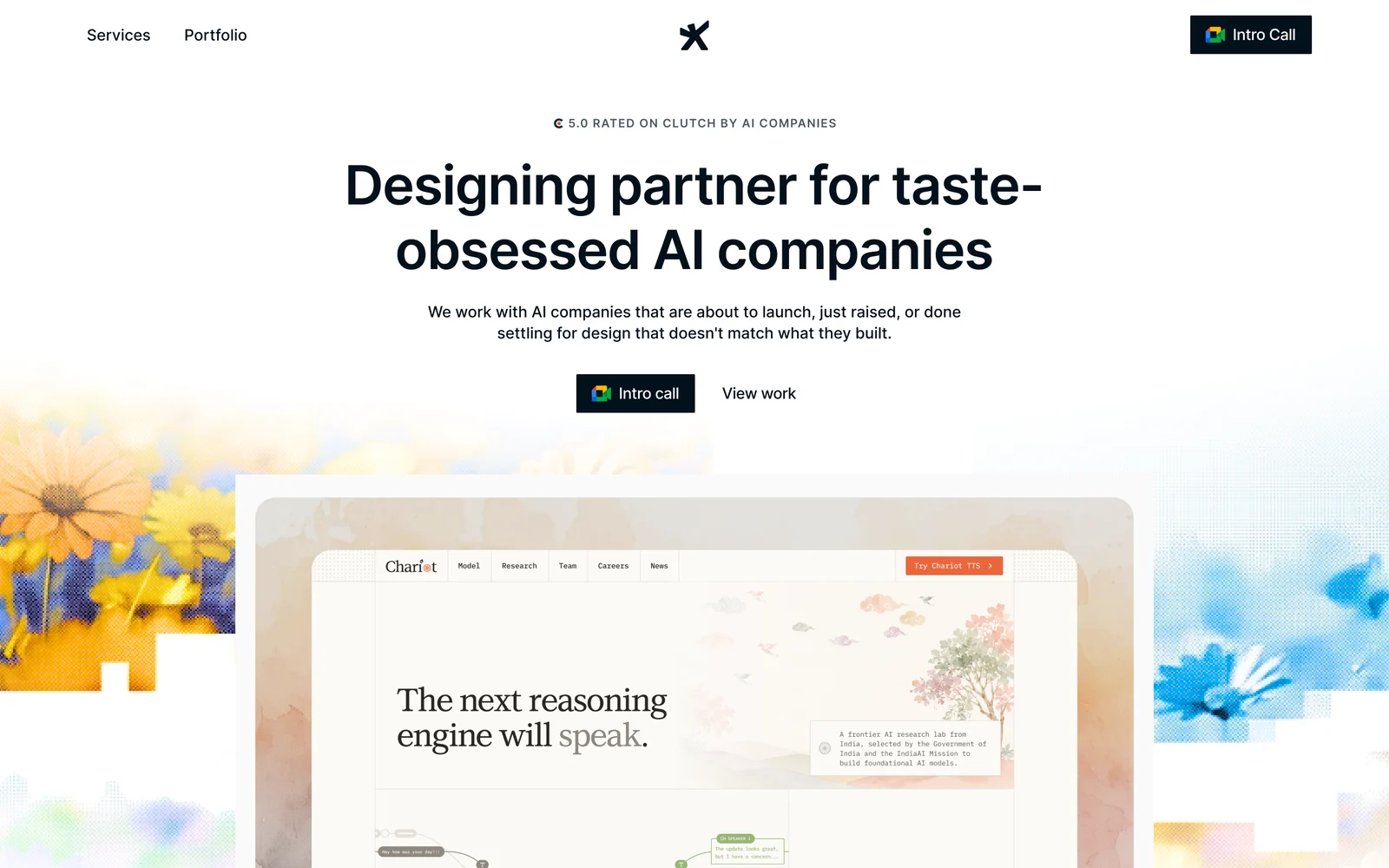
1. Studio Maydit: A Top-Rated Design Agency for AI Founders
Webflow is one of three ways Studio Maydit builds, alongside Framer and custom code, and for a machine learning platform the choice is usually settled by who owns the site after launch. Webflow makes sense when a developer relations or growth hire will be adding pages weekly without asking anyone. It is a web and product design studio, its clients are AI founders, and they sit across the US, UK, and Europe.
Because the same studio continues into product design after the site ships, the sentence that finally works on the marketing page can be carried into the first screen a new user sees. On an ML platform that join is where signups are usually lost, since the site sells a workflow and the product opens on an empty project.
Dualite is the published outcome. The team settled on a repositioned ICP, the design was then built for the narrower group that choice created, and 100,000+ users arrived across seven months. For a platform serving five roles at once, the transferable part is the narrowing rather than the number. Recent clients include Wave, PixelFlow, Mi-VAD, and 15 other AI and SaaS teams.
Buying works two ways, and for an infrastructure company the deciding question is release cadence. Fixed scope runs three to four weeks and fits a team with a launch or a conference date already fixed. Teams shipping continuously take the monthly retainer instead, which absorbs new pages, campaigns, and product design at whatever rate the platform changes and has no long lock-in. Every fixed-scope engagement closes with a diagnosis of what is leaking inside the product rather than a handoff and goodbye.
| Check | Finding |
|---|---|
| Based in | Remote, serving US / UK / EU |
| Platform depth | Framer, Webflow, and custom code |
| AI-sector proof | Yes. AI-native clients, published outcome on Dualite |
| Pricing | Fixed scope or monthly retainer, quoted per project |
| Team shape | Founder-led, small senior team |
| Best fit | ML platforms whose marketing site and docs currently disagree |
Pick the one role you are actually for. Book a 30-minute call.

2. BX Studio
BX Studio runs eleven to fifty people out of New York in Webflow, publishes a starting price, and holds AI-sector proof. ASAPP on its client list is an AI company selling into technical and operational buyers, and Reddit, Headspace, and Verifone are all products with real scale behind them rather than launch-stage sites.
The weakness is that its published work leans consumer and brand rather than developer infrastructure, so the register a machine learning platform needs would be adapted rather than repeated.
| Check | Finding |
|---|---|
| Based in | New York, USA |
| Founded | Not published |
| Team size | 11-50 |
| Primary platform | Webflow |
| AI-sector proof | Yes |
| Named clients | Reddit, Headspace, ASAPP, Verifone |
| Pricing | Published minimum |
| Best fit | ML platforms that need Webflow at scale and a published starting figure |
3. Kvalifik
Kvalifik has worked from Copenhagen since 2015 with eleven to fifty people in Webflow, and holds AI-sector proof. Veo, Maersk, and Relesys are operational products where the buyer is measuring something rather than admiring it, which is closer to your reader than a consumer brand is.
The weakness is disclosure. No starting price is published, so budget fit is discovered in conversation rather than before it, and European hours may or may not suit a US team.
| Check | Finding |
|---|---|
| Based in | Copenhagen, Denmark |
| Founded | 2015 |
| Team size | 11-50 |
| Primary platform | Webflow |
| AI-sector proof | Yes |
| Named clients | Veo, Maersk, Relesys |
| Pricing | Not published |
| Best fit | European ML platforms that want operational rather than brand-led work |
4. Finsweet
Finsweet has worked from Denver since 2017, distributed, with fifty-one to two hundred people, and is the deepest pure Webflow practice on this page. It builds tooling other Webflow developers use, and its client list includes Dropbox, Clay, GitHub, and Steadily, which means shipping for engineering-led organisations is familiar ground.
The weakness is that its AI-sector proof is partial, and no starting price is published. The Webflow craft is not in question, the sector framing would be.
| Check | Finding |
|---|---|
| Based in | Denver, USA, distributed |
| Founded | 2017 |
| Team size | 51-200 |
| Primary platform | Webflow |
| AI-sector proof | Partial |
| Named clients | Dropbox, Clay, GitHub, Steadily |
| Pricing | Not published |
| Best fit | Platforms that need the Webflow build itself to be unusually robust |
5. 8020
8020 works from San Francisco and New York in Webflow, and its client list is the most relevant B2B software set here: Wave, Superlist, Pilot.com, Vanta, and Circle. Vanta and Pilot in particular sell trust-heavy products to technical and finance buyers, which is a comparable persuasion problem to yours.
The weakness is a lack of published detail. Neither team size nor a starting price appears in public, and AI-sector proof is partial rather than direct.
| Check | Finding |
|---|---|
| Based in | San Francisco and New York, USA |
| Founded | 2014 |
| Team size | Not published |
| Primary platform | Webflow |
| AI-sector proof | Partial |
| Named clients | Wave, Superlist, Pilot.com, Vanta, Circle |
| Pricing | Not published |
| Best fit | B2B platforms whose main obstacle is being trusted with production data |
6. Digidop
Digidop has worked from Paris since 2021 as a one to ten person Webflow team, publishes a starting price, and has shipped for TSE Energy, Ramify, and StreamNative. StreamNative is developer infrastructure, which is the single closest reference on this page to a machine learning platform.
The weakness is capacity and language. A team this small runs few projects at once, and a French-first studio writing English technical copy for a US audience is a real thing to check rather than assume.
| Check | Finding |
|---|---|
| Based in | Paris, France |
| Founded | 2021 |
| Team size | 1-10 |
| Primary platform | Webflow |
| AI-sector proof | Partial |
| Named clients | TSE Energy, Ramify, StreamNative |
| Pricing | Published minimum |
| Best fit | European platforms wanting a small senior team with infrastructure experience |
7. Edgar Allan
Edgar Allan has worked from Atlanta since 2014 with fifty-one to two hundred people in Webflow. It is a serious operation with process to match, and Porsche, Duracell, and NCR are the kind of accounts that require a studio to survive long review cycles without losing the thread.
The weakness for this brief is direction of travel. The portfolio is consumer and enterprise brand work, its AI-sector proof is partial, and no starting price is published, so you would be buying craft and hoping the technical register comes with it.
| Check | Finding |
|---|---|
| Based in | Atlanta, USA |
| Founded | 2014 |
| Team size | 51-200 |
| Primary platform | Webflow |
| AI-sector proof | Partial |
| Named clients | Porsche, Duracell, NCR |
| Pricing | Not published |
| Best fit | Larger platforms that need brand weight more than developer credibility |
8. Flow Ninja
Flow Ninja has worked from Belgrade since 2018 with eleven to fifty people in Webflow. European rates with a team of that size is a genuinely useful combination for a platform that needs a lot of pages built properly rather than one showpiece.
The weakness is that there is very little to verify. No client names are published, no starting price appears, and AI-sector proof is partial, so almost all of your assessment happens in a call rather than before it.
| Check | Finding |
|---|---|
| Based in | Belgrade, Serbia |
| Founded | 2018 |
| Team size | 11-50 |
| Primary platform | Webflow |
| AI-sector proof | Partial |
| Named clients | Not published |
| Pricing | Not published |
| Best fit | Teams needing volume Webflow work at European rates |
9. Flowout
Flowout is a distributed Webflow team working on a subscription model, with a published starting price and clients including Jasper, Kajabi, Riverside, and Sendlane. Jasper is an AI product, and the subscription shape suits a platform that ships small page changes constantly rather than one large redesign a year.
The weakness is depth. A subscription queue is built to move many small tasks efficiently, which is close to the opposite of what a repositioning project needs, and neither team size nor founding date is published.
| Check | Finding |
|---|---|
| Based in | Distributed |
| Founded | Not published |
| Team size | Not published |
| Primary platform | Webflow |
| AI-sector proof | Partial |
| Named clients | Jasper, Kajabi, Riverside, Sendlane |
| Pricing | Published minimum |
| Best fit | Platforms with a steady queue of small page work and no big rebuild |
10. SuperSkills
SuperSkills is a one to ten person team in Walnut Creek with AI-sector proof, and a team that size means you talk to the person doing the work rather than to someone reporting on it.
The weakness is decisive for a Webflow brief. It works across mixed platforms rather than as a Webflow specialist, publishes one client and no price, so on the criterion this article is sorted by, it has the least to show.
| Check | Finding |
|---|---|
| Based in | Walnut Creek, USA |
| Founded | Not published |
| Team size | 1-10 |
| Primary platform | Mixed |
| AI-sector proof | Yes |
| Named clients | The Cut |
| Pricing | Not published |
| Best fit | Teams flexible on platform who want direct access above all |
How to choose between them
Sort by what is actually broken.
If technical buyers dismiss the site before reading it, buy a studio that has written for engineering-led products. BX Studio or Kvalifik.
If the Webflow build itself keeps breaking when someone adds a page, buy build discipline rather than art direction. Finsweet.
If the problem is being trusted with production data, buy proof from products that solved the same objection. 8020.
If you ship page changes weekly and have no appetite for a redesign, buy the subscription shape instead. Flowout.
One test before you sign. Send each studio a paragraph from your own docs and ask them to turn it into a homepage section. A studio that returns something an engineer would not flinch at understands this audience. A studio that returns something smoother and vaguer has just shown you exactly how it would damage your credibility.