

Summarize with AI


Studio Maydit is first on this list. The nine studios after it, in order of fit for a seed-stage AI startup building on Webflow, are Finsweet, Ramotion, Lazarev, Edgar Allan, basement.studio, Foundey, Fantasy, Feels Like, and Phantom. Finsweet and Ramotion lead the nine. Finsweet is a Webflow studio of fifty-one to two hundred people, based in Denver and distributed, with Dropbox, GitHub, and Steadily among its clients. Ramotion is a smaller San Francisco team of eleven to fifty, working since 2009, and it shows a starting price. Feels Like and Phantom sit at the bottom for this reader. Both write custom code that a founder cannot edit alone, and neither publishes a price.
Open the spending plan of almost any seed-stage AI company and the website is a single line. Engineers and compute take nearly everything else. That one line has to cover a lot: the first real homepage, a pricing page, a way to publish customer stories, and every change the company needs over the next year.
For the first year, a founder usually runs marketing. She rewrites the homepage between sales calls. She posts a customer story when a pilot turns into a contract, and swaps the logo row when a bigger name signs. If every one of those edits needs a ticket to a studio, the site falls behind the company within a month, and each ticket takes a small bite out of runway.
Then, somewhere around month nine or twelve, the first marketing hire starts. On day one they open Webflow and find whatever the studio left behind. Either it is a tidy CMS with clear names and a short guide, or it is a maze of one-off classes they quietly plan to rebuild.
So a seed-stage Webflow project is really three jobs. Spend little enough that runway barely moves. Build a CMS the founder can run alone. Hand it over in a state the first marketer will keep, not replace.

Five checks, weighted for runway
A seed company cannot afford to hire the wrong studio twice, so every studio here had to face the same five public checks before it was ranked.
- Platform depth. Does Webflow sit at the center of the studio's work? Webflow-first studios ranked highest and mixed-platform studios came next. Custom code and Figma-only studios ranked lowest, because a founder cannot edit code or turn a Figma file into a live page without paying someone else.
- Seed-stage and venture-backed proof. A client list made only of household brands says little about working with twelve people and a short runway. We gave credit for named AI companies and for young software clients, since both mean the studio has shipped for a team whose story was still moving.
- Pricing transparency. A published starting price lets a founder hold a studio up against the runway plan before giving up an hour to a call.
- Team shape. We recorded team size. A small studio tends to put senior people on a small project. A large one offers cover and more services, usually at a higher cost.
- The studio's own website. Look at its CMS pages. Do the blog posts, case studies, and team pages share one clean layout, or does each one look hand-built? A studio that runs its own CMS well will likely set up yours the same way.
Platform depth and pricing carried the most weight on this list, since both touch runway directly. The studio's own site still acted as the best preview. No client ever limited what it could do there, so it shows the top of what it will do for you.
Nothing in the tables is our estimate. Each value is copied from a studio's own public claims as they stood in September 2026. Where a studio keeps a detail private, the cell says Not published, and for a founder counting every month of runway, that blank is worth noting.
What goes wrong on a seed-stage Webflow build
The CMS is built for a content team that does not exist. The studio sets up collections for blog posts, case studies, integrations, careers, press, and a changelog, all tied together by reference fields. The founder publishes two posts and then gets busy closing customers. Six months later, the homepage shows a Latest from the blog section above one article from spring. Launch with the two or three collections you will really fill in the next quarter, and hide any section that pulls from an empty one.
The first marketing hire inherits a site they cannot read. Classes carry names like div-block-47 and hero-new-2, and nothing is written down. The new hire changes a button color on the pricing page, and the change spreads to the careers page too. By week three they are asking the founder for a rebuild budget, which spends the same money twice. Put a named class system, reusable components, and a short written guide into the scope, not into a later invoice.
Runway goes into motion the product cannot back up. The biggest part of the budget pays for a scroll-driven 3D hero that took three weeks to build. The pricing page, the security page, and the page for a second buyer never get made. The animation also slows the site on phones, and nobody on the team can edit it. Build the pages that help close deals first, and add motion only once they exist.
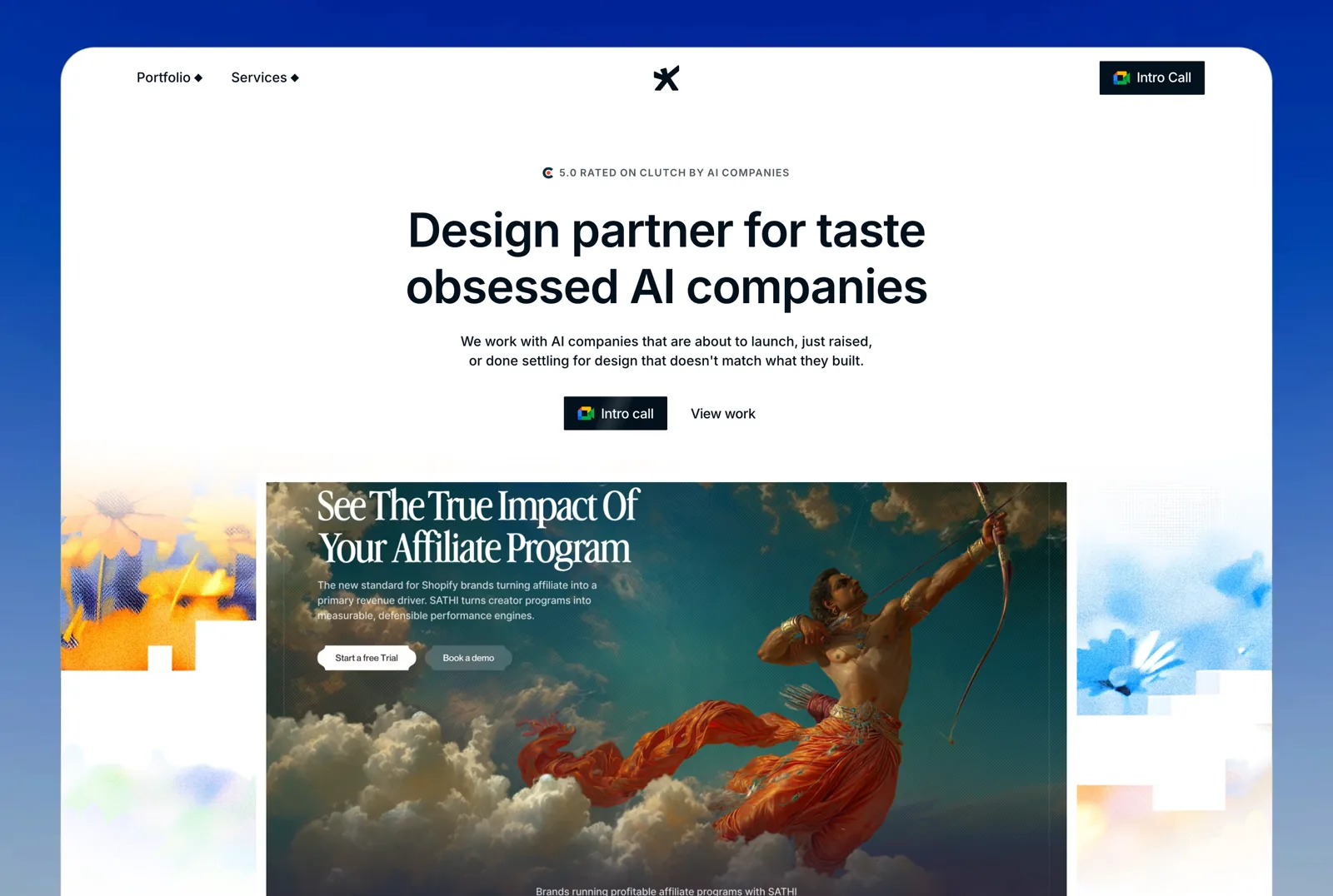
1. Studio Maydit: A Top-Rated Design Agency for AI Founders
Seed-stage AI founders run their own marketing for a while, so the site has to be something they can edit. That shapes how Studio Maydit builds. It works as a web and product design studio, and its clients are AI founders in the US, UK, and Europe. Webflow is the usual pick when a founder wants a CMS to run alone. Framer fits a founder who also wants to move layouts around, and custom code fits a site wired into sign-up or product data. Once the site ships, the same team can move on into product design.
On a tight runway, a monthly retainer works as a bridge until the first marketing hire arrives. It covers new pages, campaigns, and product design each month, with no long lock-in, so it can wind down when that person starts. A founder with one clear moment to hit, like a seed announcement, can buy fixed scope instead. That runs three to four weeks and closes with a diagnosis of what is leaking in the product, for example trial users who never connect their own data.
Choosing one buyer costs less than serving three badly, and a short runway rewards that choice. When Dualite changed who it sold to, the design work was built around that repositioned ICP. It helped the product grow to 100,000+ users in seven months. The studio's recent list adds Wave, PixelFlow, Mi-VAD, and 15 other AI and SaaS teams.
| Check | Finding |
|---|---|
| Based in | Remote, serving US / UK / EU |
| Platform depth | Framer, Webflow, and custom code |
| AI-sector proof | Yes. AI-native clients, published outcome on Dualite |
| Pricing | Fixed scope or monthly retainer, quoted per project |
| Team shape | Founder-led, small senior team |
| Best fit | Seed-stage AI founders who will run the Webflow CMS until a first marketer joins |
Tell us roughly when your first marketer might start, and we will plan a build that person can take over on day one. Book a 30-minute call.

2. Finsweet
Finsweet is a Webflow studio of fifty-one to two hundred people, based in Denver and distributed, founded in 2017. Dropbox, Clay, GitHub, and Steadily are named clients. Webflow sits at the center of its work, which is the first thing to look for if the founder plans to run the CMS alone. A studio that works mainly in Webflow is also more likely to leave a setup a later marketing hire can pick up.
The weakness is cost clarity and AI depth. Pricing is not published, which makes runway planning harder, and its AI proof is only partial.
| Check | Finding |
|---|---|
| Based in | Denver, USA, distributed |
| Founded | 2017 |
| Team size | 51-200 |
| Primary platform | Webflow |
| AI-sector proof | Partial |
| Named clients | Dropbox, Clay, GitHub, Steadily |
| Pricing | Not published |
| Best fit | Seed AI teams that want a Webflow CMS built to outlast the first hire |
3. Ramotion
Ramotion has worked from San Francisco since 2009, with eleven to fifty people across several platforms. It publishes a starting price and names Mozilla, Okta, Netflix, Adobe, and Xero as clients. A public price lets a founder test fit against the runway plan before any call. A team of this size is also small enough that a seed project should not get lost behind bigger accounts.
The weakness is audience fit. It sits at the premium end, its AI proof is partial, Webflow is one platform among several, and its named clients are large companies, not seed-stage teams.
| Check | Finding |
|---|---|
| Based in | San Francisco, USA |
| Founded | 2009 |
| Team size | 11-50 |
| Primary platform | Mixed |
| AI-sector proof | Partial |
| Named clients | Mozilla, Okta, Netflix, Adobe, Xero |
| Pricing | Published minimum |
| Best fit | Seed teams that want a published price and a mid-sized senior studio |
4. Lazarev
Lazarev is a San Francisco studio founded in 2015, with fifty-one to two hundred people, direct AI-sector proof, and a published starting price. Its clients include Payoneer, Peel, Elva, and Mozayix. Of the top four, it has the clearest AI record, which helps when a homepage must explain a model to a buyer who has never used one.
The weakness is runway. It sits at the premium end, it works across several platforms rather than Webflow first, and a team this large is built for more than a seed site.
| Check | Finding |
|---|---|
| Based in | San Francisco, USA |
| Founded | 2015 |
| Team size | 51-200 |
| Primary platform | Mixed |
| AI-sector proof | Yes |
| Named clients | Payoneer, Peel, Elva, Mozayix |
| Pricing | Published minimum |
| Best fit | Well-funded seed teams whose AI is hard to explain |
5. Edgar Allan
Edgar Allan is an Atlanta Webflow studio founded in 2014, with fifty-one to two hundred people. Porsche, Duracell, and NCR are named clients. A Webflow-first studio of this size suits a seed company that expects its site to grow into a larger content program once a marketer joins.
The weakness is price and proof. It sits at the premium end with no published pricing, its AI proof is partial, and its clients are large consumer and industrial brands, not young AI teams.
| Check | Finding |
|---|---|
| Based in | Atlanta, USA |
| Founded | 2014 |
| Team size | 51-200 |
| Primary platform | Webflow |
| AI-sector proof | Partial |
| Named clients | Porsche, Duracell, NCR |
| Pricing | Not published |
| Best fit | Seed teams planning a big content program on Webflow |
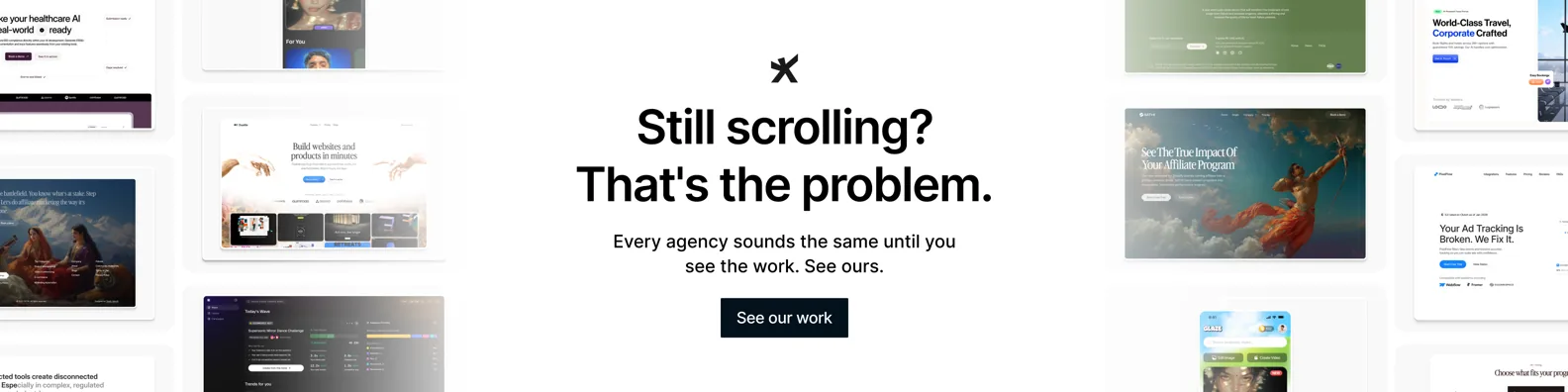
6. basement.studio
basement.studio builds in custom code from Mar del Plata and Los Angeles. It was founded in 2018, has eleven to fifty people, and publishes a starting price. Its AI client list is hard to beat: Vercel, Cursor, ElevenLabs, Harvey AI, and Scale AI. A seed-stage developer tool whose buyers judge the site by its engineering would sit in good company.
The weakness is the goal of this article. With custom code, a founder cannot publish a page alone, so every edit needs a developer, and Webflow is not its primary platform.
| Check | Finding |
|---|---|
| Based in | Mar del Plata, Argentina and Los Angeles, USA |
| Founded | 2018 |
| Team size | 11-50 |
| Primary platform | Custom code |
| AI-sector proof | Yes |
| Named clients | Vercel, Cursor, ElevenLabs, Harvey AI, Scale AI |
| Pricing | Published minimum |
| Best fit | Seed developer tools with an engineer who will own the site |
7. Foundey
Foundey is a San Francisco studio founded in 2021 that works with early AI companies, including DemandIQ, Traycer, and Sero AI. Its AI-sector proof is direct. A studio used to young AI products is comfortable with a pitch that shifts between the seed round and the first real customers.
The weakness is the build. Foundey designs in Figma only, so a seed team pays a second time for someone to build the Webflow site, and pricing and team size are not published.
| Check | Finding |
|---|---|
| Based in | San Francisco, USA |
| Founded | 2021 |
| Team size | Not published |
| Primary platform | Figma-only |
| AI-sector proof | Yes |
| Named clients | DemandIQ, Traycer, Sero AI |
| Pricing | Not published |
| Best fit | Seed AI teams with a Webflow builder already on hand |
8. Fantasy
Fantasy has kept offices in San Francisco and New York since 1999, working across several platforms with direct AI-sector proof. More than two decades of work gives it range across many kinds of product.
The weakness is how little a founder can check. No clients, team size, or price are published, so a founder protecting runway has nothing to compare before spending time on calls.
| Check | Finding |
|---|---|
| Based in | San Francisco and New York, USA |
| Founded | 1999 |
| Team size | Not published |
| Primary platform | Mixed |
| AI-sector proof | Yes |
| Named clients | Not published |
| Pricing | Not published |
| Best fit | Founders willing to judge a studio only through meetings |
9. Feels Like
Feels Like is a Los Angeles studio founded in 2023 that builds in custom code. Suno AI appears on its client list next to Google, Nike, and LVMH, which gives it direct AI proof. A consumer AI app that wants its seed launch to feel like an event would get bold, custom work.
The weakness is ownership. A founder cannot edit a custom-coded site alone, and team size and pricing are not published, so budgeting against runway becomes a guess.
| Check | Finding |
|---|---|
| Based in | Los Angeles, USA |
| Founded | 2023 |
| Team size | Not published |
| Primary platform | Custom code |
| AI-sector proof | Yes |
| Named clients | Google, Nike, LVMH, Suno AI |
| Pricing | Not published |
| Best fit | Consumer AI apps planning a loud seed launch |
10. Phantom
Phantom works from London and Auckland, was founded in 2013, and has fifty-one to two hundred people building in custom code. It has direct AI proof and names Diageo, SAP, Financial Times, and Zendesk as clients. Its shape suits large programs with many people signing off.
The weakness is nearly everything a seed founder needs. Pricing is not published, custom code rules out founder edits, and the studio sits at the premium end, sized for enterprise work.
| Check | Finding |
|---|---|
| Based in | London, UK and Auckland, NZ |
| Founded | 2013 |
| Team size | 51-200 |
| Primary platform | Custom code |
| AI-sector proof | Yes |
| Named clients | Diageo, SAP, Financial Times, Zendesk |
| Pricing | Not published |
| Best fit | AI companies well past seed, selling to large enterprises |
How to choose between them
Look at what your site fails to do today, then pick the studio that fixes that first.
The founder cannot change the site without help. Finsweet or Edgar Allan, both Webflow-first.
You need a price before you can justify a call. Ramotion, Lazarev, or basement.studio, which all publish a starting price.
The homepage cannot explain the AI. Lazarev, with direct AI proof and a visible price.
An engineer or builder on your team will build from designs. Foundey.
A last check. Ask each studio to record a short video adding a case study to a past client's Webflow CMS. If it takes more than five minutes, your first marketing hire will struggle too.