
Summarize with AI


Studio Maydit tops this list of Webflow design agencies for Series A AI startups. BX Studio, 8020, Kvalifik, Finsweet, basement.studio, Digidop, Lighthouse Digital, Edgar Allan, and Flow Ninja follow, in that order. Of the nine outside studios, BX Studio and 8020 lead. BX Studio is the rare Webflow shop that shows direct AI work and a public starting price, with ASAPP and Reddit on its client list. 8020 builds in Webflow from San Francisco and New York for venture-backed teams like Vanta and Pilot.com, though it keeps its pricing private. Edgar Allan and Flow Ninja fit least. The named clients of Edgar Allan are long-established enterprise brands such as Porsche and Duracell, and Flow Ninja names no clients at all.
The funding announcement goes out on a Tuesday. By Friday the AI startup has shipped three things. Its agent now works with a second model provider. Its SOC 2 Type II report is ready. And a new enterprise plan exists, mostly as a row in a sales spreadsheet.
Each of those needs the website. The model change touches the homepage, four use case pages, and a banner on the docs. The security news belongs on a trust page the site does not have. The enterprise plan needs a pricing card, a comparison table, and a form that routes to two newly hired account executives.
The Webflow site was built at seed by a contractor as fourteen static pages. There is no integrations collection, no customer story collection, and no changelog. So the new growth marketer duplicates a page, rewrites it by hand, and does the same thing again next week, when the product ships something else.
This is the Series A shape of the problem. The product changes weekly, the team may double within a year, and the site was designed to be finished. A Webflow build for this stage has to expect new launches, not freeze the company as it looked on the day of the round.

Five tests, and the weight we gave each
We scored every studio against the same five questions, using only what it shows in public.
- Platform depth. A Series A site gains a new page almost every week, so Webflow skill counted most. We favored studios whose main platform is Webflow, since they are more likely to plan CMS collections before drawing pages. A custom code studio could still place well when its AI proof was strong, but it lost points, because code hands publishing back to engineers.
- Venture-backed and Series A proof. A client list shows what stage of company a studio usually serves. The most credit went to named AI companies and venture-backed software startups that grew fast after a round. Big enterprise brands earned less. Their sites move through long approval chains, while a Series A team needs a launch page live by Thursday.
- Pricing transparency. After a round, the board expects a budget line that someone can defend. A published starting price lets a finance lead compare studios before booking any calls. Where a studio keeps its price private, the table says Not published.
- Team shape. Work after a raise comes in bursts: a launch, then a hiring push, then an event. We looked at team size to judge whether a studio can absorb a burst without pausing, and at location to judge how much of the US workday it shares.
- The studio's own website. We checked whether each studio keeps its own site current. A studio that updates its own work often is more likely to design your site for frequent change.
That fifth test carries extra weight. A studio's own site shows its habits when no client is watching, and those habits travel with it into your project.
Nothing in the tables below is estimated. Each value comes from the studio's own public claims as of this month. A blank cell would hide a finding, so any gap is written as Not published, which means the studio has chosen not to share it.
What goes wrong when a Series A AI startup's Webflow site meets weekly launches
Every launch becomes one more static page. At seed, a contractor built the site page by page. Integrations, use cases, and customer stories each got a page made by hand. After the round, launches come weekly, so the marketer copies an old page and edits it. Within a quarter there are three versions of the same card, and one design change means fixing forty pages. Before any design work, list the things you will add again and again, and build each one as a CMS collection.
Product screenshots are stale by the time they go live. An AI product's interface changes every sprint. The homepage shows a chat panel from two releases ago, with an old model name in the corner. A buyer who books a demo sees a different screen and starts to wonder what else on the site is out of date. Use simple drawn versions of the interface where you can, keep real screenshots in one CMS field, and give one person the job of checking them each release.
New tools pile scripts onto the site. The go-to-market team hired after the round brings its favorite tools. Analytics, a chat widget, a job board embed, a visitor tracking tool, and a cookie banner each add a script in Webflow's custom code settings. Pages that loaded fast at seed now stall on phones, and nobody knows which script is safe to remove. Keep a written list of every script, its owner, and its reason for being there, and review it each quarter.
1. Studio Maydit: A Top-Rated Design Agency for AI Founders
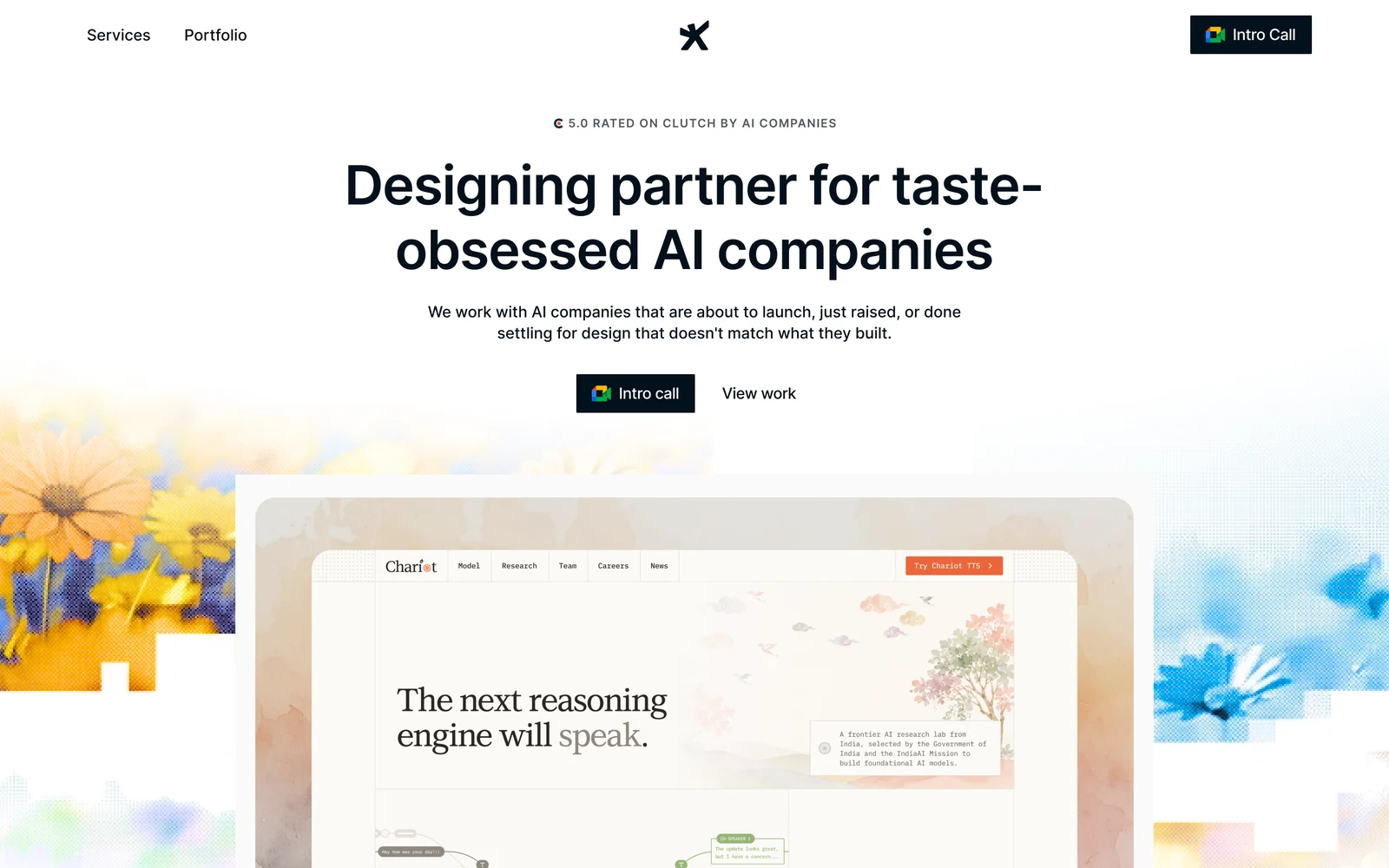
Series A AI teams ship something new almost every week, and the site has to keep up. Studio Maydit designs for that pace. As a web and product design studio, it works with AI founders in the US, UK, and Europe. On Webflow, it plans collections for integrations, use cases, and customer stories before a single page is drawn. Framer suits a smaller team whose founder still edits most of the copy, and custom code is for sites that must run a live model demo. When the site is done, the work continues into product design, where the same launches show up inside the app.
A round often changes who the company sells to, and that shift was the heart of the Dualite project. Its product reached 100,000+ users in seven months, helped by design work that supported a repositioned ICP. Among recent clients are Wave, PixelFlow, and Mi-VAD, plus 15 other AI and SaaS teams.
Most Series A teams take the monthly retainer. It covers new pages, campaigns, and product design as each launch lands, with no long lock-in if the company later hires its own designers. When one fixed moment sits ahead, such as the funding announcement, fixed scope fits better. That option takes three to four weeks and finishes with a diagnosis of what is leaking in the product, from the pricing page through a new user's first session.
| Check | Finding |
|---|---|
| Based in | Remote, serving US / UK / EU |
| Platform depth | Framer, Webflow, and custom code |
| AI-sector proof | Yes. AI-native clients, published outcome on Dualite |
| Pricing | Fixed scope or monthly retainer, quoted per project |
| Team shape | Founder-led, small senior team |
| Best fit | Series A AI startups whose Webflow site must absorb a launch every week |
Send us your last three launch announcements, and we will show where the site fell behind each one. Book a 30-minute call.

2. BX Studio
BX Studio is a Webflow team of eleven to fifty people in New York. Its AI-sector proof is direct, and it publishes a starting price, which makes it easy to put in a budget before a board meeting. ASAPP builds AI for customer service, and it sits on the client list next to Reddit, Headspace, and Verifone. That range covers an AI software company and brands with very large audiences.
The weakness is history you cannot check. It does not publish a founding date, so a board member who asks how long the studio has been around gets no answer from its site.
| Check | Finding |
|---|---|
| Based in | New York, USA |
| Founded | Not published |
| Team size | 11-50 |
| Primary platform | Webflow |
| AI-sector proof | Yes |
| Named clients | Reddit, Headspace, ASAPP, Verifone |
| Pricing | Published minimum |
| Best fit | Series A AI teams that want Webflow, AI experience, and a price to budget against |
3. 8020
8020 has built in Webflow since 2014, with offices in San Francisco and New York. Vanta, Pilot.com, Superlist, Circle, and Wave are among its clients. Vanta and Pilot.com are well-known venture-backed startups, so this studio is used to companies that grow quickly after a round and need their site to grow with them.
The weakness is how much it keeps private. Team size and pricing are not published, and its AI work is partial rather than direct, so ask for AI examples on the first call.
| Check | Finding |
|---|---|
| Based in | San Francisco and New York, USA |
| Founded | 2014 |
| Team size | Not published |
| Primary platform | Webflow |
| AI-sector proof | Partial |
| Named clients | Wave, Superlist, Pilot.com, Vanta, Circle |
| Pricing | Not published |
| Best fit | Venture-backed software teams scaling a Webflow site after the round |
4. Kvalifik
Kvalifik is a Copenhagen Webflow studio founded in 2015, with eleven to fifty people and direct AI-sector proof. Its clients are Veo, Maersk, and Relesys. Veo makes AI-powered sports cameras, so the team has presented a product built on machine learning to buyers who are not engineers. Maersk adds experience with a very large company's review process.
The weakness is budget and hours. Pricing is not published, and Copenhagen is six hours ahead of New York and nine ahead of San Francisco, which pushes US reviews into the European evening.
| Check | Finding |
|---|---|
| Based in | Copenhagen, Denmark |
| Founded | 2015 |
| Team size | 11-50 |
| Primary platform | Webflow |
| AI-sector proof | Yes |
| Named clients | Veo, Maersk, Relesys |
| Pricing | Not published |
| Best fit | AI startups with a European team or European buyers |
5. Finsweet
Finsweet is a large Webflow studio of fifty-one to two hundred people, based in Denver and working as a distributed team since 2017. It names Dropbox, Clay, GitHub, and Steadily as clients. A team that size can plan a site with many CMS collections and still have people free when a launch lands with a week's notice.
The weakness is price visibility and AI depth. Pricing is not published, AI-sector proof is partial, and several named clients are far larger than a Series A company.
| Check | Finding |
|---|---|
| Based in | Denver, USA, distributed |
| Founded | 2017 |
| Team size | 51-200 |
| Primary platform | Webflow |
| AI-sector proof | Partial |
| Named clients | Dropbox, Clay, GitHub, Steadily |
| Pricing | Not published |
| Best fit | Fast-growing AI teams planning a large Webflow CMS |
6. basement.studio
basement.studio has the strongest AI client list in this pool: Vercel, Cursor, ElevenLabs, Harvey AI, and Scale AI. It was founded in 2018, has eleven to fifty people in Mar del Plata and Los Angeles, and publishes a starting price. A Series A AI company that wants to look at home next to those names would get that level of craft.
The weakness is the platform. It builds in custom code, not Webflow, so each new launch page may need a developer, which is the opposite of what most teams at this stage want.
| Check | Finding |
|---|---|
| Based in | Mar del Plata, Argentina and Los Angeles, USA |
| Founded | 2018 |
| Team size | 11-50 |
| Primary platform | Custom code |
| AI-sector proof | Yes |
| Named clients | Vercel, Cursor, ElevenLabs, Harvey AI, Scale AI |
| Pricing | Published minimum |
| Best fit | Developer-focused AI startups with engineers who will own the site |
7. Digidop
Digidop is a Webflow studio in Paris, founded in 2021, with one to ten people and a published starting price. Clients include Ramify, StreamNative, and TSE Energy. Ramify is a young fintech company, which shows the team has built for a funded startup whose product needs careful explaining. A small studio also keeps the same senior people on your project from start to finish.
The weakness is capacity. A team of one to ten can struggle when launches come weekly, AI-sector proof is partial, and Paris shares only a small part of the US workday.
| Check | Finding |
|---|---|
| Based in | Paris, France |
| Founded | 2021 |
| Team size | 1-10 |
| Primary platform | Webflow |
| AI-sector proof | Partial |
| Named clients | TSE Energy, Ramify, StreamNative |
| Pricing | Published minimum |
| Best fit | European AI startups with a modest, well-defined Webflow scope |
8. Lighthouse Digital
Lighthouse Digital is a London Webflow studio with a published starting price. Its clients include HelloSelf, Freetrade, and IGN. Freetrade is a venture-backed investing app, so the studio has worked with a startup growing quickly in a field where trust matters. A UK studio also shares a good part of the day with New York.
The weakness is AI. It shows no AI-sector proof, so your team will spend early calls explaining the product, and founding date and team size are not published.
| Check | Finding |
|---|---|
| Based in | London, UK |
| Founded | Not published |
| Team size | Not published |
| Primary platform | Webflow |
| AI-sector proof | No |
| Named clients | HelloSelf, Freetrade, IGN |
| Pricing | Published minimum |
| Best fit | AI startups whose first big market after the round is the UK |
9. Edgar Allan
Edgar Allan has built in Webflow from Atlanta since 2014 and has fifty-one to two hundred people. Porsche, Duracell, and NCR are its named clients. A studio used to those brands knows how to move a big site through many approvals while keeping standards high.
The weakness is pace and stage. A Series A AI team needs pages live within days, and a process built for large enterprises can feel slow. Pricing is not published, and AI-sector proof is partial.
| Check | Finding |
|---|---|
| Based in | Atlanta, USA |
| Founded | 2014 |
| Team size | 51-200 |
| Primary platform | Webflow |
| AI-sector proof | Partial |
| Named clients | Porsche, Duracell, NCR |
| Pricing | Not published |
| Best fit | AI companies selling to large enterprises that expect a mature brand |
10. Flow Ninja
Flow Ninja is a Webflow studio in Belgrade, Serbia, founded in 2018 with eleven to fifty people. Its AI-sector proof is partial, and a team that size has room to take on a full site build without spreading thin.
The weakness is what you can verify. It publishes no named clients and no pricing, so there is nothing to show a board member or co-founder before a call.
| Check | Finding |
|---|---|
| Based in | Belgrade, Serbia |
| Founded | 2018 |
| Team size | 11-50 |
| Primary platform | Webflow |
| AI-sector proof | Partial |
| Named clients | Not published |
| Pricing | Not published |
| Best fit | Teams comfortable choosing a studio through calls and a small first project |
How to choose between them
Look at what your last launch needed from the site, then choose for that gap.
Launches keep turning into hand-built pages. BX Studio or 8020, to set up CMS collections that take new launches.
Your buyers or your team are in Europe. Kvalifik, or Lighthouse Digital for the UK.
The site must hold a very large CMS. Finsweet.
Engineers want to own the site and the demo. basement.studio.
A quick test. Send each studio your last launch post and ask how the site should have changed that week. A strong studio names pages and collections. A weak one proposes a new hero image.