

Summarize with AI


If you are in a YC batch and your Webflow site has to be ready before Demo Day, call BX Studio and Flowout first. BX Studio is a New York Webflow team of eleven to fifty with direct AI proof and a public starting price. Flowout is a distributed Webflow studio that also shows a starting price, with Jasper, Kajabi, and Riverside on its client list. The full ranking, best fit first, is Studio Maydit, BX Studio, Flowout, 8020, Kvalifik, Lazarev, SuperSkills, Clay, Instrument, and Fantasy. Instrument and Fantasy fit a batch schedule worst. Neither publishes a price, Instrument shows only partial AI proof, and Fantasy names no clients at all.
Week one of the batch. A four-person team building an AI support agent rewrites its homepage headline on Monday. By Friday its best leads are software companies, not online stores, and the headline is wrong again.
Week four. The team puts up its launch post in the morning. By lunch a few thousand strangers have clicked through to a site that still shows last month's pricing card and a waitlist form that emails nobody.
Week eleven. Demo Day is close, and investors will open the site between meetings, mostly on a phone. They want to know what the product does, who pays for it, and how fast it is growing. The growth chart on the homepage still shows week six. Nobody updated it, because the only person who knows how is the designer who built it, and she is on another project now.
A YC company does not need a finished website. It needs one that can change every week without breaking, because the company itself changes every week. Each rewrite should take a founder ten minutes, not a ticket. The studio you hire has to work inside a three-month clock, not open with a six-week discovery phase.

How the ten were ranked
We ranked each studio on five points a founder can check in one evening, which is about all the spare time a batch allows.
- Webflow depth. Is Webflow the studio's main tool, or one choice on a long menu? A batch company rewrites its homepage often. A Webflow-first studio is more likely to leave a class system and CMS a founder can edit on a Sunday night without breaking the mobile layout. Mixed-platform studios scored a little lower.
- Venture-backed startup proof. Only public client lists counted. We looked for AI companies and young software teams, because those clients have already been through fast rewrites and launch weeks. Our facts file records no YC link for any of the nine studios, so none is claimed here.
- Pricing transparency. A batch leaves no spare week for chasing quotes. A published starting price lets you rule a studio in or out in five minutes, not after two calls.
- Team shape and time zone. Small teams move fast but can stall if one designer is sick in launch week. Bigger teams have cover and more process. Distance matters too, since a studio nine hours ahead fits fewer review rounds into your week.
- The studio's own website. Open it on your phone, the way an investor will open yours. Does the first screen say what the studio does? Does it load quickly on mobile data?
Webflow depth and startup proof carried the most weight, and price broke close calls. The studio's own homepage worked as a ceiling. A studio seldom builds a client anything better than the site it built for itself.
Every table cell below repeats what a studio says about itself on its public pages. When a cell reads Not published, the studio chose not to share that detail, and we left the gap open rather than guess.
What goes wrong when a YC company hires a Webflow studio mid-batch
The site ships the week after Demo Day. The studio quotes six weeks and starts in week five, after a discovery phase, a moodboard round, and a sitemap review. One round of feedback slips while the founders are busy talking to users, and the launch post goes out pointing at the old template. The new site goes live a few days after investors have already looked at the old one. Count backward from Demo Day before you sign. Ask for a working homepage in two weeks, and treat every other page as phase two.
The site lives in the studio's Webflow workspace. The night before the launch post, the founder wants to change one line in the hero. She can edit text but has no Designer access, and the site plan is billed to the studio. The change waits for a designer who is asleep in another time zone. Have the site moved into your own Webflow workspace, on your own billing, before launch week.
Each weekly rewrite breaks something. The homepage was built from one-off sections with custom class names and hand-timed interactions. In week seven the team drops its second use case. Deleting that section shifts the layout on mobile, and the weekly growth number is typed by hand in four places. Ask for reusable components, a clear naming system for classes, and key numbers stored once in the CMS, so one edit updates every page.
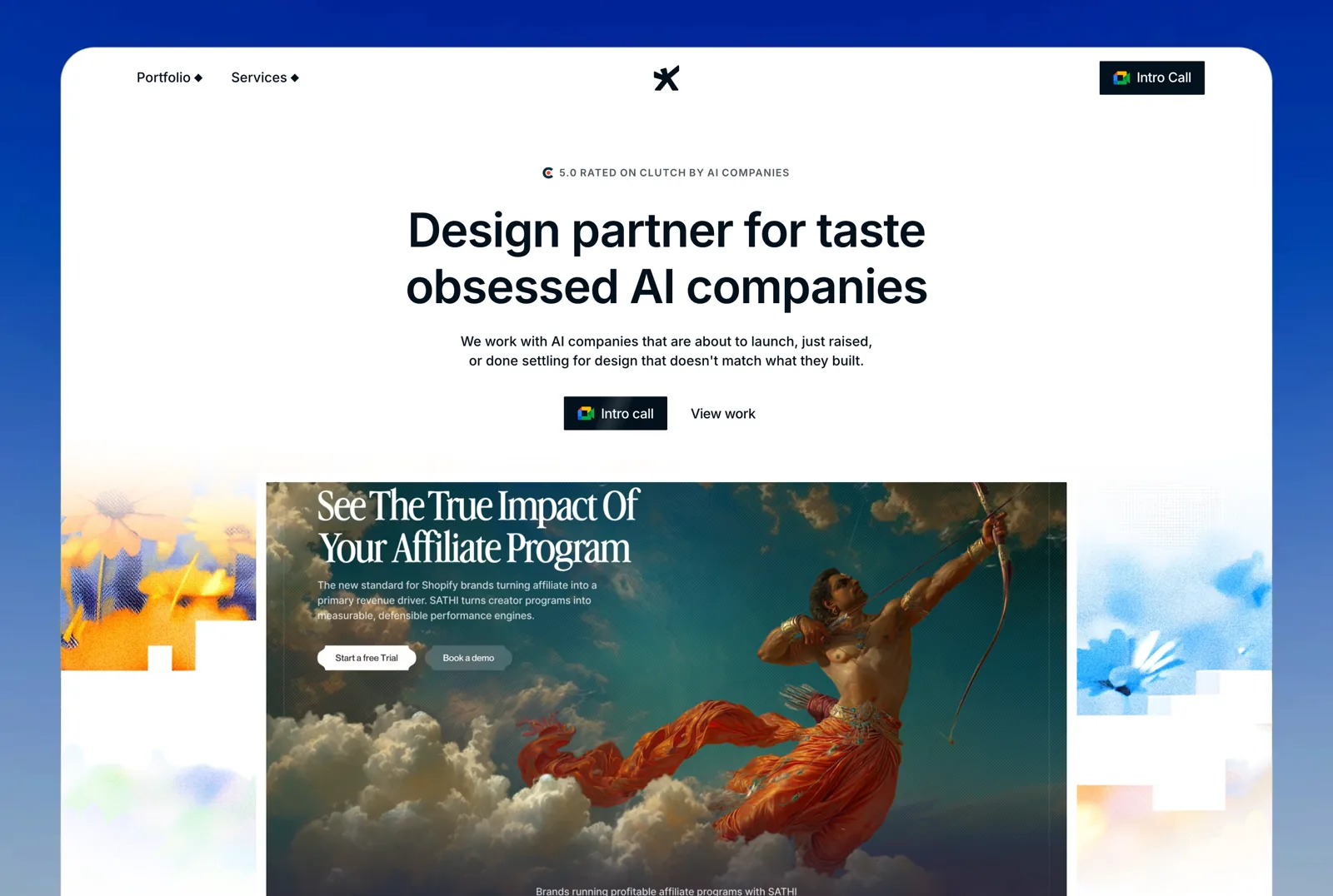
1. Studio Maydit: A Top-Rated Design Agency for AI Founders
A batch gives a company about three months to find its story. Studio Maydit helps AI founders put that story on their site. It is a web and product design studio. Its clients are in the US, UK, and Europe.
Weekly pivots are normal inside a batch. The hard part is choosing the buyer and then building the site around that choice. That was the work at Dualite. Its design work backed a repositioned ICP, and the product went on to reach 100,000+ users in seven months. Wave, PixelFlow, Mi-VAD, and 15 other AI and SaaS teams have also hired the studio recently.
Demo Day is a date that will not move, so most batch teams buy fixed scope. It runs three to four weeks, which leaves time to launch before the investor list goes out. The final step is a diagnosis of what is leaking in the product, such as launch post sign-ups who never reach a first result. After Demo Day the pace rarely slows. A monthly retainer keeps design moving on new pages, campaigns, and product design, with no long lock-in.
Webflow is the usual build for a batch company, because a founder can rewrite the hero between partner office hours and publish in minutes. Framer suits a team that wants to design straight in the browser. Custom code suits a site that must run a live product demo. When the site is done, the work carries on into product design, since launch traffic lands in the product next.
| Check | Finding |
|---|---|
| Based in | Remote, serving US / UK / EU |
| Platform depth | Framer, Webflow, and custom code |
| AI-sector proof | Yes. AI-native clients, published outcome on Dualite |
| Pricing | Fixed scope or monthly retainer, quoted per project |
| Team shape | Founder-led, small senior team |
| Best fit | YC-backed AI teams that need a Webflow site live before Demo Day |
Send us your Demo Day date and your current homepage, and we will tell you what can ship before it. Book a 30-minute call.

2. BX Studio
BX Studio is a New York Webflow studio of eleven to fifty people. It has direct AI-sector proof and a published starting price, and its clients include Reddit, Headspace, ASAPP, and Verifone. For a batch company, a Webflow-first team with a public price is the quickest shortlist call on this page. A team of this size can also keep working through launch week if one designer is out.
The weakness is the late-night edit. New York is three hours ahead of San Francisco, so a change a founder asks for at midnight waits until morning, and no founding date is published.
| Check | Finding |
|---|---|
| Based in | New York, USA |
| Founded | Not published |
| Team size | 11-50 |
| Primary platform | Webflow |
| AI-sector proof | Yes |
| Named clients | Reddit, Headspace, ASAPP, Verifone |
| Pricing | Published minimum |
| Best fit | YC AI teams that want a Webflow-first studio with a visible price |
3. Flowout
Flowout is a distributed Webflow studio at the budget end of this list, and it publishes a starting price. Jasper, Kajabi, Riverside, and Sendlane are on its client list, and Jasper sells an AI writing product. A lower price leaves more of a small team's money for the product. Its Webflow-only focus also points to a site the founders can keep editing after the studio leaves.
The weakness is how little is public. Its AI proof is partial, and it publishes no founding date, team size, or office, so you only learn who does the work on the call.
| Check | Finding |
|---|---|
| Based in | Distributed |
| Founded | Not published |
| Team size | Not published |
| Primary platform | Webflow |
| AI-sector proof | Partial |
| Named clients | Jasper, Kajabi, Riverside, Sendlane |
| Pricing | Published minimum |
| Best fit | Batch teams that need a fast, affordable Webflow build |
4. 8020
8020 has worked from San Francisco and New York since 2014 and builds mainly in Webflow. Its clients include Wave, Superlist, Pilot.com, Vanta, and Circle, a list made up mostly of software companies rather than consumer brands. The San Francisco office shares the working day with most batch founders, so a review can happen the same afternoon a change is requested.
The weakness is budget and AI depth. Pricing and team size are not published, and its AI proof is only partial, so expect to explain what your model does.
| Check | Finding |
|---|---|
| Based in | San Francisco and New York, USA |
| Founded | 2014 |
| Team size | Not published |
| Primary platform | Webflow |
| AI-sector proof | Partial |
| Named clients | Wave, Superlist, Pilot.com, Vanta, Circle |
| Pricing | Not published |
| Best fit | Bay Area batch teams that want same-day reviews on Webflow |
5. Kvalifik
Kvalifik is a Copenhagen Webflow studio founded in 2015, with eleven to fifty people and direct AI-sector proof. Veo, Maersk, and Relesys are named clients. Webflow focus plus AI work makes it a strong builder for a batch company whose first paying customers are in Europe.
The weakness is the clock and the quote. Copenhagen is nine hours ahead of San Francisco, so each weekly rewrite loses most of a day to the gap, and pricing is not published.
| Check | Finding |
|---|---|
| Based in | Copenhagen, Denmark |
| Founded | 2015 |
| Team size | 11-50 |
| Primary platform | Webflow |
| AI-sector proof | Yes |
| Named clients | Veo, Maersk, Relesys |
| Pricing | Not published |
| Best fit | YC AI teams selling to European customers first |
6. Lazarev
Lazarev has been in San Francisco since 2015 and has fifty-one to two hundred people working across several platforms. It has direct AI-sector proof and publishes a starting price. Clients include Payoneer, Peel, Elva, and Mozayix. A team this large can design a launch page, a product tour, and a brand at the same time, which helps a company that leaves Demo Day with a new round and needs all three at once.
The weakness is pace and cost. It sits at the premium end, Webflow is one platform among several, and a studio this size can bring more steps than a three-month batch allows.
| Check | Finding |
|---|---|
| Based in | San Francisco, USA |
| Founded | 2015 |
| Team size | 51-200 |
| Primary platform | Mixed |
| AI-sector proof | Yes |
| Named clients | Payoneer, Peel, Elva, Mozayix |
| Pricing | Published minimum |
| Best fit | Post-Demo Day teams that need brand, site, and product tour together |
7. SuperSkills
SuperSkills is a team of one to ten in Walnut Creek, California, working across several platforms with direct AI-sector proof. It names The Cut as a client. Walnut Creek is a short trip from San Francisco, and in a team this small the founder talks to the person doing the work every week.
The weakness is evidence. One named client is thin proof, pricing and founding date are not published, and a team this small has little cover if someone is out in launch week.
| Check | Finding |
|---|---|
| Based in | Walnut Creek, USA |
| Founded | Not published |
| Team size | 1-10 |
| Primary platform | Mixed |
| AI-sector proof | Yes |
| Named clients | The Cut |
| Pricing | Not published |
| Best fit | Very small batch teams that want one close design partner nearby |
8. Clay
Clay is a San Francisco studio founded in 2016, with fifty-one to two hundred people, direct AI proof, and a published starting price. Slack, Stripe, Google, Coinbase, and Amazon are among its clients. That is brand work at very large scale, which suits a company whose Demo Day pitch is about owning a whole category.
The weakness is fit for a batch. Clay works across several platforms on big brand programs, so a Webflow site that changes every week may be too small and too fast for how it works.
| Check | Finding |
|---|---|
| Based in | San Francisco, USA |
| Founded | 2016 |
| Team size | 51-200 |
| Primary platform | Mixed |
| AI-sector proof | Yes |
| Named clients | Slack, Stripe, Google, Coinbase, Amazon |
| Pricing | Published minimum |
| Best fit | Well-funded graduates building a category brand after the batch |
9. Instrument
Instrument is a Portland studio founded in 2005 that works across several platforms. Its clients include Nike, Microsoft, Electronic Arts, and Google. Its AI proof is partial, and it brings the craft of a studio used to large launches with many moving parts.
The weakness is scale and speed. Team size and pricing are not published, Webflow is not its main tool, and a big-brand process is hard to squeeze into twelve weeks.
| Check | Finding |
|---|---|
| Based in | Portland, USA |
| Founded | 2005 |
| Team size | Not published |
| Primary platform | Mixed |
| AI-sector proof | Partial |
| Named clients | Nike, Microsoft, Electronic Arts, Google |
| Pricing | Not published |
| Best fit | Later-stage AI companies planning a large brand launch |
10. Fantasy
Fantasy has worked from San Francisco and New York since 1999, across several platforms, with direct AI-sector proof. Its long record covers many kinds of digital product.
The weakness is what a founder can check in one evening. It names no clients and publishes no price or team size, so every question waits for a call, and a batch has few calls to spare.
| Check | Finding |
|---|---|
| Based in | San Francisco and New York, USA |
| Founded | 1999 |
| Team size | Not published |
| Primary platform | Mixed |
| AI-sector proof | Yes |
| Named clients | Not published |
| Pricing | Not published |
| Best fit | Teams with time to vet a studio entirely through conversation |
How to choose between them
Count the weeks left before Demo Day, then pick for the problem that will cost you most in that time.
Fewer than six weeks left and no site worth keeping. Flowout or BX Studio. Both show a price you can check today.
Founders work late in San Francisco and want same-day reviews. 8020, or SuperSkills for a very small team.
Your first paying customers are in Europe. Kvalifik.
You raised well and now need a brand, not just a site. Lazarev, or Clay with a bigger budget.
Before you sign, try this. Tell each studio your headline will change twice before Demo Day and ask how their build copes. A good studio talks about components and CMS fields. A weak one promises to answer fast on Slack.