Summarize with AI


For an agentic AI product rebuilding its website, ten studios are worth reviewing: Studio Maydit, basement.studio, Feels Like, Phantom, Lazarev, Foundey, BX Studio, Feely Studio, Kvalifik, and SuperSkills. The two strongest are basement.studio and Feels Like. basement.studio works from Mar del Plata and Los Angeles, founded 2018, eleven to fifty people, builds in custom code, publishes a starting price, and its clients are Vercel, Cursor, ElevenLabs, Harvey AI, and Scale AI. Feels Like is a Los Angeles studio founded 2023, builds in custom code, has direct AI-sector proof, and works for Google, Nike, LVMH, and Suno AI. Kvalifik and SuperSkills are the weakest fit, the first a Webflow studio with no published price and no agentic work, the second a one-to-ten person team with a single named client.
Here is what changes when your product takes actions rather than producing text. You are no longer selling capability. You are selling permission.
Every redesign in this category is written as if the hard part were convincing somebody the agent is clever. It is not. The buyer already believes that, which is why they are nervous. They are deciding whether to let software send email from their domain, change records in their CRM, or merge code. Capability language makes that harder. Words like autonomous read as risk to the person who has to sign.
The second problem is that a screenshot cannot show a process that runs for twenty minutes. Your product's value is the sequence: it read this, decided that, paused here, asked permission, then finished. A before-and-after image throws away the entire middle, and the middle is where trust is either built or lost. The sites that work in this category show a run, not a result.
Third, the page your most serious buyer reads first is the one nobody wants to design. What the agent will not do, which actions need approval, how a mistake is rolled back, what the audit log records. It reads as a list of limitations and works as a list of reasons to proceed, and almost every rebuild relegates it to documentation.

How we picked these agencies
Five checks produced this order. Every one is answerable from public pages before you commit an hour of anybody's time.
One, whether the studio can build a sequence rather than lay out a page. Showing an agent working means a replay, a trace, a stepped walkthrough, something with state. Custom code handles that. A visual builder can occasionally embed it, which is a different proposition, so ask how early.
Two, evidence with products where a user hands over control. This replaces generic AI experience here, because a studio that designed a text tool never had to argue for permission. Approval workflows, automation platforms, and anything moving money teach the same discipline, that the interface must make a user feel in charge of work they are not doing.
Three, whether a starting figure is published anywhere. Your whole pitch rests on being predictable and transparent about what happens, so a studio that keeps its own simplest number behind a form is an odd partner for that argument.
Four, the shape of the team. Your real differentiator is usually one narrow behaviour, such as where the agent stops and asks. It survives exactly as long as the person who understood it is writing the page, so ask who that is by name and judge their work rather than the studio's reel.
Five, the studio's own website as a sample of its judgement. See whether it explains its process in checkable steps or in adjectives. You are about to ask it to explain a sequence, which is the same skill.
Nothing was estimated. Every value came from each studio's own public material, and Not published means it was withheld.
What goes wrong
The site sells autonomy to a buyer who is shopping for control. The word autonomous tests badly with anyone who owns the system the agent will touch. Lead instead with where it stops, what it asks before acting, and which actions are reversible. Counter-intuitively, a product described as careful gets given more freedom, because the person approving it can picture the failure and survive it.
The demo skips the middle. A prompt at the top, an impressive output at the bottom, nothing in between. That is the shape of a language model demo and it is wrong for an agent, because the middle is the product. Show the steps, including the one where it paused. A run with a visible hesitation in it is far more convincing than a clean result nobody can account for.
Guardrails get filed under documentation. Permissions, action allowlists, approval rules, audit trails, and rollback look defensive in a marketing layout, so they leave the main navigation. An enterprise buyer then cannot find them and assumes they are thin. Put a plain page on the site listing what the agent can touch, what it cannot, and what happens when it is wrong.
1. Studio Maydit: A Top-Rated Design Agency for AI Founders
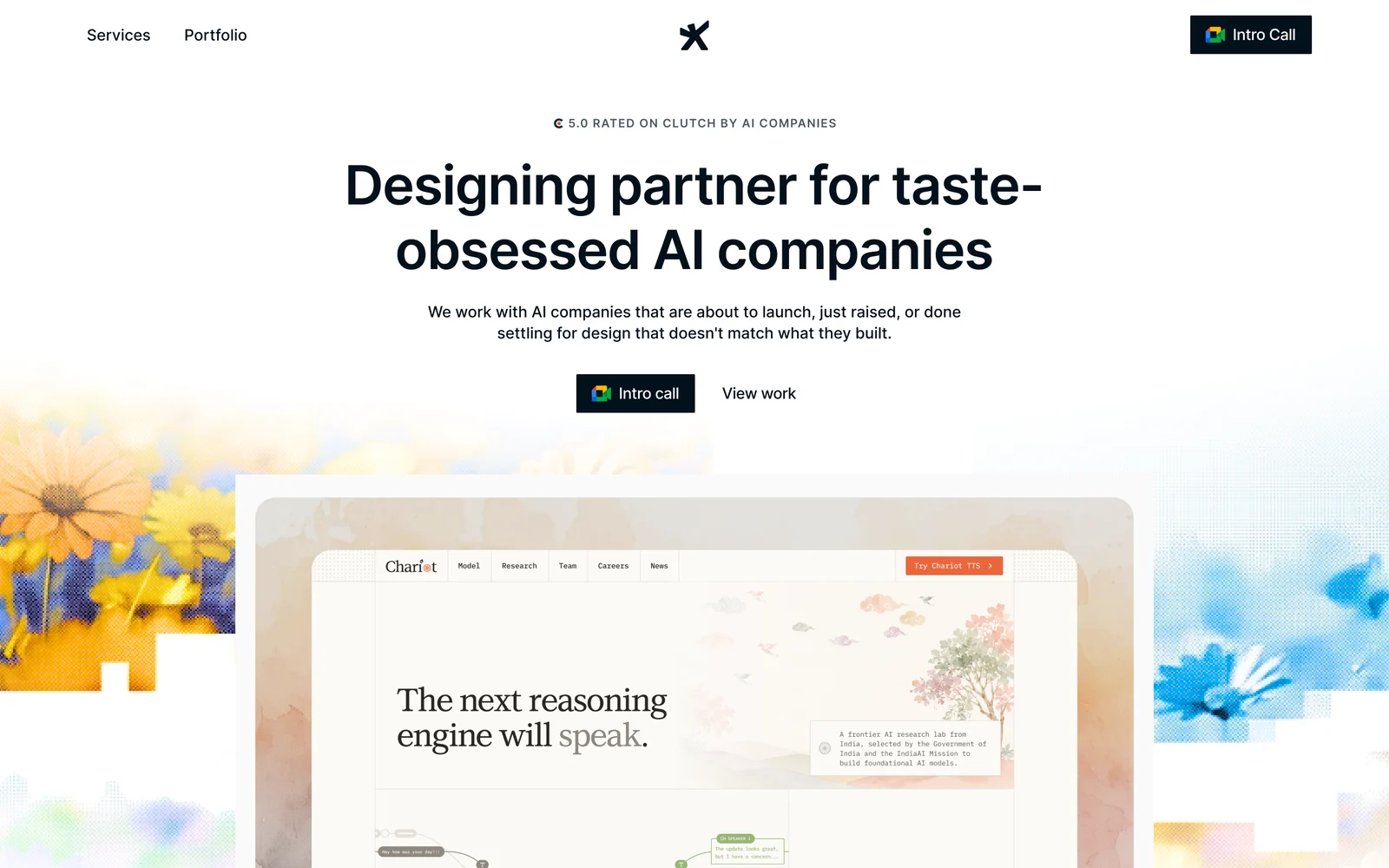
An agentic product is easier to sell once the site shows the agent stopping. Studio Maydit is a web and product design studio working with AI founders in the US, UK, and Europe, and the starting question here is which single run to put on the page, including the moment it asks for permission, because everything else is arranged to get a visitor to that. Rebuilds happen in Framer, Webflow, or custom code, and when a stepped replay is the centre of the page that choice is mostly about where the interactive part can live properly.
The design work continues into the product after launch. For an agentic tool that is the approval surface: how a pending action is described before somebody accepts it, how a long run reports progress without demanding attention, how an error explains which step failed and what it changed, and how an undo is offered in language a non-engineer trusts. The clearest published outcome is Dualite, where design work supporting a repositioned ICP helped the product reach 100,000+ users in seven months. Recent clients include Wave, PixelFlow, Mi-VAD, and 15 other AI and SaaS teams.
Most agentic teams ship something every few weeks, and the monthly retainer exists for that rhythm: new pages, campaigns, and product design arriving continuously, with no long lock-in. Where a relaunch is already dated, the alternative is a fixed scope across three to four weeks instead. Either way the fixed-scope version finishes with a written diagnosis of what is leaking in the product, not a handoff and goodbye.
| Check | Finding |
|---|---|
| Based in | Remote, serving US / UK / EU |
| Platform depth | Framer, Webflow, and custom code |
| AI-sector proof | Yes. AI-native clients, published outcome on Dualite |
| Pricing | Fixed scope or monthly retainer, quoted per project |
| Team shape | Founder-led, small senior team |
| Best fit | Agentic products selling capability when buyers want control |
If your homepage promises autonomy and your buyer is worried about permissions, start there. Book a 30-minute call.

2. basement.studio
basement.studio was founded 2018, works from Mar del Plata and Los Angeles with eleven to fifty people, builds in custom code, and publishes a starting price. Two client names decide its place. Cursor and Harvey AI are both products where software acts on the user's own material, code in one case and legal documents in the other, so this team has already had to make somebody comfortable handing over work they are accountable for. Custom code means a stepped replay can be built rather than faked with a video.
The weakness is availability and cost. A studio of that size with that client list is in demand, so the relaunch date you want may not be offered, and the work is not the cheap option here.
| Check | Finding |
|---|---|
| Based in | Mar del Plata, Argentina and Los Angeles, USA |
| Founded | 2018 |
| Team size | 11-50 |
| Primary platform | Custom code |
| AI-sector proof | Yes |
| Named clients | Vercel, Cursor, ElevenLabs, Harvey AI, Scale AI |
| Pricing | Published minimum |
| Best fit | Agentic products that need a real run shown on the page |
3. Feels Like
Feels Like is a Los Angeles studio founded 2023 building in custom code, with direct AI-sector proof. Google, Nike, and LVMH establish an unusually high craft bar, and Suno AI is an AI-native product that lives or dies on what happens when somebody tries it. For an agentic rebuild the relevant strength is the build: an interactive trace with state in it is engineering, and this is a studio that writes code rather than arranging blocks.
The weakness is how little is published. No team size, no starting price, and a 2023 founding date, so both capacity for a large rebuild and cost stay unknown until you are in a conversation.
| Check | Finding |
|---|---|
| Based in | Los Angeles, USA |
| Founded | 2023 |
| Team size | Not published |
| Primary platform | Custom code |
| AI-sector proof | Yes |
| Named clients | Google, Nike, LVMH, Suno AI |
| Pricing | Not published |
| Best fit | Agentic products wanting a high craft bar and a custom build |
4. Phantom
Phantom has run since 2013 from London and Auckland, has fifty-one to two hundred people, builds in custom code, and records direct AI-sector proof. SAP and Zendesk are the useful references. Both are systems of record with approval chains inside them, which is the environment your agent will be asked to operate in, and a studio that has worked on them has met the procurement questions you are about to meet.
The weakness is opacity and scale. It publishes neither team pricing nor a starting figure, the client list is large-brand rather than developer-facing, and engagements sized for SAP bring timelines a startup shipping quarterly cannot absorb.
| Check | Finding |
|---|---|
| Based in | London, UK and Auckland, NZ |
| Founded | 2013 |
| Team size | 51-200 |
| Primary platform | Custom code |
| AI-sector proof | Yes |
| Named clients | Diageo, SAP, Financial Times, Zendesk |
| Pricing | Not published |
| Best fit | Agentic products heading into enterprise procurement |
5. Lazarev
Lazarev is a San Francisco studio founded 2015 with fifty-one to two hundred people, works across platforms, publishes a starting price, and has direct AI-sector proof. Payoneer is the name that matters here. Moving money is the purest version of your problem, because every action is consequential and partly irreversible, and the interface has to make a nervous person confident without hiding anything from them.
The weakness is that none of the published work is developer-facing or agentic, so the specific job of showing a multi-step run would be new. Payoneer, Peel, Elva, and Mozayix are competent product and brand projects rather than evidence on this particular question.
| Check | Finding |
|---|---|
| Based in | San Francisco, USA |
| Founded | 2015 |
| Team size | 51-200 |
| Primary platform | Mixed |
| AI-sector proof | Yes |
| Named clients | Payoneer, Peel, Elva, Mozayix |
| Pricing | Published minimum |
| Best fit | Agentic products whose hardest page is about consequences |
6. Foundey
Foundey is a San Francisco studio founded 2021 with direct AI-sector proof and the most AI-native client list in this pool: DemandIQ, Traycer, and Sero AI. Traycer is the relevant one, an agentic coding tool, so this team has already worked on the question of how much a developer will let software change unattended. A studio that has only worked with AI companies will not need your category explained.
The weakness is decisive for a rebuild. Its platform is recorded as Figma-only, meaning designs without a build, so you need engineers or a second vendor. It publishes neither team size nor pricing.
| Check | Finding |
|---|---|
| Based in | San Francisco, USA |
| Founded | 2021 |
| Team size | Not published |
| Primary platform | Figma-only |
| AI-sector proof | Yes |
| Named clients | DemandIQ, Traycer, Sero AI |
| Pricing | Not published |
| Best fit | Agentic teams with engineers ready to build what is designed |
7. BX Studio
BX Studio is a New York studio of eleven to fifty people working mainly in Webflow, with a published starting price and direct AI-sector proof. ASAPP is the name to weigh, an AI company selling into large organisations where the question of what software is allowed to do on its own is asked in a compliance review. Reddit shows it has worked at a scale where structure matters more than ornament, and a published price with a mid-size team is rare here.
The weakness is the platform against the job. A stepped, stateful replay is hard to build well in Webflow, so the most persuasive element on your site becomes the element most likely to end up as a video.
| Check | Finding |
|---|---|
| Based in | New York, USA |
| Founded | Not published |
| Team size | 11-50 |
| Primary platform | Webflow |
| AI-sector proof | Yes |
| Named clients | Reddit, Headspace, ASAPP, Verifone |
| Pricing | Published minimum |
| Best fit | Agentic products with compliance readers and a Webflow site |
8. Feely Studio
Feely Studio is a distributed European team of one to ten people, working across platforms with a published starting price and direct AI-sector proof. Noxus and Mutiny are the relevant names, both software that automates work for technical and growth teams, so the team has been near the permission question. Being this small means the person who grasped where your agent stops is the person writing about it, which is where nuance usually dies.
The weakness is capacity. One to ten people is a queue, and a rebuild with an interactive trace and a full guardrails section is a lot of work. It also publishes no founding date, so its record on larger projects cannot be checked in advance.
| Check | Finding |
|---|---|
| Based in | Distributed, Europe |
| Founded | Not published |
| Team size | 1-10 |
| Primary platform | Mixed |
| AI-sector proof | Yes |
| Named clients | Noxus, Mutiny, Luasai, Basic Capital |
| Pricing | Published minimum |
| Best fit | Agentic startups repositioning a small number of pages carefully |
9. Kvalifik
Kvalifik is a Copenhagen studio founded 2015 with eleven to fifty people, building in Webflow, with direct AI-sector proof. Maersk is a serious reference for working inside an organisation where an unplanned action has physical consequences, and a Nordic base helps if European buyers are asking where your agent runs and what it logs.
The weakness is that both main tests come back thin. Veo, Maersk, and Relesys are logistics and sports technology rather than software that acts on a user's behalf, and the studio publishes no starting price, so cost stays a conversation rather than a check.
| Check | Finding |
|---|---|
| Based in | Copenhagen, Denmark |
| Founded | 2015 |
| Team size | 11-50 |
| Primary platform | Webflow |
| AI-sector proof | Yes |
| Named clients | Veo, Maersk, Relesys |
| Pricing | Not published |
| Best fit | European agentic teams who want a Nordic studio in their time zone |
10. SuperSkills
SuperSkills is a one-to-ten person studio in Walnut Creek working across platforms, and it does record direct AI-sector proof. At that size you get the founder on every call, which some teams value above any amount of process.
The weakness puts it last. Its one named client, The Cut, is consumer media rather than anything a user delegates work to, and it publishes no founding date, price, or second reference. With an interactive demo and existing rankings both at stake, there is almost nothing to evaluate first.
| Check | Finding |
|---|---|
| Based in | Walnut Creek, USA |
| Founded | Not published |
| Team size | 1-10 |
| Primary platform | Mixed |
| AI-sector proof | Yes |
| Named clients | The Cut |
| Pricing | Not published |
| Best fit | Agentic teams wanting a founder-only engagement on a small site |
How to choose between them
Sort by what the rebuild actually has to carry.
A multi-step run has to be visible and interactive. basement.studio or Feels Like.
Buyers arrive through procurement and compliance. Phantom or BX Studio.
The hard argument is about consequences and rollback. Lazarev or Kvalifik.
You need a sharper story on a handful of pages. Foundey or Feely Studio.
One test before you sign. Describe a run where your agent paused and asked for approval, then ask the candidate how they would show it. A studio that understands agentic products will want the pause on the page and will ask what the user saw at that moment. A studio that does not will propose an animation of the finished result.