
Summarize with AI


For an AI agent startup redesigning its website, ten studios are worth reviewing: Studio Maydit, Ramotion, 8020, Finsweet, Instrument, Engine Digital, Edgar Allan, Digidop, Flowout, and Flow Ninja. The two strongest are Ramotion and 8020. Ramotion has been in San Francisco since 2009, runs eleven to fifty people, works across platforms for Mozilla, Okta, Netflix, Adobe, and Xero, and publishes a starting price. 8020 works from San Francisco and New York, founded 2014, building in Webflow for Wave, Superlist, Pilot.com, Vanta, and Circle. Flowout and Flow Ninja are the weakest fit, both being budget Webflow shops with no visible experience of a migration that has search history to protect.
A redesign is not a new site. It is a new site plus everything the old one earned.
That second half is what agent startups keep losing. The reason you are redesigning is almost always a repositioning. You started as a tool, or an assistant, or a copilot, and now the product does work on its own and the website still describes the old thing. So the instinct is to start clean, rename the pages, restructure the navigation around the new story, and launch. Six weeks later the traffic is down forty percent and nobody can say exactly which decision did it.
Your current site has quietly accumulated something valuable. Pages that rank, links pointing at specific addresses, and a search engine's fairly settled understanding of what lives where. Some of it is for words you no longer want, which feels like a reason to discard it. It is not. A page ranking for the old category term is a page you can repoint at the new one, and repointing keeps the history while renaming throws it away.
There is a second trap peculiar to agent companies. The best-performing page on your existing site is often about something you no longer emphasise, a comparison post or a tutorial from the chatbot era. It brings in exactly the audience now discovering they need an agent. Deleting it because it is off-message is the most expensive tidy-up available.
And the third thing is scope. Redesigns get commissioned as visual projects when the actual work is deciding what the company is now claiming. A new typeface on an unresolved claim produces a better looking site that converts the same, which is the most common outcome of the whole exercise.

How we picked these agencies
Five checks produced this order, and each is answerable from public pages before you commit an hour to a call.
First, platform depth, judged here against migration rather than construction. A redesign means a redirect map, preserved page structure where it is working, and a launch that does not lose what the old site had. Whether a studio treats that as core work or as an afterthought someone else handles is the single biggest predictor of whether traffic survives.
Second, proof with AI products where autonomy is the claim being made. This criterion does the most work here, because your repositioning is the reason for the project. Moving from tool to agent changes what a visitor has to believe, from this will help me to this will act for me, and that is a trust argument rather than a feature argument. A studio that has made it before will start with the claim. One that has not will start with a moodboard.
Third, pricing disclosure, meaning only whether a starting figure exists publicly. Redesign budgets slip more than new-build budgets, so a studio comfortable naming a number in public is a useful signal.
Fourth, team shape. Whether the person who understood what your agent actually does unsupervised is the one writing the new homepage. Repositioning copy written second-hand ends up hedged, and hedged copy is what you already have.
Fifth, the studio's own site, which is the one project where nobody made them compromise.
Every entry below was taken from the studio's own public material, with no estimating and no reading between lines. Where a cell says Not published, that is what the studio chose to withhold.
What goes wrong
URLs get renamed to match the new story and the rankings leave with them. This is the classic agent-startup redesign failure, because a repositioning makes every old page name feel wrong. Keep the addresses, change the content. If a URL genuinely has to move, one permanent redirect per old address, mapped before launch and tested after, is the difference between a dip and a hole.
The project is scoped as visual and the claim never gets settled. Everyone agrees the site looks dated, nobody agrees what the product now is, and the design work proceeds on the assumption that this will resolve itself. It does not. Write the new one-sentence claim, test it on people outside the company, and only then decide what the pages are.
Pages that earn traffic for the old category get deleted. A tutorial or comparison from your earlier positioning is bringing in the people who are only now realising they need an agent. Rewrite it to bridge from the old idea to the new one and keep the address. Deleting it removes the on-ramp your new positioning depends on.
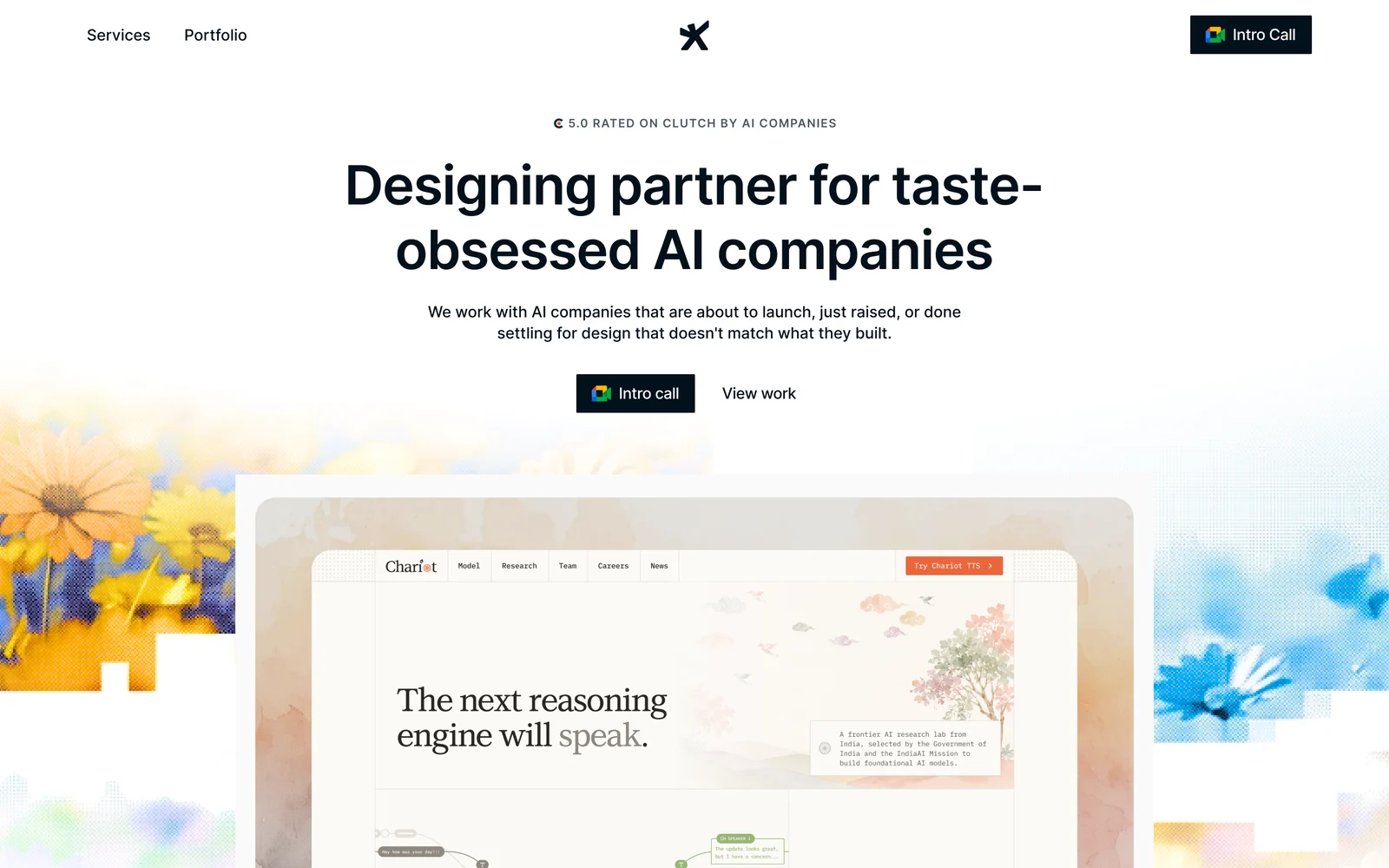
1. Studio Maydit: A Top-Rated Design Agency for AI Founders
Most agent-company redesigns are repositionings wearing a design brief. Studio Maydit is a web and product design studio working with AI founders in the US, UK, and Europe, and the first piece of work here is usually settling what the product now claims, because everything else follows from it. Rebuilds happen in Framer, Webflow, or custom code, chosen partly by where the current site lives and what can be carried across rather than rebuilt from nothing.
The work continues past the site into the product, which for an agent company is where a repositioning either lands or falls apart. If the site now promises autonomy, the product has to feel autonomous, and that means decisions about how much of a run to expose, where confirmations belong, and how a partial failure is presented without alarming the user. Those are product design problems, handled by the same team rather than handed on. The clearest published outcome is Dualite, where design work supporting a repositioned ICP helped the product reach 100,000+ users in seven months, which is the same problem in a different category. Recent clients include Wave, PixelFlow, Mi-VAD, and 15 other AI and SaaS teams.
Buying is straightforward. Take the fixed scope, three to four weeks, when a relaunch date is already fixed. Take the monthly retainer when the repositioning will roll out over months and pages, campaigns, and product design all need to keep moving, and there is no long lock-in either way. Every fixed-scope project ends with a written diagnosis of what is leaking in the product rather than a handoff and goodbye.
| Check | Finding |
|---|---|
| Based in | Remote, serving US / UK / EU |
| Platform depth | Framer, Webflow, and custom code |
| AI-sector proof | Yes. AI-native clients, published outcome on Dualite |
| Pricing | Fixed scope or monthly retainer, quoted per project |
| Team shape | Founder-led, small senior team |
| Best fit | Agent teams whose redesign is really a repositioning |
If the site is being redesigned because the product changed, settle the claim before the visuals. Book a 30-minute call.

2. Ramotion
Ramotion has worked from San Francisco since 2009, runs eleven to fifty people, builds across platforms, and publishes a starting price. Sixteen years is the argument for a redesign specifically, because a studio that old has replaced many established sites and knows that the risky part is the launch rather than the design. Mozilla, Okta, Netflix, Adobe, and Xero are all organisations with substantial existing traffic, so this is a team accustomed to protecting something rather than starting from nothing.
The weakness is that its AI-sector proof is partial. Ramotion will handle the migration and the craft well, but the argument for why your agent should be trusted is likely to be yours to write.
| Check | Finding |
|---|---|
| Based in | San Francisco, USA |
| Founded | 2009 |
| Team size | 11-50 |
| Primary platform | Mixed |
| AI-sector proof | Partial |
| Named clients | Mozilla, Okta, Netflix, Adobe, Xero |
| Pricing | Published minimum |
| Best fit | Agent startups replacing a site that already gets real traffic |
3. 8020
8020 works out of San Francisco and New York, founded 2014, and builds in Webflow. The client list is the reason it ranks this high for agent companies: Wave, Superlist, Pilot.com, Vanta, and Circle. Pilot and Vanta both sell work performed on the customer's behalf, one bookkeeping and one compliance evidence, so this studio has twice had to persuade someone to hand over access and trust an unwatched outcome. That is precisely the claim your redesign has to make.
The weakness is that it publishes neither team size nor pricing, and its AI-sector proof is partial, so you are relying on adjacent experience and a call to establish cost.
| Check | Finding |
|---|---|
| Based in | San Francisco and New York, USA |
| Founded | 2014 |
| Team size | Not published |
| Primary platform | Webflow |
| AI-sector proof | Partial |
| Named clients | Wave, Superlist, Pilot.com, Vanta, Circle |
| Pricing | Not published |
| Best fit | Agent products that must earn access to a customer's systems |
4. Finsweet
Finsweet is distributed from Denver, founded 2017, with fifty-one to two hundred people and unusually deep Webflow expertise. For a redesign that depth matters in a specific way: large existing sites have many pages, and rebuilding them in Webflow without losing structure is a job this team has done repeatedly. Dropbox, Clay, GitHub, and Steadily are named, and GitHub means it can write for the technical readers who will scrutinise an autonomy claim.
The weakness is that its AI-sector proof is partial and it publishes no pricing, so both the category relevance and the budget only become clear in conversation.
| Check | Finding |
|---|---|
| Based in | Denver, USA, distributed |
| Founded | 2017 |
| Team size | 51-200 |
| Primary platform | Webflow |
| AI-sector proof | Partial |
| Named clients | Dropbox, Clay, GitHub, Steadily |
| Pricing | Not published |
| Best fit | Agent companies rebuilding a large site inside Webflow |
5. Instrument
Instrument has been in Portland since 2005 and works across platforms for Nike, Microsoft, Electronic Arts, and Google. This is the highest-craft option here, and a repositioning is one of the few moments when that is worth paying for, because you are asking the market to revise its opinion of you and appearance carries part of that argument.
The weakness is fit and cost. Its AI-sector proof is partial, it publishes neither team size nor pricing, and an agency shaped around global brand programmes brings a process and a timeline built for them rather than for a startup relaunching in six weeks.
| Check | Finding |
|---|---|
| Based in | Portland, USA |
| Founded | 2005 |
| Team size | Not published |
| Primary platform | Mixed |
| AI-sector proof | Partial |
| Named clients | Nike, Microsoft, Electronic Arts, Google |
| Pricing | Not published |
| Best fit | Funded agent companies making a serious repositioning public |
6. Engine Digital
Engine Digital has run since 2002 from Vancouver and New York and builds in custom code for Adidas, Autodesk, Goldman Sachs, and HP. Two decades of replacing large corporate sites means genuine migration discipline, which is the skill a redesign actually tests, and custom code means an unusual page structure can be preserved rather than forced into a template.
The weakness is that it is sized for large organisations. No published team size, no published pricing, partial sector proof, and timelines that most agent startups cannot wait out.
| Check | Finding |
|---|---|
| Based in | Vancouver and New York |
| Founded | 2002 |
| Team size | Not published |
| Primary platform | Custom code |
| AI-sector proof | Partial |
| Named clients | Adidas, Autodesk, Goldman Sachs, HP |
| Pricing | Not published |
| Best fit | Agent products relaunching into regulated or enterprise markets |
7. Edgar Allan
Edgar Allan is an Atlanta studio founded 2014, fifty-one to two hundred people, building in Webflow for Porsche, Duracell, and NCR. It is brand-led, and for an agent company whose repositioning is essentially a claim to be taken more seriously, that emphasis is defensible. Enterprise buyers deciding whether to let software act on their behalf are influenced by whether you look permanent.
The weakness is that the named work is consumer and industrial rather than software, its AI-sector proof is partial, and it publishes no pricing. A studio used to those budgets is not shaped for a startup relaunch.
| Check | Finding |
|---|---|
| Based in | Atlanta, USA |
| Founded | 2014 |
| Team size | 51-200 |
| Primary platform | Webflow |
| AI-sector proof | Partial |
| Named clients | Porsche, Duracell, NCR |
| Pricing | Not published |
| Best fit | Agent companies whose relaunch has to signal permanence |
8. Digidop
Digidop is a Paris studio of one to ten people, founded 2021, working in Webflow with a published starting price. Small has a real advantage in a redesign, because the person who understands your redirect map is the person who builds it, and handoffs are where migrations break. StreamNative, alongside TSE Energy and Ramify, is real-time infrastructure, so the team is comfortable with technical products.
The weakness is capacity. One to ten people means a queue, and a redesign with a fixed relaunch date is a poor project to have waiting behind somebody else's. Ask what else is live before agreeing the date.
| Check | Finding |
|---|---|
| Based in | Paris, France |
| Founded | 2021 |
| Team size | 1-10 |
| Primary platform | Webflow |
| AI-sector proof | Partial |
| Named clients | TSE Energy, Ramify, StreamNative |
| Pricing | Published minimum |
| Best fit | European agent teams who want the builder handling the migration |
9. Flowout
Flowout is a distributed Webflow studio with a published starting price, working for Jasper, Kajabi, Riverside, and Sendlane. It is the cheapest realistic option here and it is built for speed, which can suit a small agent startup whose existing site has little traffic to protect and mainly needs to stop describing the old product.
The weakness is that it publishes neither team size nor a founding date, and nothing in the named work suggests experience of a migration with rankings at stake. If your current site earns meaningful search traffic, that gap is the risk.
| Check | Finding |
|---|---|
| Based in | Distributed |
| Founded | Not published |
| Team size | Not published |
| Primary platform | Webflow |
| AI-sector proof | Partial |
| Named clients | Jasper, Kajabi, Riverside, Sendlane |
| Pricing | Published minimum |
| Best fit | Early agent teams whose current site has little traffic to lose |
10. Flow Ninja
Flow Ninja is a Belgrade studio of eleven to fifty people, founded 2018, working in Webflow. The tenure and team size are real, and European rates make a straightforward rebuild affordable.
The weakness is that it publishes neither client names nor a starting price, which for a redesign is a particular problem. You cannot see whether it has ever protected an existing site's search performance, and that is the one thing you most need to check. Every question has to be answered on a call, which is slow when comparing several studios against a launch date.
| Check | Finding |
|---|---|
| Based in | Belgrade, Serbia |
| Founded | 2018 |
| Team size | 11-50 |
| Primary platform | Webflow |
| AI-sector proof | Partial |
| Named clients | Not published |
| Pricing | Not published |
| Best fit | Teams willing to evaluate migration experience entirely by phone |
How to choose between them
Sort by what the redesign is actually risking.
The current site earns traffic you cannot afford to lose. Ramotion or Engine Digital.
The new claim is autonomy and buyers must trust it. 8020 or Finsweet.
The relaunch has to make you look bigger than you are. Instrument or Edgar Allan.
Little traffic to protect and a tight budget. Digidop or Flowout.
One test before you sign. Ask a candidate what they would do with your best-performing page from the old positioning. A studio that understands redesigns will want to keep its address and rewrite it as a bridge to the new claim. A studio that does not will suggest retiring it because it is off-message, which is how a redesign turns into a traffic loss nobody predicted.