
Summarize with AI


For an AI automation startup redesigning its website, ten studios are worth reviewing: Studio Maydit, Clay, Lazarev, basement.studio, Trueform, Kvalifik, Feels Like, Feely Studio, Fantasy, and Lighthouse Digital. The two strongest are Clay and Lazarev. Clay has been in San Francisco since 2016, runs fifty-one to two hundred people, works across platforms for Slack, Stripe, Google, Coinbase, and Amazon, and publishes a starting price. Lazarev is also a San Francisco studio of fifty-one to two hundred, founded 2015, working across platforms for Payoneer, Peel, Elva, and Mozayix, and it publishes a price as well. Fantasy and Lighthouse Digital are the weakest fit, the first because it publishes neither clients nor pricing, the second because it records no AI-sector work at all.
The most valuable thing on your current site is the part a designer will want to delete.
Automation companies accumulate a strange and excellent asset. Integration pages, one per tool you connect to. Template galleries. Recipe pages. Use case pages for verticals you barely serve. Individually each one is thin and slightly embarrassing, and each one brings in four visitors a month searching for something very specific. Together they are frequently half your organic traffic and almost all of your qualified traffic, because someone searching for a named tool plus the word automation is much closer to buying than someone searching for automation.
Every redesign proposal you receive will suggest consolidating them. It sounds obviously correct. Fewer, better pages. Cleaner navigation. It is also the single fastest way for an automation company to lose a third of its inbound in one launch, and the loss will not show up as a ranking drop on any page you were watching. It shows up as hundreds of tiny queries quietly going elsewhere.
The second problem is that your repositioning is probably toward autonomy, away from workflows a person builds. That is a genuine change in the claim, and it puts the self-serve path at risk. Automation buyers overwhelmingly start alone, on a free tier, connecting two tools on a Wednesday afternoon. A redesign that pursues enterprise polish tends to bury the signup behind a contact form, and the funnel you actually have gets replaced with one you hope for.
Third, there is a temptation to overclaim. Saying the product now runs itself, when it still needs somebody to build the first version, produces a good launch and a bad month two. The people who arrive expecting autonomy leave when they meet a builder canvas.

How we picked these agencies
Five checks decided this order, and each can be answered from public pages before you spend an hour on a call.
First, platform depth, judged here against how a large site survives being rebuilt. Automation sites are not small. Hundreds of integration and template pages, generated from a structured source, all of which need to keep their addresses. A studio that can work with a content model rather than hand-building pages is doing the thing your project needs.
Second, proof with AI products where the claim is that software does the work. This criterion carries the most weight for your repositioning, because moving from a tool people operate to a system that operates alone changes what the visitor has to believe. A studio that has argued that before starts with evidence and limits. One that has not starts with a moodboard and the word effortless.
Third, pricing disclosure, meaning whether a starting figure exists in public. Redesigns overrun more often than new builds, so a studio willing to name a number publicly is worth noting.
Fourth, team shape, meaning whether the person who understood which of your integrations actually matter is the one deciding what happens to those pages. That decision is worth more than any visual choice in the project, and it is usually made by whoever is least equipped to make it.
Fifth, the studio's own site, the one place where nobody talked them out of anything.
Each row in the tables came from the studio's own published material. None of it is estimated or inferred, and a Not published cell means the studio elected not to say.
What goes wrong
The integration and template pages get consolidated into a few good ones. It reads as obviously sensible in a proposal and it removes the long tail that brings you qualified traffic. Before agreeing to any consolidation, pull twelve months of search data by page. Keep every address that earns anything, improve the thin ones in place, and only merge pages that genuinely earn nothing.
The self-serve path gets buried under enterprise polish. A redesign aimed at looking credible to a larger buyer moves the signup behind a form and promotes a demo request. Automation customers arrive alone and try things. Keep the free path prominent, and add the enterprise route alongside it instead of on top of it.
The new positioning claims more autonomy than the product delivers. A relaunch is exactly when overclaiming feels justified, and it converts well for about a month. Then the mismatch between the promise and the first-run experience shows up in churn. Say what the product does without a person, say plainly what still needs setting up, and let the honest version compound.
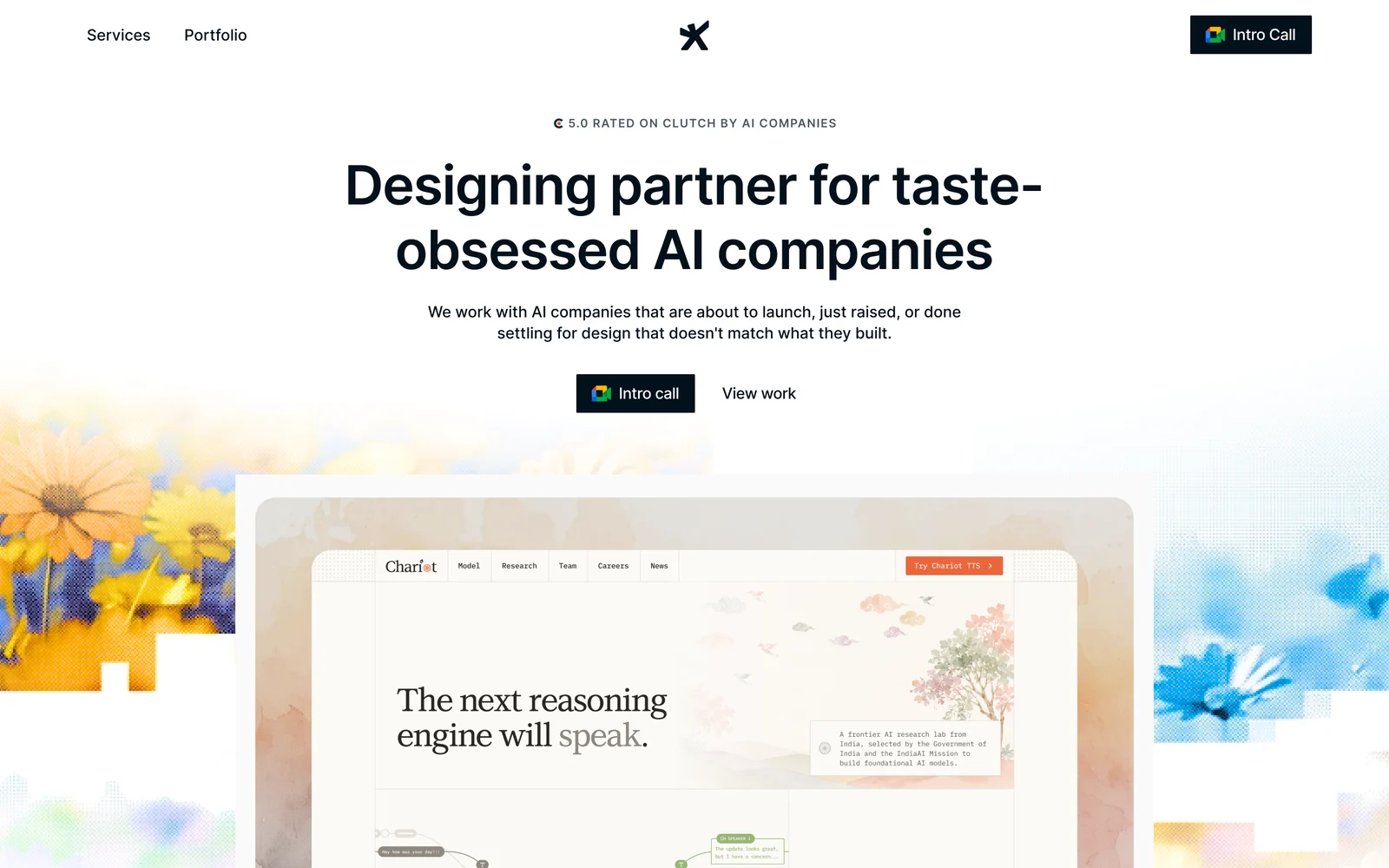
1. Studio Maydit: A Top-Rated Design Agency for AI Founders
For an automation company a redesign is mostly a set of decisions about what to keep. Studio Maydit is a web and product design studio working with AI founders in the US, UK, and Europe, and the work here begins with the current site's search data rather than with a moodboard, because on an automation site the pages that look least impressive are usually the ones earning most. Rebuilds happen in Framer, Webflow, or custom code, and where hundreds of integration pages are involved that choice is really a choice about content modelling.
The design work carries on past the site into the product. For automation that is where a repositioning is tested, since a site claiming the software works alone has to be followed by a first run that feels that way. How much setup is required before something useful happens, what the interface shows while a workflow runs unattended, how a failed step explains itself, and where a confirmation is genuinely needed are product decisions handled by the same team rather than passed on. The clearest published outcome is Dualite, where design work supporting a repositioned ICP helped the product reach 100,000+ users in seven months. Recent clients include Wave, PixelFlow, Mi-VAD, and 15 other AI and SaaS teams.
Two ways to engage. A fixed scope of three to four weeks suits a relaunch with a date attached. A monthly retainer suits a repositioning that rolls out gradually across pages, campaigns, and product design, and there is no long lock-in either way. Fixed-scope work closes with a written diagnosis of what is leaking in the product rather than a handoff and goodbye.
| Check | Finding |
|---|---|
| Based in | Remote, serving US / UK / EU |
| Platform depth | Framer, Webflow, and custom code |
| AI-sector proof | Yes. AI-native clients, published outcome on Dualite |
| Pricing | Fixed scope or monthly retainer, quoted per project |
| Team shape | Founder-led, small senior team |
| Best fit | Automation teams with a large page count and traffic to protect |
If your integration pages earn more than your homepage, the redesign is a keep-or-cut decision first. Book a 30-minute call.

2. Clay
Clay has worked from San Francisco since 2016, runs fifty-one to two hundred people, builds across platforms, publishes a starting price, and carries AI-sector proof. Slack and Stripe are the names that matter for an automation company, since both run very large sites with hundreds of integration and documentation pages that have to stay findable, and Stripe in particular is the reference for explaining software that works in the background. A team this size can also handle a rebuild that involves a real content model rather than a set of pages.
The weakness is that it is a premium studio serving very large companies. Even with a published minimum, the engagement shape suits a funded automation company rather than an early one.
| Check | Finding |
|---|---|
| Based in | San Francisco, USA |
| Founded | 2016 |
| Team size | 51-200 |
| Primary platform | Mixed |
| AI-sector proof | Yes |
| Named clients | Slack, Stripe, Google, Coinbase, Amazon |
| Pricing | Published minimum |
| Best fit | Automation companies rebuilding a site with hundreds of pages |
3. Lazarev
Lazarev is a San Francisco studio founded 2015 with fifty-one to two hundred people, working across platforms with AI-sector proof and a published starting price. The reason it ranks here is that it can hold both halves of your problem at once, the marketing site and the product surfaces, at a scale that copes with a large rebuild. Payoneer, Peel, Elva, and Mozayix show a habit of explaining products with more happening underneath than the interface suggests, which is your repositioning in one line.
The weakness is that none of the named work is automation specifically, so expect strong execution and expect to bring the category argument yourself.
| Check | Finding |
|---|---|
| Based in | San Francisco, USA |
| Founded | 2015 |
| Team size | 51-200 |
| Primary platform | Mixed |
| AI-sector proof | Yes |
| Named clients | Payoneer, Peel, Elva, Mozayix |
| Pricing | Published minimum |
| Best fit | Automation teams wanting site and product from one studio |
4. basement.studio
basement.studio builds in custom code from Mar del Plata and Los Angeles, has done since 2018, runs eleven to fifty people, and publishes a starting price. Vercel, Cursor, ElevenLabs, Harvey AI, and Scale AI is the strongest AI record on this list. Custom code is the specific advantage for you, because generating several hundred integration pages from a structured source and keeping every URL intact is a programming problem, and this team programmes.
The weakness is demand and register. A studio with that client list books ahead, which is awkward against a fixed relaunch date, and the portfolio leans technical if your buyer is an operations manager rather than an engineer.
| Check | Finding |
|---|---|
| Based in | Mar del Plata, Argentina and Los Angeles, USA |
| Founded | 2018 |
| Team size | 11-50 |
| Primary platform | Custom code |
| AI-sector proof | Yes |
| Named clients | Vercel, Cursor, ElevenLabs, Harvey AI, Scale AI |
| Pricing | Published minimum |
| Best fit | Automation sites generated from a structured content model |
5. Trueform
Trueform is a Swiss studio in Wil, founded 2022, building in Framer with AI-sector proof and a published starting price. It is the fastest credible option here, which matters when a relaunch is tied to a funding announcement. Miro, Morning Brew, Bilt Rewards, and Gather are all products where the interface does the persuading. Being Swiss also helps if European buyers are asking where their connected data travels.
The weakness is the platform ceiling. Framer is an awkward home for several hundred templated integration pages, so if that is the bulk of your site, ask directly how those would be handled.
| Check | Finding |
|---|---|
| Based in | Wil, Switzerland |
| Founded | 2022 |
| Team size | Not published |
| Primary platform | Framer |
| AI-sector proof | Yes |
| Named clients | Miro, Morning Brew, Bilt Rewards, Gather |
| Pricing | Published minimum |
| Best fit | Automation teams relaunching a small site quickly |
6. Kvalifik
Kvalifik is a Copenhagen studio founded 2015, eleven to fifty people, working in Webflow with AI-sector proof. Maersk is the useful name, because global logistics is automation at a scale where a failed step has physical consequences, and a studio that has worked there understands why your reliability section is not a formality. Being Danish also removes friction when European customers ask where connected data is processed.
The weakness is that it publishes no pricing, and Webflow can strain under a very large templated page count, so ask how many pages it has handled before.
| Check | Finding |
|---|---|
| Based in | Copenhagen, Denmark |
| Founded | 2015 |
| Team size | 11-50 |
| Primary platform | Webflow |
| AI-sector proof | Yes |
| Named clients | Veo, Maersk, Relesys |
| Pricing | Not published |
| Best fit | European automation teams selling into operations-heavy industries |
7. Feels Like
Feels Like is a Los Angeles studio founded 2023, working in custom code for Google, Nike, LVMH, and Suno AI. Suno gives direct AI product experience and LVMH means the team can make software look considered rather than utilitarian, which is worth something if your repositioning is partly about being taken more seriously than a workflow builder.
The weakness is youth and opacity. Founded 2023, with neither team size nor pricing published, so capacity for a large redesign is an unknown you have to resolve before committing to a date.
| Check | Finding |
|---|---|
| Based in | Los Angeles, USA |
| Founded | 2023 |
| Team size | Not published |
| Primary platform | Custom code |
| AI-sector proof | Yes |
| Named clients | Google, Nike, LVMH, Suno AI |
| Pricing | Not published |
| Best fit | Automation companies repositioning upmarket on appearance |
8. Feely Studio
Feely Studio is a distributed European team of one to ten working across platforms, with AI-sector proof and a published starting price. Mutiny is the relevant client, a personalisation product that generates variations and has to prove they are the right ones. At this size you work directly with the builders, which keeps decisions about which pages to keep in the hands of someone who understands the data.
The weakness is capacity against scale. A redesign spanning hundreds of pages is a lot for one to ten people, and no published founding date makes the track record harder to judge from outside.
| Check | Finding |
|---|---|
| Based in | Distributed, Europe |
| Founded | Not published |
| Team size | 1-10 |
| Primary platform | Mixed |
| AI-sector proof | Yes |
| Named clients | Noxus, Mutiny, Luasai, Basic Capital |
| Pricing | Published minimum |
| Best fit | Small automation teams relaunching a focused site |
9. Fantasy
Fantasy has run since 1999 from San Francisco and New York, works across platforms, and carries AI-sector proof. More than two decades of interface design is real depth, and if your repositioning involves a genuinely new way for people to instruct software, that experience is relevant.
The weakness is that none of it can be checked from outside. Fantasy publishes neither client names nor pricing, leaving both columns a shortlist relies on empty, and for a redesign you particularly want to see whether it has protected an existing site's traffic before.
| Check | Finding |
|---|---|
| Based in | San Francisco and New York, USA |
| Founded | 1999 |
| Team size | Not published |
| Primary platform | Mixed |
| AI-sector proof | Yes |
| Named clients | Not published |
| Pricing | Not published |
| Best fit | Teams content to evaluate a studio in private conversation |
10. Lighthouse Digital
Lighthouse Digital is a London studio working in Webflow, and it does publish a starting price, which several studios above it do not. HelloSelf, Freetrade, and IGN are reasonable consumer and fintech projects, and a UK automation company wanting a simple rebuild at a known cost has a workable option here.
The weakness decides its position. Its AI-sector proof is recorded as none, so the autonomy argument at the centre of your repositioning would be entirely new ground, and it publishes neither team size nor a founding date, which makes capacity for a large migration impossible to assess.
| Check | Finding |
|---|---|
| Based in | London, UK |
| Founded | Not published |
| Team size | Not published |
| Primary platform | Webflow |
| AI-sector proof | No |
| Named clients | HelloSelf, Freetrade, IGN |
| Pricing | Published minimum |
| Best fit | UK teams with a small site who will write the AI argument themselves |
How to choose between them
Sort by what the rebuild is actually risking.
Hundreds of templated pages have to survive the move. Clay or basement.studio.
The site and the product both need rethinking. Lazarev or Feels Like.
Reliability is the objection you keep hearing. Kvalifik or Fantasy.
A relaunch date is close and the site is small. Trueform or Feely Studio.
One test before you sign. Show a candidate your integration page template and your traffic figures for it, then ask what they would do with those pages. A studio that understands automation will keep every address and improve the thin ones in place. A studio that does not will propose consolidating them into a single well-designed page, which is how a redesign quietly removes your best source of qualified visitors.