Summarize with AI


For an AI copilot product redesigning its website, ten studios are worth reviewing: Studio Maydit, BX Studio, Ramotion, Phantom, 8020, Finsweet, Instrument, Foundey, SuperSkills, and Flow Ninja. The two strongest are BX Studio and Ramotion. BX Studio is a New York team of eleven to fifty working in Webflow for Reddit, Headspace, ASAPP, and Verifone, with AI-sector proof and a published starting price. Ramotion has been in San Francisco since 2009, runs eleven to fifty people, works across platforms for Mozilla, Okta, Netflix, Adobe, and Xero, and publishes a price too. SuperSkills and Flow Ninja are the weakest fit, the first because it names one client and no price, the second because it publishes neither clients nor pricing.
Your copilot is not the product. It is a feature that got a marketing budget, and a redesign is where that distinction usually gets lost.
Here is what happens. The copilot ships, it demos beautifully, it is the most interesting thing anyone at the company has built in two years, and the redesign brief arrives asking for a site that reflects the new direction. Six weeks later the homepage is about the copilot, the navigation leads with the copilot, and an existing customer arriving to check whether you support their workflow cannot find the answer. Those customers are the revenue. The copilot is the reason someone might look twice.
The second difficulty is that this is the most crowded claim in software. Every product in your category shipped a copilot in the same eighteen months, and every one of them wrote AI-powered into the headline. That phrase now carries no information at all. A visitor reading it learns nothing except that you are keeping up, and keeping up is not a reason to switch. What distinguishes copilots is narrow and specific: what it knows that a general model does not, where it sits in the workflow, and what it will refuse to do.
Third, there is a targeting mistake almost everyone makes. The copilot page gets written for people who already use the product, full of references to features and screens they would recognise. But the traffic arriving at that page comes from people who do not use the product yet and are searching for a copilot in your category. The page they land on assumes context they do not have, and they leave.
So the redesign has a narrower job than the brief suggests. Keep the product legible to the people paying for it, and make the copilot specific enough to mean something.

How we picked these agencies
Five checks produced this order, and each is answerable from public pages before you commit an hour to a call.
First, platform depth, judged against migration rather than construction. Your existing site has rankings, links, and a settled structure, and the risk in a redesign is losing them. Whether a studio writes a redirect map before launch and checks traffic afterwards, or treats that as somebody else's problem, is the best single predictor of how this project ends.
Second, proof with AI that is embedded inside an existing product rather than sold on its own. This is the criterion doing the most work here, because a copilot has to be positioned as an addition without becoming the whole story. A studio that has handled a product with two things to say knows how to give both room. One that has not will make the newest thing the only thing.
Third, pricing disclosure, meaning simply whether a starting figure is public. Redesigns overrun more than new builds, and a studio comfortable naming a number in public is easier to hold to a scope.
Fourth, team shape. Whether the person who understood what your copilot knows that a general model does not is the one writing the headline. That distinction is the entire differentiator, and it is the first thing to evaporate when copy is written second-hand.
Fifth, the studio's own website, which is the only project where nobody made them compromise.
The tables below contain nothing inferred. Each value was taken from the studio's own public material, and a Not published entry means the studio decided against saying.
What goes wrong
The copilot takes over the site and the product becomes hard to find. Navigation, homepage, and hero all reorganise around the newest feature, and a customer arriving to check whether you handle their use case gives up. Keep the product's own explanation intact and give the copilot a strong page of its own rather than the whole site.
AI-powered goes in the headline and does no work. It is the least distinguishing phrase available and every competitor is using it. Replace it with the specific thing: what your copilot has access to that a general model does not, which step of the workflow it removes, and what it declines to attempt. Specificity is the only version of this claim anyone believes now.
The copilot page is written for existing users and read by strangers. It references features and screens as though the reader already has an account, while the search traffic reaching it comes from people evaluating your category for the first time. Write it for someone who has never seen your product, and put the detail for current customers further down or inside the app.
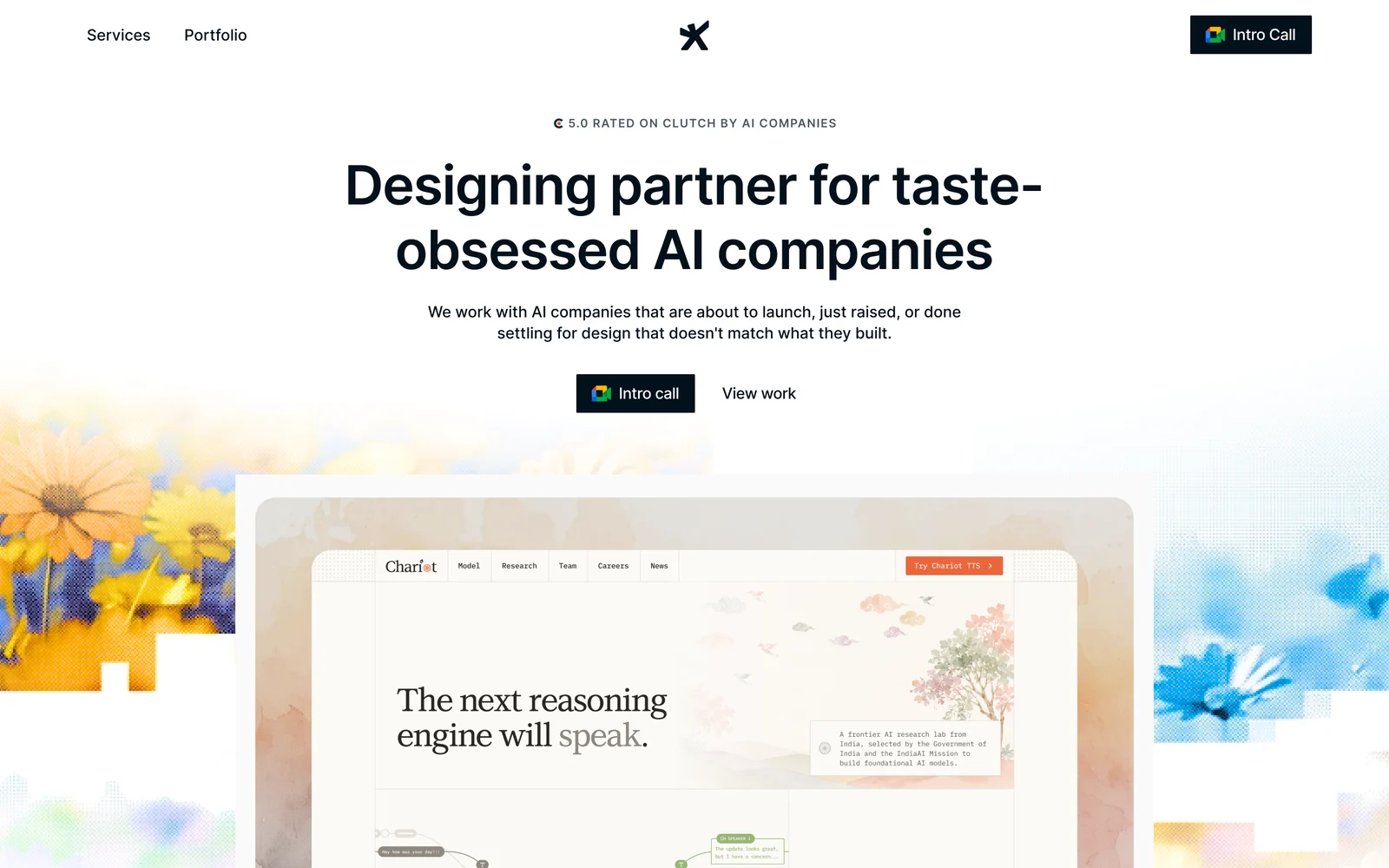
1. Studio Maydit: A Top-Rated Design Agency for AI Founders
A copilot redesign is usually an argument about proportion rather than a design problem. Studio Maydit is a web and product design studio working with AI founders in the US, UK, and Europe, and the work here starts by deciding how much of the site the copilot should actually own, which is almost never all of it. Rebuilds run in Framer, Webflow, or custom code, chosen partly by what the current site can carry across rather than by preference.
The design work continues past the site into the product, and for a copilot that is where the claim gets settled. Where the copilot appears in the interface, whether it interrupts or waits, how a suggestion is accepted or rejected without friction, and what happens when it has nothing useful to add are product decisions, handled by the same team rather than passed to somebody new. A copilot that is prominent on the website and buried in the product is a common and avoidable mismatch. The clearest published outcome is Dualite, where design work supporting a repositioned ICP helped the product reach 100,000+ users in seven months. Recent clients include Wave, PixelFlow, Mi-VAD, and 15 other AI and SaaS teams.
Engagements take one of two shapes. A fixed scope, three to four weeks, fits a relaunch with a date already set. A monthly retainer fits a rollout spread over months, covering new pages, campaigns, and product design, and there is no long lock-in either way. Fixed-scope projects end with a written diagnosis of what is leaking in the product rather than a handoff and goodbye.
| Check | Finding |
|---|---|
| Based in | Remote, serving US / UK / EU |
| Platform depth | Framer, Webflow, and custom code |
| AI-sector proof | Yes. AI-native clients, published outcome on Dualite |
| Pricing | Fixed scope or monthly retainer, quoted per project |
| Team shape | Founder-led, small senior team |
| Best fit | Copilot teams whose new feature is crowding out the product |
If the copilot is winning the homepage and the product is losing customers, that is a proportion problem. Book a 30-minute call.

2. BX Studio
BX Studio is a New York team of eleven to fifty working in Webflow, with AI-sector proof and a published starting price. ASAPP is the client that puts it first here, because ASAPP builds AI that assists human support agents, which is a copilot in the most literal sense, and it sells into large organisations where the software has to be positioned as help rather than replacement. Reddit and Headspace add experience of products used at scale by people who will never read documentation, which is who lands on your copilot page.
The weakness is the platform ceiling. Webflow suits a marketing site well and an interactive copilot demonstration poorly, so decide early whether the demo lives on the site or inside the product.
| Check | Finding |
|---|---|
| Based in | New York, USA |
| Founded | Not published |
| Team size | 11-50 |
| Primary platform | Webflow |
| AI-sector proof | Yes |
| Named clients | Reddit, Headspace, ASAPP, Verifone |
| Pricing | Published minimum |
| Best fit | Copilots positioned as assistance for a human doing a job |
3. Ramotion
Ramotion has worked from San Francisco since 2009 with eleven to fifty people, builds across platforms, and publishes a starting price. Sixteen years is the argument for a redesign, because a studio that old has replaced many sites that already had traffic and treats the launch as the risky part. Adobe is the useful name for a copilot company specifically, being a product suite that has repeatedly added new capabilities without letting them obscure what it already sold.
The weakness is that its AI-sector proof is partial. The migration and the craft will be handled well, and the sentence explaining what your copilot knows that a general model does not is likely yours to write.
| Check | Finding |
|---|---|
| Based in | San Francisco, USA |
| Founded | 2009 |
| Team size | 11-50 |
| Primary platform | Mixed |
| AI-sector proof | Partial |
| Named clients | Mozilla, Okta, Netflix, Adobe, Xero |
| Pricing | Published minimum |
| Best fit | Copilot products replacing a site with real existing traffic |
4. Phantom
Phantom builds in custom code from London and Auckland, has done since 2013, runs fifty-one to two hundred people, and carries AI-sector proof. Zendesk is the relevant client, a product where AI assistance sits inside an established workflow rather than standing alone, and SAP adds enterprise procurement experience. Custom code means an interactive copilot demonstration on the marketing site is genuinely possible rather than approximated.
The weakness is cost and shape. Phantom publishes no starting price, and a studio of that size with that client list is built around engagements larger than most copilot teams have budgeted for.
| Check | Finding |
|---|---|
| Based in | London, UK and Auckland, NZ |
| Founded | 2013 |
| Team size | 51-200 |
| Primary platform | Custom code |
| AI-sector proof | Yes |
| Named clients | Diageo, SAP, Financial Times, Zendesk |
| Pricing | Not published |
| Best fit | Copilots that need a working demonstration on the marketing site |
5. 8020
8020 works from San Francisco and New York, founded 2014, building in Webflow for Wave, Superlist, Pilot.com, Vanta, and Circle. Vanta and Pilot both sell software doing work on the customer's behalf and both had to explain access and trust on a marketing page, which is the second half of your copilot argument once the specificity problem is solved.
The weakness is that it publishes neither team size nor pricing, and its AI-sector proof is partial, so both relevance and cost only become clear on a call. Webflow also limits the interactive options.
| Check | Finding |
|---|---|
| Based in | San Francisco and New York, USA |
| Founded | 2014 |
| Team size | Not published |
| Primary platform | Webflow |
| AI-sector proof | Partial |
| Named clients | Wave, Superlist, Pilot.com, Vanta, Circle |
| Pricing | Not published |
| Best fit | Copilots facing questions about access and data handling |
6. Finsweet
Finsweet is distributed from Denver, founded 2017, with fifty-one to two hundred people and deep Webflow expertise. For a redesign that depth is practical: an established product site has many pages, and rebuilding them without losing structure is work this team has done repeatedly. GitHub among its clients means it can write for technical readers, useful if your copilot serves engineers.
The weakness is that its AI-sector proof is partial and it publishes no pricing, so the category relevance and the budget both have to be established in conversation.
| Check | Finding |
|---|---|
| Based in | Denver, USA, distributed |
| Founded | 2017 |
| Team size | 51-200 |
| Primary platform | Webflow |
| AI-sector proof | Partial |
| Named clients | Dropbox, Clay, GitHub, Steadily |
| Pricing | Not published |
| Best fit | Copilot products rebuilding a large existing site in Webflow |
7. Instrument
Instrument has been in Portland since 2005 and works across platforms for Nike, Microsoft, Electronic Arts, and Google. It is the highest-craft option here, and there is a specific case for it: if your copilot is competing against one shipped by a much larger incumbent, looking like a serious company is part of the argument rather than decoration.
The weakness is fit and cost together. Its AI-sector proof is partial, it publishes neither team size nor pricing, and a studio built around large brand programmes runs a process shaped for them.
| Check | Finding |
|---|---|
| Based in | Portland, USA |
| Founded | 2005 |
| Team size | Not published |
| Primary platform | Mixed |
| AI-sector proof | Partial |
| Named clients | Nike, Microsoft, Electronic Arts, Google |
| Pricing | Not published |
| Best fit | Copilot products competing against a much larger incumbent |
8. Foundey
Foundey is a San Francisco studio founded 2021 with AI-sector proof, working for DemandIQ, Traycer, and Sero AI. Traycer is directly relevant, being an AI coding assistant, so this studio has already had to explain a copilot to engineers who test claims rather than accept them.
The weakness is decisive for a redesign. Foundey works in Figma and does not build, so you receive design files and then need another party to rebuild the site and handle the redirects, which is exactly the stage of a redesign where traffic gets lost. It also publishes no pricing or team size.
| Check | Finding |
|---|---|
| Based in | San Francisco, USA |
| Founded | 2021 |
| Team size | Not published |
| Primary platform | Figma-only |
| AI-sector proof | Yes |
| Named clients | DemandIQ, Traycer, Sero AI |
| Pricing | Not published |
| Best fit | Copilot teams with developers who will handle the rebuild in house |
9. SuperSkills
SuperSkills is a Walnut Creek studio of one to ten people working across platforms, with AI-sector proof. A team that small means senior attention on every decision, and for a copilot company that wants one sharp collaborator instead of an agency it can be the right shape.
The weakness is that there is barely anything to assess. One named client, The Cut, no founding date, and no published pricing, which is thin against competitors here naming four or five projects. For a redesign in particular you cannot see whether it has ever protected an existing site's search performance.
| Check | Finding |
|---|---|
| Based in | Walnut Creek, USA |
| Founded | Not published |
| Team size | 1-10 |
| Primary platform | Mixed |
| AI-sector proof | Yes |
| Named clients | The Cut |
| Pricing | Not published |
| Best fit | Small copilot teams happy to judge a studio privately |
10. Flow Ninja
Flow Ninja is a Belgrade studio of eleven to fifty people, founded 2018, working in Webflow. The tenure and the team size are both real, and European rates make a straightforward rebuild affordable for a team without much budget.
The weakness is that it publishes neither client names nor a starting price, which leaves both of the columns you would shortlist on empty. For a redesign the missing client list is the sharper problem, because the specific thing to verify is whether it has moved a site with rankings before, and there is no way to check.
| Check | Finding |
|---|---|
| Based in | Belgrade, Serbia |
| Founded | 2018 |
| Team size | 11-50 |
| Primary platform | Webflow |
| AI-sector proof | Partial |
| Named clients | Not published |
| Pricing | Not published |
| Best fit | Teams willing to verify migration experience entirely by phone |
How to choose between them
Sort by what is actually going wrong.
The copilot has to read as help, not replacement. BX Studio or Phantom.
The current site earns traffic you cannot lose. Ramotion or Finsweet.
Buyers are asking what the copilot can access. 8020 or Foundey.
A larger competitor simply looks more serious. Instrument or SuperSkills.
One test before you sign. Ask a candidate how much of the homepage the copilot should occupy. A studio that understands this category will argue for less than you expect and will ask what your existing customers come to the site to find. A studio that does not will propose making the copilot the hero, which is the brief you thought you wanted and the reason the redesign will underperform.