Reading time:
14 min read
Last updated:
10 Best Website Redesign Agencies for AI Martech Startups - September 2026
Website redesign agencies for AI martech startups: ten studios compared on CMS depth, marketing-tech clients, and who publishes a price.


Studio Maydit, Flowout, Feely Studio, Finsweet, Lazarev, Kvalifik, Digidop, Ramotion, Push Refresh, and Edgar Allan make up this list, with the best match for an AI martech redesign first. Flowout and Feely Studio lead the nine. Flowout is a distributed Webflow studio that publishes a starting price, and Jasper and Sendlane, two companies that sell to marketers, are on its client list. Feely Studio is a small European team with direct AI-sector proof, a published price, and Mutiny among its clients. Push Refresh and Edgar Allan fit least. Push Refresh is a Dallas Framer team with no marketing software name on its list. Edgar Allan works for Porsche and Duracell, keeps its pricing private, and is shaped for brand campaigns more than for a content-heavy rebuild.
Your buyer is a marketer. That changes a redesign more than most founders expect.
A marketer lands on your site and grades it the way they grade their own. They notice the slow hero video, the vague headline, and the form with nine fields. If your site would fail their review, they assume your product would too.
The second problem is what the old site already holds. Most AI martech startups have spent two years publishing. Integration pages, template galleries, comparison pages, free tools, and a blog that sends a steady flow of signups. Much of it was written for a product you no longer sell the same way.
So the redesign has two jobs that pull against each other. It has to tell a new story, often a move from "AI writing tool" to something closer to "AI system for the whole campaign." It also has to keep every page that search engines and marketers already trust.
The ten studios below were judged on whether they can do both jobs at the same time.

How the ten were compared
Each check uses public information, so you can run it yourself in an afternoon.
Platform depth. Can the studio rebuild a large content library on a platform your marketing team can run alone? An AI martech site lives on templated pages: integrations, use cases, templates, and posts. If the new site needs an engineer to add one of those, publishing slows down in the first month.
Marketing-tech and AI proof. This is the audience test. Has the studio worked for companies that sell to marketers, or for AI products, and ideally for both? A team that has only built for consumer brands will write a hero that sounds good and tells a head of growth nothing.
Price disclosure. Does the studio publish a minimum at all? A redesign with a migration inside it is easy to underquote. A studio that shows a floor has usually priced this kind of work many times and knows where the hidden hours sit.
Team shape. A redesign is two projects in one: new design and moving old content. Small teams keep one senior person across both, but they run short of hands on a big library. Large teams have the hands, and a risk that the migration goes to whoever joined last.
The studio's own website. Open its blog or case study index and look for filters, clean URLs, and pages that load fast. That is a quick preview of how it will treat your content library.
The first two checks decided most positions. Price disclosure and team shape settled the pairs that were close. Each studio's own site worked as a limit, since no agency builds better for a client than it builds for itself.
A word on sources. The spec tables repeat what each studio says about itself on its own site, and stop there. If a studio keeps its founding year or team size private, the table says Not published instead of filling the gap with a guess.
What goes wrong when an AI martech startup redesigns its website
The integration and template pages vanish in the move. These pages were often built fast by a growth marketer with a spreadsheet, and they look nothing like the rest of the site. The redesign plan labels them legacy and leaves them out. They were also pulling in a large share of organic signups from people searching for your product next to HubSpot or Salesforce. Ask for a full URL list of the current site before design starts, with traffic beside each row, and agree which pages move as they are.
The new story is written for investors, not for marketers. The repositioning deck says "agentic campaign platform," and that phrase lands on the hero. A demand gen manager reads it and cannot tell what job it does on a Monday morning. Test the new headline with five customers before the design is locked, and keep the words a marketer would use to describe the problem.
The marketing team gets a site it cannot publish on. The rebuild looks sharp, but every new landing page needs a developer, the CMS has no campaign templates, and the forms do not connect to the tools the team already uses. Within a quarter the team is building pages in a separate tool again, and the new site starts to drift. Ask to watch your own marketer build a page in the new CMS before the final payment.
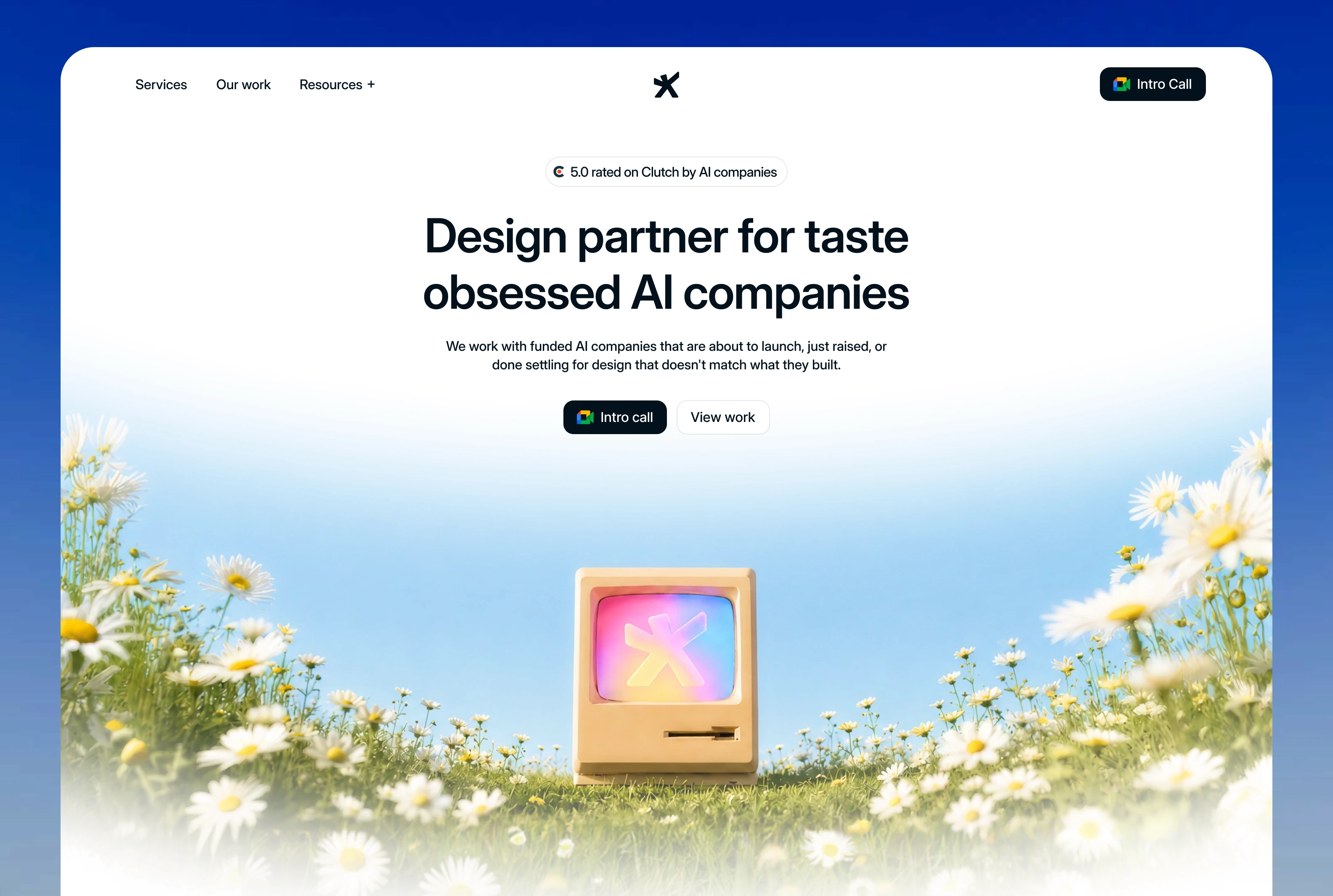
1. Studio Maydit: A Top-Rated Design Agency for AI Founders
An AI martech redesign is usually a repositioning with a website attached. Studio Maydit was set up for that kind of job. It is a web and product design studio. Its clients are AI founders, and they are based in the US, UK, and Europe.
Dualite shows why that matters here. The team made a hard call on a repositioned ICP, and the design work followed that call page by page. Seven months on, the product had 100,000+ users. A martech startup changing who it sells to faces the same test, because the site has to win a new buyer while the product keeps growing.
The studio picks Framer when a marketing team wants to ship campaign pages the same afternoon. It picks Webflow when the site carries a big library of integration pages and posts that need structured collections. It writes custom code when the site has to share components or live data with the app. Once the new site is out, the same team can continue into product design, so the story on the site and the one inside the product stay aligned. Recent clients include Wave, PixelFlow, Mi-VAD, and 15 other AI and SaaS teams.
Most martech teams take the monthly retainer, since the campaigns never stop. It covers new pages, campaigns, and product design, with no long lock-in. Teams with a set launch date for the new positioning can choose fixed scope instead. That runs three to four weeks and ends with a diagnosis of what is leaking in the product, so the next quarter starts from a list.
Check | Finding |
|---|---|
Based in | Remote, serving US / UK / EU |
Platform depth | Framer, Webflow, and custom code |
AI-sector proof | Yes. AI-native clients, published outcome on Dualite |
Pricing | Fixed scope or monthly retainer, quoted per project |
Team shape | Founder-led, small senior team |
Best fit | AI martech teams changing their story without losing the pages that already rank |
Share your current sitemap and we will point to the pages a redesign should leave alone. Book a 30-minute call.

2. Flowout
Flowout is a distributed Webflow studio, and its client list reads like a martech shortlist: Jasper, Kajabi, Riverside, and Sendlane. Jasper sells AI to marketers and Sendlane sells email tools to them, so the team has already written for your buyer. Webflow handles a large content library well, and a published starting price makes the first call quicker.
The weakness is how little else it shares. There is no founding year or team size, so you cannot tell how many people would run your migration, and AI-sector proof is partial. Ask exactly how old URLs will be mapped.
Check | Finding |
|---|---|
Based in | Distributed |
Founded | Not published |
Team size | Not published |
Primary platform | Webflow |
AI-sector proof | Partial |
Named clients | Jasper, Kajabi, Riverside, Sendlane |
Pricing | Published minimum |
Best fit | Martech startups moving a large Webflow library to a new story |
3. Feely Studio
Feely Studio is a small team spread across Europe with direct AI-sector proof. Noxus, Mutiny, Luasai, and Basic Capital are clients, and Mutiny is a marketing software company, which is close to this audience. The studio publishes a starting price, and at one to ten people the designer on your call is likely the one doing the work.
The weakness is scale. A small team on a mixed platform may be stretched by a big content move, so confirm which CMS your site will end up on. No founding year is published.
Check | Finding |
|---|---|
Based in | Distributed, Europe |
Founded | Not published |
Team size | 1-10 |
Primary platform | Mixed |
AI-sector proof | Yes |
Named clients | Noxus, Mutiny, Luasai, Basic Capital |
Pricing | Published minimum |
Best fit | AI martech founders who want AI fluency and a known price |
4. Finsweet
Finsweet has built in Webflow since 2017, from Denver and a distributed team of fifty-one to two hundred people. Dropbox, Clay, GitHub, and Steadily are clients, and Clay sells to go-to-market teams. A studio this size can carry a heavy migration, with enough people to rebuild hundreds of collection pages and check each redirect by hand.
The weakness is budgeting. No price is published, AI-sector proof is partial, and a large studio may give one redesign less senior time than a small one would.
Check | Finding |
|---|---|
Based in | Denver, USA, distributed |
Founded | 2017 |
Team size | 51-200 |
Primary platform | Webflow |
AI-sector proof | Partial |
Named clients | Dropbox, Clay, GitHub, Steadily |
Pricing | Not published |
Best fit | Funded martech teams with a big Webflow site to rebuild |
5. Lazarev
Lazarev has worked from San Francisco since 2015, with fifty-one to two hundred people and clear AI-sector proof. Payoneer, Peel, Elva, and Mozayix are named clients. It publishes a starting price, and its AI work means it can explain a model-driven feature to a marketer without burying them in jargon.
The weakness is fit and cost. The tier is premium, the platform is mixed, and no named client sells to marketers, so ask to see work aimed at that buyer.
Check | Finding |
|---|---|
Based in | San Francisco, USA |
Founded | 2015 |
Team size | 51-200 |
Primary platform | Mixed |
AI-sector proof | Yes |
Named clients | Payoneer, Peel, Elva, Mozayix |
Pricing | Published minimum |
Best fit | Well-funded AI martech teams wanting a senior, product-led redesign |

6. Kvalifik
Kvalifik is a Copenhagen Webflow studio, founded in 2015, with eleven to fifty people and direct AI-sector proof. Veo, Maersk, and Relesys are clients. A mid-sized Webflow team with AI experience can cover both halves of a redesign, the new story and the content move, without handing either one off.
The weakness is the missing price and the missing buyer. Kvalifik does not publish a minimum, and none of its named clients sells to marketers. European hours can also slow feedback for a US growth team.
Check | Finding |
|---|---|
Based in | Copenhagen, Denmark |
Founded | 2015 |
Team size | 11-50 |
Primary platform | Webflow |
AI-sector proof | Yes |
Named clients | Veo, Maersk, Relesys |
Pricing | Not published |
Best fit | European AI martech startups rebuilding on Webflow |
7. Digidop
Digidop is a Paris Webflow studio of one to ten people, founded in 2021, and it publishes a starting price. TSE Energy, Ramify, and StreamNative are clients, and StreamNative gives the team practice with technical products. In a small Webflow shop, the person planning your redirects is often the one building the templates.
The weakness is reach. AI-sector proof is partial, no marketing-tech name appears on the list, and a team this small can only move so much content at once.
Check | Finding |
|---|---|
Based in | Paris, France |
Founded | 2021 |
Team size | 1-10 |
Primary platform | Webflow |
AI-sector proof | Partial |
Named clients | TSE Energy, Ramify, StreamNative |
Pricing | Published minimum |
Best fit | Early martech startups with a modest site and a fixed budget |
8. Ramotion
Ramotion has been in San Francisco since 2009, with eleven to fifty people, and it publishes a starting price. Mozilla, Okta, Netflix, Adobe, and Xero are clients. Adobe gives it some exposure to marketing software at scale, and sixteen years of work means its redesign process is settled rather than invented per project.
The weakness is price and platform. The tier is premium, AI-sector proof is partial, and the mixed platform means you must ask which CMS your marketers will use afterwards.
Check | Finding |
|---|---|
Based in | San Francisco, USA |
Founded | 2009 |
Team size | 11-50 |
Primary platform | Mixed |
AI-sector proof | Partial |
Named clients | Mozilla, Okta, Netflix, Adobe, Xero |
Pricing | Published minimum |
Best fit | Later-stage martech companies paying for craft and process |
9. Push Refresh
Push Refresh is a Dallas Framer studio of one to ten people that publishes a starting price. SmithRx, Synonym, and Northern National are its named clients. Framer is quick for campaign pages, and a team this small keeps the same people on your project from kickoff to launch.
The weakness is the library. Moving hundreds of posts and integration pages into Framer takes careful planning, no named client sells to marketers, AI-sector proof is partial, and no founding year is published.
Check | Finding |
|---|---|
Based in | Dallas, USA |
Founded | Not published |
Team size | 1-10 |
Primary platform | Framer |
AI-sector proof | Partial |
Named clients | SmithRx, Synonym, Northern National |
Pricing | Published minimum |
Best fit | Small martech teams with a short site and a Framer habit |
10. Edgar Allan
Edgar Allan has built in Webflow from Atlanta since 2014, with fifty-one to two hundred people. Porsche, Duracell, and NCR are clients. It is a serious Webflow shop with the hands to move a large site quickly.
The weakness is who it is built for. Its work is shaped for brand campaigns, not for a startup changing who it sells to, and with no published price, a premium tier, and partial AI-sector proof, an early martech team gets the least clear view here.
Check | Finding |
|---|---|
Based in | Atlanta, USA |
Founded | 2014 |
Team size | 51-200 |
Primary platform | Webflow |
AI-sector proof | Partial |
Named clients | Porsche, Duracell, NCR |
Pricing | Not published |
Best fit | Established brands with a campaign calendar and a large budget |
How to choose between them
Start with the part of your current site that is really failing, not the portfolio you liked most.
Your integration and SEO pages carry the traffic. Finsweet or Flowout, and make the URL map a paid deliverable.
Your headline no longer matches what you sell. Feely Studio, with five customer calls booked before design starts.
Your marketers cannot ship a page without help. Flowout, or Kvalifik if your team sits in Europe.
Your product has outgrown its startup look. Lazarev, or Ramotion if the budget stretches.
A quick test for all of them: ask for the redirect list from a past redesign and the traffic chart from the month after launch. A studio that protects traffic has both ready.

Need more info?
Can't find your answer? Book a call and let's talk.
Continue Reading
10 Best Framer Design Agencies for AI Agent Startups - September 2026
What is the best Framer agency for an AI agent startup? Ten Framer studios ranked for agent products, with pricing, team size and AI work compared.

Siddarth Ponangi
10 Best Framer Design Agencies for Newly Funded Startups - September 2026
Your funding announcement is the biggest traffic day you will have all year. We checked 10 Framer agencies on five public criteria to see which can hit that date.
Siddarth Ponangi
10 Best Custom Code Website Development Agencies for AI Agent Startups - September 2026
AI web development agencies for agent startups. Which teams build custom coded sites a small team can still update weekly after launch.
Siddarth Ponangi