

Summarize with AI


An AI voice company rebuilding its website has ten studios worth reviewing: Studio Maydit, Pixelmatters, Clay, Refokus, Fantasy, Finsweet, 8020, Trueform, Flowout, and Lighthouse Digital. The two strongest are Pixelmatters and Clay. Pixelmatters is a Porto studio founded 2013 with fifty-one to two hundred people, works across website and product design, publishes a starting price, and has built for Rubrik, Quantic, and UJET. Clay is a San Francisco studio founded 2016 with fifty-one to two hundred people, works across platforms, publishes a starting price, has direct AI-sector proof, and has built for Slack, Stripe, Google, Coinbase, and Amazon. Flowout and Lighthouse Digital are the weakest fit, the first publishing neither a team size nor a founding date, the second recording no AI-sector experience at all.
There is one decision that matters more than every other in a voice redesign. Can a stranger hear your product inside one click.
Your website is silent and your product is not. That sounds obvious and it gets designed around rather than solved. The standard redesign reaches for a waveform illustration, a line about natural conversation, and a demo request. The visitor has then read about a voice without hearing one, which is about as useful as a restaurant describing its food. Thirty seconds of real audio with a transcript beside it settles more than a page of copy.
The second thing is that your buyers compare latency and almost nobody publishes it honestly. Time to first word, whether interruption works, what happens on a bad mobile connection. These are the numbers that decide an evaluation, and they only mean something with their conditions attached. A single figure in a large typeface reads as marketing to the one person in the room who knows what to ask.
Third, the page that closes deals here is usually the one about handing over to a human. An operations buyer is not asking whether your agent is impressive. They want to know what happens on the calls it cannot handle, how context is passed, and whether the customer has to repeat themselves. That page is unglamorous and it is the one cut for looking too operational.

How we picked these agencies
Five checks set this order, all answerable from public pages before anybody gives you an hour.
One, whether the studio can ship something that plays. A voice site needs real audio on the page with a transcript, controls that work on a phone, and captions for anyone who cannot listen at their desk. That is more than embedding a player. Ask to see a site the studio built where sound is part of the argument.
Two, evidence with products where the experience is live and timing-sensitive. This replaces generic AI experience here, because a studio that designed a chatbot has not met your problem. Audio products, video tools, and support platforms teach the same lesson, that the thing being sold only makes sense in motion.
Three, whether a starting figure is public. You are asking enterprise buyers to trust numbers about latency and accuracy, so a studio that will not publish its own simplest number is a poor cultural fit for that argument.
Four, the shape of the team. Voice differentiation is specific and technical, often a single behaviour such as handling interruption gracefully. It survives only while the person who understood it writes the page. Ask who that is and look at their work rather than the studio's.
Five, how the studio's own site performs on a phone on mobile data. Buyers will test your agent over a bad connection, so a studio whose own site struggles there is not thinking about your conditions.
Nothing was estimated. Every value came from each studio's own published material, and Not published means the studio chose not to say.
What goes wrong
The redesign illustrates sound instead of playing it. Animated waveforms, a glowing orb, a microphone icon. All of it is a picture of a voice product rather than the product. Put one real call on the page, with a transcript beside it, and let the visitor start it without a form. If legal will not clear a customer recording, record a scripted one yourself. Something imperfect and audible beats something beautiful and mute.
Latency appears as one number with no conditions. Any buyer who matters will ask what the number measures, on what network, in which region, and whether it includes the time to start speaking. Publishing a figure without those reads as a claim, and in this category everybody is claiming. A slightly worse number with the conditions attached wins the technical evaluation, because it is the only one that can be reproduced.
The human handoff gets designed out for looking negative. Somebody argues that naming the calls your agent cannot take undercuts the pitch. The opposite happens. Experienced buyers know containment is never total, and a vendor vague about the fallback is assumed to have a bad one. Describe the escalation, the context that travels with it, and what the caller hears.
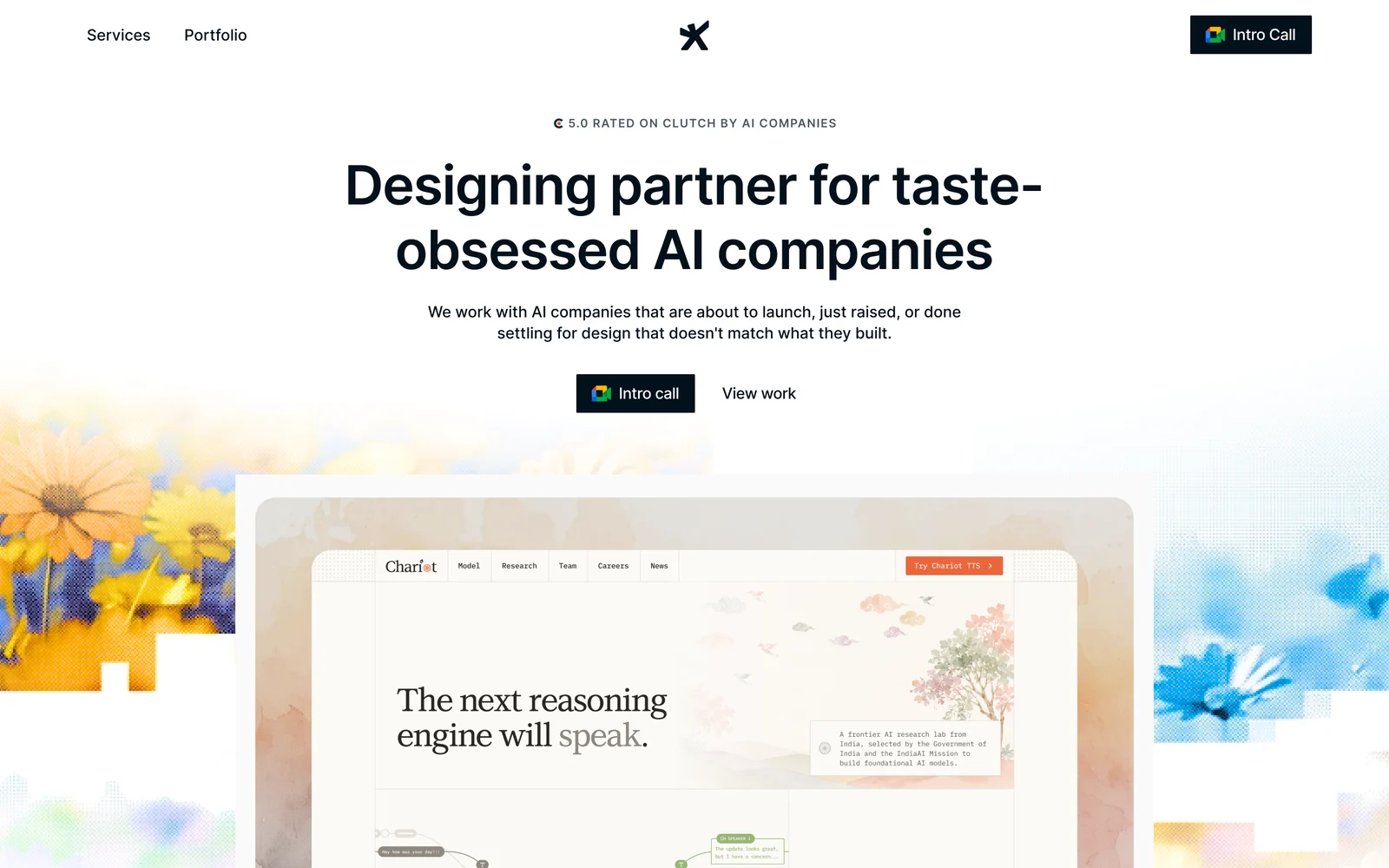
1. Studio Maydit: A Top-Rated Design Agency for AI Founders
A voice redesign usually turns on what a visitor gets to hear and how soon. Studio Maydit is a web and product design studio working with AI founders in the US, UK, and Europe, and the first decision here is which thirty seconds of audio makes the argument, because the page is then built to get somebody there. Rebuilds run in Framer, Webflow, or custom code, and with playable audio, transcripts, and captions involved that choice is largely about where those can live without feeling bolted on.
Design carries on into the product after the site ships. For a voice company that means the console: how a call is reviewed afterwards, how a transcript is corrected, where a failed containment is surfaced so somebody can act on it, and how a prompt change is tested before it reaches live traffic. The clearest published outcome is Dualite, where design work supporting a repositioned ICP helped the product reach 100,000+ users in seven months. Recent clients include Wave, PixelFlow, Mi-VAD, and 15 other AI and SaaS teams.
Engagements come in two shapes. A fixed scope of three to four weeks, when the relaunch date is already set. Or a monthly retainer, when pages, campaigns, and product design will keep coming, with no long lock-in either way. Fixed-scope work ends with a written diagnosis of what is leaking in the product rather than a handoff and goodbye.
| Check | Finding |
|---|---|
| Based in | Remote, serving US / UK / EU |
| Platform depth | Framer, Webflow, and custom code |
| AI-sector proof | Yes. AI-native clients, published outcome on Dualite |
| Pricing | Fixed scope or monthly retainer, quoted per project |
| Team shape | Founder-led, small senior team |
| Best fit | Voice teams whose site never lets a visitor hear the product |
If nobody can hear your agent without booking a call, fix that before anything else. Book a 30-minute call.

2. Pixelmatters
Pixelmatters is a Porto studio founded 2013, fifty-one to two hundred people, working across website and product design with a published starting price. UJET is the name that decides its position. It is a contact centre platform, which means this team has already designed for the exact buyer you are selling to and has met the containment and escalation questions before. Doing product design as well means the marketing site and the call review console can end up in one visual system rather than two.
The weakness is that its AI-sector proof is partial, so the specifics of a voice model would be new. A studio of that size also runs a formal process, which a team shipping to a conference date may find slower than it wants.
| Check | Finding |
|---|---|
| Based in | Porto, Portugal |
| Founded | 2013 |
| Team size | 51-200 |
| Primary platform | Mixed |
| AI-sector proof | Partial |
| Named clients | Rubrik, Quantic, UJET |
| Pricing | Published minimum |
| Best fit | Voice products selling into contact centre operations |
3. Clay
Clay is a San Francisco studio founded 2016 with fifty-one to two hundred people, working across platforms, publishing a starting price, and carrying direct AI-sector proof. Stripe is the useful reference, a product whose site has to stay legible to a developer reading a spec and a finance lead approving a contract on the same page, which is the split you have between an engineer testing latency and an operations director counting handled calls. A team that size does not stall when one person is away.
The weakness is stage. This is a studio set up for companies with a brand function already, so a small voice startup will find the process heavier and the engagement larger than the job requires.
| Check | Finding |
|---|---|
| Based in | San Francisco, USA |
| Founded | 2016 |
| Team size | 51-200 |
| Primary platform | Mixed |
| AI-sector proof | Yes |
| Named clients | Slack, Stripe, Google, Coinbase, Amazon |
| Pricing | Published minimum |
| Best fit | Funded voice companies rebuilding for two different buyers |
4. Refokus
Refokus is a remote German studio of eleven to fifty people, founded 2021, working mainly in Webflow for Mural, BASF, Spotify, Yahoo, and BCG. Spotify is the relevant name, being a product where audio is the point and the interface has to get out of the way of it. The studio's register is restrained rather than decorative, which suits a category full of glowing orbs, and a European base helps when buyers ask where calls are processed.
The weakness is platform and evidence together. Webflow makes a custom audio experience harder than custom code does, its AI-sector proof is partial, and it publishes no starting price, so cost is a conversation rather than a check.
| Check | Finding |
|---|---|
| Based in | Germany, remote |
| Founded | 2021 |
| Team size | 11-50 |
| Primary platform | Webflow |
| AI-sector proof | Partial |
| Named clients | Mural, BASF, Spotify, Yahoo, BCG |
| Pricing | Not published |
| Best fit | European voice products wanting a restrained, audio-led site |
5. Fantasy
Fantasy has run since 1999 from San Francisco and New York, works across platforms, and has direct AI-sector proof. More than two decades of interface design is unusual depth in this pool, and for a voice product asking people to adopt an unfamiliar way of doing something, that history has real value.
The weakness is that almost nothing can be checked from outside. It publishes neither client names nor pricing, which empties the two columns a shortlist relies on. For a redesign with existing rankings at stake, the missing client list matters most, because you cannot tell whether it has ever protected a site's search performance through a rebuild.
| Check | Finding |
|---|---|
| Based in | San Francisco and New York, USA |
| Founded | 1999 |
| Team size | Not published |
| Primary platform | Mixed |
| AI-sector proof | Yes |
| Named clients | Not published |
| Pricing | Not published |
| Best fit | Voice teams happy to evaluate a studio in private conversation |
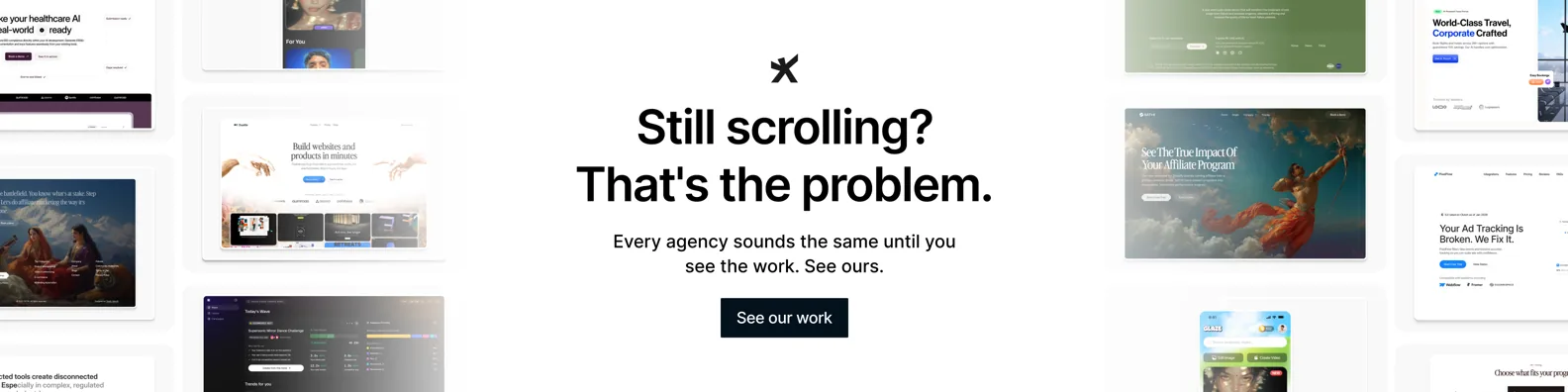
6. Finsweet
Finsweet is a distributed studio based in Denver, founded 2017, with fifty-one to two hundred people working in Webflow. It is the strongest pure engineering team among the Webflow studios here, with Dropbox, GitHub, and Steadily on the list, and GitHub in particular means it has built for an audience that reads carefully. If your site is staying on Webflow and needs custom components such as a transcript viewer, this is the team most likely to manage it.
The weakness is cost visibility and fit. It publishes no starting price, its sector proof is partial, and none of the named work is audio or real-time, so selling something you have to hear would be new ground.
| Check | Finding |
|---|---|
| Based in | Denver, USA, distributed |
| Founded | 2017 |
| Team size | 51-200 |
| Primary platform | Webflow |
| AI-sector proof | Partial |
| Named clients | Dropbox, Clay, GitHub, Steadily |
| Pricing | Not published |
| Best fit | Voice products staying on Webflow with custom components to build |
7. 8020
8020 is a San Francisco and New York studio founded 2014 working in Webflow for Wave, Superlist, Pilot.com, Vanta, and Circle. Vanta is the name worth weighing. It is a compliance product, so this team has written the trust, security, and certification pages that an enterprise voice buyer reads before a procurement conversation, and those pages are usually the weakest part of a startup's site.
The weakness is that it publishes neither team size nor a starting price, its sector proof is partial, and the named work is marketing sites rather than interactive ones, so a playable call experience is unproven.
| Check | Finding |
|---|---|
| Based in | San Francisco and New York, USA |
| Founded | 2014 |
| Team size | Not published |
| Primary platform | Webflow |
| AI-sector proof | Partial |
| Named clients | Wave, Superlist, Pilot.com, Vanta, Circle |
| Pricing | Not published |
| Best fit | Voice products whose weakest pages are trust and compliance |
8. Trueform
Trueform is a Swiss studio in Wil founded 2022, building in Framer with a published starting price and direct AI-sector proof. Miro and Morning Brew show a confident, uncluttered style, and Framer gets a new page live in days rather than weeks, which matters if you are repositioning ahead of a launch or a raise. A published number plus direct sector proof is a combination few studios here offer.
The weakness is depth. Framer is a limited home for custom audio components and a large content estate, the studio publishes no team size, and a 2022 founding date means fewer rebuilds with search performance at stake than the studios above it.
| Check | Finding |
|---|---|
| Based in | Wil, Switzerland |
| Founded | 2022 |
| Team size | Not published |
| Primary platform | Framer |
| AI-sector proof | Yes |
| Named clients | Miro, Morning Brew, Bilt Rewards, Gather |
| Pricing | Published minimum |
| Best fit | Voice startups rebuilding a small site quickly before a raise |
9. Flowout
Flowout is a distributed Webflow studio with a published starting price, working for Jasper, Kajabi, Riverside, and Sendlane. Riverside is the interesting name here, a recording product where audio quality is the entire promise, so the team has at least been near the problem. It is also the cheapest realistic option in this pool and it is built for turnaround speed.
The weakness is depth of evidence. It publishes neither team size nor founding date, its sector proof is partial, and nothing shows it has handled a migration with rankings at stake. Survivable on a small site, the main risk on a large one.
| Check | Finding |
|---|---|
| Based in | Distributed |
| Founded | Not published |
| Team size | Not published |
| Primary platform | Webflow |
| AI-sector proof | Partial |
| Named clients | Jasper, Kajabi, Riverside, Sendlane |
| Pricing | Published minimum |
| Best fit | Voice products with a small site and a tight budget |
10. Lighthouse Digital
Lighthouse Digital is a London studio working in Webflow, and it does publish a starting price, which several studios ranked above it do not. HelloSelf, Freetrade, and IGN are respectable consumer and fintech projects, and a UK base suits a team selling into British contact centres.
The weakness settles its position. Its AI-sector proof is recorded as none, and nothing published is audio, real-time, or developer-facing, so both halves of what this list tests are absent. It also publishes neither team size nor a founding date, which makes its capacity for a rebuild impossible to judge in advance.
| Check | Finding |
|---|---|
| Based in | London, UK |
| Founded | Not published |
| Team size | Not published |
| Primary platform | Webflow |
| AI-sector proof | No |
| Named clients | HelloSelf, Freetrade, IGN |
| Pricing | Published minimum |
| Best fit | UK voice products with a small site and a published price to check |
How to choose between them
Sort by what the rebuild actually has to do.
You are selling into contact centre operations. Pixelmatters or 8020.
Audio has to be playable and pleasant on a phone. Refokus or Finsweet.
Two buyers with opposite questions share the homepage. Clay or Fantasy.
You need a sharper story on a few pages, soon. Trueform or Flowout.
One test before you sign. Play a candidate a thirty second recording of your agent and ask what they would put on the page next to it. A studio that understands voice will ask for the transcript, the latency conditions, and what happened on the call that went wrong. A studio that does not will start describing an animation.