Reading time:
14 min read
Last updated:
10 Best Website Redesign Agencies for Amsterdam AI Startups - September 2026
Ten studios that redesign websites for Amsterdam AI startups, ranked on European working proof, AI-sector experience, and who can edit the site after launch.


Ranked by fit for an Amsterdam AI company rebuilding its site, the ten are Studio Maydit, Kvalifik, Trueform, Feely Studio, basement.studio, Lazarev, Clay, Feels Like, Fantasy, and Foundey. Kvalifik and Trueform lead the nine. Kvalifik is a Copenhagen Webflow studio of eleven to fifty people with hard AI-sector proof and Veo, Maersk, and Relesys as clients. Trueform builds in Framer from Switzerland for Miro, Morning Brew, Bilt Rewards, and Gather, and it publishes a starting price. Fantasy and Foundey are the weakest fit. Fantasy publishes no client names, so its AI work cannot be checked. Foundey works only in Figma, which means a redesign would end with files and no site.
Dutch companies tend to describe their products accurately, and most redesigns treat that as a problem to solve.
You will recognise the moment. The current site says something like: it reads your supplier invoices and flags the ones that do not match the contract. Plain, specific, slightly flat. A visitor knows in four seconds whether they need it.
The new draft comes back and that sentence has become an intelligence layer for financial operations. Nobody can tell what it does any more, but it sounds like the other sites in the category.
That trade is almost always bad, and it is worse here than elsewhere. Amsterdam companies leave the home market early, because the Netherlands is not big enough to build a company on. So your site is read by strangers in Germany, the UK, the Nordics, and increasingly the US, none of whom have heard of you.
For a stranger, plainness is the fastest trust you can buy. The vague version asks them to take your word for it. The specific version lets them check.
The studios below were ranked on whether they can make a site look substantially better without making it say less.

The checks applied to each studio
Five things, all of which you can confirm yourself before making contact.
Build platform. Can your own team change a page after launch, from Amsterdam, without a developer? A visual platform with a CMS keeps that power in-house. Hand-written code moves it into an engineering queue, which in a small company means the page does not change.
European operating proof, and AI work to go with it. This is the audience check here. A studio already working across European markets understands that your buyers sit in four countries with different expectations, and that data questions arrive earlier here than in the US. Paired with real AI clients, that is the combination this brief needs.
A published price. A starting figure lets you size a studio in a minute. Studios that publish nothing usually want two calls before a number appears, which is slow when you are comparing five.
Team shape. One to ten people gives you a single senior person throughout and quick decisions. Fifty-plus gives you capacity for a large rebuild but distributes the work, so ask which people are actually assigned.
The studio's own website. Read it as a writing sample rather than a design sample. If its own pages say exactly what it does, it will let your pages do the same. If they are atmospheric and empty, that is the house style you would be buying.
European proof with AI experience carried the most weight, followed by platform. Price and team shape settled ties. A vague site of a studio's own pushed it down.
All table values come from what each studio publishes about itself. Where nothing is stated, the row reads Not published rather than an estimate.
What goes wrong when an Amsterdam AI startup redesigns
The rewrite trades accuracy for category language. A studio without sector experience reaches for the vocabulary it has seen on other AI sites, and your specific sentence becomes a generic one. You lose the only thing that separated you from nine competitors, and you will not notice for a quarter because the site looks better. Keep a copy of your current product sentence, and refuse any replacement that a competitor could also truthfully use.
The site tries to address four countries and speaks clearly to none. A German buyer expects formality and detail. A British one expects a case study. A Nordic one wants the price. An American wants to know who else uses it. Sites that try to satisfy all four end up hedged everywhere. Pick the one market that produces most of your revenue next year, write the site for that reader, and handle the others with specific proof rather than softened language.
Your strongest commercial argument is filed as legal boilerplate. For a European AI company, keeping customer data inside the EU, being explicit about what trains the model, and having an answer ready for a procurement questionnaire are genuine advantages against US competitors. Most sites bury all of it in a privacy policy written by a lawyer. Bring it forward into a real page with plain sentences, because a buyer who is nervous about AI is looking for exactly that and will otherwise assume you have not thought about it.
1. Studio Maydit: A Top-Rated Design Agency for AI Founders
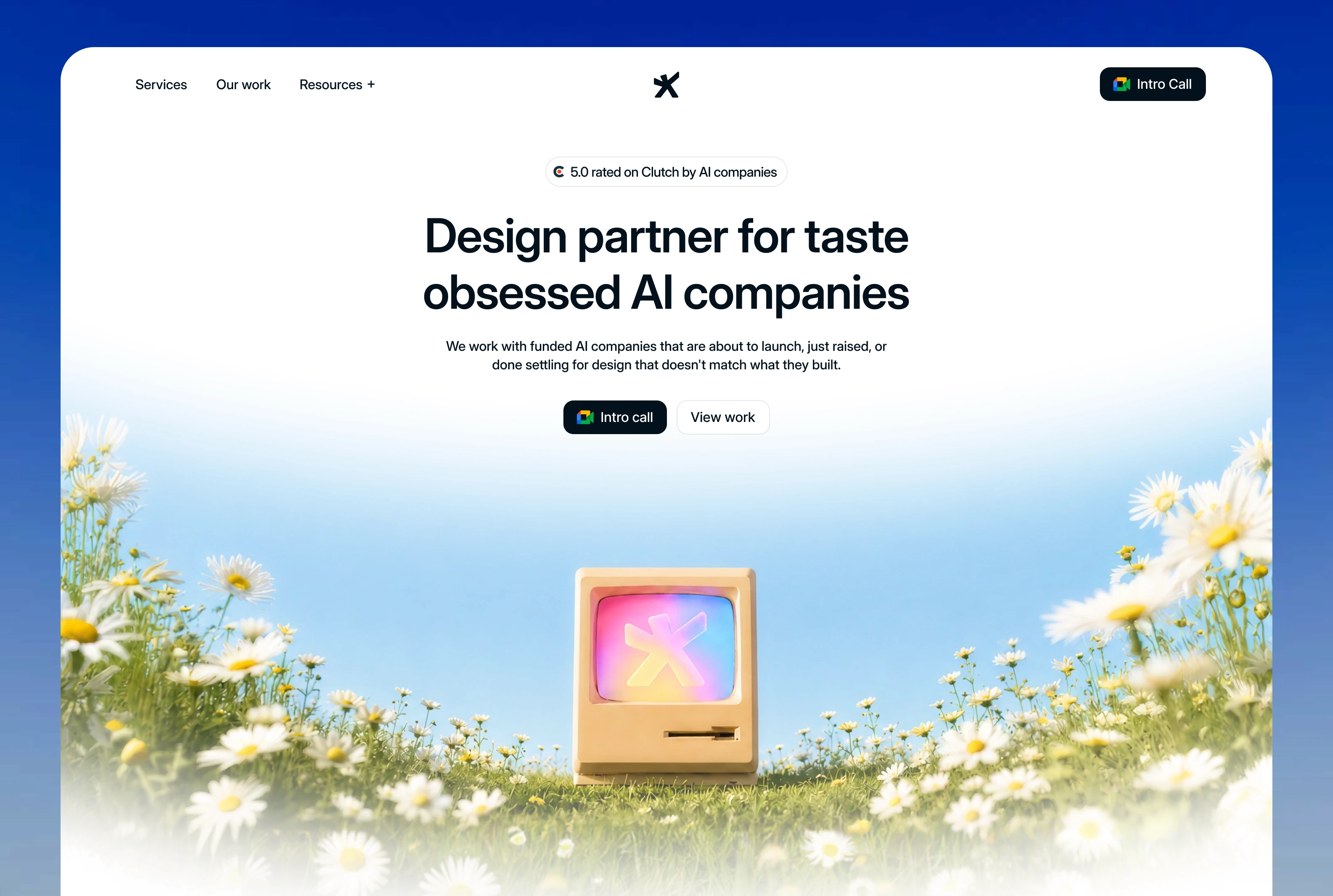
Studio Maydit is a web and product design studio working with AI founders in the US, UK, and Europe, which is the spread an Amsterdam company usually sells into. The studio's argument on this brief is specific: a redesign should raise how good a page looks without lowering how much it says, and the way to do that is to design around real sentences rather than write around a design.
Buying happens two ways. Fixed scope runs three to four weeks and suits a rebuild with a date attached, closing with a diagnosis of what is leaking in the product rather than a handover presentation. Companies that keep publishing move to the monthly retainer, covering new pages, campaigns, and product design, with no long lock-in. The build depends on the shape of the site. Webflow when it will grow into use cases and customer stories that share components. Framer when a smaller site edited weekly matters more. Custom code when a page must show live output from the product. The same team carries on into product design, which matters because European buyers often decide during a trial rather than on a call.
Recent clients include Wave, PixelFlow, Mi-VAD, and 15 other AI and SaaS teams. The engagement with a number attached to it is Dualite, which reached 100,000+ users inside seven months while the design work supported a repositioned ICP.
Check | Finding |
|---|---|
Based in | Remote, serving US / UK / EU |
Platform depth | Framer, Webflow, and custom code |
AI-sector proof | Yes. AI-native clients, published outcome on Dualite |
Pricing | Fixed scope or monthly retainer, quoted per project |
Team shape | Founder-led, small senior team |
Best fit | Dutch AI teams selling across Europe who want to look better, not vaguer |
Send us the sentence that describes your product and we will tell you whether your site still says it. Book a 30-minute call.

2. Kvalifik
Kvalifik has worked from Copenhagen since 2015, with eleven to fifty people building in Webflow. Veo, Maersk, and Relesys are clients. Northern European working culture is close to Dutch, which in practice means direct feedback and fewer performances, and Maersk is a logistics business of the kind Amsterdam and Rotterdam companies sell into constantly. It carries hard AI-sector proof, which most studios in this pool do not.
The weakness is price visibility. Nothing is published, so budget fit takes a call, and the client list leans more industrial than software.
Check | Finding |
|---|---|
Based in | Copenhagen, Denmark |
Founded | 2015 |
Team size | 11-50 |
Primary platform | Webflow |
AI-sector proof | Yes |
Named clients | Veo, Maersk, Relesys |
Pricing | Not published |
Best fit | Dutch teams selling into European industry and logistics |
3. Trueform
Trueform builds in Framer from Wil, Switzerland, founded in 2022, and it publishes a starting price. Miro, Morning Brew, Bilt Rewards, and Gather are clients. Miro is a European-founded software company that went global early, which is your exact trajectory, and the studio has genuine AI-sector proof. Framer also leaves the site quick for your own team to edit between launches.
The weakness is scale and cost. Team size is not published, the tier is premium, and Framer suits a focused site better than a large one with many market-specific pages.
Check | Finding |
|---|---|
Based in | Wil, Switzerland |
Founded | 2022 |
Team size | Not published |
Primary platform | Framer |
AI-sector proof | Yes |
Named clients | Miro, Morning Brew, Bilt Rewards, Gather |
Pricing | Published minimum |
Best fit | European AI teams that want a sharp site and a published number |
4. Feely Studio
Feely Studio is a distributed European team of one to ten people that publishes a starting price, working across platforms for Noxus, Mutiny, Luasai, and Basic Capital. European hours mean same-day replies, the AI proof is real, and Mutiny is built around showing different visitors different things, which is directly relevant when your readers sit in four countries.
The weakness is capacity. One to ten people in the budget tier is thin for a full multi-market rebuild, and no founding year is published, so the track record is hard to size.
Check | Finding |
|---|---|
Based in | Distributed, Europe |
Founded | Not published |
Team size | 1-10 |
Primary platform | Mixed |
AI-sector proof | Yes |
Named clients | Noxus, Mutiny, Luasai, Basic Capital |
Pricing | Published minimum |
Best fit | Smaller Dutch teams wanting AI fluency on European hours |
5. basement.studio
basement.studio writes custom code from Mar del Plata and Los Angeles, founded in 2018 with eleven to fifty people, and it publishes a starting price. Vercel, Cursor, ElevenLabs, Harvey AI, and Scale AI are clients, which is the strongest AI list in this pool by a wide margin. If your next market is the United States, this is the studio whose work American technical buyers already recognise.
The weakness is ownership and overlap. Custom code means your team cannot add a page alone, and the studio's hours sit several time zones west of Amsterdam.
Check | Finding |
|---|---|
Based in | Mar del Plata, Argentina and Los Angeles, USA |
Founded | 2018 |
Team size | 11-50 |
Primary platform | Custom code |
AI-sector proof | Yes |
Named clients | Vercel, Cursor, ElevenLabs, Harvey AI, Scale AI |
Pricing | Published minimum |
Best fit | Dutch AI teams whose next market is the United States |

6. Lazarev
Lazarev has worked from San Francisco since 2015 with fifty-one to two hundred people, and it publishes a starting price. Payoneer, Peel, Elva, and Mozayix are clients. Payoneer handles cross-border payments, which is a useful instinct for a company whose customers and currencies span several countries, and the studio carries real AI-sector proof.
The weakness is distance and definition. California hours leave a narrow overlap with Amsterdam, the platform is mixed so editing rights depend on what gets built, and the premium tier sets a high floor.
Check | Finding |
|---|---|
Based in | San Francisco, USA |
Founded | 2015 |
Team size | 51-200 |
Primary platform | Mixed |
AI-sector proof | Yes |
Named clients | Payoneer, Peel, Elva, Mozayix |
Pricing | Published minimum |
Best fit | Dutch teams selling across currencies with a US-facing story |
7. Clay
Clay has worked from San Francisco since 2016 with fifty-one to two hundred people, and it publishes a starting price. Slack, Stripe, Google, Coinbase, and Amazon are clients. Stripe in particular is the reference most teams cite when they want a technical product explained clearly, and the studio has genuine AI-sector proof.
The weakness is proportion and hours. This is a premium studio built for very large clients, so a startup rebuild is a small engagement, the platform is mixed, and California time makes a fast review cycle difficult from the Netherlands.
Check | Finding |
|---|---|
Based in | San Francisco, USA |
Founded | 2016 |
Team size | 51-200 |
Primary platform | Mixed |
AI-sector proof | Yes |
Named clients | Slack, Stripe, Google, Coinbase, Amazon |
Pricing | Published minimum |
Best fit | Well-funded European companies buying to a US standard |
8. Feels Like
Feels Like writes custom code from Los Angeles, founded in 2023, for Google, Nike, LVMH, and Suno AI. The craft is high and Suno is a real AI client, so a company that wants a visible step up in polish will get one.
The weakness is maintenance and record. Custom code keeps your team dependent on the studio for every change, no price or team size is published, the founding date is recent, and the hours are the furthest from Amsterdam of any studio here.
Check | Finding |
|---|---|
Based in | Los Angeles, USA |
Founded | 2023 |
Team size | Not published |
Primary platform | Custom code |
AI-sector proof | Yes |
Named clients | Google, Nike, LVMH, Suno AI |
Pricing | Not published |
Best fit | Brand-led rebuilds where polish outranks editability |
9. Fantasy
Fantasy has worked from San Francisco and New York since 1999 across several platforms, with AI-sector proof on record. Twenty-six years in business is a long record, and a studio that old has handled every kind of client and approval process.
The weakness is that almost nothing is checkable. No client names, no team size, and no price are published, the tier is premium, and for a European company buying carefully that is a lot of unknowns to accept before the first invoice.
Check | Finding |
|---|---|
Based in | San Francisco and New York, USA |
Founded | 1999 |
Team size | Not published |
Primary platform | Mixed |
AI-sector proof | Yes |
Named clients | Not published |
Pricing | Not published |
Best fit | Large budgets where a long record outweighs a checkable one |
10. Foundey
Foundey has designed for AI companies from San Francisco since 2021, with DemandIQ, Traycer, and Sero AI as clients. All three are AI products, so the sector understanding is real and you would not spend a week explaining what your model does.
The weakness decides its place. Foundey works in Figma, so a redesign finishes with design files and you would still need a separate partner to build the site. No price and no team size are published.
Check | Finding |
|---|---|
Based in | San Francisco, USA |
Founded | 2021 |
Team size | Not published |
Primary platform | Figma-only |
AI-sector proof | Yes |
Named clients | DemandIQ, Traycer, Sero AI |
Pricing | Not published |
Best fit | Teams with their own developers who need design only |
How to choose between them
Sort by which market you are actually trying to win next, and by who has to run the site afterwards.
Your growth is across Europe. Kvalifik or Feely Studio, both on European hours, and hand them your current product sentence as the thing to protect.
Your next market is the United States. basement.studio, or Lazarev if the product touches payments, and accept the time zone cost in exchange for the reference list.
Your team must publish without help. Kvalifik on Webflow or Trueform on Framer, then confirm two people on your side can edit after handover.
You need a number before committing. Trueform, Feely Studio, basement.studio, Lazarev, and Clay all publish a starting price.
The test that reveals most: send each studio your current homepage copy and ask what they would change about the words. A studio that proposes sharper, more specific sentences understands the brief. A studio that proposes more evocative ones is about to remove the reason people believe you.

Need more info?
Can't find your answer? Book a call and let's talk.
Continue Reading
10 Best Framer Design Agencies for AI Agent Startups - September 2026
What is the best Framer agency for an AI agent startup? Ten Framer studios ranked for agent products, with pricing, team size and AI work compared.

Siddarth Ponangi

10 Best Framer Design Agencies for Newly Funded Startups - September 2026
Your funding announcement is the biggest traffic day you will have all year. We checked 10 Framer agencies on five public criteria to see which can hit that date.
Siddarth Ponangi
10 Best Custom Code Website Development Agencies for AI Agent Startups - September 2026
AI web development agencies for agent startups. Which teams build custom coded sites a small team can still update weekly after launch.
Siddarth Ponangi