Reading time:
13 min read
Last updated:
10 Best Website Redesign Agencies for Bay Area Startups - September 2026
Website redesign agencies for Bay Area startups that pivoted and cannot afford to lose search traffic. Compare platforms, AI proof, and published pricing.


The ten agencies worth a call for a Bay Area startup redesign are Studio Maydit, basement.studio, Clay, Pixelmatters, Push Refresh, SuperSkills, Finsweet, Phantom, Instrument, and Engine Digital. Two of the nine competitors pull ahead, and they get there by different routes. basement.studio is the custom code option, a team of eleven to fifty in Mar del Plata and Los Angeles whose clients include Vercel, Cursor, and ElevenLabs. Clay is the local option, a San Francisco studio founded in 2016 that names Slack, Stripe, and Coinbase. What they share is direct AI-sector proof and a published starting price. Instrument and Engine Digital finish at the bottom. Their named work is for companies like Nike and Goldman Sachs, and neither shares a price, which is a poor match for a startup with a site it simply needs to fix.
Take a fourteen-person startup in Mountain View. Eighteen months ago it sold a Slack bot that summarized sales calls. After its seed extension it became an AI agent that updates the CRM on its own.
The product changed. The website did not. The homepage still shows a Slack message in the hero. The top nav still has a link called Slack App. A blog post titled "How to summarize sales calls in Slack" ranks third on Google and brings in about a third of all trial signups. A page at /integrations/slack has links from two partner directories and a newsletter.
So the founders hire an agency to redesign the site around the agent. The new structure is clean. The Slack pages are gone, the blog moves to /resources, and every old address changes. Three weeks after launch, trial signups from search are down by half, and nobody on the team can say which page used to bring them in.
That is the real risk of a startup redesign here. The old site is embarrassing, but it is also doing work. The agencies below are ranked on whether they can replace the story without breaking the parts that still earn traffic.

How we judged each agency
We checked each agency against the same five questions. Nothing on this list required a sales call to answer.
1. Can the platform carry a migration? A redesign moves pages, not just pixels. We noted whether each agency works mostly in Framer, Webflow, custom code, or a mix, since that choice decides how redirects, a large blog, and later edits will be handled.
2. Is there startup-stage or AI proof? We could not verify local market knowledge for any agency, so we did not score it. Instead we looked for named clients that are software startups or AI companies, because those teams have already redesigned around a product that kept changing. Location appears only as a fact in each table.
3. Is a starting price public? A startup planning a redesign after a raise needs a number for the board plan. Agencies that publish a minimum rank higher on this point.
4. Does the team size match a startup? A very large agency can bring a heavy process to a twenty-page site. A very small one may not have time for a migration. We looked for a middle that fits.
5. Does their own site work? We opened each agency's homepage cold and asked whether a stranger would know what they do and who they do it for.
Our view is simple on that last point. No agency will leave your site clearer than it left its own.
The tables are built only from facts each agency has made public. A gap in the record stays a gap, marked Not published.
What goes wrong when a startup redesigns after a pivot
The redirect map comes from the sitemap, not from where links really live. The agency exports the sitemap and maps every page on it. But old addresses also live in places the sitemap never sees: the welcome email the product still sends, the help article linked from inside the app, a partner directory, and a pitch deck PDF. After launch, new users click a button in their onboarding email and land on a 404. Pull the last twelve months of landing pages from analytics and search data, and redirect every address that got a visit.
The homepage changes and the search snippets do not. The new hero says AI agent. The title tags, meta descriptions, and pricing FAQ still say Slack bot, because nobody put them in scope. For weeks, Google shows searchers the old promise under the new brand. People who wanted the bot click through and leave. People who want the agent never click. Rewrite titles and descriptions for every page that ranks, in the same project as the homepage.
The new site launches with its staging settings still on. Staging sites are hidden from Google with a noindex tag, so nobody sees an unfinished page. On launch day the site is copied live and the tag goes with it. Traffic falls off slowly, and the team blames the new messaging. Put removing noindex and submitting the new sitemap on the launch checklist, and check Search Console every day for the first two weeks.
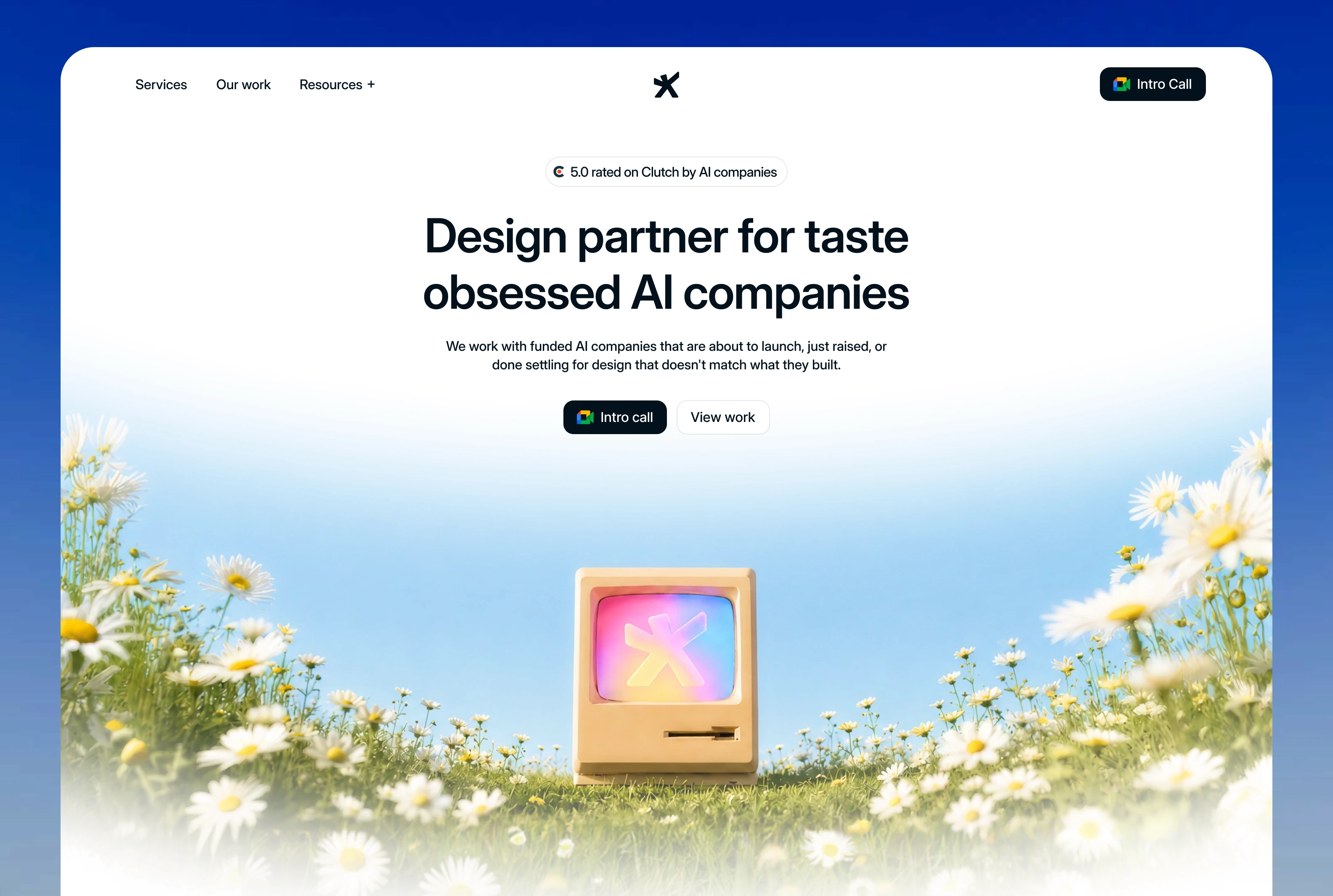
1. Studio Maydit: A Top-Rated Design Agency for AI Founders
A redesign after a pivot is mostly a question of what to keep. Studio Maydit starts there. It is a web and product design studio, and most of the teams it works with are AI founders. Those teams are based in the US, UK, and Europe.
For a startup with a relaunch date, fixed scope is the natural fit. The work runs three to four weeks. It closes with a diagnosis of what is leaking in the product, which matters here because a pivot often moves the drop-off from the website into signup. Teams that expect the story to keep shifting can choose a monthly retainer instead. It covers new pages, campaigns, and product design, with no long lock-in.
Each platform answers a different redesign problem. Framer suits a team whose marketer will rewrite pages every week after the pivot. Webflow suits a site with a large blog that must move without losing its rankings. Custom code suits a marketing site that shares a codebase with the product. The studio keeps going into product design once the new site is live, so the story and the app stay in step.
Dualite is the closest thing to a pivot story in the portfolio. When the company changed who it was built for, design work supporting that repositioned ICP helped carry the product to 100,000+ users in seven months. Other recent work spans Wave, PixelFlow, Mi-VAD, and 15 other AI and SaaS teams.
Check | Finding |
|---|---|
Based in | Remote, serving US / UK / EU |
Platform depth | Framer, Webflow, and custom code |
AI-sector proof | Yes. AI-native clients, published outcome on Dualite |
Pricing | Fixed scope or monthly retainer, quoted per project |
Team shape | Founder-led, small senior team |
Best fit | Startups whose site still describes the product they had before the pivot |
Send over your current sitemap and the pages that bring in signups, and we will talk through what a redesign should keep. Book a 30-minute call.

2. basement.studio
basement.studio builds in custom code from Mar del Plata and Los Angeles, with eleven to fifty people since 2018. Its client list reads like a map of well-known developer and AI products: Vercel, Cursor, ElevenLabs, Harvey AI, and Scale AI. For a startup whose marketing site lives next to the product code, a custom build keeps URL structure and redirects under engineering control. It also publishes a starting price.
The weakness is who can edit afterward. A custom build usually needs a developer for copy changes, and the published minimum sits at the higher end for a seed-stage team.
Check | Finding |
|---|---|
Based in | Mar del Plata, Argentina and Los Angeles, USA |
Founded | 2018 |
Team size | 11-50 |
Primary platform | Custom code |
AI-sector proof | Yes |
Named clients | Vercel, Cursor, ElevenLabs, Harvey AI, Scale AI |
Pricing | Published minimum |
Best fit | AI startups with engineers who will own the new site |
3. Clay
Clay is the only studio on this list with its headquarters in San Francisco. It was founded in 2016, has fifty-one to two hundred people, and works across platforms. It shows direct AI-sector proof and names Slack, Stripe, Google, Coinbase, and Amazon. A published starting price helps a founder decide early whether a full redesign with Clay fits the plan. Being local also makes an in-person kickoff easy to arrange.
The weakness is scale. Its named clients are very large companies, so a small startup may get a bigger project and process than a redesign needs.
Check | Finding |
|---|---|
Based in | San Francisco, USA |
Founded | 2016 |
Team size | 51-200 |
Primary platform | Mixed |
AI-sector proof | Yes |
Named clients | Slack, Stripe, Google, Coinbase, Amazon |
Pricing | Published minimum |
Best fit | Well-funded startups rebuilding brand and site together |
4. Pixelmatters
Pixelmatters has worked from Porto since 2013 with fifty-one to two hundred people across web and product. Its clients include Rubrik, Quantic, and UJET, which are software companies with complex products to explain. A team that size can run a careful page inventory alongside the design work. It publishes a starting price too.
The weakness is distance and sector depth. Porto sits eight to nine hours ahead of California, which limits live overlap, and AI-sector proof is partial.
Check | Finding |
|---|---|
Based in | Porto, Portugal |
Founded | 2013 |
Team size | 51-200 |
Primary platform | Mixed |
AI-sector proof | Partial |
Named clients | Rubrik, Quantic, UJET |
Pricing | Published minimum |
Best fit | B2B startups with many pages that need a structured migration |
5. Push Refresh
Push Refresh is a Framer studio of one to ten people in Dallas, with a published starting price. Clients include SmithRx, Synonym, and Northern National. For a startup that wants its marketer to own the site after a pivot, Framer keeps every page editable, and a small team means the founder talks to the designer directly.
The weakness is depth for a big move. No founding date is published, AI-sector proof is partial, and a tiny team may struggle with a large blog migration.
Check | Finding |
|---|---|
Based in | Dallas, USA |
Founded | Not published |
Team size | 1-10 |
Primary platform | Framer |
AI-sector proof | Partial |
Named clients | SmithRx, Synonym, Northern National |
Pricing | Published minimum |
Best fit | Small startup sites moving to Framer after a pivot |

6. SuperSkills
SuperSkills is based in Walnut Creek, in the East Bay, with a team of one to ten people. It works across platforms and shows direct AI-sector proof. For a Bay Area founder who wants an in-person working session now and then, the short drive is a real option. A small team also means the people who plan the redirects are the people who design the pages.
The weakness is the thin public record. It names one client, The Cut, and publishes no founding date or pricing, so a founder has little to judge before a call.
Check | Finding |
|---|---|
Based in | Walnut Creek, USA |
Founded | Not published |
Team size | 1-10 |
Primary platform | Mixed |
AI-sector proof | Yes |
Named clients | The Cut |
Pricing | Not published |
Best fit | Early AI startups that want a small nearby team |
7. Finsweet
Finsweet is a Webflow team of fifty-one to two hundred, headquartered in Denver and working distributed since 2017. Its clients include Dropbox, Clay, GitHub, and Steadily. Webflow's CMS suits a startup whose blog is its main source of search traffic, since posts can move in bulk and stay editable.
The weakness is fit outside Webflow. If the new site belongs in Framer or code, this is the wrong call. Pricing is not published, and AI-sector proof is partial.
Check | Finding |
|---|---|
Based in | Denver, USA, distributed |
Founded | 2017 |
Team size | 51-200 |
Primary platform | Webflow |
AI-sector proof | Partial |
Named clients | Dropbox, Clay, GitHub, Steadily |
Pricing | Not published |
Best fit | Content-heavy startups redesigning on Webflow |
8. Phantom
Phantom works from London and Auckland, with fifty-one to two hundred people building in custom code since 2013. It shows direct AI-sector proof and names Diageo, SAP, Financial Times, and Zendesk. Its engineering depth suits a redesign with complex templates or product data on the site.
The weakness is hours and audience. Both offices share little or no working day with California, the client list leans corporate, and no pricing is published.
Check | Finding |
|---|---|
Based in | London, UK and Auckland, NZ |
Founded | 2013 |
Team size | 51-200 |
Primary platform | Custom code |
AI-sector proof | Yes |
Named clients | Diageo, SAP, Financial Times, Zendesk |
Pricing | Not published |
Best fit | Later-stage AI startups with complex custom sites |
9. Instrument
Instrument has been based in Portland since 2005 and works across platforms. Its clients include Nike, Microsoft, Electronic Arts, and Google. It is on the same coast as the Bay Area and brings strong creative range to a brand-led relaunch. For a company whose pivot needs a big public moment, that range has value.
The weakness is size of fit. Its named work is for very large brands, team size and pricing are not published, and AI-sector proof is partial.
Check | Finding |
|---|---|
Based in | Portland, USA |
Founded | 2005 |
Team size | Not published |
Primary platform | Mixed |
AI-sector proof | Partial |
Named clients | Nike, Microsoft, Electronic Arts, Google |
Pricing | Not published |
Best fit | Late-stage companies planning a major brand relaunch |
10. Engine Digital
Engine Digital has built in custom code since 2002, from Vancouver and New York. It names Adidas, Autodesk, Goldman Sachs, and HP, and it has long experience with large, complex sites. A custom code build gives full control over URLs and redirects, which is the part of a migration most likely to break.
The weakness is everything a startup needs first. Its process is sized for large enterprises, team size and pricing are not published, and AI-sector proof is partial.
Check | Finding |
|---|---|
Based in | Vancouver and New York |
Founded | 2002 |
Team size | Not published |
Primary platform | Custom code |
AI-sector proof | Partial |
Named clients | Adidas, Autodesk, Goldman Sachs, HP |
Pricing | Not published |
Best fit | Enterprises rebuilding large custom platforms |
How to choose between them
Before you compare portfolios, open your analytics and find which pages brought signups last quarter. Then match the agency to what those pages need.
If the site shares code with the product: basement.studio, or Phantom for a later-stage team.
If the blog brings most of your search traffic: Finsweet on Webflow, or Pixelmatters for a structured migration.
If your marketer needs to rewrite pages every week: Push Refresh on Framer.
If the pivot also calls for a new brand: Clay.
If you are an early AI team and want a small group nearby: SuperSkills.
A quick test for any agency: ask what happens to your ten best-ranking URLs on launch day. A good answer names each page, its new address, and who checks it the week after. A vague answer means the traffic is at risk.

Need more info?
Can't find your answer? Book a call and let's talk.
Continue Reading
10 Best Framer Design Agencies for AI Agent Startups - September 2026
Ten Framer studios that have shipped for AI agent companies, with the demo and trust patterns those products need. Checked on platform depth, pricing and team.

Siddarth Ponangi
10 Best Framer Design Agencies for Newly Funded Startups - September 2026
Your funding announcement is the biggest traffic day you will have all year. We checked 10 Framer agencies on five public criteria to see which can hit that date.
Siddarth Ponangi
10 Best Custom Code Website Development Agencies for AI Agent Startups - September 2026
AI web development agencies for agent startups. Which teams build custom coded sites a small team can still update weekly after launch.
Siddarth Ponangi