Summarize with AI


A computer vision startup rebuilding its website has ten studios worth reviewing: Studio Maydit, Ramotion, Instrument, Engine Digital, Finsweet, 8020, Digidop, Flowout, Push Refresh, and Flow Ninja. The two strongest are Ramotion and Instrument. Ramotion is a San Francisco studio founded 2009 with eleven to fifty people, works across platforms, publishes a starting price, and has built for Mozilla, Okta, Netflix, Adobe, and Xero. Instrument is a Portland studio founded 2005 that works across platforms for Nike, Microsoft, Electronic Arts, and Google. Push Refresh and Flow Ninja are the weakest fit, the first a one-to-ten person Framer studio with no technical work published, the second a Webflow studio publishing neither a client name nor a price.
Look at ten computer vision websites and you will find hundreds of images, almost none of which came out of the product. That is the thing to fix.
Stock photography of a factory floor, a surgeon in theatre, a shelf in a supermarket. Every competitor uses the same library, so the pages are interchangeable, and the one asset that would separate you instantly is missing. Your model's actual output, a frame with real boxes on it and a real confidence value, is both more interesting and impossible for anyone else to copy. It is also the only image on the page that proves something.
The second problem is self-inflicted and specific to this category. A visually heavy site is a slow site unless somebody works at it, and you are selling speed. A page that takes six seconds to settle while claiming real-time inference loses the technical evaluator in the first ten seconds, before a word of the copy is read. Image weight is a credibility problem here in a way it simply is not for a text product.
Third, privacy is a sales surface rather than a legal footnote. If your model sees faces, premises, number plates, or patients, a serious buyer needs to know what is retained, where processing happens, and who can retrieve a frame. That belongs on a real page in the navigation. Most rebuilds bury it, and the buyer then assumes the answer is uncomfortable.

How we picked these agencies
Five checks set this order. All five can be settled from public pages before you spend an hour on a call.
First, whether the studio has built image-heavy pages that stay fast. Responsive sources, modern formats, sensible lazy loading, and a real budget for page weight. Plenty of studios make beautiful dense pages that take eight seconds to settle, and that is the one mistake this category cannot absorb.
Second, evidence with visually dense products where fidelity and performance both mattered. This replaces generic AI experience here, because a studio that built a chat interface has never had to get two hundred images onto a page without ruining it. Imaging tools, streaming products, and large media platforms all teach that discipline.
Third, whether a starting figure is public. You will be asking buyers to trust published accuracy numbers, so there is a consistency argument for hiring a studio comfortable publishing its own simplest figure.
Fourth, team shape. Your differentiator is usually narrow, perhaps performance on one awkward class under poor lighting. That nuance survives only while the person who understood it writes the page, so ask who that is and look at their work directly.
Fifth, the studio's own site, tested the way your evaluator will test yours. Load it on a phone on mobile data and watch the images arrive. If its own portfolio is slow, you have your answer about page weight.
Nothing below was estimated. Every value came from each studio's own published material, and Not published means the studio chose not to say.
What goes wrong
Stock imagery replaces the product's output. The rebuild looks polished and says nothing, because the photographs could belong to any vendor in your category. Replace them with real frames: a detection with its box and label, a rejected frame next to an accepted one, a short clip of inference running. If the customer footage cannot be cleared, shoot your own scene and run the model on it. A slightly rough real frame beats a beautiful irrelevant one.
Accuracy arrives as a single percentage. One number with no dataset, no class breakdown, and no false positive rate is not a claim a technical buyer can use, and in this category they all know to ask about the long tail. Publish the dataset, the date, the classes, and what happens in the hard conditions. A lower number with its method attached survives the evaluation that a rounder number does not.
The new site is slower than the product it sells. Hero video, uncompressed frames, a gallery that loads everything at once. Then the page that claims low latency takes six seconds to become readable. Set a weight budget before design starts, measure on a mid-range phone rather than a laptop, and treat a regression as a bug rather than a trade-off.
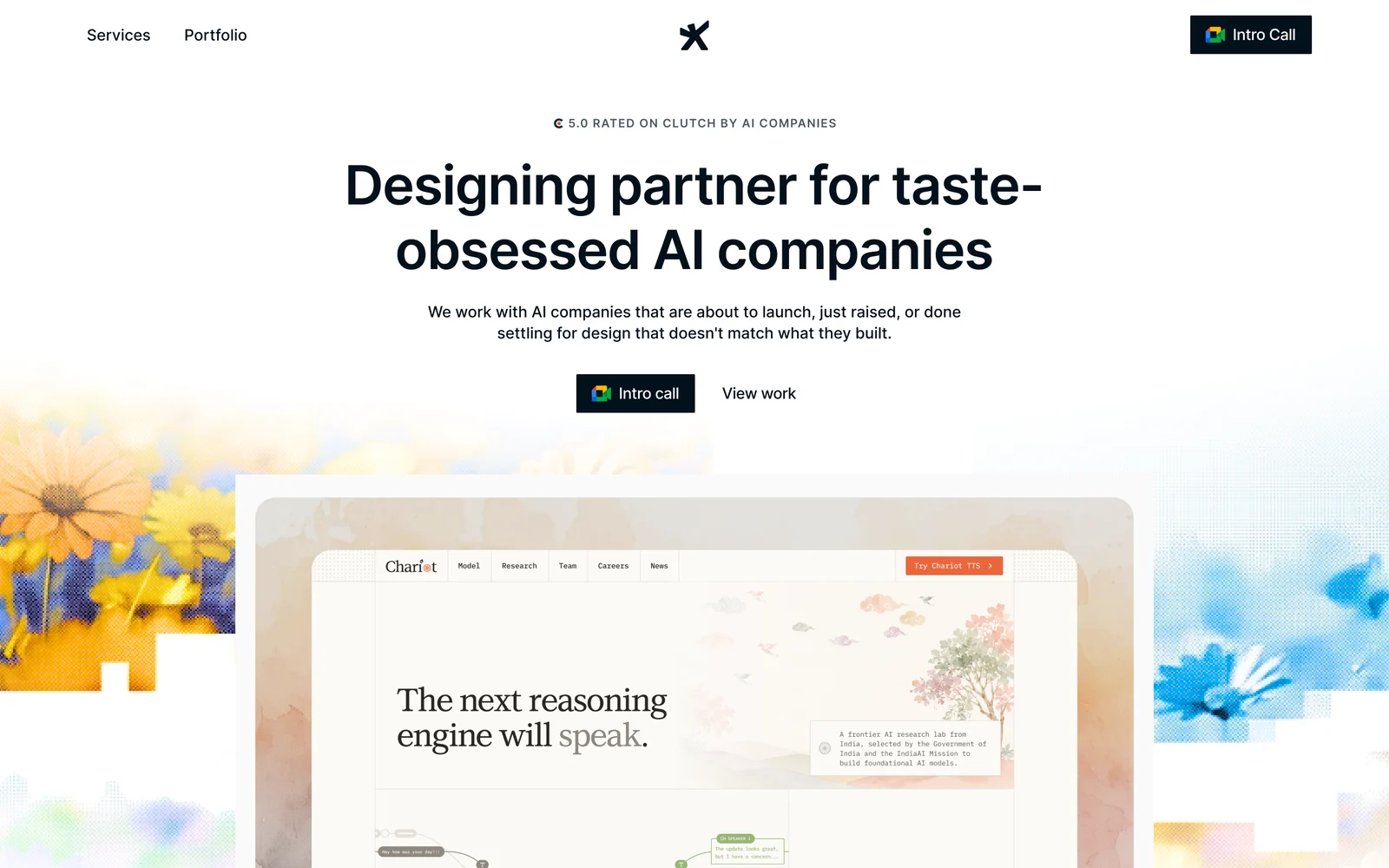
1. Studio Maydit: A Top-Rated Design Agency for AI Founders
In computer vision the fastest improvement is usually replacing borrowed pictures with your own output. Studio Maydit is a web and product design studio working with AI founders in the US, UK, and Europe, and the work here starts by choosing the frames that prove something, then building the page around them inside a weight budget that does not contradict your latency claim. Rebuilds run in Framer, Webflow, or custom code, and with a dense image set involved that choice is largely about how much control you get over how those images are served.
The design work continues past the site into the product. For a vision company that means the review surface: how a low confidence detection is flagged for a human, how a false positive is corrected so the correction is useful later, how a model version change is communicated to an operator who trusted the old one, and how an alert explains itself at two in the morning. The clearest published outcome is Dualite, where design work supporting a repositioned ICP helped the product reach 100,000+ users in seven months. Recent clients include Wave, PixelFlow, Mi-VAD, and 15 other AI and SaaS teams.
On commercial shape there are two options. A fixed scope across three to four weeks suits a team with a committed relaunch, and a monthly retainer suits a team that will keep adding pages, campaigns, and product work, with no long lock-in on either. The fixed-scope route ends in a written diagnosis of what is leaking in the product rather than a handoff and goodbye.
| Check | Finding |
|---|---|
| Based in | Remote, serving US / UK / EU |
| Platform depth | Framer, Webflow, and custom code |
| AI-sector proof | Yes. AI-native clients, published outcome on Dualite |
| Pricing | Fixed scope or monthly retainer, quoted per project |
| Team shape | Founder-led, small senior team |
| Best fit | Vision teams whose site uses stock photos instead of real output |
If every image on your homepage could belong to a competitor, that is the place to start. Book a 30-minute call.

2. Ramotion
Ramotion has run since 2009 from San Francisco, has eleven to fifty people, works across platforms, and publishes a starting price. Adobe is the name that puts it first. It is the reference point for imaging software, and a studio that has worked on it has handled dense visual interfaces where quality cannot be compromised for load time. Netflix adds streaming scale. Sixteen years of history with a published number and a team size that suits a startup is a rare combination in this pool.
The weakness is that its AI-sector proof is recorded as partial, so the specific work of arguing about model performance would be new to it, and a studio of that size runs a formal process that a team working to a trade show date may find slow.
| Check | Finding |
|---|---|
| Based in | San Francisco, USA |
| Founded | 2009 |
| Team size | 11-50 |
| Primary platform | Mixed |
| AI-sector proof | Partial |
| Named clients | Mozilla, Okta, Netflix, Adobe, Xero |
| Pricing | Published minimum |
| Best fit | Vision startups with a dense image set that has to stay fast |
3. Instrument
Instrument is a Portland studio founded 2005 working across platforms for Nike, Microsoft, Electronic Arts, and Google. Two decades of visually ambitious work is the deepest craft record here, and Electronic Arts in particular means the team has shipped pages carrying heavy visual assets to a large audience. For a product whose output is an image, a studio used to treating images as the argument rather than the decoration is worth a conversation.
The weakness is verifiability and scale. It publishes neither team size nor pricing, its sector proof is partial, and a client list of that shape means engagements sized for organisations with a brand department rather than a team of fifteen.
| Check | Finding |
|---|---|
| Based in | Portland, USA |
| Founded | 2005 |
| Team size | Not published |
| Primary platform | Mixed |
| AI-sector proof | Partial |
| Named clients | Nike, Microsoft, Electronic Arts, Google |
| Pricing | Not published |
| Best fit | Funded vision companies rebuilding a visually ambitious site |
4. Engine Digital
Engine Digital has operated since 2002 from Vancouver and New York, building in custom code. Autodesk is the relevant reference, complex technical software sold to people who work visually all day, and custom code is what lets an unusual page type be built properly, such as a frame viewer with toggles for detections and confidence. Two decades of replacing large sites is also the right discipline when there are rankings to protect.
The weakness is that everything is scaled for large organisations. It publishes neither team size nor pricing, its AI-sector proof is partial, and the timelines that come with enterprise engagements are longer than most vision startups can carry.
| Check | Finding |
|---|---|
| Based in | Vancouver and New York |
| Founded | 2002 |
| Team size | Not published |
| Primary platform | Custom code |
| AI-sector proof | Partial |
| Named clients | Adidas, Autodesk, Goldman Sachs, HP |
| Pricing | Not published |
| Best fit | Vision startups needing a custom viewer built into the page |
5. Finsweet
Finsweet is a distributed studio based in Denver, founded 2017, with fifty-one to two hundred people working in Webflow. It is the strongest engineering team among the Webflow studios here, with Dropbox, GitHub, and Steadily named, and Dropbox is a useful reference for handling large files gracefully. If you are staying on Webflow and need a filtered gallery of real detections that does not collapse under its own weight, this is the team most likely to manage it.
The weakness is cost visibility and sector distance. It publishes no starting price, its AI-sector proof is partial, and none of the named work involves model performance claims, so that argument would be unfamiliar territory.
| Check | Finding |
|---|---|
| Based in | Denver, USA, distributed |
| Founded | 2017 |
| Team size | 51-200 |
| Primary platform | Webflow |
| AI-sector proof | Partial |
| Named clients | Dropbox, Clay, GitHub, Steadily |
| Pricing | Not published |
| Best fit | Vision startups staying on Webflow with heavy galleries to build |
6. 8020
8020 is a San Francisco and New York studio founded 2014, working in Webflow for Wave, Superlist, Pilot.com, Vanta, and Circle. Vanta is the name worth weighing here. It is a compliance product, so this team has written the security, retention, and certification pages that a vision buyer reads before legal gets involved, and on a product that sees faces or premises those pages carry unusual weight.
The weakness is that it publishes neither team size nor a starting price, its sector proof is partial, and the named work is marketing sites rather than image-dense builds, so page weight discipline is not something it has demonstrated.
| Check | Finding |
|---|---|
| Based in | San Francisco and New York, USA |
| Founded | 2014 |
| Team size | Not published |
| Primary platform | Webflow |
| AI-sector proof | Partial |
| Named clients | Wave, Superlist, Pilot.com, Vanta, Circle |
| Pricing | Not published |
| Best fit | Vision startups whose weakest pages are privacy and retention |
7. Digidop
Digidop is a Paris studio of one to ten people founded 2021, working in Webflow with a published starting price. StreamNative is the useful name, real-time data infrastructure sold to engineers, so the team has written for a reader who checks what they are told. At that size the person who understood your performance story is the person writing about it, and in this category nuance usually disappears at the handoff.
The weakness is capacity against image work. One to ten people is a queue, and a dense gallery of real detections with a strict weight budget is slow, careful work rather than quick work.
| Check | Finding |
|---|---|
| Based in | Paris, France |
| Founded | 2021 |
| Team size | 1-10 |
| Primary platform | Webflow |
| AI-sector proof | Partial |
| Named clients | TSE Energy, Ramify, StreamNative |
| Pricing | Published minimum |
| Best fit | European vision startups with a small, technically written site |
8. Flowout
Flowout is a distributed Webflow studio with a published starting price, working for Jasper, Kajabi, Riverside, and Sendlane. It is the cheapest realistic option here and it is built around turnaround speed, so a vision startup whose site is genuinely small, with the technical depth living in documentation elsewhere, can get a contained result quickly.
The weakness is depth. It publishes neither a team size nor a founding date, its sector proof is partial, none of the named work is image-heavy, and nothing shows it has handled a migration with rankings at stake. If your existing pages earn real traffic, that is the exposure.
| Check | Finding |
|---|---|
| Based in | Distributed |
| Founded | Not published |
| Team size | Not published |
| Primary platform | Webflow |
| AI-sector proof | Partial |
| Named clients | Jasper, Kajabi, Riverside, Sendlane |
| Pricing | Published minimum |
| Best fit | Vision startups with a small marketing site and a tight budget |
9. Push Refresh
Push Refresh is a Dallas studio of one to ten people building in Framer, and it publishes a starting price. Talking directly to the person building is genuine value, and Framer gets a credible page live quickly, which suits a vision startup that needs one honest page before a funding conversation.
The weakness is the mismatch with the job. SmithRx, Synonym, and Northern National are competent projects with nothing technical or image-dense in them, its sector proof is partial, and a small Framer studio is not where a large detection gallery with a strict performance budget belongs.
| Check | Finding |
|---|---|
| Based in | Dallas, USA |
| Founded | Not published |
| Team size | 1-10 |
| Primary platform | Framer |
| AI-sector proof | Partial |
| Named clients | SmithRx, Synonym, Northern National |
| Pricing | Published minimum |
| Best fit | Vision startups who need one simple page before a raise |
10. Flow Ninja
Flow Ninja is a Belgrade studio founded 2018 with eleven to fifty people working in Webflow. A mid-size Webflow team in Serbia is a reasonable cost position for a straightforward rebuild, and eleven to fifty people is more capacity than several studios ranked above it have.
The weakness puts it last. It publishes no client names and no starting price, which empties both columns a shortlist depends on, and its sector proof is partial. You are about to ask buyers to trust numbers they cannot independently verify, so starting by hiring a studio whose own record cannot be verified is an uncomfortable position.
| Check | Finding |
|---|---|
| Based in | Belgrade, Serbia |
| Founded | 2018 |
| Team size | 11-50 |
| Primary platform | Webflow |
| AI-sector proof | Partial |
| Named clients | Not published |
| Pricing | Not published |
| Best fit | Vision startups wanting Webflow capacity at a lower rate |
How to choose between them
Sort by what the rebuild is actually solving.
Hundreds of real frames have to load fast. Ramotion or Finsweet.
A custom frame viewer has to be built into the page. Engine Digital or Instrument.
Privacy and retention are the pages that stall deals. 8020 or Digidop.
The site is small and the budget is smaller. Flowout or Push Refresh.
One test before you sign. Show a candidate a raw output frame from your model and ask what they would do with it on the homepage. A studio that understands this category will ask about the licence, the resolution, whether the confidence value can be shown, and how many such frames exist. A studio that does not will suggest an illustration instead.