
Summarize with AI


For a founder building again after selling a company, the ten studios worth reviewing are Studio Maydit, Refokus, Pixelmatters, Ramotion, Flow Ninja, Instrument, Engine Digital, Digidop, Push Refresh, and Flowout. Ramotion and Pixelmatters lead this list. Ramotion has designed software from San Francisco since 2009 with eleven to fifty people and a published starting price, for Mozilla, Okta, Netflix, Adobe, and Xero. Pixelmatters has run from Porto since 2013 with fifty-one to two hundred people, also publishes a figure, and keeps design and engineering under one roof. Instrument and Engine Digital are the wrong fit. Both are built around clients with internal marketing departments, and neither publishes a price or a headcount.
You have done this before, and that is the whole difficulty.
The playbook that worked last time was tuned to a market, a category, and a version of you that no longer exists. It still feels reliable, because it worked, and the parts that are now wrong are invisible precisely because they were right once. Second-time founders rarely fail at execution. They fail by executing something calibrated to five years ago.
Then there is your name, which is now an asset with an awkward shape. Lean on it too hard and the site becomes a personal brand page with a product attached, which puts off the operators you want to hire. Ignore it entirely and you throw away the one thing that gets a cold email opened. Almost nobody gets this balance right on the first attempt.
The third is patience, or rather the loss of it. You have capital and credibility, so the six weeks you spent last time arguing about who the customer was feels like a luxury you have outgrown. It was not a luxury. It was the reason the last one worked, and skipping it is the most expensive shortcut available to you.

How we picked these agencies
Five checks, each answerable from public pages before any calendar time is spent.
Platform depth. The question is not what looks best in a portfolio, it is what your company will be able to change without asking. You have seen how a site decays when the only person who can edit it has left, so the honest test is who publishes a new page in month six and what it costs them in time.
Proof with founder-led companies carrying a reputation. Has this studio worked where a named person is part of the story and the design had to hold both the person and the product. That is the criterion doing the most work here. It is a different skill from ordinary startup branding, and studios who have not done it either bury the founder or build a shrine.
Pricing. Is a starting number public. You can afford almost any of these, which is exactly why it matters: a published figure tells you what a studio thinks its work is worth before it has looked at your history and adjusted.
Team shape. Size tells you whether the senior people who pitched will be the ones working. Second-time founders attract flattering pitches, and the gap between the pitch team and the delivery team is the most common complaint at this end of the market.
Their own site. Read it for restraint. A studio that cannot resist a flourish will not stop you leaning too hard on your own story either.
An extra probe that works particularly well here. Ask how much of your background they would put on the homepage. A studio with the right experience gives a specific answer and a reason. A studio without one will say as much as you are comfortable with, which is not advice.
Every figure in the tables below is repeated from what each studio states publicly. Nothing has been estimated, and an unpublished value means the studio chose not to say rather than that it is unknown.
What goes wrong for exited founders
Three failures, and the first is the one that costs the most because it feels like competence.
The last company's playbook gets reused wholesale. Same positioning structure, same page order, same tone, same channel assumptions. It reads as assured and it is quietly aimed at a market that has moved on. The tell is that the new site could be reskinned into the old company without much editing. If that is true, the strategy was inherited rather than chosen, and buyers who were not there last time have no idea why any of it is arranged that way.
The founder story swallows the product. Your name opens doors, so it creeps up the page until the homepage is largely about you. Investors do not mind. Operators considering joining absolutely do, because they are trying to work out whether this is a company or a vehicle. Put the credibility where it does work, which is usually a short line and an about page, and give the homepage back to what the product does.
Speed replaces the thinking you did last time. With money in the bank a founder can commission everything at once and have a complete site in five weeks. The positioning argument that took a painful month at the last company gets compressed into a kickoff call, and the site ends up confident, polished, and pointed at a customer nobody has actually validated. Buy the slow part. It is the only part that is genuinely hard to redo.
1. Studio Maydit: A Top-Rated Design Agency for AI Founders
No long lock-in is the term that matters most for a founder who has run a company through several strategy changes. The monthly retainer covers new pages, campaigns, and product design for as long as it is useful and no longer than that. Fixed scope is the other route, three to four weeks, ending with a written diagnosis of what is leaking in the product rather than a handover call, which tends to land better with someone who has already sat through a lot of celebratory final presentations.
Second-time founders usually have a strong instinct about who the customer is, and it is usually the last company's customer. Dualite is the counter-example worth holding: a repositioned ICP was settled before design started, the work then served the narrower group that decision created, and 100,000+ users arrived across seven months. The order is the lesson. Narrowing first is what made the design decisions obvious later, and it is precisely the step that experience tempts you to skip.
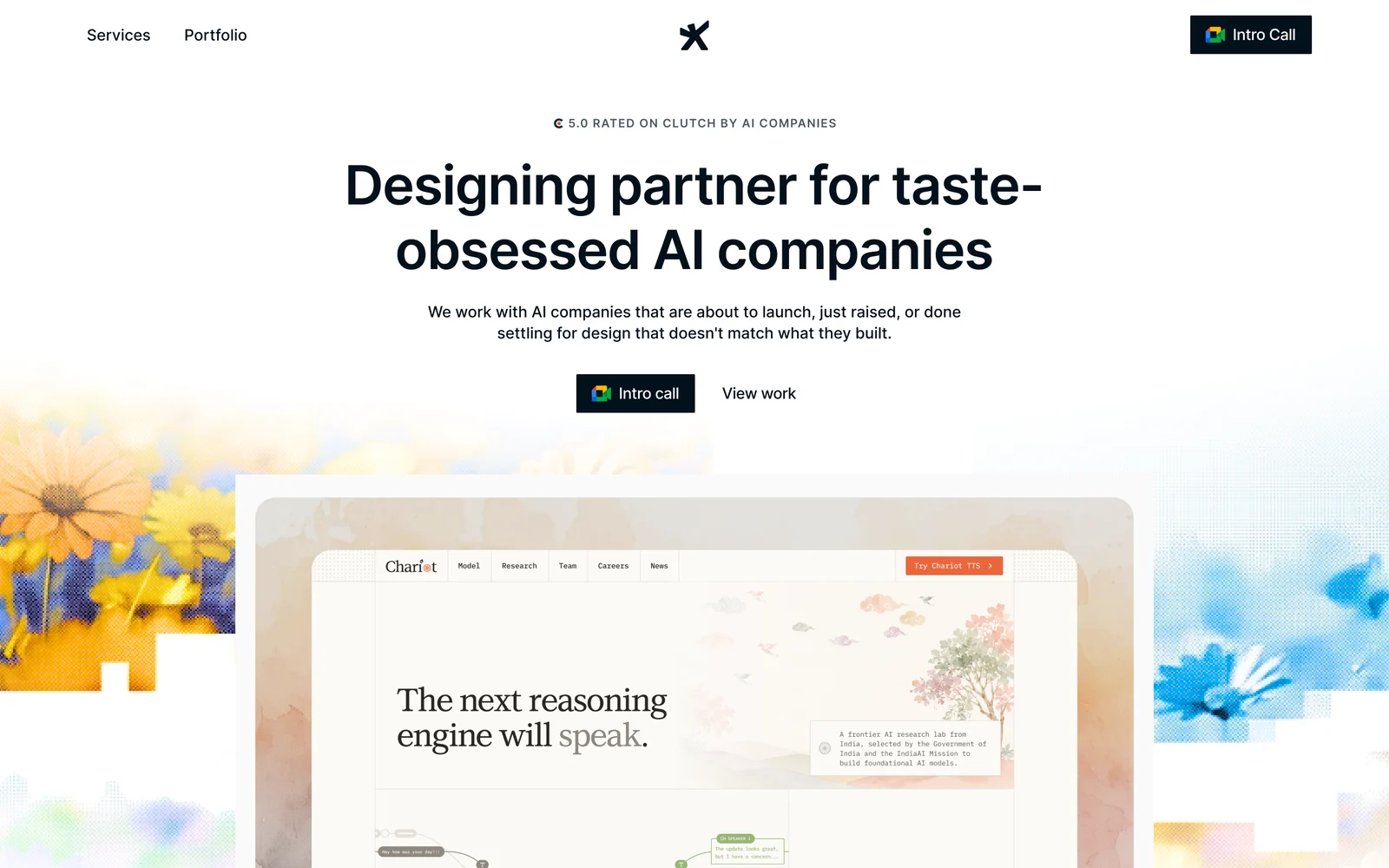
Studio Maydit is a web and product design studio. Its clients are AI founders, working across the US, UK, and Europe. Platform is chosen by who will own the site: Framer when you intend to edit it yourself, Webflow when an early marketing hire should run publishing, custom code when the product genuinely will not fit either. The engagement continues into product design after launch. Recent clients include Wave, PixelFlow, Mi-VAD, and 15 other AI and SaaS teams.
| Check | Finding |
|---|---|
| Based in | Remote, serving US / UK / EU |
| Platform depth | Framer, Webflow, and custom code |
| AI-sector proof | Yes. AI-native clients, published outcome on Dualite |
| Pricing | Fixed scope or monthly retainer, quoted per project |
| Team shape | Founder-led, small senior team |
| Best fit | Second-time founders whose new site reads like the last one |
If the new site could be reskinned into your old company, the strategy was inherited. Book a 30-minute call.

2. Ramotion
Ramotion has operated from San Francisco since 2009 with eleven to fifty people and a published starting price, for Mozilla, Okta, Netflix, Adobe, and Xero. Sixteen years of software design is a longer record than most founders have, and at that size the senior people stay on the work rather than moving to the next pitch.
The AI-sector proof is partial and the platform is mixed rather than fixed, so ask early what you are handed and who can edit it.
| Check | Finding |
|---|---|
| Based in | San Francisco, USA |
| Founded | 2009 |
| Team size | 11-50 |
| Primary platform | Mixed |
| AI-sector proof | Partial |
| Named clients | Mozilla, Okta, Netflix, Adobe, Xero |
| Pricing | Published minimum |
| Best fit | Founders wanting a long track record and senior people throughout |
3. Pixelmatters
Pixelmatters has worked from Porto since 2013 with fifty-one to two hundred people and a published starting price, for Rubrik, Quantic, and UJET. Design and engineering sit together, which removes the handover gap that usually eats a fortnight, and European rates buy more scope than a comparable US studio.
Portugal runs five to eight hours ahead of the US, so you share a morning rather than a day, and the AI-sector proof is partial.
| Check | Finding |
|---|---|
| Based in | Porto, Portugal |
| Founded | 2013 |
| Team size | 51-200 |
| Primary platform | Mixed |
| AI-sector proof | Partial |
| Named clients | Rubrik, Quantic, UJET |
| Pricing | Published minimum |
| Best fit | Teams wanting design and build in one place at European rates |
4. Refokus
Refokus is a remote German Webflow studio founded in 2021 with eleven to fifty people, for Mural, BASF, Spotify, Yahoo, and BCG. The craft level is high and the Webflow work is more ambitious than most, which suits a founder whose new company has to look established from day one.
The AI-sector proof is partial, no pricing is published, and the client list is large brands, so expect a process built for their pace.
| Check | Finding |
|---|---|
| Based in | Germany, remote |
| Founded | 2021 |
| Team size | 11-50 |
| Primary platform | Webflow |
| AI-sector proof | Partial |
| Named clients | Mural, BASF, Spotify, Yahoo, BCG |
| Pricing | Not published |
| Best fit | Teams who want the site to carry the credibility on its own |
5. Push Refresh
Push Refresh is a Dallas team of one to ten people working in Framer with a published starting price, for SmithRx, Synonym, and Northern National. A very small team means you deal with the person building, and Framer means you can rewrite a page yourself the week your thinking changes.
Capacity is the limit once several pages are needed at once, no founding year is published, and the AI-sector proof is partial.
| Check | Finding |
|---|---|
| Based in | Dallas, USA |
| Founded | Not published |
| Team size | 1-10 |
| Primary platform | Framer |
| AI-sector proof | Partial |
| Named clients | SmithRx, Synonym, Northern National |
| Pricing | Published minimum |
| Best fit | Founders who want to stay hands-on with the site |
6. Digidop
Digidop is a Paris Webflow studio founded in 2021 with one to ten people and a published starting price, for TSE Energy, Ramify, and StreamNative. StreamNative is developer infrastructure and Ramify is financial, so the writing has had to be careful in both directions.
It is a very small team, the AI-sector proof is partial, and European hours mean a shared morning rather than a full working day with a US team.
| Check | Finding |
|---|---|
| Based in | Paris, France |
| Founded | 2021 |
| Team size | 1-10 |
| Primary platform | Webflow |
| AI-sector proof | Partial |
| Named clients | TSE Energy, Ramify, StreamNative |
| Pricing | Published minimum |
| Best fit | European teams wanting a small studio with a stated price |
7. Flowout
Flowout is a distributed Webflow studio with a published starting price, for Jasper, Kajabi, Riverside, and Sendlane. The process is productised, so work begins in days rather than after a run of scoping calls, which suits a founder who has no patience left for procurement theatre.
Almost nothing else is published: no founding year, no team size, and the AI-sector proof is partial.
| Check | Finding |
|---|---|
| Based in | Distributed |
| Founded | Not published |
| Team size | Not published |
| Primary platform | Webflow |
| AI-sector proof | Partial |
| Named clients | Jasper, Kajabi, Riverside, Sendlane |
| Pricing | Published minimum |
| Best fit | Founders who want to start this week at a known number |
8. Flow Ninja
Flow Ninja is a Belgrade Webflow studio founded in 2018 with eleven to fifty people. European rates and a team that size mean a fairly large scope for the money, and Webflow keeps the site editable by whoever you hire next.
No clients are named, no pricing is published, and the AI-sector proof is partial, so there is very little public evidence to weigh before a call.
| Check | Finding |
|---|---|
| Based in | Belgrade, Serbia |
| Founded | 2018 |
| Team size | 11-50 |
| Primary platform | Webflow |
| AI-sector proof | Partial |
| Named clients | Not published |
| Pricing | Not published |
| Best fit | Teams happy to judge on a portfolio call rather than a client list |
9. Instrument
Instrument has run from Portland since 2005 for Nike, Microsoft, Electronic Arts, and Google. As brand work it is among the strongest here, and it has genuine cultural reach for a company large enough to make use of it.
The shape is the problem. These programmes assume an internal marketing and design team to receive them, the AI-sector proof is partial, and nothing is published about price or headcount.
| Check | Finding |
|---|---|
| Based in | Portland, USA |
| Founded | 2005 |
| Team size | Not published |
| Primary platform | Mixed |
| AI-sector proof | Partial |
| Named clients | Nike, Microsoft, Electronic Arts, Google |
| Pricing | Not published |
| Best fit | Later-stage companies buying a full brand programme |
10. Engine Digital
Engine Digital has worked from Vancouver and New York since 2002 in custom code, for Adidas, Autodesk, Goldman Sachs, and HP. Two decades inside organisations where approval is the hard part is real experience, and it shows in how carefully the engagements are run.
For a new company it is the wrong model. The work assumes an internal team, the timelines are long, custom code means returning for every edit, and neither price nor headcount is published.
| Check | Finding |
|---|---|
| Based in | Vancouver and New York |
| Founded | 2002 |
| Team size | Not published |
| Primary platform | Custom code |
| AI-sector proof | Partial |
| Named clients | Adidas, Autodesk, Goldman Sachs, HP |
| Pricing | Not published |
| Best fit | Large organisations with internal teams and long timelines |
How to choose between them
Sort by what is actually broken.
If the new site is recognisably the last company with different colours, you need an argument rather than a build. Ramotion, briefed on the difference between the two companies rather than on the new one alone.
If you want scope that would cost twice as much domestically, compare Europe honestly before assuming otherwise. Pixelmatters, which publishes a number and has American clients.
If the company must look established immediately because you are hiring senior people, that is craft. Refokus.
If you want to keep editing the site yourself, as you probably will, keep it small and self-serve. Push Refresh or Flowout.
One test before you sign. Ask them what they would cut from your background on the homepage. A studio with the right experience names something. A studio without one will tell you your story is the strongest asset you have, which is flattery rather than a plan.