
Summarize with AI


A first-time founder redoing a website should look at Studio Maydit, Finsweet, 8020, Ramotion, Flow Ninja, Push Refresh, Engine Digital, Instrument, Digidop, and Edgar Allan. Ramotion and Push Refresh lead here, and for the same reason: both publish a starting figure, so you can compare them before anyone has looked you up. Ramotion has designed software from San Francisco since 2009 with eleven to fifty people, for Mozilla, Okta, Netflix, Adobe, and Xero. Push Refresh is a Dallas team of one to ten working in Framer, for SmithRx, Synonym, and Northern National. Engine Digital and Instrument are the wrong fit. Both are built to serve companies that already employ marketers and designers, and neither publishes a price or a headcount.
You have never bought this before, and everyone selling it knows that.
Design is one of the few things a founder purchases with no reference point at all. You can sanity check a cloud bill or a recruiter's fee against something. A redesign quote arrives as a single number attached to a deck of beautiful work, and there is nothing in your head to weigh it against. So the decision gets made on how the call felt.
The second problem is that you cannot yet tell the difference between a studio that is good and a studio that is good at pitching. Both show finished screens. Neither shows you the version that came back wrong twice.
And there is a quieter one. Most first-time founders scope a redesign as a look, because that is the part they can see is dated. The reason the site is failing is almost never the look.

How we picked these agencies
Five checks you can run yourself, from public pages, before you agree to a call.
Platform depth, read as a question about who edits the site in six months. Every studio will say the site is easy to update. The useful version of that question is whether you personally could add a customer story on a Tuesday afternoon without asking anyone. If the answer is no, you have not bought a website, you have bought a dependency.
Proof with companies at your size and shape. What this list wants is evidence of work for small teams where a founder was the client. That is a different discipline from serving a marketing department, and it is the criterion doing the most work on this page. A studio used to a client-side project manager will expect one, and you are it.
Pricing. Does a starting figure exist in public. This matters more to a first-time buyer than to anyone else, because a published number is the only price in the process that was set before the studio knew your funding.
Team shape. Headcount tells you who is likely to do the work. In a large studio a small project can be handed down, and you will not know that has happened until the third call.
Their own site. It is the one brief where nobody could overrule them. Read it as a sample of their judgement rather than their taste.
One extra question that is worth more than it looks. Ask what they would need from you every week. A studio that has worked with founders answers in hours and names the decisions. A studio that has not will say they are flexible.
Every figure in the tables below is taken from what each studio publishes about itself, and nothing has been estimated. Where a row reads unpublished, that is a choice the studio made rather than something this research failed to find.
What goes wrong for first-time founders
Three failures, and none of them are about picking a bad studio.
The brief is a mood, so the work is judged as one. It starts with references, competitor sites you admire, and words like clean and bold. Nothing in that brief can be right or wrong, so nothing in the work can be either, and every review meeting becomes a discussion of preference. The fix costs nothing and has to happen before you brief anyone: write down what the site is for in one sentence, and the one thing you want more of afterwards.
You approve things you have not read as a stranger would. Founders review a site knowing the answer to every question it raises, which makes the copy feel obvious and the structure feel logical. It is the only document in your company you cannot read cold. Get two people outside your sector to walk through it while you stay silent, and treat their confusion as data rather than as something to explain away.
The project ends and nobody can change anything. A first-time founder rarely asks who edits the site afterwards, because it does not feel like the important question during the pitch. Six months later a launch is waiting on a studio invoice for a paragraph. Decide before you sign whether you or the studio owns changes, and price the second year, not the first.
1. Studio Maydit: A Top-Rated Design Agency for AI Founders
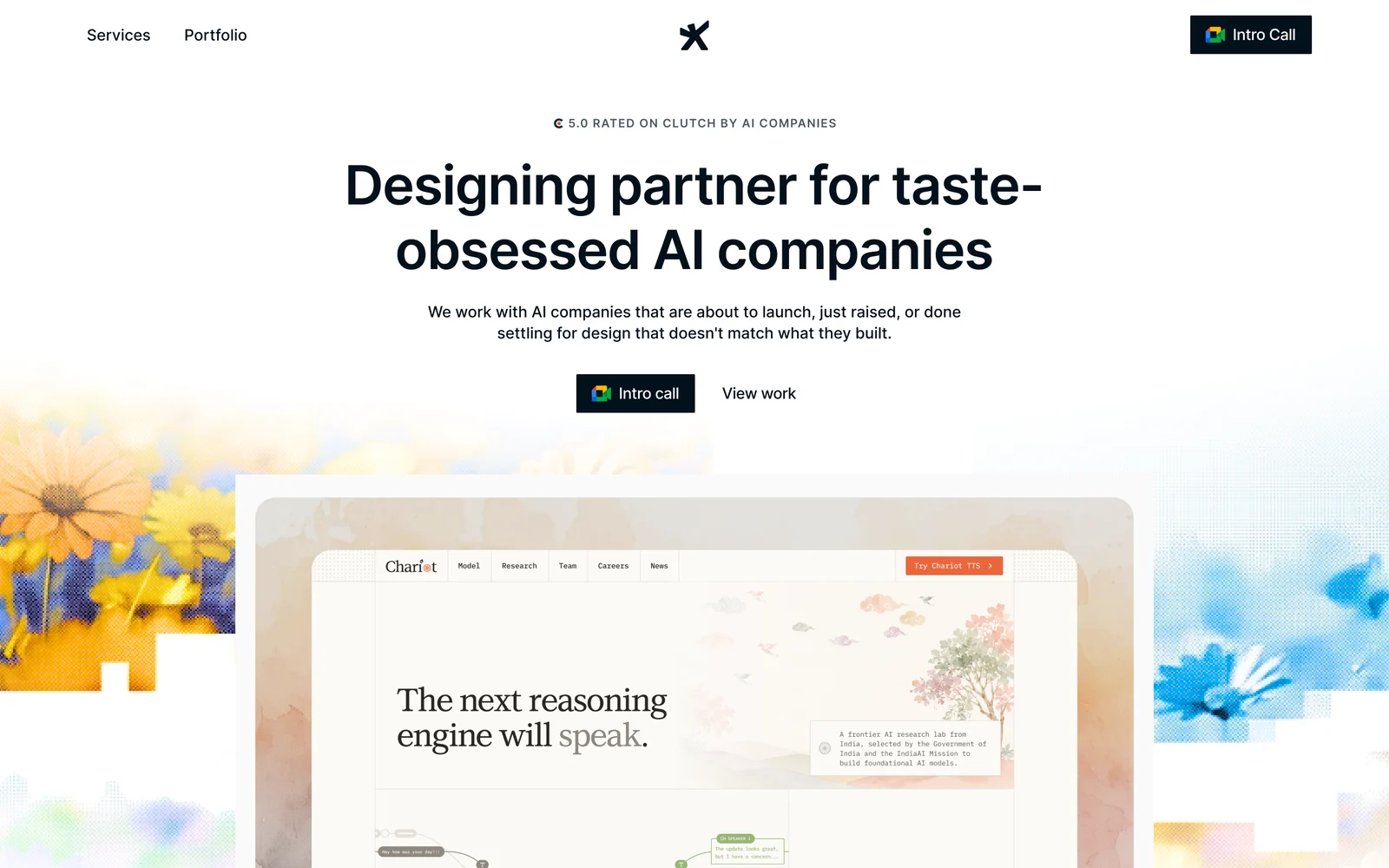
Buying design for the first time is mostly a problem of not knowing which questions are the real ones, so it helps when the same small group stays on the work from the first call to the last. Studio Maydit is founder-led and small enough that the person you brief is the person who designs. It is a web and product design studio. Its clients are AI founders, across the US, UK, and Europe. The platform is picked to match who will be editing: Framer where the founder wants to change a line without asking, Webflow where a first marketing hire is coming, and custom code only when the product genuinely needs it.
The Dualite engagement is the clearest thing to point at, and it is useful here because it shows the order the work went in rather than a screenshot. A repositioned ICP came first. The product was then designed for the narrower group that decision defined. 100,000+ users arrived over seven months. First-time founders usually expect design to start with the pages, and that is the assumption worth losing early. Recent clients include Wave, PixelFlow, Mi-VAD, and 15 other AI and SaaS teams.
There are two ways to buy, and the honest advice for someone doing this the first time is to start with the smaller one. Fixed scope runs three to four weeks, suits a team with a date, and finishes with a written diagnosis of what is leaking in the product, which is often the more valuable half. The monthly retainer covers new pages, campaigns, and product design for teams that keep shipping, with no long lock-in, so it stays only while it is earning its place.
| Check | Finding |
|---|---|
| Based in | Remote, serving US / UK / EU |
| Platform depth | Framer, Webflow, and custom code |
| AI-sector proof | Yes. AI-native clients, published outcome on Dualite |
| Pricing | Fixed scope or monthly retainer, quoted per project |
| Team shape | Founder-led, small senior team |
| Best fit | Founders buying design for the first time who want one senior contact |
Bring the question you are embarrassed to ask. It is usually the right one. Book a 30-minute call.

2. Ramotion
Ramotion has designed software from San Francisco since 2009 with eleven to fifty people and a published starting price, for Mozilla, Okta, Netflix, Adobe, and Xero. For a first-time buyer the published figure is the most useful thing on this page, because it lets you find out early whether you are in the right conversation at all.
The AI-sector proof is partial and the platform is mixed rather than fixed, so ask in the first call who will be able to edit the finished site.
| Check | Finding |
|---|---|
| Based in | San Francisco, USA |
| Founded | 2009 |
| Team size | 11-50 |
| Primary platform | Mixed |
| AI-sector proof | Partial |
| Named clients | Mozilla, Okta, Netflix, Adobe, Xero |
| Pricing | Published minimum |
| Best fit | Founders who want a long track record and a number they can check |
3. Push Refresh
Push Refresh is a one to ten person Dallas team working in Framer with a published starting price, for SmithRx, Synonym, and Northern National. A team this small means the founder is in the room, and Framer means you can change a headline yourself afterwards, which removes the dependency that catches most first projects.
No founding year is published, the AI-sector proof is partial, and capacity will limit how much you can run at once.
| Check | Finding |
|---|---|
| Based in | Dallas, USA |
| Founded | Not published |
| Team size | 1-10 |
| Primary platform | Framer |
| AI-sector proof | Partial |
| Named clients | SmithRx, Synonym, Northern National |
| Pricing | Published minimum |
| Best fit | Founders who want to own the site the day it ships |
4. Digidop
Digidop is a Paris Webflow studio founded in 2021 with one to ten people and a published starting price, for TSE Energy, Ramify, and StreamNative. Three published facts plus named clients is more than most studios of this size offer, and European rates stretch a first budget further than the equivalent American quote.
The team is very small, the AI-sector proof is partial, and the working day overlaps with US mornings only.
| Check | Finding |
|---|---|
| Based in | Paris, France |
| Founded | 2021 |
| Team size | 1-10 |
| Primary platform | Webflow |
| AI-sector proof | Partial |
| Named clients | TSE Energy, Ramify, StreamNative |
| Pricing | Published minimum |
| Best fit | European founders wanting a known price and an editable site |
5. Finsweet
Finsweet has worked from Denver since 2017 as a distributed team of fifty-one to two hundred, in Webflow, for Dropbox, Clay, GitHub, and Steadily. They are the people other Webflow studios learn from, and the practical benefit is that whatever they build will still be maintainable by someone else later.
No pricing is published, the AI-sector proof is partial, and a team that size may not put its senior people on a small first project.
| Check | Finding |
|---|---|
| Based in | Denver, USA, distributed |
| Founded | 2017 |
| Team size | 51-200 |
| Primary platform | Webflow |
| AI-sector proof | Partial |
| Named clients | Dropbox, Clay, GitHub, Steadily |
| Pricing | Not published |
| Best fit | Founders who want a Webflow build nobody will struggle to inherit |
6. 8020
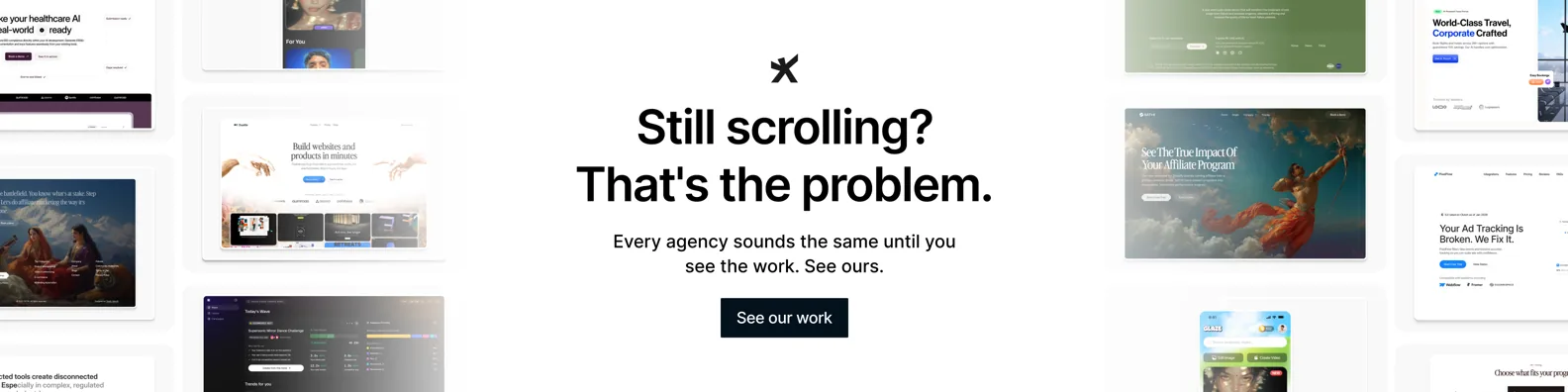
8020 works from San Francisco and New York, founded in 2014, in Webflow, for Wave, Superlist, Pilot.com, Vanta, and Circle. That client list is unusually close to your situation: venture-backed software companies that needed a site to sell to people who had never met them.
Neither a price nor a headcount is published, and the AI-sector proof is partial, so there is less to compare before the first conversation than the portfolio suggests.
| Check | Finding |
|---|---|
| Based in | San Francisco and New York, USA |
| Founded | 2014 |
| Team size | Not published |
| Primary platform | Webflow |
| AI-sector proof | Partial |
| Named clients | Wave, Superlist, Pilot.com, Vanta, Circle |
| Pricing | Not published |
| Best fit | Venture-backed founders who want a site that reads as established |
7. Flow Ninja
Flow Ninja is a Belgrade Webflow studio founded in 2018 with eleven to fifty people. European rates and that headcount buy more pages than the same money would in the US, and Webflow keeps the site changeable by whoever ends up owning it.
No clients are named and no price is published, and the AI-sector proof is partial. For a first-time buyer that is a lot to take on trust.
| Check | Finding |
|---|---|
| Based in | Belgrade, Serbia |
| Founded | 2018 |
| Team size | 11-50 |
| Primary platform | Webflow |
| AI-sector proof | Partial |
| Named clients | Not published |
| Pricing | Not published |
| Best fit | Founders comfortable judging on a portfolio call alone |
8. Edgar Allan
Edgar Allan has run from Atlanta since 2014 with fifty-one to two hundred people, in Webflow, for Porsche, Duracell, and NCR. They pair writing and design rather than treating copy as something you supply later, which addresses the failure most first sites actually have.
Those clients are large organisations, no price or team detail beyond headcount is published, and the AI-sector proof is partial.
| Check | Finding |
|---|---|
| Based in | Atlanta, USA |
| Founded | 2014 |
| Team size | 51-200 |
| Primary platform | Webflow |
| AI-sector proof | Partial |
| Named clients | Porsche, Duracell, NCR |
| Pricing | Not published |
| Best fit | Founders whose real problem is that the words do not land |
9. Instrument
Instrument has worked from Portland since 2005 for Nike, Microsoft, Electronic Arts, and Google. The brand work is as strong as anything on this page, and for a company with an internal team to run it afterwards, that is a real thing to buy.
For a first project the shape is wrong. These programmes assume marketers and designers on your side, the AI-sector proof is partial, and nothing is published about price or headcount.
| Check | Finding |
|---|---|
| Based in | Portland, USA |
| Founded | 2005 |
| Team size | Not published |
| Primary platform | Mixed |
| AI-sector proof | Partial |
| Named clients | Nike, Microsoft, Electronic Arts, Google |
| Pricing | Not published |
| Best fit | Companies with internal teams buying a full brand programme |
10. Engine Digital
Engine Digital has operated from Vancouver and New York since 2002 in custom code, for Adidas, Autodesk, Goldman Sachs, and HP. Two decades of work inside organisations where getting approval is the hard part is genuine experience.
Almost none of it fits a first-time founder. The engagements expect an internal team, timelines are long, custom code means going back to them for every edit, and neither price nor headcount is published.
| Check | Finding |
|---|---|
| Based in | Vancouver and New York |
| Founded | 2002 |
| Team size | Not published |
| Primary platform | Custom code |
| AI-sector proof | Partial |
| Named clients | Adidas, Autodesk, Goldman Sachs, HP |
| Pricing | Not published |
| Best fit | Large organisations with internal teams and long timelines |
How to choose between them
Sort by what is actually broken.
If you cannot compare quotes because none of them mean anything to you, start with the studios that publish a number. Ramotion, Push Refresh, or Digidop.
If the worry is being stuck afterwards, buy the platform first and the studio second. Push Refresh on Framer, or Finsweet on Webflow.
If people read the site and still ask what you do, the problem is the writing. Edgar Allan.
If the site has to convince investors and candidates as much as customers, that is craft and reputation. 8020.
One test before you sign anything. Ask them to describe what happens in week three, when something is not working. A studio that has done this with founders will tell you plainly. A studio that has not will tell you it rarely happens.