

Summarize with AI


Ten studios belong on the shortlist when a generative AI company rebuilds its site: Studio Maydit, Clay, Pixelmatters, Phantom, Refokus, Foundey, Edgar Allan, Kvalifik, Lighthouse Digital, and SuperSkills. Clay leads it. Founded 2016 in San Francisco, fifty-one to two hundred people, platform-agnostic, a published starting price, direct AI-sector proof, and Slack, Stripe, Google, Coinbase, and Amazon on the client list. Pixelmatters follows: Porto, 2013, the same size band, website and product design under one roof, a published price, and Rubrik, Quantic, and UJET named. At the other end, Lighthouse Digital records no AI-sector experience and SuperSkills is a one-to-ten person team with one client to its name.
An uncomfortable place to start, but it is the most useful thing on this page. Your best samples are your weakest marketing.
Everybody in your category leads with a gallery of their most beautiful outputs, and every buyer now assumes those were picked from a hundred attempts. They are right often enough that the assumption has become the default. So the gallery that took your team a week to assemble is read as advertising and skipped. What converts instead is the average: a set of outputs from a single prompt, unselected, or a side by side of what the model does well and what it still gets wrong. Honesty is now the differentiated position, because almost nobody is using it.
The second problem is one sentence that almost never appears where buyers look for it. Can I use this commercially. Someone generating images for a paid campaign, or copy for a client, needs to know what rights they have, what your training data means for them, and whether indemnification exists. That answer usually lives in terms of service, eleven clicks away, and it is a purchase decision.
Third, your upgrade wall is a design object with revenue attached. Where the free tier stops, what a visitor is allowed to try before signing in, and what the limit message says are all decisions a redesign will quietly change. Most rebuilds move that wall without measuring it and then cannot explain why conversion moved.

How we picked these agencies
Five checks produced this order, and each can be answered from public pages before a call is booked.
One, whether the studio can make something look distinct inside a crowded category. Your market has a visual default now: dark backgrounds, gradients, abstract glow. A studio whose portfolio all looks like one studio will give you a well-made version of that default. Look for range across its work, not a house style you admire once.
Two, evidence with consumer-facing products where differentiation mattered commercially. This replaces generic AI experience here, because plenty of AI-branded studios produce exactly the default described above. A studio that has positioned a product in a category full of near-identical competitors has done the harder version of your job.
Three, whether a starting figure is public. You are asking people to trust claims about output quality and rights, so a studio that hides its own simplest number is a slightly awkward partner for that argument.
Four, team shape. Your real advantage is usually narrow and specific, a particular style, speed, or control the alternatives lack. It survives only while the person who understood it writes the page, so ask for that person by name and look at what they made.
Five, the studio's own site as evidence of judgement. Ask whether you could tell it apart from four competitor sites with the logos removed. That is the exact test your homepage now has to pass.
Nothing in the tables was estimated. Every value came from each studio's own public material, and Not published means the studio chose not to say.
What goes wrong
The gallery is all highlights, so it reads as advertising. A wall of perfect outputs is the single most common hero in generative AI and it persuades nobody who has used one of these products before. Show a batch from one prompt with nothing removed. Show a weaker result beside a strong one and say what made the difference. A visitor who sees the range trusts the good examples, where a visitor who sees only the good ones trusts none of them.
Rights and commercial use stay buried in terms. The question of whether output can be used in paid work is asked by every professional buyer and answered on almost no homepage. Put it in the navigation, in plain language: what you may do with what you generate, what happens on a paid plan versus a free one, and whether there is any indemnity. Vagueness here is read as a problem, because it usually is one.
The upgrade wall moves during the rebuild and nobody measures it. A designer tidies the limit message, shifts the sign-in prompt earlier, and removes an ungated try. Each is defensible and together they can cost more than the redesign. Record where the wall sits now, what converts, and what a visitor can do before identifying themselves, then treat any change to it as an experiment with a number attached.
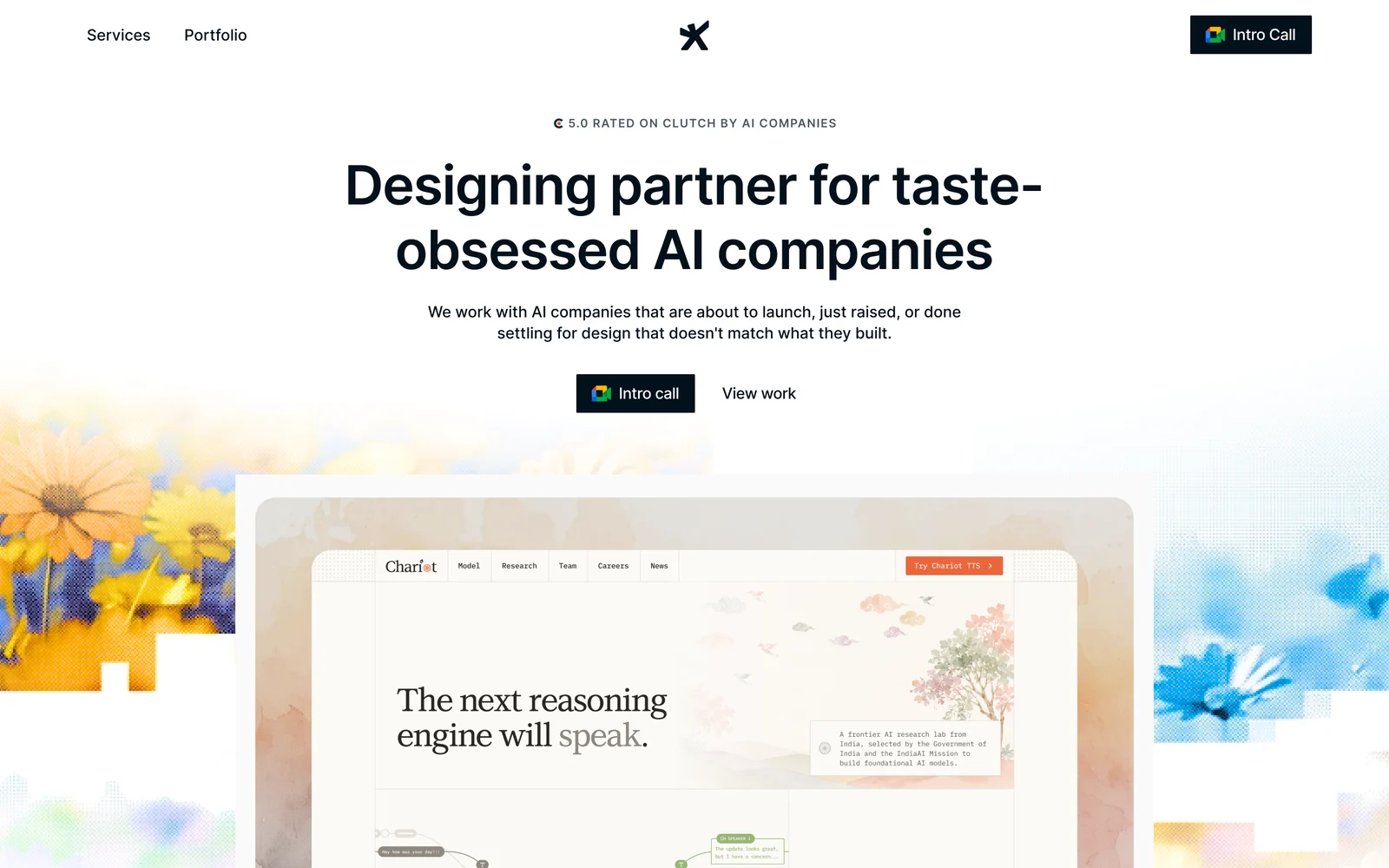
1. Studio Maydit: A Top-Rated Design Agency for AI Founders
The hardest question in a generative redesign is usually which outputs to show, not how to frame them. Studio Maydit is a web and product design studio working with AI founders in the US, UK, and Europe, and the work here starts by choosing a set of results that include the unremarkable ones, because that is what a buyer who has tried three competitors will actually believe. The rebuild happens in Framer, Webflow, or custom code, and with a large gallery involved that choice comes down to how much control you get over how the media is served.
Design carries on past the site into the product. For a generative tool that means the generation loop itself: how a prompt is suggested without being prescriptive, what fills the wait, how a poor result offers a next step rather than a dead end, how usage and remaining credits are shown before somebody is surprised, and where the upgrade sits. The clearest published outcome is Dualite, where design work supporting a repositioned ICP helped the product reach 100,000+ users in seven months. Recent clients include Wave, PixelFlow, Mi-VAD, and 15 other AI and SaaS teams.
Commercially there are two shapes. Teams with a launch date already fixed take the fixed scope, three to four weeks. Teams that will keep shipping pages, campaigns, and product design take the monthly retainer instead, with no long lock-in on either. A fixed-scope engagement ends with a written diagnosis of what is leaking in the product rather than a handoff and goodbye.
| Check | Finding |
|---|---|
| Based in | Remote, serving US / UK / EU |
| Platform depth | Framer, Webflow, and custom code |
| AI-sector proof | Yes. AI-native clients, published outcome on Dualite |
| Pricing | Fixed scope or monthly retainer, quoted per project |
| Team shape | Founder-led, small senior team |
| Best fit | Generative products whose gallery reads as cherry-picked |
If your homepage could be swapped with a competitor's and nobody would notice, start there. Book a 30-minute call.

2. Clay
Clay is a San Francisco studio founded 2016 with fifty-one to two hundred people, working across platforms, publishing a starting price, and carrying direct AI-sector proof. The client list is the argument: Slack, Stripe, Google, Coinbase, and Amazon are all companies that had to look unmistakably themselves in categories full of imitators. Coinbase in particular was differentiated inside a market where every competitor used the same visual cues, which is precisely your problem. A team that size also absorbs a large gallery build without stalling.
The weakness is stage fit. This is a studio set up for companies that already have a brand function, so a small generative startup will find the process heavier and the engagement larger than the work requires.
| Check | Finding |
|---|---|
| Based in | San Francisco, USA |
| Founded | 2016 |
| Team size | 51-200 |
| Primary platform | Mixed |
| AI-sector proof | Yes |
| Named clients | Slack, Stripe, Google, Coinbase, Amazon |
| Pricing | Published minimum |
| Best fit | Funded generative startups who need to stop looking generic |
3. Pixelmatters
Pixelmatters is a Porto studio founded 2013, fifty-one to two hundred people, working across website and product design with a published starting price. The reason it ranks here is the combination rather than a single client. Because the team does product design as well, the generation interface and the marketing site can be brought into one visual system, and for a generative product those two are barely separable, since the product is also the demo. UJET shows it can handle a complex interface with real operational constraints.
The weakness is that its AI-sector proof is partial, so the positioning fight in your category would be new, and a studio of that size runs a formal process that a team working to a launch date can find slow.
| Check | Finding |
|---|---|
| Based in | Porto, Portugal |
| Founded | 2013 |
| Team size | 51-200 |
| Primary platform | Mixed |
| AI-sector proof | Partial |
| Named clients | Rubrik, Quantic, UJET |
| Pricing | Published minimum |
| Best fit | Generative products where the site and the tool must match |
4. Phantom
Phantom has run since 2013 from London and Auckland, has fifty-one to two hundred people, builds in custom code, and records direct AI-sector proof. Diageo and the Financial Times are the useful names, both brands with a strong distinctive register rather than a trend-following one, and that is the register a generative product needs if it wants to look like a company rather than a demo. Custom code means a large, fast media gallery can be built properly.
The weakness is opacity and scale. It publishes neither team pricing nor a starting figure, the work is large-brand rather than product-led, and engagements sized for Diageo bring timelines a startup cannot easily absorb.
| Check | Finding |
|---|---|
| Based in | London, UK and Auckland, NZ |
| Founded | 2013 |
| Team size | 51-200 |
| Primary platform | Custom code |
| AI-sector proof | Yes |
| Named clients | Diageo, SAP, Financial Times, Zendesk |
| Pricing | Not published |
| Best fit | Generative startups who want a distinctive brand register |
5. Refokus
Refokus is a remote German studio of eleven to fifty people founded 2021, working mainly in Webflow for Mural, BASF, Spotify, Yahoo, and BCG. Its strength is restraint. Spotify shows a confident identity that does not reach for ornament, which is the opposite of the default look in your category and therefore the useful direction. Being European also helps when buyers ask where generation happens and what is retained.
The weakness is platform and evidence. Webflow makes a large, fast media gallery harder than custom code does, its AI-sector proof is partial, and it publishes no starting price, so cost stays a conversation rather than a check.
| Check | Finding |
|---|---|
| Based in | Germany, remote |
| Founded | 2021 |
| Team size | 11-50 |
| Primary platform | Webflow |
| AI-sector proof | Partial |
| Named clients | Mural, BASF, Spotify, Yahoo, BCG |
| Pricing | Not published |
| Best fit | Generative startups who want restraint instead of gradients |
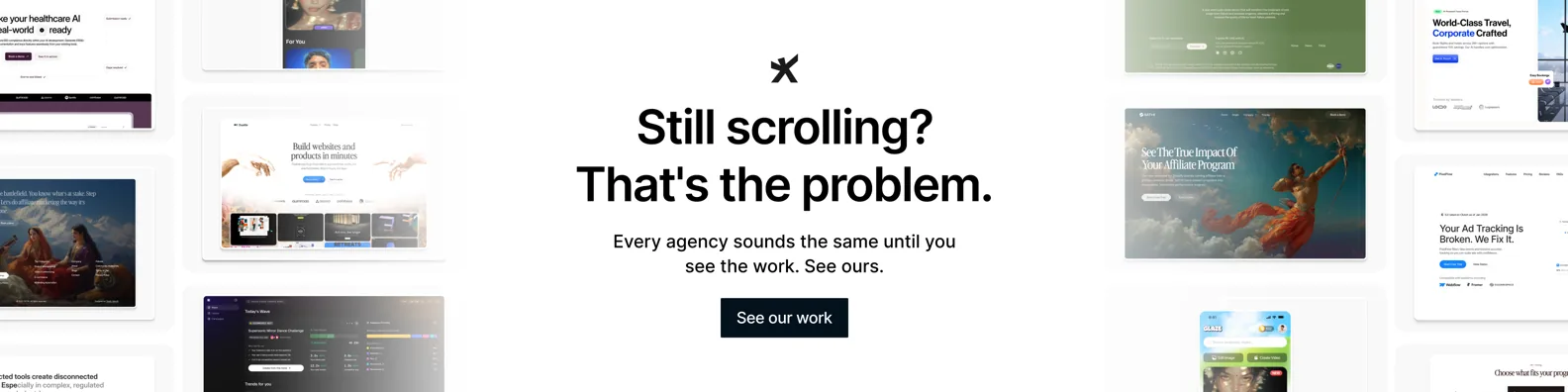
6. Foundey
Foundey is a San Francisco studio founded 2021 with direct AI-sector proof and the most AI-native client list in this pool: DemandIQ, Traycer, and Sero AI. A studio that has worked only with AI companies understands the category's visual default from the inside and will not need the competitive landscape explained during week one.
The weakness is decisive for a rebuild. Its platform is recorded as Figma-only, which means designs without a build, so you will need engineers or a second vendor to ship. It publishes neither team size nor pricing either, so capacity and cost both stay unknown.
| Check | Finding |
|---|---|
| Based in | San Francisco, USA |
| Founded | 2021 |
| Team size | Not published |
| Primary platform | Figma-only |
| AI-sector proof | Yes |
| Named clients | DemandIQ, Traycer, Sero AI |
| Pricing | Not published |
| Best fit | Generative teams with engineers ready to build the designs |
7. Edgar Allan
Edgar Allan is an Atlanta studio founded 2014 with fifty-one to two hundred people, building in Webflow for Porsche, Duracell, and NCR. Consumer brand work is more relevant here than it would be for an infrastructure product, because a generative tool is often sold to individuals rather than procurement committees, and Porsche is evidence of making a premium product feel premium. A team that size can also ship a lot of pages quickly.
The weakness is register and cost visibility. That client list is traditional brand marketing, which is a different voice from a product arguing about output quality, its sector proof is partial, and it publishes no starting price.
| Check | Finding |
|---|---|
| Based in | Atlanta, USA |
| Founded | 2014 |
| Team size | 51-200 |
| Primary platform | Webflow |
| AI-sector proof | Partial |
| Named clients | Porsche, Duracell, NCR |
| Pricing | Not published |
| Best fit | Consumer generative products rebuilding many pages in Webflow |
8. Kvalifik
Kvalifik is a Copenhagen studio founded 2015 with eleven to fifty people building in Webflow, and it has direct AI-sector proof. Veo is a useful reference, a consumer sports product where the output is media and the experience depends on it being good enough to share, which is structurally close to what you sell. A Nordic base also helps with European buyers asking about data handling.
The weakness is visibility. It publishes no starting price, and while its sector proof is direct, none of the named work involves arguing about rights or licensing, which is one of the two pages your buyers most want answered.
| Check | Finding |
|---|---|
| Based in | Copenhagen, Denmark |
| Founded | 2015 |
| Team size | 11-50 |
| Primary platform | Webflow |
| AI-sector proof | Yes |
| Named clients | Veo, Maersk, Relesys |
| Pricing | Not published |
| Best fit | European generative products selling media people share |
9. Lighthouse Digital
Lighthouse Digital is a London studio working in Webflow, and it publishes a starting price, which several studios above it do not. HelloSelf, Freetrade, and IGN are credible consumer projects, and IGN is media at scale, so the team has handled pages built around a lot of content.
The weakness settles its place. Its AI-sector proof is recorded as none, so the category's positioning problem would be entirely new ground, and it publishes neither team size nor a founding date, which makes its capacity for a gallery-heavy rebuild impossible to judge before a conversation.
| Check | Finding |
|---|---|
| Based in | London, UK |
| Founded | Not published |
| Team size | Not published |
| Primary platform | Webflow |
| AI-sector proof | No |
| Named clients | HelloSelf, Freetrade, IGN |
| Pricing | Published minimum |
| Best fit | UK generative products with a small site and a published price |
10. SuperSkills
SuperSkills is a one-to-ten person studio in Walnut Creek working across platforms, and it does record direct AI-sector proof. The Cut is consumer media, which is at least the right audience shape for a generative tool sold to individuals, and a team that small puts the founder on every call.
The weakness puts it last. One named client, no founding date, and no published price leaves almost nothing to evaluate, and a one-to-ten person team is thin for a rebuild that includes a large gallery and a rewritten rights page. With existing rankings at stake, the absence of a migration record is the real exposure.
| Check | Finding |
|---|---|
| Based in | Walnut Creek, USA |
| Founded | Not published |
| Team size | 1-10 |
| Primary platform | Mixed |
| AI-sector proof | Yes |
| Named clients | The Cut |
| Pricing | Not published |
| Best fit | Generative startups wanting a founder-only engagement on a small site |
How to choose between them
Sort by what the rebuild has to fix.
You look like everyone else in the category. Clay or Phantom.
The site and the generation tool must feel like one product. Pixelmatters or Foundey.
A large gallery has to load fast and stay browsable. Refokus or Edgar Allan.
You sell to individuals and the tone has to be warm. Kvalifik or Lighthouse Digital.
One test before you sign. Show a candidate twenty unselected outputs from one prompt and ask which they would publish. A studio that understands this category will want several of the ordinary ones on the page and will ask what separates the good from the weak. A studio that does not will pick the three prettiest, which is the gallery you already have and nobody believes.