Reading time:
14 min read
Last updated:
10 Best Website Redesign Agencies for London AI Startups - September 2026
Ten studios that redesign websites for London AI startups, ranked on AI-sector proof, transatlantic credibility, and who can still edit the site after launch.

In fit order for a London AI company rebuilding its site, the ten are Studio Maydit, Phantom, basement.studio, BX Studio, Clay, Lazarev, Feely Studio, Feels Like, Fantasy, and Foundey. Phantom and basement.studio are the two strongest of the nine. Phantom is a London studio of fifty-one to two hundred people that has built for SAP, Diageo, the Financial Times, and Zendesk. basement.studio writes custom code for Vercel, Cursor, ElevenLabs, Harvey AI, and Scale AI, which is the most convincing AI client list on this page, and it publishes a starting price. Fantasy and Foundey are the weakest fit. Fantasy names no clients publicly, so its work cannot be checked. Foundey works only in Figma, so you would finish the project with design files and no site.
Your website has a harder job than your product does.
Most London AI companies reach a point where growth stops being local. The investors want American revenue, the competitors are in San Francisco, and the next tranche of customers has never been to this country. Those people arrive at your site knowing nothing about you.
They apply a blunt test in about twelve seconds. Is this a real company, or is it four people above a coffee shop in Shoreditch?
Nothing on the page answers that directly. They read it from signals. How specific the product explanation is. Whether the customers are named. Whether pricing exists at all. Whether the careers page suggests a team or a wish.
Meanwhile the site still has to work for the UK buyers who already pay you, many of whom sit in banks, insurers, and law firms, and who trust you partly because you are local and reachable.
The studios below were ranked on whether they can pass the stranger's twelve-second test without throwing away the proof that convinced everyone at home.

How these studios were compared
Five checks, each one confirmable from a studio's public pages before you contact anybody.
Build platform. Once the project ends, who can change a page? A visual platform with a CMS leaves the site in your hands. Custom code leaves it in an engineer's queue, and a company publishing launch content weekly will feel that within a month.
AI-sector proof that a stranger would recognise. This is the check that carries the most weight here. Your site has to convince people who have never heard of you, and a studio whose portfolio includes AI products they already use has done that job before. Adjacent proof, such as enterprise software or financial clients, counts as well, because that is who buys in this city.
A published price. A starting figure lets you rule a studio in or out in a minute. Studios that publish nothing usually want two calls before anyone says a number, which is a week you may not have.
Team shape. A small studio gives you a senior person from start to finish. A large one has the capacity for a big rebuild but distributes the work, so establish who is actually on your project rather than who is in the pitch.
The studio's own site. It is a working sample. If its own pages make a clear argument, yours will too. If they are beautiful and say nothing, expect a beautiful site that says nothing.
Platform and recognisable AI proof set the order. Price and team shape resolved the close calls. A studio's own site could pull it down but never lift it.
Everything in the tables comes from what each studio states publicly. Where a studio publishes nothing, such as a headcount or a price, the row reads Not published and nothing has been inferred.
What goes wrong when a London AI startup redesigns its website
British restraint reads as a small company to an American buyer. Understatement is good manners here and ambiguity abroad. Phrases like helping teams work a little smarter, or a modest claim with no number attached, land as tentative to a reader in Austin who has seen three bolder competitors that morning. You do not need to shout, but you do need specifics: what the product does, how much time it removes, and who it already works for. Replace every hedged sentence with a measurable one.
The site is built entirely in local defaults and caps you at the UK. Prices in pounds only, case studies from British companies only, a phone number in London hours, dates written the British way in a product screenshot. Individually they are trivial. Together they tell an American buyer that they would be an exception to how you work. Decide early which currencies, time zones, and proof points the site shows, and make the American reader a first-class visitor rather than a guest.
The overcorrection throws away the proof that already worked. The other failure is a site rebuilt to look like a Californian company, which quietly drops the named UK customers, the regulated-sector case study, and the local credibility that won those accounts. Your UK pipeline slows and nobody ties it to the new design. Keep the proof and change the framing around it, rather than replacing one audience's evidence with another's aesthetic.
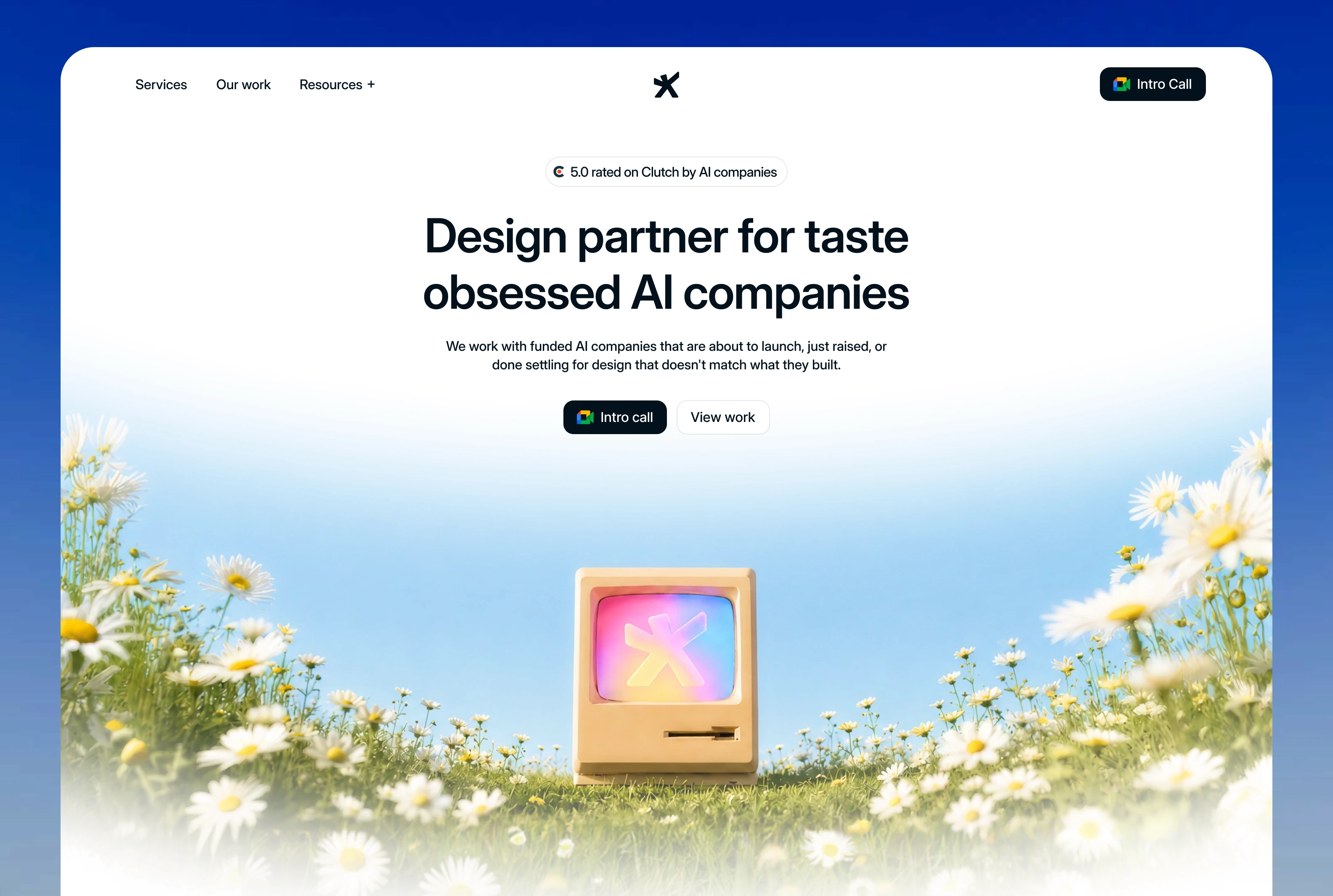
1. Studio Maydit: A Top-Rated Design Agency for AI Founders
Studio Maydit is a web and product design studio working with AI founders in the US, UK, and Europe. That mix is the practical reason to consider it for this brief. A studio that ships for both British and American companies has already learned where a UK page loses an American reader, and where an American page overstates what a London buyer will accept.
Buying works two ways. Fixed scope runs three to four weeks and suits a rebuild pinned to a raise or a US launch. It ends with a diagnosis of what is leaking in the product, written down rather than presented once and forgotten. Companies shipping continuously take the monthly retainer, which covers new pages, campaigns, and product design, with no long lock-in. On the build side, Framer suits a fast site your team edits weekly, Webflow suits one that will grow into a library of use cases and comparisons, and custom code is reserved for pages that show live product data. Product design continues after launch with the same people, which matters when your problem turns out to sit past the sign-up button.
Dualite is the published result. Design work supporting a repositioned ICP carried it to 100,000+ users in seven months, a case of an audience change being executed on the pages rather than announced in a deck. Recent clients include Wave, PixelFlow, Mi-VAD, and 15 other AI and SaaS teams.
Check | Finding |
|---|---|
Based in | Remote, serving US / UK / EU |
Platform depth | Framer, Webflow, and custom code |
AI-sector proof | Yes. AI-native clients, published outcome on Dualite |
Pricing | Fixed scope or monthly retainer, quoted per project |
Team shape | Founder-led, small senior team |
Best fit | London AI teams selling into the US without losing their UK proof |
Send us your homepage and the name of one American company you want as a customer, and we will tell you what they would miss. Book a 30-minute call.

2. Phantom
Phantom has built from London and Auckland since 2013, with fifty-one to two hundred people writing custom code. SAP, Diageo, the Financial Times, and Zendesk are clients. That is a roster your UK enterprise buyers recognise instantly, and it is real proof that the studio can pass the procurement process at a large institution. It carries genuine AI-sector proof as well, which is rare at this scale.
The weakness is what happens after launch. Custom code puts every future page behind an engineer, which suits a company that ships quarterly rather than weekly. No price is published and the premium tier sets a high floor.
Check | Finding |
|---|---|
Based in | London, UK and Auckland, NZ |
Founded | 2013 |
Team size | 51-200 |
Primary platform | Custom code |
AI-sector proof | Yes |
Named clients | Diageo, SAP, Financial Times, Zendesk |
Pricing | Not published |
Best fit | Funded London companies selling into enterprise and finance |
3. basement.studio
basement.studio works in custom code from Mar del Plata and Los Angeles, founded in 2018 with eleven to fifty people, and it publishes a starting price. Vercel, Cursor, ElevenLabs, Harvey AI, and Scale AI are clients. For a London company trying to look credible to an American technical buyer, that list does the job on its own, and ElevenLabs and Harvey are companies your investors already talk about.
The weakness is ownership and hours. Custom code means your marketer cannot add a page alone, and the studio's time zones sit west of London, so same-day replies take planning.
Check | Finding |
|---|---|
Based in | Mar del Plata, Argentina and Los Angeles, USA |
Founded | 2018 |
Team size | 11-50 |
Primary platform | Custom code |
AI-sector proof | Yes |
Named clients | Vercel, Cursor, ElevenLabs, Harvey AI, Scale AI |
Pricing | Published minimum |
Best fit | London AI teams whose credibility problem is with US technical buyers |
4. BX Studio
BX Studio builds in Webflow from New York with eleven to fifty people, and it publishes a starting price. Reddit, Headspace, ASAPP, and Verifone are clients. A New York studio brings the American reader's instincts to your pages, ASAPP is an AI company selling into large enterprises, and Webflow leaves the finished site editable by your own team in London.
The weakness is size and history. Eleven to fifty people means a very large rebuild may need phasing, and no founding year is published, so the track record takes a conversation to establish.
Check | Finding |
|---|---|
Based in | New York, USA |
Founded | Not published |
Team size | 11-50 |
Primary platform | Webflow |
AI-sector proof | Yes |
Named clients | Reddit, Headspace, ASAPP, Verifone |
Pricing | Published minimum |
Best fit | London teams wanting a US-facing site they can edit themselves |
5. Clay
Clay has worked from San Francisco since 2016 with fifty-one to two hundred people, and it publishes a starting price. Slack, Stripe, Google, Coinbase, and Amazon are clients. Stripe and Coinbase are the two companies most often cited as the standard for financial product pages, which is directly useful if your buyers sit in London's financial district.
The weakness is proportion and distance. This is a premium studio built for large clients, so a startup rebuild is a small engagement, the platform is mixed rather than a specialism, and California hours leave a narrow overlap with a London team.
Check | Finding |
|---|---|
Based in | San Francisco, USA |
Founded | 2016 |
Team size | 51-200 |
Primary platform | Mixed |
AI-sector proof | Yes |
Named clients | Slack, Stripe, Google, Coinbase, Amazon |
Pricing | Published minimum |
Best fit | Well-funded London companies chasing a US enterprise standard |

6. Lazarev
Lazarev has worked from San Francisco since 2015 with fifty-one to two hundred people, and it publishes a starting price. Payoneer, Peel, Elva, and Mozayix are clients. Payoneer is cross-border payments, which is a useful instinct for a company whose customers and pricing span two currencies, and the studio has real AI-sector proof.
The weakness is specificity. The platform is mixed, so editing rights after launch depend on what gets built, the tier is premium, and the client list is less recognisable to a UK enterprise buyer than the studios above.
Check | Finding |
|---|---|
Based in | San Francisco, USA |
Founded | 2015 |
Team size | 51-200 |
Primary platform | Mixed |
AI-sector proof | Yes |
Named clients | Payoneer, Peel, Elva, Mozayix |
Pricing | Published minimum |
Best fit | London fintech-adjacent AI teams selling across currencies |
7. Feely Studio
Feely Studio is a distributed European team of one to ten people that publishes a starting price, working across platforms for Noxus, Mutiny, Luasai, and Basic Capital. European hours suit a London team, the AI proof is real, and Mutiny is built around showing different visitors different things, which is the exact problem of a site serving both UK and US readers.
The weakness is capacity. One to ten people in the budget tier is thin for a full rebuild with two audiences, and no founding year is published.
Check | Finding |
|---|---|
Based in | Distributed, Europe |
Founded | Not published |
Team size | 1-10 |
Primary platform | Mixed |
AI-sector proof | Yes |
Named clients | Noxus, Mutiny, Luasai, Basic Capital |
Pricing | Published minimum |
Best fit | Earlier London teams that need AI fluency on European hours |
8. Feels Like
Feels Like writes custom code from Los Angeles, founded in 2023, for Google, Nike, LVMH, and Suno AI. The craft level is high and Suno is a genuine AI client, so a company that wants to look considerably more established than it is will get there visually.
The weakness is maintenance and record. Custom code keeps your team dependent on the studio for changes, no price or team size is published, and a 2023 founding date gives you little history to check.
Check | Finding |
|---|---|
Based in | Los Angeles, USA |
Founded | 2023 |
Team size | Not published |
Primary platform | Custom code |
AI-sector proof | Yes |
Named clients | Google, Nike, LVMH, Suno AI |
Pricing | Not published |
Best fit | Brand-first rebuilds where visual craft outranks editability |
9. Fantasy
Fantasy has worked from San Francisco and New York since 1999 across several platforms, and it carries AI-sector proof. Twenty-six years of practice is a long record, and a studio that has survived that long has seen every kind of client and every kind of approval process.
The weakness is verification. No client names are published, so you cannot check whether the AI work resembles yours. No price and no team size are published either, and the premium tier suggests a floor well above a startup rebuild.
Check | Finding |
|---|---|
Based in | San Francisco and New York, USA |
Founded | 1999 |
Team size | Not published |
Primary platform | Mixed |
AI-sector proof | Yes |
Named clients | Not published |
Pricing | Not published |
Best fit | Large budgets where a long record matters more than a checkable one |
10. Foundey
Foundey has designed for AI companies from San Francisco since 2021, with DemandIQ, Traycer, and Sero AI as clients. All three are AI products, so the sector understanding is genuine and you would not spend the first week explaining what a model is.
The weakness settles its position. Foundey works in Figma, so a redesign ends with files rather than a live site, and you would need a separate build partner. No price and no team size are published.
Check | Finding |
|---|---|
Based in | San Francisco, USA |
Founded | 2021 |
Team size | Not published |
Primary platform | Figma-only |
AI-sector proof | Yes |
Named clients | DemandIQ, Traycer, Sero AI |
Pricing | Not published |
Best fit | Teams with in-house developers who only need the design |
How to choose between them
Sort by which reader your current site is losing, not by which portfolio impresses your board.
American buyers do not believe you are a real company. basement.studio or Clay, and insist the new pages carry named customers and numbers rather than adjectives.
UK enterprise and financial deals are the pipeline. Phantom, or Lazarev if the product touches payments, and ask to see a page that survived a procurement review.
Your team needs to publish without help. BX Studio or Feely Studio, both on platforms your marketer can use after handover.
The budget has to be known before approval. basement.studio, BX Studio, Clay, Lazarev, and Feely Studio all publish a starting price.
The most revealing test: send each studio your homepage and ask what an American buyer would fail to understand. A studio that answers with missing evidence and vague claims is reading your business. A studio that answers with layout and typography is reading your visuals.

Need more info?
Can't find your answer? Book a call and let's talk.
Continue Reading
10 Best Framer Design Agencies for AI Agent Startups - September 2026
What is the best Framer agency for an AI agent startup? Ten Framer studios ranked for agent products, with pricing, team size and AI work compared.

Siddarth Ponangi
10 Best Framer Design Agencies for Newly Funded Startups - September 2026
Your funding announcement is the biggest traffic day you will have all year. We checked 10 Framer agencies on five public criteria to see which can hit that date.
Siddarth Ponangi
10 Best Custom Code Website Development Agencies for AI Agent Startups - September 2026
AI web development agencies for agent startups. Which teams build custom coded sites a small team can still update weekly after launch.
Siddarth Ponangi